
Honor YOYO Next opens custom large models, bringing smartphone AI toward an "open Android"
The recently revealed YOYO Next in MagicOS 11 adds a skill store and a custom large-model portal, pushing the previously closed smartphone AI assistant toward an open ecosystem. This isn’t just a pile of new features—it’s Honor betting that developers will step in.
Honor YOYO Next Opens Custom Large Model for the First Time: Has the "App Store Moment" for Smartphone AI Assistants Arrived?
Early on July 13, tech bloggers @数码闲聊站 and @旺仔百事通 leaked the core updates of Honor MagicOS 11 — the new version will introduce YOYO Next, which comes with something called YOYO Claw. Most importantly, it supports custom AI large models, along with a skill store.
If you see this merely as a routine system update, you might easily miss the point. Over the past two years, Honor’s approach with YOYO has been crystal-clear — build intelligent agents first, then enable self-evolution, with the number of supported scenarios growing from 200 to 3,000. It’s been a closed, "we deliver the complete experience" model. Now, suddenly giving up control over model selection and skill expansion marks a change in direction.
What’s Revealed: A Clear Breakdown of New Capabilities
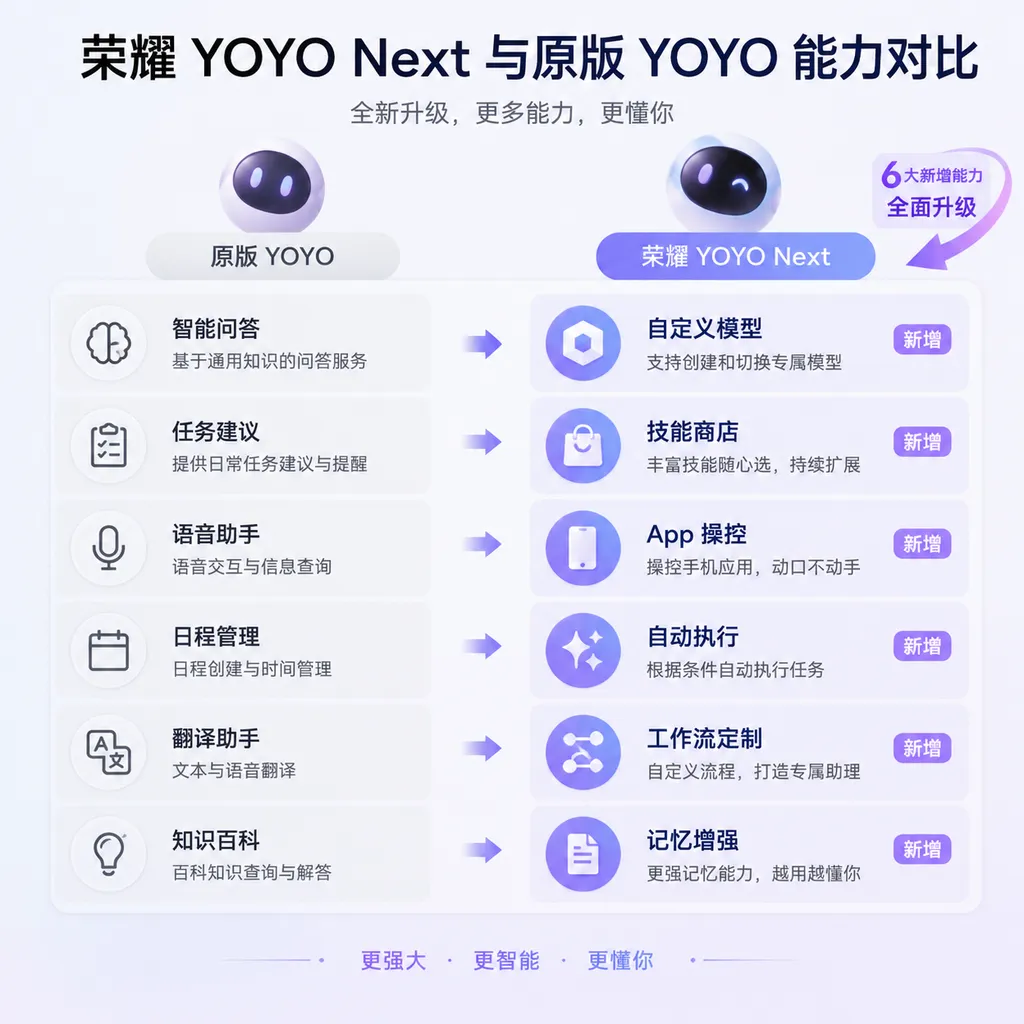
From the leaked chart, YOYO Next’s capabilities expand in six directions compared to the original YOYO:
- App Control: Fully supported. The original YOYO could only control a few apps in limited scenarios, while Next extends this across all.
- Complex Tasks: Multi-step, cross-app sequential/parallel task execution.
- Long-Term Memory: Accumulates user preferences across sessions and scenarios.
- Skill Store: Third-party developers can package and publish their capabilities.
- Custom Model: Users/developers can plug in their chosen large model as YOYO’s reasoning backend.
- YOYO Claw: Continues the "Lobster Universe" trio announced at the Magic V6 launch in March (YOYO Claw, Eco Shrimp, Safe Shrimp). We’ll explain this separately—it’s more significant than it looks.
Looking at this list, the first four are directions everyone in the industry is focusing on — Apple Intelligence, Xiaomi HyperOS, and vivo BlueHeart are all working on app control and complex task orchestration. What truly elevates YOYO Next from "just another OTA" to a strategic shift is the custom model feature.
Honor’s Previous Path: Everything In-House
For context, Honor’s YOYO foundational models have been fully self-developed in recent years:
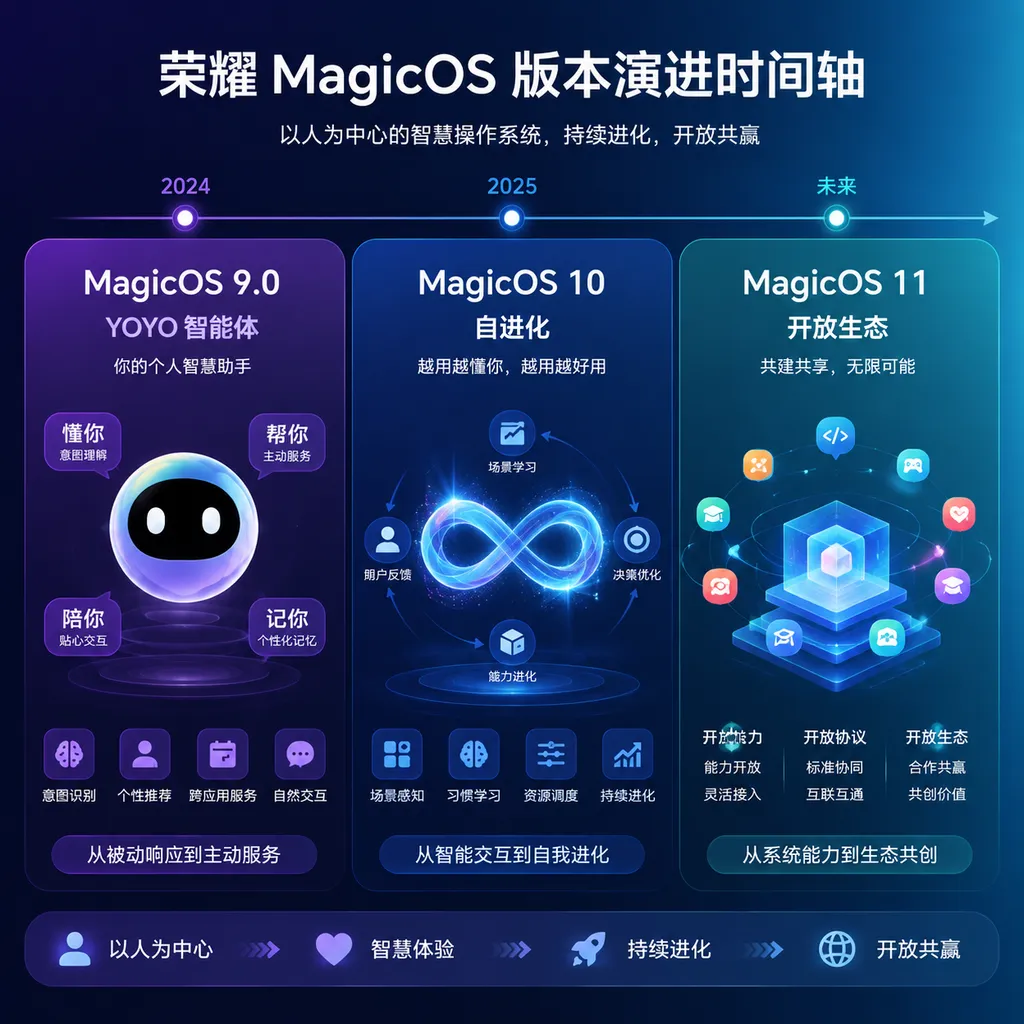
- At the 2024 HGDC conference, MagicOS 9.0 upgraded YOYO Assistant to YOYO Agent, with Zhao Ming declaring “smartphones entering the autonomous driving era.”
- In July 2025, at the World Artificial Intelligence Conference, Honor open-sourced a 7-billion-parameter on-device VLA model, MagicGUI.
- In October 2025, at the Magic8 launch, the Magic Large Model 3.0 debuted — a system-level MCP architecture unifying on-device MagicVL + cloud synergy, covering 80% of high-frequency scenarios and integrating over 4,000 ecosystem agents.
- Meanwhile, in April 2026, YOYO became the first AI assistant in the Android camp to connect to DeepSeek-V4.
Notice the last point — only three months after integrating DeepSeek-V4, Honor decided to fully open up model interfaces. That reveals two things: 1) DeepSeek’s integration educated them — they saw how dramatically user experience can shift with a model change; 2) Honor no longer assumes its Magic Large Model 3.0 can satisfy all users’ needs.
Why Custom Models Mark a Turning Point
AI assistants on phones have faced a paradox: manufacturers all claim "the more you use it, the better it understands you," yet users have no choice of model. Buy a Honor phone — you get Honor’s model. Switch to Xiaomi — you’re tied to theirs. It’s like pre-2010 feature phones: you use what’s preinstalled.
Allowing custom large models essentially transforms the AI assistant from a "pre-installed app" into a platform. This implies several things:
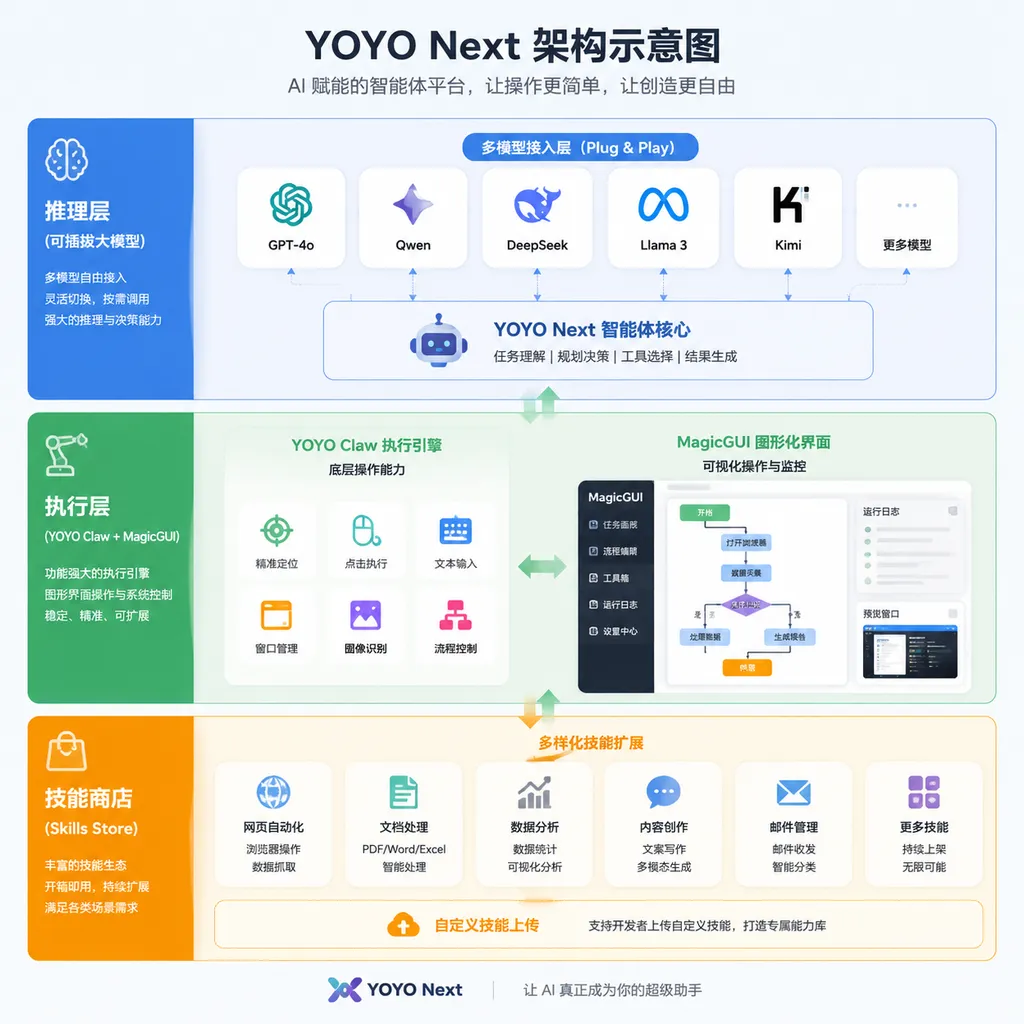
First, user-side choice. Within the same YOYO Claw interaction framework, the reasoning model behind it can be swapped. Want stronger coding? Plug in Claude. Better Chinese long-text? Try DeepSeek. Rich multimodal vision? Connect GPT. Previously, this was only possible through third-party apps — now it’s built into the system AI assistant.
Second, developer-side access. With the skill store in play, third parties can wrap their own agents and publish them. Back in MagicOS 9.0, Honor proposed the "Hundred Model Ecosystem Plan" and an agent store, but access was highly curated—partners like Baidu Maps or Meituan. The new store is closer to an open platform, welcoming smaller developers, too.
Third, a distribution channel for model vendors. Companies like DeepSeek, Kimi, or Zhipu — who lack hardware distribution — have long needed a consistent mobile entry point. If the YOYO Next model API is permissive enough, this becomes the Android ecosystem’s first system-level, pluggable AI assistant portal.
Let’s judge it plainly: Honor had no choice. No matter how advanced its Magic Large Model 3.0 becomes, it can’t match top-tier closed models’ iteration pace. Without openness, users will "vote with their feet" and install third-party apps. Better to become a platform than be sidelined.
YOYO Claw: Separating the Execution Layer
The leak mentioned YOYO Next includes YOYO Claw — the name says it all: "Claw" represents execution power. Previously, Honor bundled perception and execution inside the YOYO agent; by the Magic8 era, it separated “YOYO Vision” and “YOYO Execution.” Now, Claw formalizes the execution layer.
This design echoes Anthropic’s Computer Use or OpenAI’s Operator — reasoning is reasoning, execution is execution. The reasoning model may vary, but the execution framework stays stable. No matter what model serves as the "brain," YOYO Claw still knows how to tap apps, fill forms, and call system permissions.
One worthwhile technical inference: Honor’s open-sourced MagicGUI is a VLA (Vision-Language-Action) model built specifically for GUI control. YOYO Claw likely builds upon MagicGUI. This explains why Honor dares open large model integration — execution remains under its control. You may plug in Claude as the brain, but the phone’s actions are still handled by Honor’s Claw. It’s a cautious openness: hand over the high-value reasoning layer, but keep safety-critical execution firmly owned.
Skill Store: Why the App Store Analogy Isn’t Perfect
The term “skill store” naturally recalls the App Store, but their business logic differs. App Stores host independent apps that users choose to install; in an AI assistant’s skill store, users may not even realize which skills are installed — YOYO might invoke them automatically during intent recognition.
This raises the question: who controls distribution?
Honor already answered this back in the MagicOS 9.0 era: its intent framework + agent store + Quick Services route distribution through “global traffic guidance and service-initiated discovery.” In plain terms: Honor owns the user-intent entry point; third parties upload services; Honor decides when and whose services get triggered.
For developers, that’s a double-edged sword. The advantage: no need to educate users; if your service fits an intent, you’ll get exposure. The downside: all ranking power rests with Honor. This mirrors WeChat Mini Programs or Alipay Mini Apps — the platform fully controls traffic distribution.
Whether small developers join depends on MagicOS’s installation base.
About YOYO Claw and the "Shrimp Universe"
We have to mention the Lobster Universe. At the end of the March 10 Magic V6 launch, product manager Han Enze announced that YOYO now supports shrimp farming — Claw Shrimp, Eco Shrimp, and Safe Shrimp. At the time, many thought it was just a joke.
But looking at YOYO Next’s capabilities list, YOYO Claw is now an official, independent feature. It’s a vertical capability (controlling smart shrimp tanks), but the signal it sends is intriguing:
Honor is targeting long-tail IoT devices. AI assistants connecting to mainstream smart home brands isn’t new; connecting to a niche like aquaculture gear indicates that Honor’s MCP framework and skill store have lowered integration thresholds enough for small hardware vendors to join. This proves ecosystem vitality more than signing ten big appliance brands ever could.
In other words: When the long tail thrives, the center holds. Major apps will support any phone AI assistant, but whoever conquers the long tail owns true ecosystem openness.
Comparing Competitors
Let’s line them up:
- Apple Intelligence: fully closed model; in China, an Alicloud Tongyi version handles moderation. Users have zero choice.
- Xiaomi HyperOS + XiaoAi: self-developed + MiLM + DeepSeek hybrid; limited scene-specific model switching, no system-level custom option.
- vivo BlueHeart: self-developed BlueHeart model, third-party models mostly closed.
- OPPO XiaoBu: similar to vivo, mainly self-developed.
- Huawei Celia: uses Pangu and DeepSeek models; no open customization.
Honor is the first mainstream OEM to integrate pluggable large models at the system AI assistant level. This is a strategic differentiation — betting that developer ecosystems will decide the AI phone race, not the models themselves.
I’m cautiously optimistic. The biggest issue with smartphone AI assistants lately isn’t weak models, but the fact that one model serves everyone, leading to misaligned experiences — coders find it too verbose, writers find it too robotic, visual designers find it weak at multimodality. Pluggable models could be the right cure.
But yes, there’s an obvious risk: experience consistency could collapse. If a user picks a weaker model, YOYO’s performance will drop. Users won’t blame themselves; they’ll blame Honor AI. How Honor keeps baseline user experience intact while opening up — we’ll see after MagicOS 11 launches.
What It Means for Developers
If you’re building models or AI applications, YOYO Next’s openness offers at least two new opportunities:
- Model developers can integrate into YOYO Next as optional reasoning backends — becoming the first system-level entry point on Android. Early participants will likely enjoy brand leverage.
- Intelligent agent developers can publish in the skill store, delivering vertical-scene capabilities. Honor’s intent framework handles distribution; you focus on service quality.
By the way, if you’re developing AI apps that need to compare multiple models, platforms like OpenAI Hub can save a lot of effort — a single key can access GPT, Claude, Gemini, DeepSeek, etc., with local access and OpenAI-format compatibility for easy multi-model benchmarking. This is aligned with YOYO Next’s vision: standardized interfaces turn models into interchangeable components.
Unanswered Questions
The leak only outlines features — many key details remain unknown:
- What is the integration protocol for custom models — OpenAI-compatible or Honor-specific?
- What are the developer revenue-sharing rules for the skill store?
- Is YOYO Claw’s execution layer fully open to third-party models or permission-tiered?
- Where is long-term memory stored — locally or cloud-side? What’s the privacy boundary?
- When will MagicOS 11 launch officially, and which devices will it cover?
The answers will decide whether YOYO Next represents "marketing-level openness" or "structural openness." Given Honor’s heavy AI R&D investment, the October developer conference will likely reveal the full picture.
Summary
The YOYO Next leak carries far more weight than it seems. Honor is transforming its smartphone AI assistant from a product into a platform. Success won’t depend on today’s feature list, but on how many developers join in six months.
If, post-launch, MagicOS 11 offers dozens of third-party connected models and hundreds of skill-store apps, the competition landscape for Android AI phones will be redrawn. If the open APIs exist but no one joins, it’s back to "self-developed model self-entertainment."
The next key date to watch: Honor’s Developer Conference, where we’ll see how open MagicOS 11 truly is — and its first batch of partners.
References
- Honor’s new YOYO Next capabilities leaked: supports App control, complex tasks, and Claw Shrimp functions - IT Home — Original MagicOS 11 update and YOYO Next capability leak


