
Seedance 2.0 internal channel exposed, Byte video generation undergoes a drastic upgrade
ByteDance Seedance 2.0 beta version was recently revealed through internal channels in the developer community. It features second-level generation, zero queueing, major improvements in semantic understanding and dynamic coherence, and overall performance surpassing Sora 2 Pro and Veo 3.1.
Seedance 2.0, officially released in February, has recently sparked a new wave of excitement — a developer in the community exposed ByteDance’s internal 2.0 generation channel, where videos can be generated in seconds without queueing, pushing this already hotly discussed model back into the spotlight.
This is not a simple version update. Judging from community tests and official technical documentation, the leap from Seedance 1.0 to 2.0 may be the most significant breakthrough in the video generation field over the past year.
Conclusion first: where its strength really lies
In short: Seedance 2.0 is currently the video generation model closest to being production-ready.
This conclusion isn’t made out of thin air. Feng Ji, CEO of Game Science and producer of Black Myth: Wukong, publicly praised it as “the most powerful video generation model on the planet right now,” stating bluntly that “the childhood of AIGC is over.” On international social media platforms, invite codes are in high demand, even being resold privately. The A-share film and television sector saw a wave of price limits, with companies like Chinese Online and Enlight Media hitting the 20% daily cap.
For a video generation model to trigger this level of market reaction, it means it has reached a critical threshold.
From 1.0 to 2.0: a two-year technical evolution
To understand why Seedance 2.0 has reached this level, we must first look at ByteDance’s roadmap in video generation.
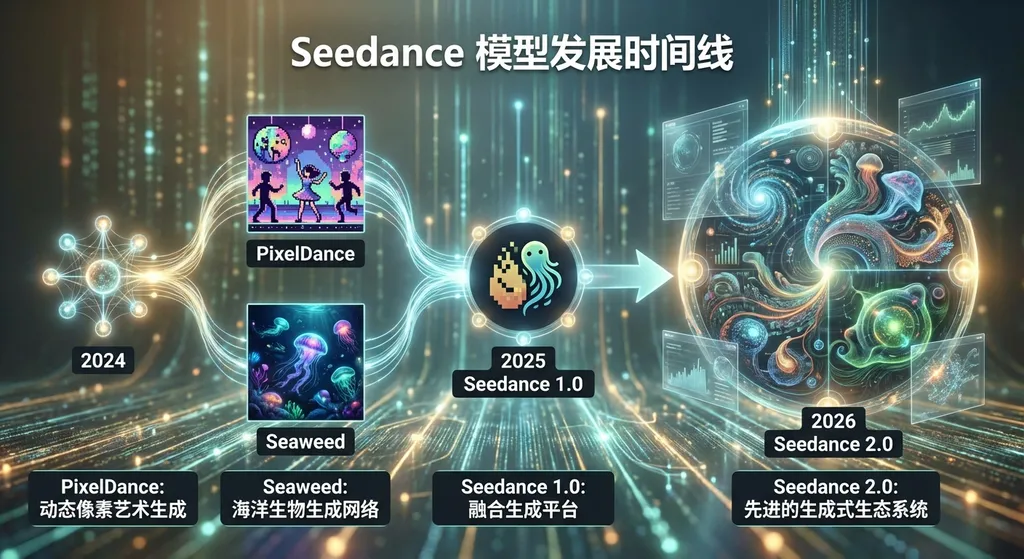
The starting point of this line was September 2024, when Volcano Engine released PixelDance and Seaweed, two enterprise-level video generation models that laid the technical foundation. In April 2025, ByteDance made a key organizational adjustment — merging the AI Lab team into the Seed team, integrating R&D power entirely. One month later, PixelDance and Seaweed were deeply fused to launch Seedance 1.0 lite.
In June 2025, Seedance 1.0 Pro was officially released. That December, version 1.5 Pro went live, introducing a native audio-video co-generation architecture for the first time, capable of synchronously generating narrative-aligned audio.
By February 2026, Seedance 2.0 was fully released, marking a clear technological evolution: from single-modality video generation to integrated audio-visual production, then to unified multimodal co-generation. Each step represented not a superficial feature stack but a fundamental architectural upgrade.
Technical breakdown: four meaningful breakthroughs
1. Multimodal input — not just a gimmick
Seedance 2.0 supports four input modalities — text, image, audio, and video — which can even be mixed. Up to 9 images, 3 videos, and 3 audio clips can be used simultaneously.
What does this mean? For example, you can feed the model a storyboard (text), some character reference images (images), a scene reference video (video), and a music-style reference (audio), then have it generate a complete 15-second audio-visual piece in one go.
This is not a simple step up from “text-to-video” or “image-to-video.” It shifts the creative process from “single-point generation” to “director-level orchestration.” In official terms, “what you imagine is what you see.” While it may sound like marketing fluff, demo results show an impressive level of controllability.
2. Physical realism — finally less broken
One of the most painful issues with video generation models is their violation of physical laws — wrong finger counts, object clipping, or impossible motion trajectories. Seedance 2.0 brings a visible improvement.
In one official example — a pairs figure skating performance — both skaters synchronize their jumps, spin mid-air, and land precisely, even including slight “errors” such as the male skater’s off-axis rotation and the female skater’s center-of-gravity adjustment in response. Such complex multi-subject interactions and motion generation were practically impossible before.
Community tests confirm that collapse rates have dropped sharply. Of course, “sharply reduced” isn’t “eliminated,” as errors still occur in complex scenes, but usability has reached industry SOTA levels.
3. Stereo audio — a key step toward audiovisual integration
Seedance 1.5 Pro already generated synchronized audio, but version 2.0 takes it further: stereophonic sound, supporting multiple tracks such as background music, ambient effects, and voiceover—all precisely aligned with visual rhythm.
In one official wuxia demo — a bamboo forest duel with rain, thunder, and clashing swords — all sound effects were generated by the model in sync, not added in post-production. Even subtle ASMR-like sounds such as glass friction or fabric rubbing were faithfully reproduced.
For creators working on short videos, ads, or film previews, this means the generated content can be used directly, without extra sound design.
4. Video editing and extension — from “generation” to “creation”
Version 2.0 adds two highly useful functions: video editing and video extension.
Video editing allows directional modification of specific clips, characters, actions, or storylines. Video extension enables continuous-shot generation — not just “make a video,” but “keep filming.”
These functions transform Seedance 2.0 from a “video generation tool” into an early-stage “video creation platform.” For commercial scenarios requiring iterative updates (advertising, e-commerce, game CG), this is far more efficient than regenerating from scratch.
Comparing with competitors: Sora 2 Pro, Veo 3.1, and Kling 3.0
The video generation field is now a four-way battle: OpenAI’s Sora series, Google’s Veo 3.1, Kuaishou’s Kling 3.0, and ByteDance’s Seedance 2.0.
According to official test results, Seedance 2.0 leads in two core tasks — text-to-video and image-to-video. Specifically:
- Motion stability and physical realism: Seedance 2.0 > Sora 2 Pro ≈ Veo 3.1 > Kling 3.0
- Instruction adherence: Seedance 2.0 outperforms others in handling long scripts and open-ended prompts
- Multimodal reference support: Seedance 2.0 covers the widest range of reference tasks
- Audio performance: Its stereo capability currently has no direct rival
- Generation speed: Official benchmarks show 2K video rendering 30% faster than Kling
Of course, these are ByteDance’s internal results and may carry some “home-field advantage.” But based on independent community tests and overseas feedback, Seedance 2.0 indeed ranks in the top tier — especially in multimodal input and synchronized audiovisual generation.
That said, Seedance 2.0 still needs improvement in multi-subject consistency, text fidelity, and complex editing stability. The company openly acknowledges that “it’s far from perfect; many flaws remain,” a level of candor rarely seen among domestic developers.
Internal access leak: what “instant generation” means
Returning to the community exposure mentioned earlier — a developer claimed to have gained internal access to Seedance 2.0, reporting instant video generation without queueing.
This detail is telling.
Public versions of Seedance 2.0 (via platforms like Jiemeng and Doubao) still have lengthy queue times during peak periods. Instant responses in the internal version imply ByteDance’s inference infrastructure is robust, and queueing likely serves as traffic control during the public testing stage rather than a compute bottleneck.
The developer’s test showed that internal and public versions perform identically, with three key advantages:
- Extremely precise semantic understanding — a long-standing ByteDance strength
- Greatly improved motion coherence and reduced breakdowns
- Exceptionally fast rendering speed
For developers or enterprises needing large-scale video generation, such responsiveness has true productivity value.
Controversy and risk: too realistic for comfort
Seedance 2.0’s “highlight moment” came with an awkward side effect — its generated videos are too realistic.
On February 9, the Jiemeng platform urgently announced that during internal testing, Seedance 2.0 would suspend support for using real human images or videos as subject references. The reason is simple: the model is so powerful that it risks blurring the line between virtual and real, raising identity misuse and content abuse concerns.
According to Professor Sha Lei from Beihang University’s AI Research Institute, ByteDance has proactively restricted its model capabilities (e.g., requiring real-person authentication, banning real-person material). These measures help prevent misuse, but he also noted that balancing innovation, data compliance, and copyright protection remains a global, long-term challenge for the AI industry.
This issue isn’t unique to Seedance, but because its results are so lifelike, it became the first model forced to confront it head-on — an unintended “reverse validation” of its capabilities.
What it means for developers
Seedance 2.0 is now accessible via Volcengine Ark API (model name Doubao-Seedance-2.0), supporting multiple invocation modes such as text-to-video and image-to-video.
For developers wanting to integrate video generation into their products, this is one of the most powerful video generation APIs currently available in China. If you already use an OpenAI-compatible aggregation service (like OpenAI Hub), integration is even simpler — no need for a dedicated Volcengine SDK; a unified API key works fine.
Here’s a typical call example:
import requests

# Call Seedance 2.0 via OpenAI Hub-compatible interface
response = requests.post(
    "https://openai-hub.com/v1/videos/generations",
    headers={
        "Authorization": "Bearer YOUR_OPENAI_HUB_KEY",
        "Content-Type": "application/json"
    },
    json={
        "model": "doubao-seedance-2.0",
        "prompt": "Cyberpunk-style Canton Tower at night in the rain, neon lights flickering, drone formation circling the tower",
        "aspect_ratio": "16:9",
        "duration": 10,
        "audio": True  # Enable synchronized audio generation
    }
)

result = response.json()
print(result["data"]["video_url"])
Note: The API also enforces real-person material restrictions — any uploaded reference image or video containing real human faces will be blocked.
Final thoughts
The video generation track was ignited by Sora’s debut in 2024, entered a multi-player stage in 2025, and by early 2026, Seedance 2.0 may mark a new phase — from “able to generate videos” to “able to generate usable videos.”
ByteDance’s strategy here follows a clear pattern: first integration (PixelDance + Seaweed), then architectural upgrades (audio-video co-generation), then multi-modal unification. Each step hit the right timing.
That said, we shouldn’t be overly optimistic. Seedance 2.0’s 15-second duration limit, multi-subject consistency issues, and ethical challenges around real-person inputs all show that it’s still short of true “industrial-grade readiness.” But the gap has narrowed significantly compared to just six months ago.
For developers, now is an excellent time to start seriously evaluating video generation API integration — perhaps not yet for production, but at least to start prototyping, testing, and cost modeling.
References
- ByteDance Video Generation 2.0 Internal Account Leak and Community Testing — Developer report on internal channel access and proxy services on Linux.do


