
Apple SpeechAnalyzer real-world test: Speed crushes Whisper, but accuracy still falls just short
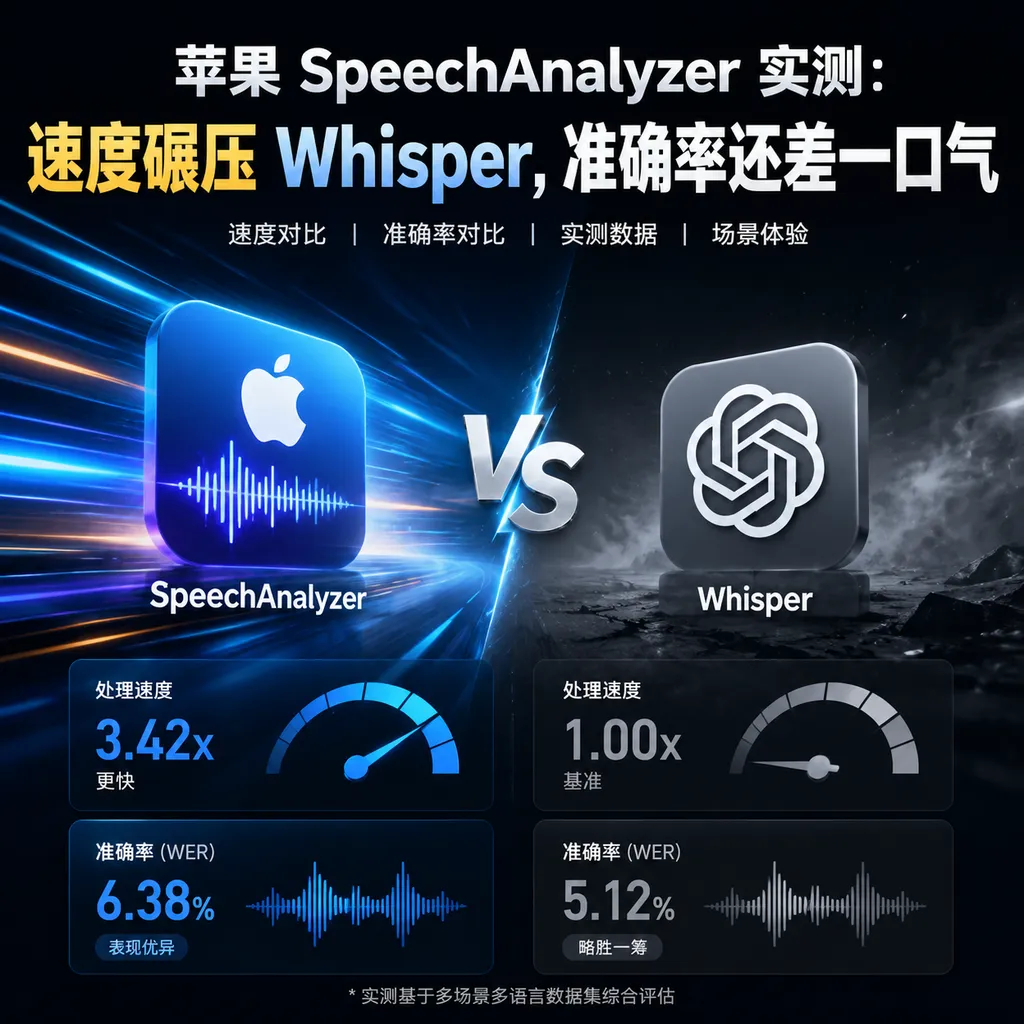
The developer ran the same batch of audio through Apple SpeechAnalyzer, Whisper Large-v3, and Parakeet ASRs, and the conclusion is quite interesting: Apple’s new API leaves Whisper far behind in terms of latency and resource usage, but its WER still hasn’t beaten OpenAI’s.
iOS 26 and macOS 26 have been out for a while now, and the new SpeechAnalyzer API has been a recurring topic in the developer community. Over the past few days, several teams building transcription tools have released proper benchmark data, putting Apple’s speech recognition on the same scale as Whisper for the first time—and the results are not one‑sided.
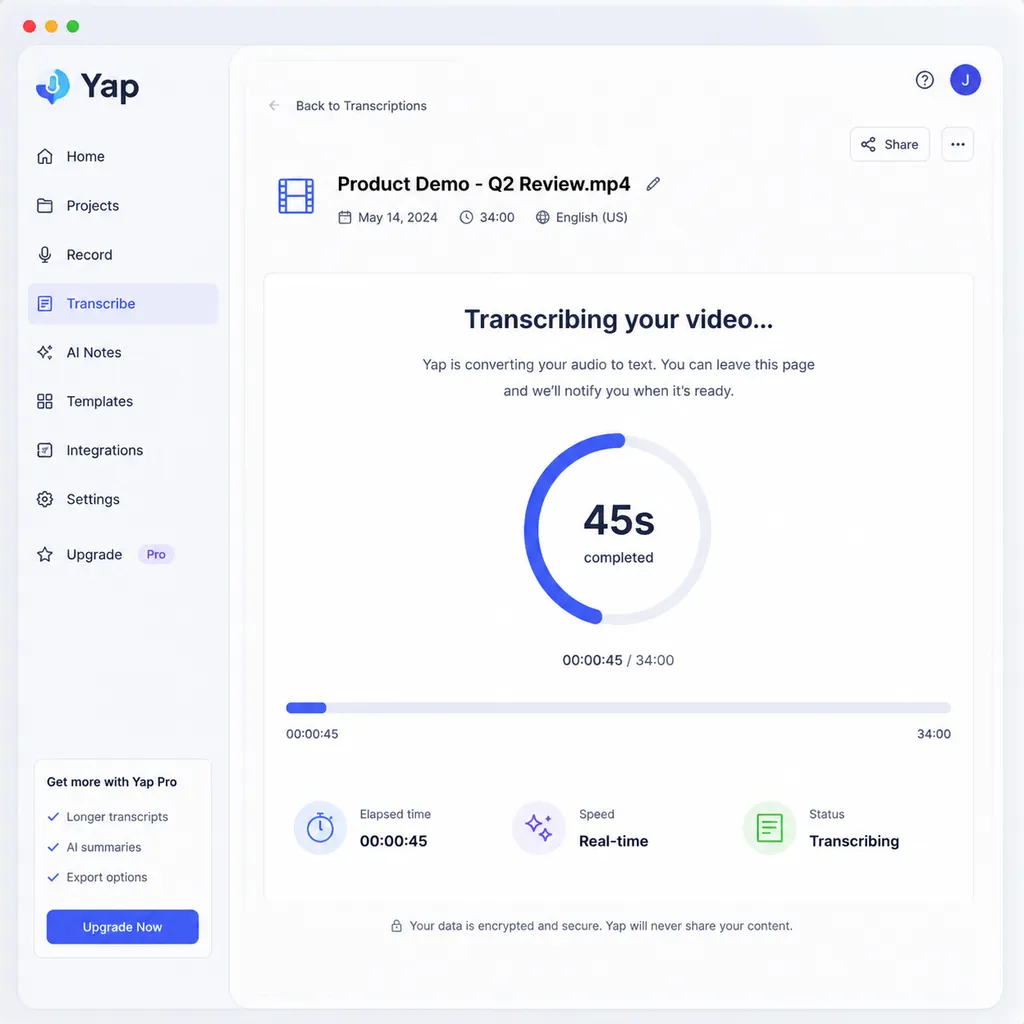
Let’s start with the number that grabs all the attention: Yap, a macOS app based on SpeechAnalyzer, transcribed a 34‑minute, 7 GB 4K video in 45 seconds. The comparison group, MacWhisper (running the open‑source OpenAI Whisper model), took minutes on the same hardware. That’s not a small lead; it’s an order‑of‑magnitude difference.
But speed doesn’t automatically mean quality. A benchmark by the Inscribe team tells a clearer story: Whisper Large‑v3 still has the lowest word error rate (WER) among the three, with Apple’s SpeechAnalyzer in second place, about 2–3 percentage points behind, leaving the old SFSpeechRecognizer far behind. NVIDIA Parakeet performs very well on short English audio, but once it encounters long recordings or multi‑speaker scenarios, it falters.
What Exactly Is SpeechAnalyzer
Many people’s first reaction is, “Didn’t Apple already have SFSpeechRecognizer?” It did—but that framework has been around since iOS 10, designed for short‑form speech input—think “Hey Siri” or a short dictation in Notes. Feed it an audio clip longer than one minute and it starts failing in various ways. Plus, it began as a cloud service before gradually moving on‑device.
SpeechAnalyzer is a complete rewrite. It’s built around Swift’s AsyncSequence, with the core idea of breaking speech processing into a modular pipeline:
SpeechAnalyzer: the orchestrator, accepting a set ofSpeechModulesSpeechTranscriber: responsible for speech‑to‑textSpeechDetector: responsible for endpoint detection and silence handling- Future modules can include translation, speaker separation, and more
let transcriber = SpeechTranscriber(locale: .current)
let analyzer = SpeechAnalyzer(modules: [transcriber])
try await analyzer.prepareToAnalyze(in: audioFormat)

for try await result in transcriber.results {
    print(result.text)
}

try await analyzer.analyzeSequence(from: audioFile)
On the surface, the API looks like Swift syntactic sugar, but in essence it changes the old paradigm of “feed once, wait for output” to a “stream‑in, stream‑out” model. The direct benefit for developers? You can start getting intermediate results while the recording is still in progress—real‑time captions or meeting transcripts with almost zero delay.
What That Benchmark Actually Tested
Inscribe’s evaluation covered several representative types of audio:
- Tech podcast: clear speech, heavy jargon
- Multi‑speaker meetings: overlapping dialogue, background noise
- Accented English: Indian, Australian, and Scottish accents
- Medical interviews: rare professional vocabulary
Each test was run using Whisper Large‑v3, Parakeet TDT‑0.6B, Apple SpeechAnalyzer (local mode), and the old SFSpeechRecognizer, measuring WER and Real‑Time Factor (RTF = processing time / audio length).
Key data points:
- Clear English audio: Whisper ≈ 4.2 % WER; SpeechAnalyzer ≈ 6.8 %; Parakeet 5.1 %; old SFSpeechRecognizer 11 % +
- Multi‑speaker scenes: Whisper still most stable, SpeechAnalyzer within 1.5 points
- Heavy accents: Whisper leads clearly, SpeechAnalyzer ≈ 12 %, Parakeet collapses ≈ 20 %
- Speed: On M‑series chips, SpeechAnalyzer’s RTF ≈ 0.02–0.05; Whisper Large‑v3 ≈ 0.15–0.3 — 5–10× slower
Resource usage is the key. On an M2 MacBook Air handling long audio, SpeechAnalyzer peaks around 800 MB of RAM; Whisper Large‑v3 soars to 4–5 GB, turning the fan on. That gap largely determines their respective use cases.
Apple’s Rationale
Judging by WER alone, SpeechAnalyzer didn’t win—it couldn’t beat Whisper. But accuracy isn’t Apple’s main goal.
Apple wants on‑device, low‑latency, low‑power. Together, that means: you can record real‑time meeting transcriptions on iPhone without overheating, run background transcriptions on a Mac without interrupting coding, and show live captions on Vision Pro without dropping frames.
Whisper’s architecture simply isn’t built for that. Whisper is a classic encoder‑decoder Transformer requiring input to be cut into fixed 30‑second chunks, processing one chunk at a time. You can make it stream, but only with tricks—sliding windows, early beam‑search cutoff, chunk stitching and de‑duplication—all of which hurt accuracy and increase engineering complexity. Real‑time Whisper tools such as whisper.cpp’s streaming mode typically have 1–2 second latency.
SpeechAnalyzer, by contrast, is natively streaming. With AsyncSequence, results start flowing in as audio arrives, even allowing it to “rewind and correct” earlier guesses. For product developers, that API design is far more important than a 2 percentage‑point deficit in WER.
Reaction from the Open‑Source Community
A top‑voted Reddit comment summed it up perfectly: “Whisper is still the most accurate, but this is the first on‑device Apple offering I’d actually build a real product with.”
Developers working on local AI generally view SpeechAnalyzer positively. Before this, anyone building transcription on iOS had only two options—use SFSpeechRecognizer and live with its limitations, or package a CoreML‑converted Whisper model into the app (bundle size + 500 MB or more). Now there’s a third path, with a system API that doesn’t consume user storage and benefits from Neural Engine acceleration.
Still, some developers complain:
- Limited language support: fewer than Whisper’s 99 languages
- No custom models: Apple doesn’t (yet) allow swapping in your own ASR model
- Chinese performance: decent but still behind Whisper Large‑v3, especially with mixed Chinese‑English
- No tunables: parameters such as temperature or beam width can’t be adjusted
A Signal Worth Noticing
Stepping back: at WWDC, Apple launched both SpeechAnalyzer (for speech) and Foundation Models framework (for LLMs). The common ground—on‑device, Swift‑native, free to use.
The intent is clear: let iOS/macOS developers add AI features without paying API fees, worrying about privacy, or bundling large models. Fantastic for indie devs, long‑term pressure for API providers.
Cloud APIs won’t vanish, though, because on‑device models can’t yet match top‑tier cloud counterparts. SpeechAnalyzer can’t beat Whisper Large‑v3; on‑device LLMs can’t beat the latest GPT or Claude. High‑accuracy, high‑quality scenarios—legal transcriptions, medical records, cross‑language meetings—still rely on the cloud.
The practical setup is hybrid: use on‑device for lightweight, real‑time, privacy‑sensitive tasks, and cloud APIs for heavy or mission‑critical workloads. Developers increasingly deploy both—e.g., SpeechAnalyzer (local transcription) plus a cloud LLM (for post‑processing, error correction, summarization). In such hybrid architectures, managing multiple cloud models under one API key becomes essential—aggregator platforms like OpenAI Hub do exactly this: they unify GPT, Claude, Gemini, DeepSeek under the OpenAI‑compatible interface, saving developers a lot of headaches.
Practical Advice for Developers
If you’re evaluating a move to SpeechAnalyzer, consider:
- Is your scenario real‑time‑first?
If yes, migrate—the slight drop in accuracy is worth the streaming experience. - Is English your main language?
SpeechAnalyzer shines in English; low‑resource languages require caution. - Can you adopt iOS 26+ as the minimum version?
If not, you’ll need a fallback. - Do you need control over inference parameters?
If you rely on custom vocabularies, bias lists, or beam‑search tuning, SpeechAnalyzer isn’t flexible enough yet.
Conclusion: SpeechAnalyzer isn’t a Whisper killer, but it elevates “on‑device real‑time ASR” from awkward to viable. For most apps, it’s good enough—and far better than before. For absolute best‑accuracy use cases, Whisper remains Whisper.
In tech circles lately, the features that most impact daily developer life aren’t the biggest models unveiled onstage, but rather moves like this—taking something “good enough” and baking it into system APIs. SpeechAnalyzer is precisely that kind of move.


