
SoftBank Partners with Sierra: AI Customer Service Officially Launches in Japan
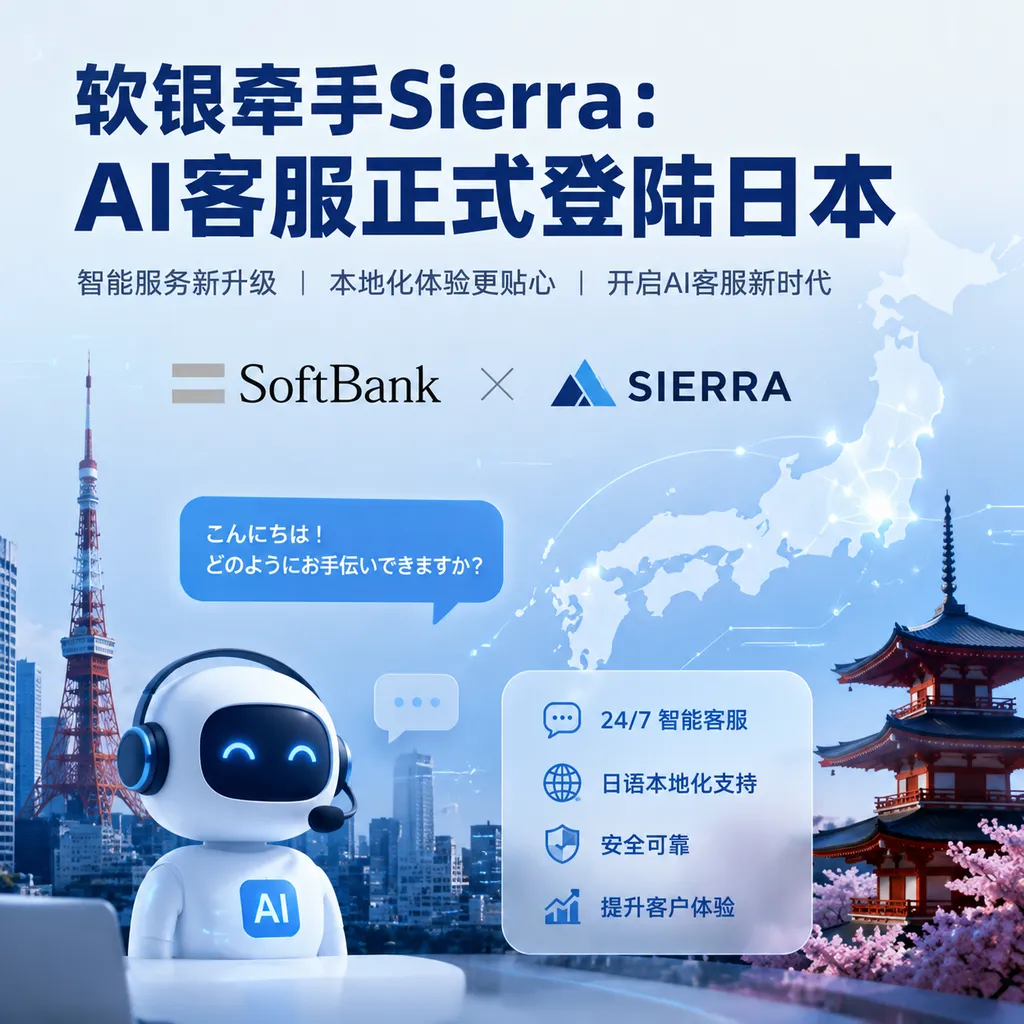
On July 14, SoftBank Group announced that it would become the exclusive partner of U.S. AI startup Sierra in Japan, jointly launching a new generation of customer service solutions based on intelligent agents. Its Linemo brand will be the first to adopt the system, followed by SoftBank, Y!mobile, and other brands in succession.
SoftBank Partners with Sierra: AI Customer Service Officially Lands in Japan as Intelligent Agents Take Over the Phone
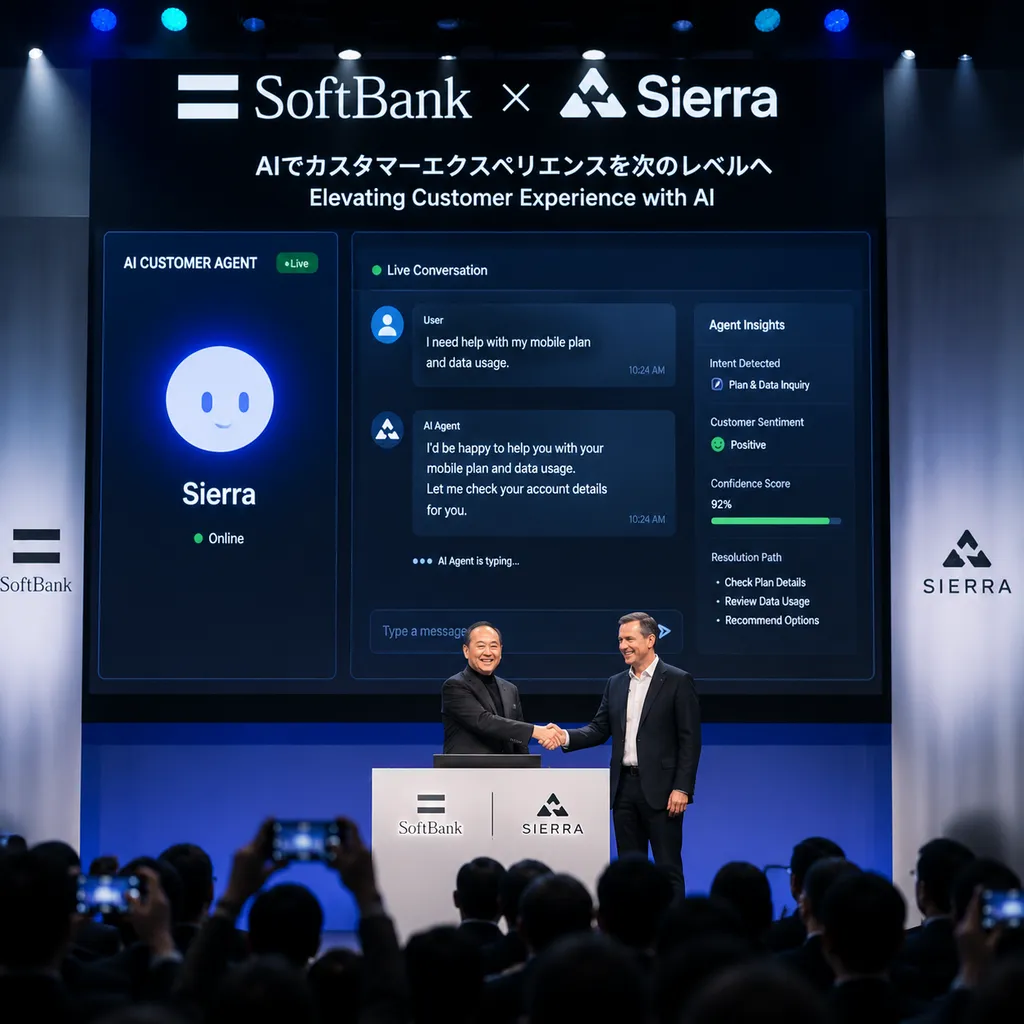
On July 14, SoftBank Group officially announced a strategic partnership with American AI startup Sierra, becoming its exclusive partner in the Japanese market. This isn’t just another memorandum of understanding — SoftBank’s online mobile brand Linemo has already integrated Sierra’s technology into its customer service system, and SoftBank, Y!mobile, along with other business lines in the group, are scheduled to follow suit.
The news itself is short, but the implications are significant. Who is Sierra? It’s a company founded in late 2023 by former Salesforce co-CEO Bret Taylor and former Google executive Clay Bavor, focusing on “AI Agents for Customer Experience.” Its valuation already approached USD 4.5 billion last year. SoftBank granting exclusivity means that in the coming years, any company in Japan that wants to use Sierra’s technology must go through SoftBank.
Why Japan, and Why Now
Let’s start with a commonly overlooked background: Japan’s customer service industry can no longer sustain itself.
Data from Japan’s Ministry of Internal Affairs and Communications shows that the average age of call center workers has continued to rise over the past five years. Small and medium-sized operators can’t recruit, and large enterprises struggle to retain staff. Moreover, the complexity of Japanese honorifics and the extreme sensitivity of customers to service quality make the traditional “outsource to the Philippines/India” route unworkable — linguistic and cultural barriers have kept overseas agents out.
Thus, a clear market gap has emerged: a solution that can speak natural keigo, handle complex business logic, and work 24/7 without breaks. Three years ago, this sounded like science fiction; today, it’s Sierra’s product brochure.
SoftBank’s timing is precise. Since last year, Masayoshi Son has repeatedly said that “AGI is just around the corner.” SoftBank has invested billions in OpenAI, and the Stargate project is building data centers across the U.S. But these are long-term bets that won’t impact earnings anytime soon. AI for customer service is different — it’s a business that can deploy immediately, cut labor costs now, and start generating subscription revenue right away. For SoftBank, this is the shortest path from AI narrative to monetization.
What Makes Sierra Stand Out
When people hear “AI customer service,” many still think “isn’t that just a better chatbot?” That impression was accurate two years ago — not anymore.
Sierra’s product architecture is fundamentally different from traditional customer service bots in several ways:
- Agent, not Bot. Instead of relying on keyword matching and decision trees, it lets an LLM act as the "agent," able to understand context, call backend APIs, and change course mid-conversation. When a user says, “Can I cancel the plan I registered last week?” it must check the order, policies, and penalties on its own, and reply naturally.
- State retention across multiple turns. The worst part of traditional IVR is having to re-enter your ID every time you get transferred. Sierra’s Agent maintains state throughout the entire conversation — even across sessions — remembering the user.
- Controllability and safeguards. This is Sierra’s crucial edge over some open-source agent frameworks — it has an “Agent OS,” essentially a rule layer around the LLM. For example: “Any refund request over 10,000 yen must escalate to a human.” Such rules can be hard-coded, not left to prompt luck.
To put it another way: if ChatGPT is a knowledgeable but unreliable intern, then what Sierra sells is a well-trained full-time employee. What enterprises pay for is not model capability alone, but the combination of model capability + business constraints.
The Significance of Linemo Leading the Rollout
SoftBank’s decision to have Linemo implement Sierra first was deliberate.
Linemo is SoftBank’s online-only mobile brand — no physical stores, with all support via phone and chat. Its user base skews young and digital-native, naturally more receptive to AI customer service. In other words, Linemo is the lowest-risk “guinea pig” within SoftBank’s group — low experimentation cost, fast feedback loops, and replicable results once successful.
This rollout strategy is uncommon among Japanese corporations. Traditional Japanese IT projects usually “start at HQ with a PoC, pilot for two years, then expand group-wide.” Linemo’s “subsidiary first, main brand later” approach feels more like an American tech company. It shows SoftBank’s sense of urgency in deploying AI.
Competitive Landscape: Who Else Wants a Slice of Japan’s Market
Japan’s AI customer service market isn’t empty.
NTT DATA, Fujitsu, and NEC all have their own offerings. Among local startups, PKSHA Technology and Karakuri have been building solutions for years. Overseas, Salesforce’s Einstein, Zendesk’s AI Agent, and Cresta all have their eyes on Japan. So why did SoftBank bet on Sierra?
In my view, three reasons:
- Technology gap. Domestic players largely remain at 2023 levels — retrieval-augmented generation and intent classification crumble under complex business logic. Sierra’s native LLM Agent architecture is a generation ahead.
- Bret Taylor’s credibility. He’s also the chair of OpenAI’s board — SoftBank’s well-known ties to OpenAI mean potential ecosystem synergy.
- Exclusivity for speed. For Sierra to enter Japan alone, it would need to build a team, localize, and go through compliance — a two-year effort. Giving SoftBank exclusivity lets it leverage SoftBank’s distribution power and enterprise network to reach major corporate clients within a year.
For Sierra, it’s a classic “exclusive region for acceleration” trade. For SoftBank, it’s “market access for technological lead.”
Pitfalls Ahead
That said, AI customer service in Japan faces several challenges.
First, honorifics and tone. In Japanese, the difference between “desu/masu” and “gozaimasu” may be a single word, but it changes how polite you sound. Was Sierra’s model trained natively in Japanese or fine-tuned from an English base? That will directly affect user experience. While details are unclear, Linemo’s early rollout suggests SoftBank will likely customize deeply using real business data.
Second, compliance. Japan’s Personal Information Protection Law imposes strict rules on handling call recordings and chat logs, especially concerning cross-border data. Is Sierra’s inference done within Japan? Is it locally deployed? These details haven’t been disclosed but represent hard requirements for clients.
Third, user acceptance: “AI agent vs human agent.” Japanese consumers show stronger aversion to “talking to a machine” than Western ones — a cultural factor that technology alone can’t fix quickly. Linemo’s younger users are fine, but for SoftBank’s main brand customers (often 40 and older), adoption will take time.
A Bigger Picture
Viewed through the lens of the 2026 AI landscape, this becomes even more interesting.
Over the past year, “Agent” has become an overused buzzword, but few products have truly proven commercial viability. Sierra is one of the rare ones that has — clients sign annual contracts, consumption is billed per conversation, with ACVs reaching six figures in USD. This business model is far steadier than selling API tokens, which explains SoftBank’s confidence.
For Chinese developers, a few takeaways stand out:
- Vertical specialization of agent products is the big trend — generic agents will struggle against vertical ones in the short term.
- Customer service, sales, and aftersales are the first frontiers of AI agent commercialization; more complex domains will follow.
- Large conglomerates prefer “exclusive partnership + group-wide rollout” over building in-house. That’s a key lesson for enterprise-focused AI companies.
By the way, if you want to benchmark how Claude, GPT, and Gemini perform in customer service scenarios, platforms like OpenAI Hub (which aggregate multiple models under one key, OpenAI-compatible) save tons of effort for A/B testing. Sierra’s deployment in Japan also highlights a broader truth: model capability is no longer the bottleneck; how you embed the model into business workflows is.
SoftBank and Sierra’s July 14 announcement was just the starting gun. The real markers to watch over the next 6–12 months are: Linemo’s customer service NPS, the SoftBank main brand’s rollout progress, and the first non–SoftBank Japanese enterprise signing a deal. Any one of these signals going live would mark the moment AI customer service in Japan evolves from “demo” to “infrastructure.”
References
Currently accessible Chinese reports mainly come from quick news channels such as Sina Finance and 36Kr. From the developer community side, discussions on Zhihu about Sierra and AI Agent commercialization and technical articles on Juejin regarding LLM Agent architecture and enterprise implementation are useful for understanding the technology stack choices behind this partnership.


