
Amap releases ABot-World Studio: Create a 3D world you can explore for an hour with a single sentence
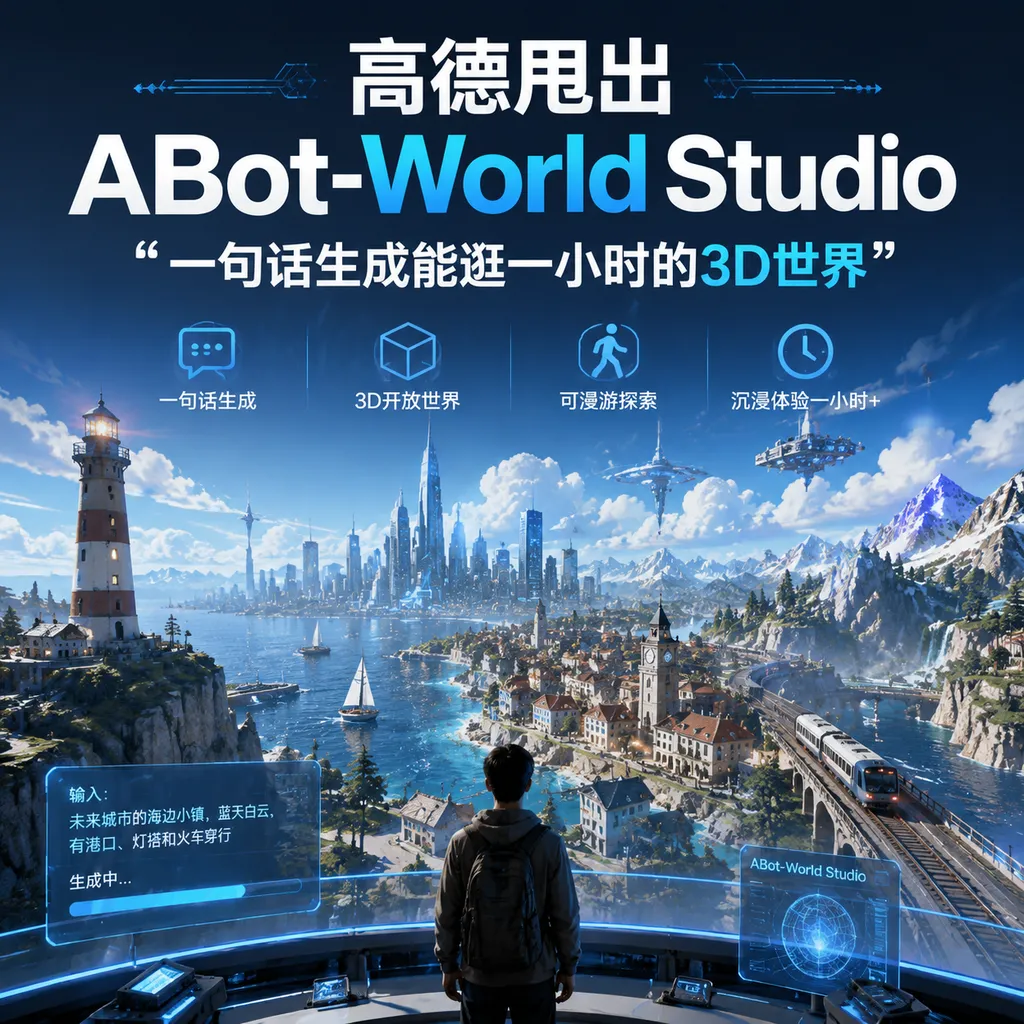
Amap, a subsidiary of Alibaba, has released the general world model platform **ABot‑World Studio**, integrating interactive video and 3DGS scene generation into a single product. It can run on a single 5090 GPU and has also open‑sourced its underlying model.
Amap Launches ABot-World Studio: Text Prompts Can Generate a 3D World You Can Explore for an Hour, Runs on a Single 5090 GPU
On July 14, Alibaba’s subsidiary Amap quietly dropped a bombshell—its general-purpose world model platform, ABot-World Studio, was officially released and opened for testing. At the same time, the underlying ABot-World series of models were fully open-sourced.
The idea itself isn’t new—over the past six months, from Genie 3 to various domestic world model demos, everyone’s been racing toward “text-to-3D worlds.” But what Amap released this time includes a few specs that make you pause: single RTX 5090 local deployment, stable continuous inference for over 1 hour, and simultaneous output of interactive video and 3DGS files. At a time when most competitors are still capped at one-minute generations, these three features together mark a leap far beyond the typical “demo-level” update.
What Exactly Is This Thing?
Stripping away the marketing language, what ABot-World Studio does is something the industry has long tackled separately—it merges interactive video generation and 3D scene generation into one product.
Developers familiar with this field know that the “world models” have traditionally split in two directions:
- The video route: an extension of the Sora approach, focusing on immersion and real-time feedback—every user action leads to new frame evolution. The problem: once the video ends, so does the interaction. It’s essentially a “controllable pixel stream,” not a persistently explorable world.
- The 3D scene route: directly generating NeRF or 3DGS-style spatial assets—geometrically accurate and freely explorable—but each scene is an island, with no continuity between worlds.
Each approach has its own dead ends. ABot-World Studio stitches the two together—whatever you prompt it to generate, it outputs both a real-time explorable video stream and a 3DGS spatial asset you can save. The former solves “playability now,” and the latter solves “preservation and sharing.”
Unifying these is easier said than done. The temporal modeling logic of video models and geometric consistency constraints of 3D models are inherently conflicting in their training objectives. Amap hasn’t revealed exactly how it handled that coupling, but given that the framework splits into ABot-World0 (video generation) and ABot-3DWorld0 (3D generation), it’s likely a dual-model collaboration with a unified interaction layer, rather than a giant end-to-end model.
That “1 Hour” Is the Key
The technical report highlights one crucial detail: there’s no architectural limit on inference duration; internal tests show stable, continuous generation exceeding 1 hour with consistent image quality, no crashes, and no degradation.
This number only makes sense in context. Compare the competition:
| Product | Continuous Interaction Duration | |---|---| | Mainstream interactive video world models | ~1 minute | | Genie 3 (DeepMind) | A few minutes | | ABot-World Studio | >1 hour (verified) |
For developers who’ve wrestled with diffusion video models, long-sequence drift is a nightmare. Error accumulation, temporal drift, and content loss all cause outputs to degrade over time. Running stably for an hour implies serious advances in temporal modeling and memory mechanisms—this isn’t something brute-force parameter scaling can achieve; it requires architectural innovation.
Combine that with the condition that it runs on a single RTX 5090 locally, and the significance grows. Running hour-long inference on a consumer GPU drops the entry barrier dramatically—indie developers, small studios, and game prototypers can all experiment with this. In contrast, similar systems often require H100 clusters for offline rendering; ABot-World Studio aims to be “table-ready.”
The “Portal” Mechanic Is Clever
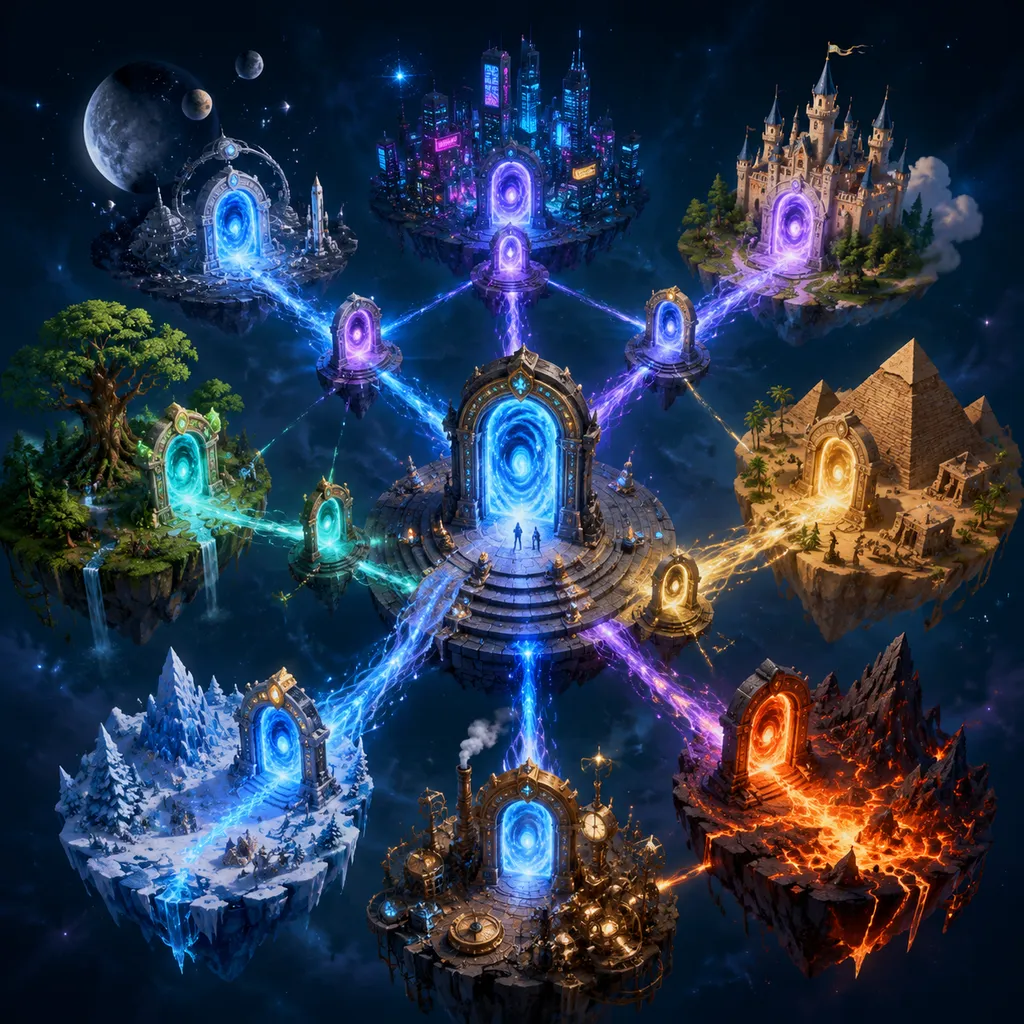
The Studio includes a “Portal” system. At first glance, it sounds like marketing fluff, but the explanation reveals thoughtful design.
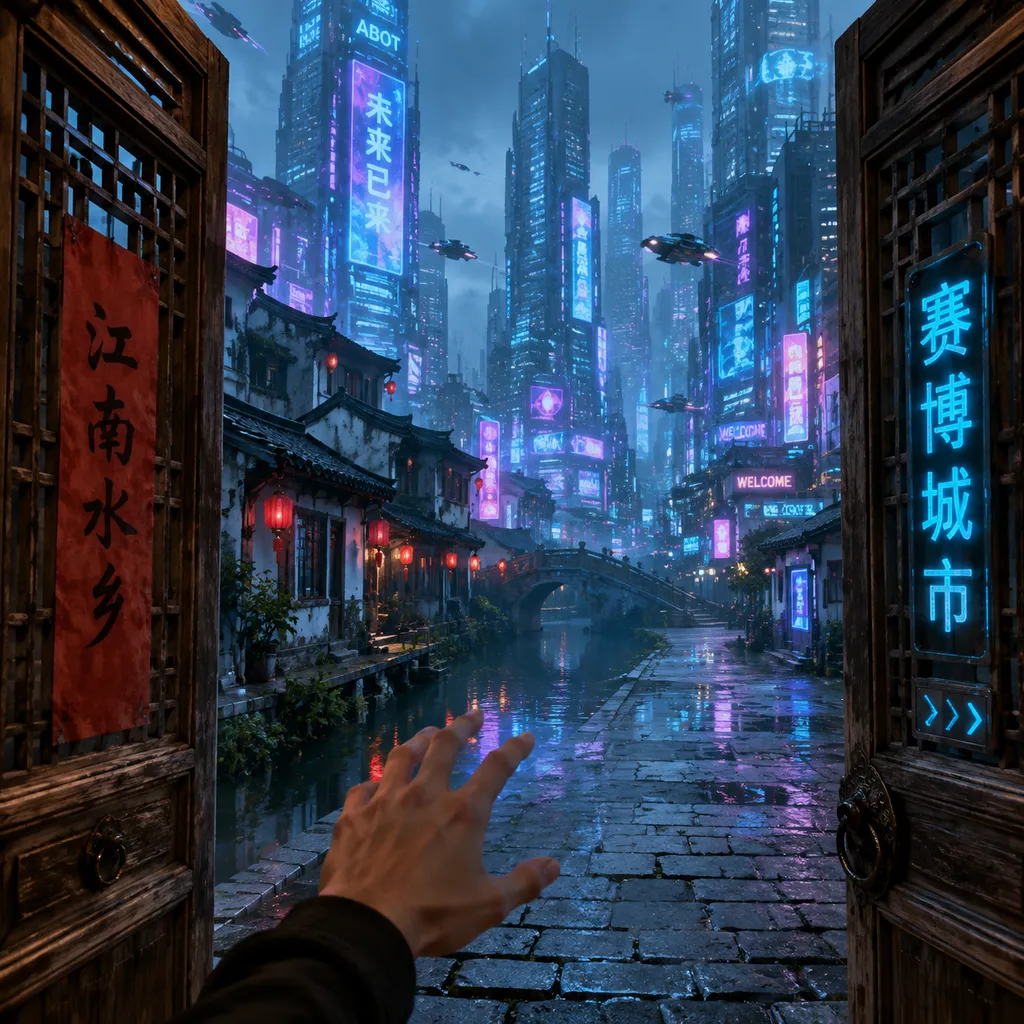
Simply put: within any generated 3D world, you can place a door—walking through it teleports you to another user’s world. A wooden gate in a Jiangnan village might open into a cyberpunk street; a ferry crossing could lead straight to Yanmenguan. It connects isolated scenes into a network through spatial teleportation.
This design has two implications:
- Technically: it addresses the long-standing problem where “scene boundaries = world boundaries.” Traditional infinite terrain generation requires the model to constantly produce new content—compute cost scales linearly. The portal reframes continuity from physical to topological: the experience remains seamless while computation stays modular—much smarter engineering.
- Ecologically: it’s a UGC hook. Every user-generated world can be accessed via someone else’s portal, forming a shared world library. The logic parallels early Roblox map sharing, but now the content is AI-generated, high-fidelity 3D scenes. If the ecosystem gains traction, it could get very interesting.
Recreating Physics Is Critical
The official description included a line worth unpacking: “The generated world is no longer a passively played pixel stream—it evolves and responds to every user action in real time.”
Translation: the model learns physical rules, not just the visual appearance of physical phenomena. Anyone who’s seen early Sora demos knows the difference—those physics glitches (walking through walls, anti-gravity water, vanishing objects) show that the model was doing visual pattern matching, not building an internal world representation.
ABot-World Studio emphasizes “high fidelity to real physical rules” and “precise controllability.” If that holds up in practice, this becomes more than a content generation tool—it’s a real step toward a true World Model—usable for embodied intelligence, robotic training, and autonomous driving simulation.
Interestingly, the builder here is Amap. With China’s most complete road and POI data, Amap has a natural edge in spatial intelligence. This also explains why Alibaba placed the project under Amap instead of Tongyi—the map company’s spatial perspective fits the mission perfectly.
Open Source and Accessibility
The ABot-World model series is now fully open-sourced, which is excellent news for the developer community. This means:
- Local deployment—no worries about API limits or data export policies
- Fine-tuning—create domain-specific world generators (for games, education, simulations)
- Inspectability—understand how long-sequence stability was achieved
For researchers, an open-source, reproducible, single-GPU, hour-long world model baseline is as valuable as a paper.
Remaining Questions
As editors, we should also note what the official release didn’t clarify:
- Evaluation for “1-hour inference”: “Quality comparable to first frame” sounds subjective—are there quantitative metrics like PSNR/SSIM? How is long-term physical consistency tested? Details are missing.
- 3DGS geometric fidelity: How “high-fidelity” is it? Compared with native Gaussian Splatting, does it maintain multi-view consistency?
- Interaction latency: What is “real-time” in FPS? On the 5090, is it 720p or 1080p? What’s the input-to-display latency for first-person movement? Those determine usability.
- Portal implementation: Are linked worlds pre-generated or generated on-the-fly? If the latter, how seamless is the transition?
These questions will need community testing once the open-source code is live.
Industry Context
In the “world model” space, we’ve got DeepMind’s Genie series, OpenAI’s Sora (pushing the video extreme), and several Chinese 3DGS projects—all with distinct focuses. ABot-World Studio’s differentiation is clear:
- Not chasing peak performance, but pursuing practical combinations—single GPU deployability + hour-long stability + dual video/3D outputs + a UGC hook
- Open-source strategy, diverging from closed commercial paths—better for ecosystem growth
- Backed by Amap’s spatial data, offering long-term advantages for embodied AI and autonomous simulation
For developers, this is something to try right away. Especially for teams building game prototypes, indie experiences, or XR applications, ABot-World Studio delivers capabilities that were previously inaccessible or prohibitively expensive.
The “world model” concept has long been hyped as the “next-generation AI interface.” Judging by this release, the shift from demos to usable products may have arrived sooner than expected.
References
- DeepMind Genie Series Discussion - Reddit - community deep dives into world model technical routes
- 3D Gaussian Splatting Open-Source Implementations - GitHub - open 3DGS tools and projects
- World Model Repositories - Hugging Face - open world models and interactive video generation models


