
Alibaba Cloud Bailian Bargain GLM-5.2 Fast Mode Price Cut by 20%
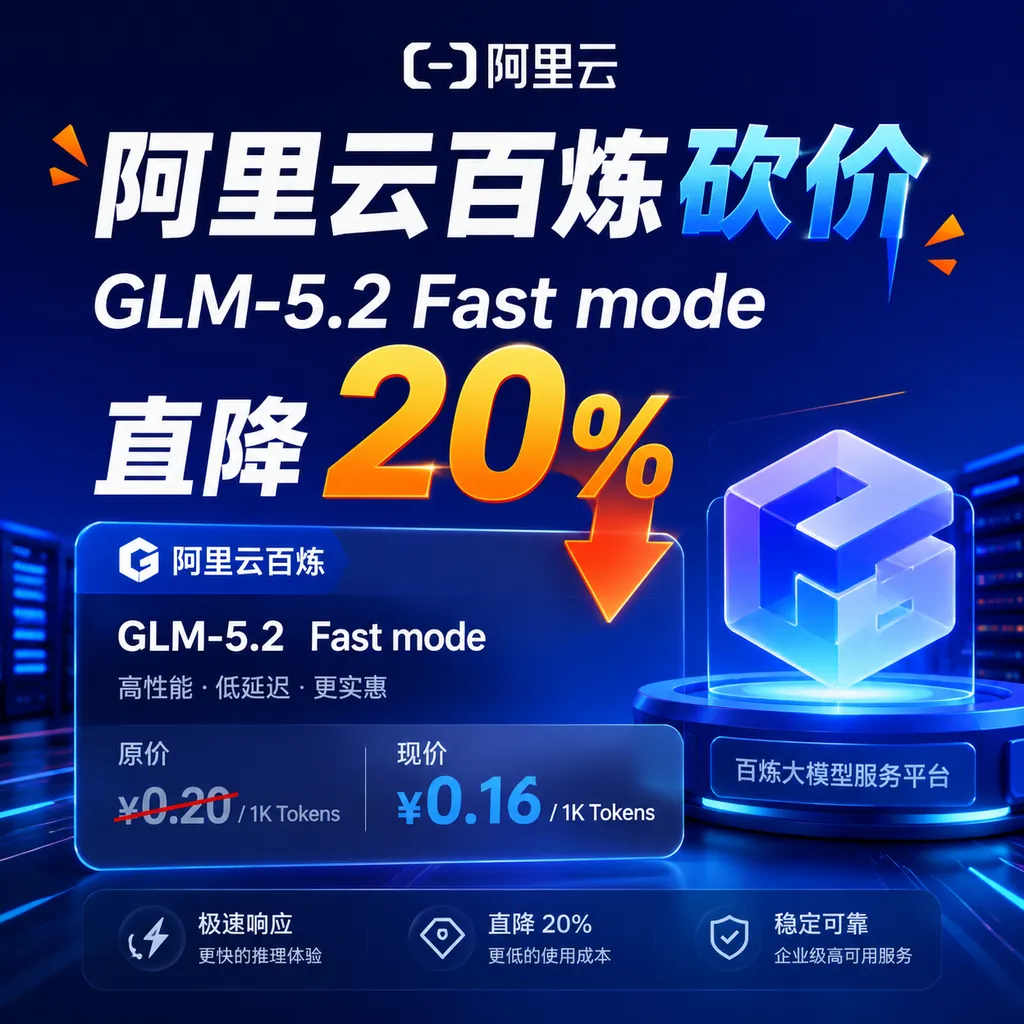
The Alibaba Cloud Bailian platform announced that starting from midnight on July 15, the billing unit price for **GLM-5.2 Fast mode** will be reduced by **20%**. This high-TPS mode is designed for latency-sensitive scenarios such as **streaming programming**, **multi-step reasoning for agents**, and **real-time conversations**.
Alibaba Cloud is at it again—this time the one taking the hit is GLM‑5.2's Fast mode.
On July 14, Alibaba Cloud’s Bailian platform issued a notice: starting 00:00:00 Beijing time, July 15 2026, the price per unit for the Fast mode of the GLM‑5.2 model will be reduced by 20%. The price‑cut window is short—just a little more than half a day between announcement and effect. For teams that already run this pathway in production, bills will automatically become cheaper at midnight tomorrow, with no code changes required.
This change doesn’t look huge—20% is not a headline number. But if you’re building an AI coding assistant, agent system, or real‑time chat product, the share of Fast mode in your bill is probably non‑trivial; that 20 percent cut will feel much more tangible than the percentage on paper.
What exactly makes Fast mode “fast”
Let’s clarify what this mode is first—otherwise, there’s no baseline for that price drop.
GLM‑5.2 on Bailian provides two paths: the standard API and Fast mode. The calling method is almost identical; you just change the model parameter to the Fast mode model ID (currently glm-5.2-fast-preview) and switch the domain to the workspace‑level endpoint https://{workspace_id}.cn-beijing.maas.aliyuncs.com/compatible-mode/v1.
The core difference: throughput.
According to the official statement, Fast mode achieves 80–100 TPS, roughly 1.5–2× the standard API. TPS doesn’t mean much for chat, where users read slower than the model writes, but it makes a big difference in certain cases:
- AI streaming coding assistants: tools like Cursor, Cline, Copilot. Every millisecond from pressing Tab to seeing the first code token counts. Raising TPS from 50 to 100 means a 200‑token completion drops from 4 seconds to 2 seconds—difference between “snappy” and “laggy.”
- Agent multi‑step reasoning: complex agent tasks that chain tool calls, reflections, and generations serially. Double the single‑step latency and the whole chain doubles; doubling TPS almost compresses total time linearly.
- Real‑time dialogue: speech or customer‑service chat depends on first‑token latency and streaming token rate; Fast mode optimizes the latter.
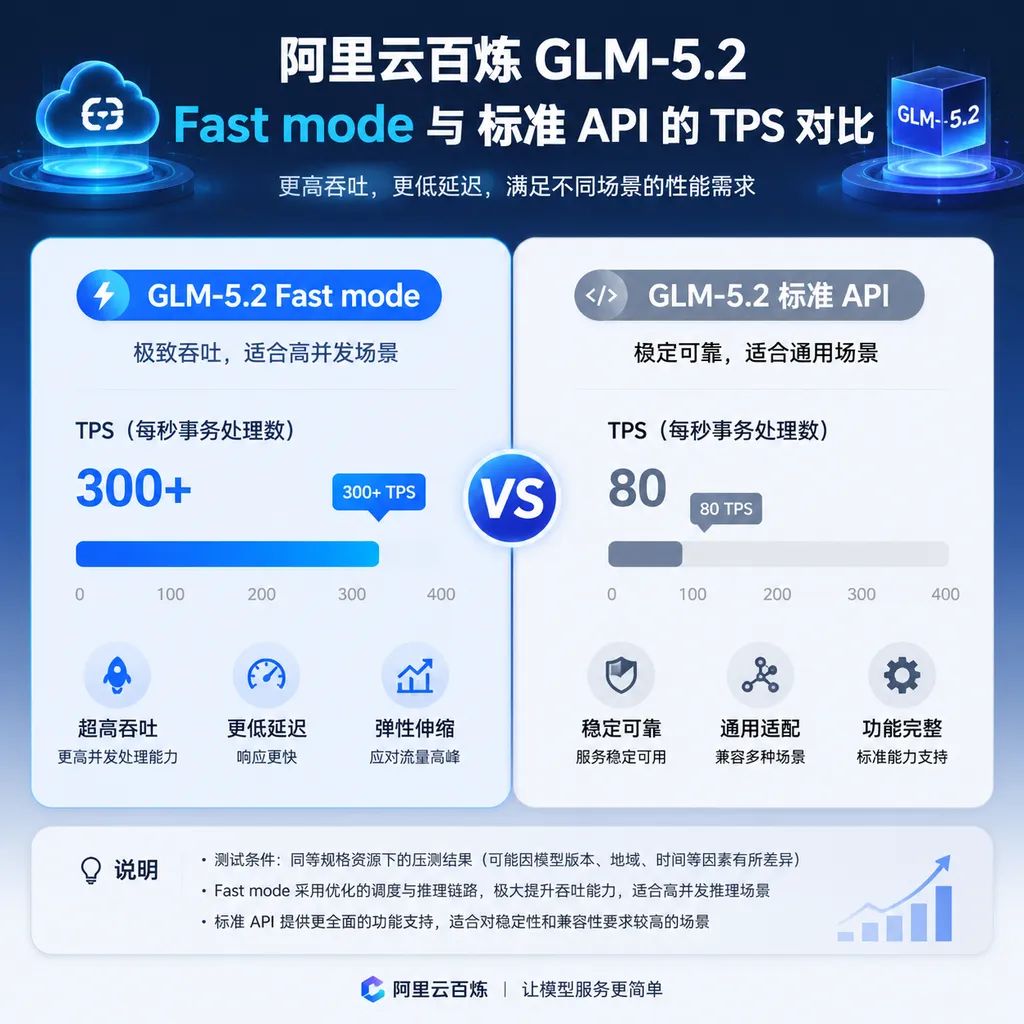
There’s also a subtle but useful rate‑limit policy difference: Fast mode won’t immediately reject requests exceeding TPM quota—it queues them instead. For workloads with bursty traffic, this is far easier to handle than a hard 429; no need for complex client‑side backoff logic. The queue isn’t infinite, of course—sustained overage still incurs delay—but it turns “crash” into “slow.”
Billing logic stays simple: same as the standard API, charged by input + output tokens, with no tiered plans, commitments, or annual bundles. This 20% cut directly reduces that unit price on the rate table.
Why now, and why this mode
The timing makes it more interesting.
GLM‑5.1 was released on Bailian this May, sold for two months as part of Bailian’s third‑party model matrix. GLM‑5.2 is its upgrade—featuring 1 M context, coding enhancements, and agent‑scene optimization—all of which happen to match Fast mode’s target customers. Fast mode itself still carries a preview label, signaling Alibaba Cloud’s “run first, tune specs anytime” stance.
A 20% cut now sends a clear message: Alibaba Cloud aims to make GLM‑5.2 Fast mode the default choice for real‑time inference.
The broader context: overseas, GLM‑5.2 has been trending these past two months—OpenRouter data ranks it in the top 10 by usage; reports say Coinbase’s internal LLM gateway defaults to GLM and Kimi. Domestically, capability reviews reach similar consensus—adequate for coding and agent tasks, and that 1 M context proves invaluable for code‑base‑level comprehension. What remains is which cloud can deliver the best access experience and lowest price.
Bailian’s strategy is consistent: a single key connects to Tongyi Qianwen, Zhipu GLM, MiniMax, Kimi, and more—a multi‑model aggregation hub. In this position, price adjustments are routine operations, not major strategy shifts. You can see this as Alibaba Cloud’s “daily ops”: wherever usage and developer feedback peak, they double‑down.
Looking at Alibaba Cloud’s past rhythm clarifies things. In 2023, the 50% slash across core products was a market‑share war. In late 2024, an 80% drop on Tongyi Qianwen vision models was a cost‑power flex for in‑house models. This time it’s a targeted tun‑up—20%, single‑model, single‑mode—not an industry quake.
What it means for developers
The takeaway: if you’re already using the GLM‑5.2 standard API for real‑time scenarios, tomorrow morning is a good time to seriously evaluate switching to Fast mode.
Let’s do the math. Fast mode has always been more expensive—that’s the premium for higher TPS. After a 20% cut, the price gap narrows sharply while the TPS advantage remains. For products sensitive to first‑token latency and generation speed, the user‑experience gain far outweighs a few extra RMB per million tokens.
From another angle, if you’re on a different cloud’s GLM‑5.2 or running open‑source weights yourself, Fast mode’s value equation changes. Self‑hosting isn’t cheap: GLM‑5.2 is a 744 B MoE model, needing about 744 GB VRAM just for weights at FP8, plus KV cache and runtime overhead—roughly eight B200s to barely run one instance. The capital + Ops cost per token usually makes the API route more reassuring. Unless compliance (data locality, on‑premises deployment) forces you, few teams need that hardware struggle.
Concrete recommendations:
- Real‑time chat / streaming coding tools: make Fast mode the default, keep standard API as fallback. Users won’t forgive lag for a slight discount.
- Agent systems: for 3‑step+ chains, Fast mode dramatically shortens total runtime—anyone optimizing agents knows wall‑clock time in serial calls is hardest to save.
- Batch / offline jobs: insensitive to TPS; standard API remains more cost‑effective.
- Preview status caution: Fast mode is still preview; capabilities and specs may change. Keep model‑switch toggles configurable; don’t hard‑code the model ID.
One more note: GLM‑5.2 returns a reasoning_content field by default. In streaming outputs, reasoning and answer tokens arrive separately as delta.reasoning_content and delta.content. Front‑end engineers new to this pipeline should render them separately; otherwise, the reasoning trace may leak into the user interface.
A brief assessment
This price cut isn’t a milestone, but it signals clearly that domestic cloud vendors competing on GLM‑5.2‑class “high‑performance open‑source models + high‑throughput inference modes” have entered the price‑and‑experience race.
Whether the model itself is strong is no longer the question—GLM‑5.2, Kimi K series, DeepSeek and other open‑source Chinese models have repeatedly proven their upper bound. What decides market share now is inference engineering: higher TPS, friendlier throttling, clearer billing, smoother integration. Bailian’s tweak targets exactly this layer.
Good news for developers: same model, run it on the platform that handles it best, at the most reasonable price, with the smoothest experience—that should be the norm. Which cloud or aggregator fits best will be decided by usage. China already has multiple AI‑API aggregation platforms, and OpenAI‑compatible hubs like OpenAI Hub are onboarding the GLM series too. More entries mean more choice.
At midnight tomorrow, GLM‑5.2 Fast mode bills drop 20% automatically—no code changes, no migration required. A “save‑money‑in‑your‑sleep” update like this deserves a round of applause for the ops team.


