
NVIDIA completely exposed Nemotron: this time, open-source models mean serious business.
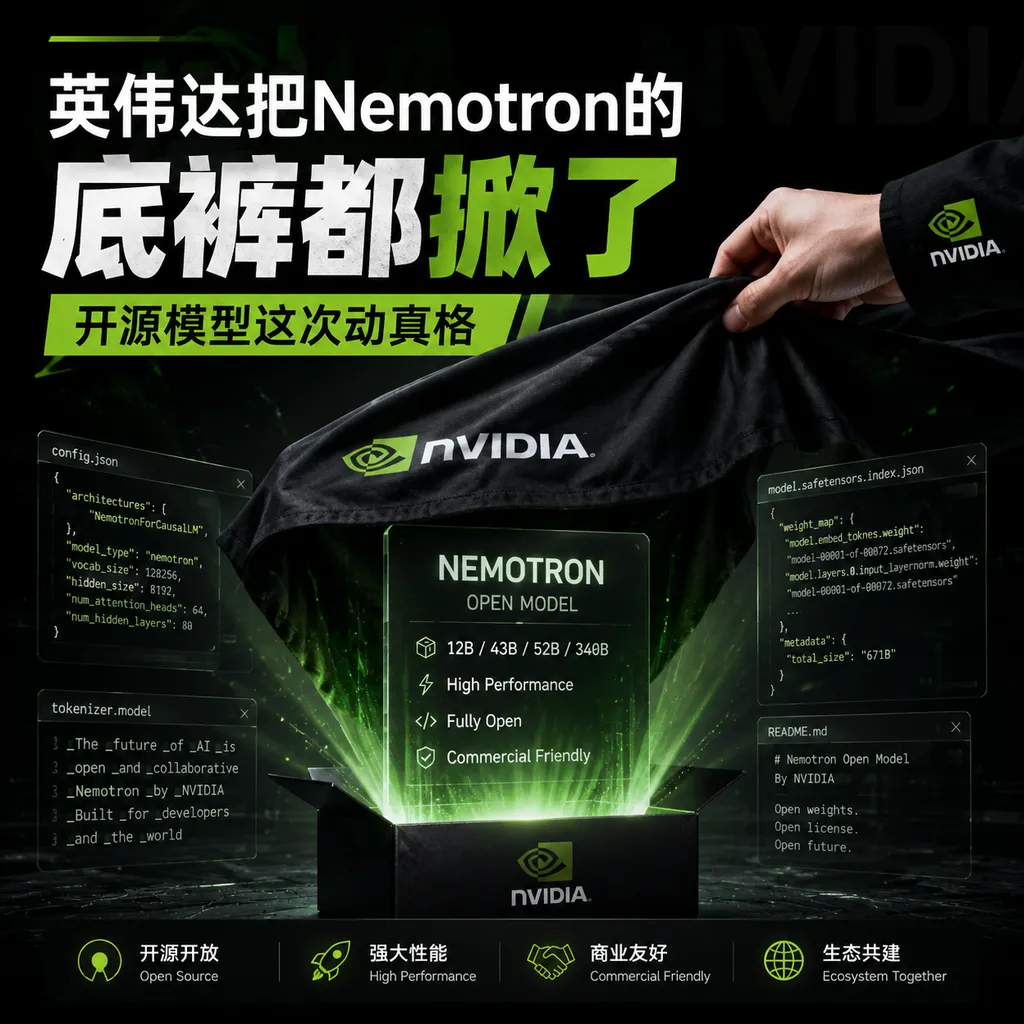
NVIDIA has systematically disclosed the technical details and enterprise implementation roadmap of the Nemotron open-source model system. From the hybrid Mamba-Transformer-MoE architecture to the full release of nearly 10 trillion tokens of pretraining data, this represents a rare case of “full-stack open source,” directly addressing enterprises’ core anxiety over controllable AI.
NVIDIA just published a long blog post revisiting the foundation of its open-source Nemotron series models—it’s not a product launch, but rather a piece of “technical evangelism” aimed at enterprise and sovereign AI clients. The core message can be summed up in one line: what enterprises want is not the strongest model, but a model they can hold in their own hands.
Behind this statement lies the toughest question that closed-source models have struggled to answer over the past year. No matter how powerful GPT or Claude are, enterprise clients still ask three questions: where does the data go, can the model be modified, and is offline deployment possible? The open-source Nemotron stack is NVIDIA’s answer—and this time, it has laid out the weights, training data, reinforcement learning environments, and post-training recipes all on Hugging Face.
A Rare “Full-Stack Open Source” Release
First, let’s clarify the facts. In December last year, NVIDIA officially launched the Nemotron 3 series, which includes Nano, Super, and Ultra versions, all adopting a hybrid Mamba–Transformer–MoE architecture with native support for 1 million-token contexts. Currently, Nano (30B total parameters / 3B active) is live; Super (~100B/10B active) and Ultra (~500B/50B active) are expected to roll out in the first half of this year.
Unlike most “open-source” models that share only weights, NVIDIA has turned over every link in the chain this time:
- Model weights: released under the NVIDIA Open Model License, available for commercial use
- Pretraining corpus: nearly 10 trillion tokens of synthetic data made public in Nemotron-Pre-Training-Datasets
- Post-training data: the full 13 million-sample Nemotron Post-Training 3.0 dataset is open
- Reinforcement learning environment: NeMo Gym and NeMo RL libraries are open source, enabling plug-and-play environments for tool use, multi-step reasoning, etc.
- Evaluation tools: NeMo Evaluator for reproducing official benchmark results
- Training recipes: end-to-end reproducible workflows published on GitHub
This level of openness is even more radical than the Llama series—Meta has never released its training datasets. For teams building domain-specialized models without wanting to start from scratch, this is essentially NVIDIA moving its own “internal kitchen” directly onto Hugging Face.
Nano, the Tiny Powerhouse, Outperforms Qwen3 and GPT-OSS
The numbers in the technical report are solid. Nemotron 3 Nano is trained on 25T tokens, has 3.5B active parameters and 30B total parameters. Compared with similar-scale Qwen3-30B-A3B-Thinking-2507 and GPT-OSS 20B:
- Inference throughput reaches up to 3.3× that of its competitors
- Excels across all categories in math, science reasoning, coding, agent tool use, instruction following, and long context benchmarks
- Matches GPT-OSS on reasoning benchmarks, and significantly outperforms it in agent, dialogue, and long-context tasks
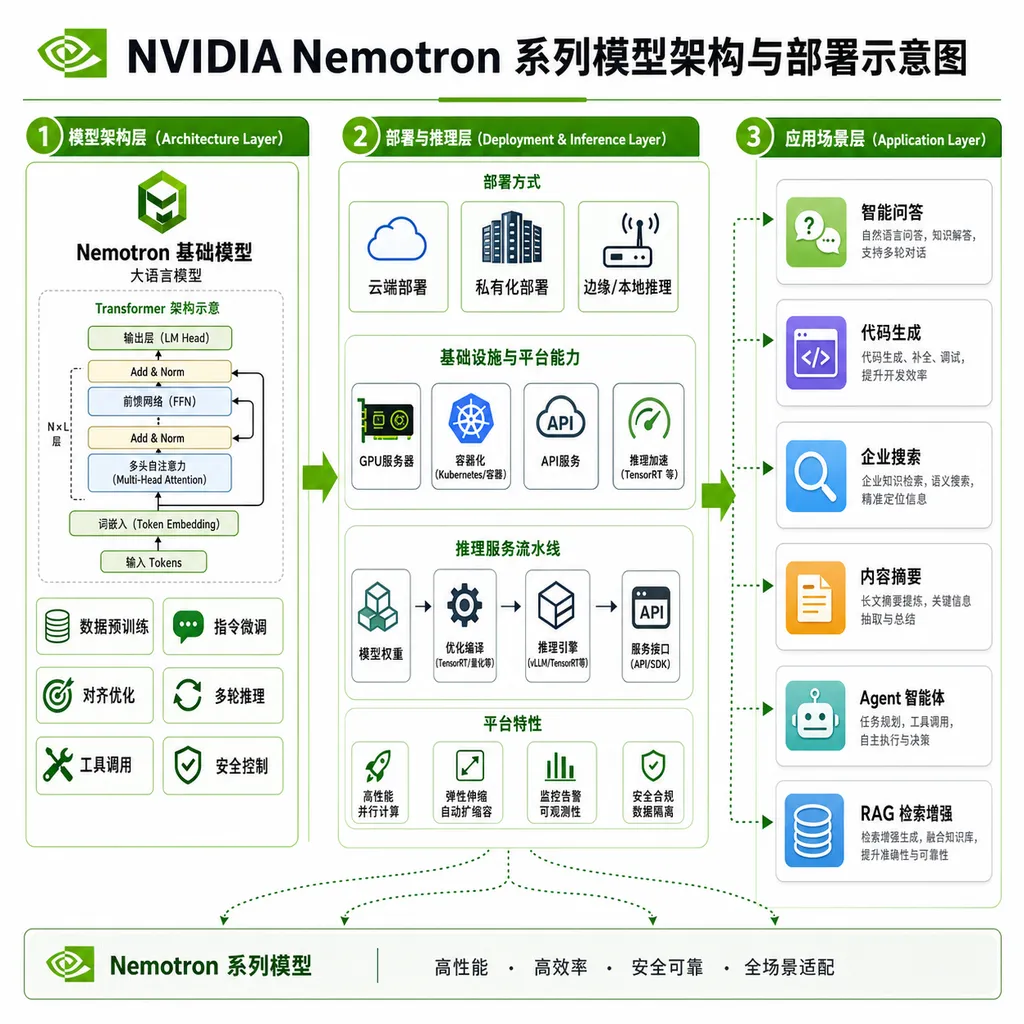
The key to its throughput advantage lies in architecture. Nemotron 3 interleaves Mamba-2 and MoE layers with sparse Transformer layers—Mamba handles long sequences with linear complexity, Transformer layers preserve global attention expressiveness, and MoE sparsity controls inference cost. It’s not a new idea, but NVIDIA tuned it to an engineering-ready tipping point.
The result: a 30B-parameter model that performs like a dense 100B model on a single DGX Spark or H100, while inference cost drops drastically. For enterprises, the math is simple—you can handle several times more agent requests on the same budget.
Super and Ultra Bet on NVFP4
The unreleased large variants are notable for their training format. Nemotron 3 Super and Ultra use NVFP4 (4-bit floating point) format training based on the Blackwell architecture, combined with a latent MoE design—experts operate on shared latent representations, then project back to the token space.
NVFP4 training is NVIDIA’s major focus this year. Compared with FP8, it halves memory requirements and boosts training throughput by several times. NVIDIA claims Ultra achieves 5× training efficiency gains on Blackwell, targeting high-frequency workloads like code assistants, deep search, and complex workflow automation.
Simply put, Ultra is NVIDIA’s “flagship demo” for its Blackwell platform—if you want top speed, use Blackwell. The business logic is clear: open source is the hook; hardware is the main course.
The Enterprise Customer List Says It All
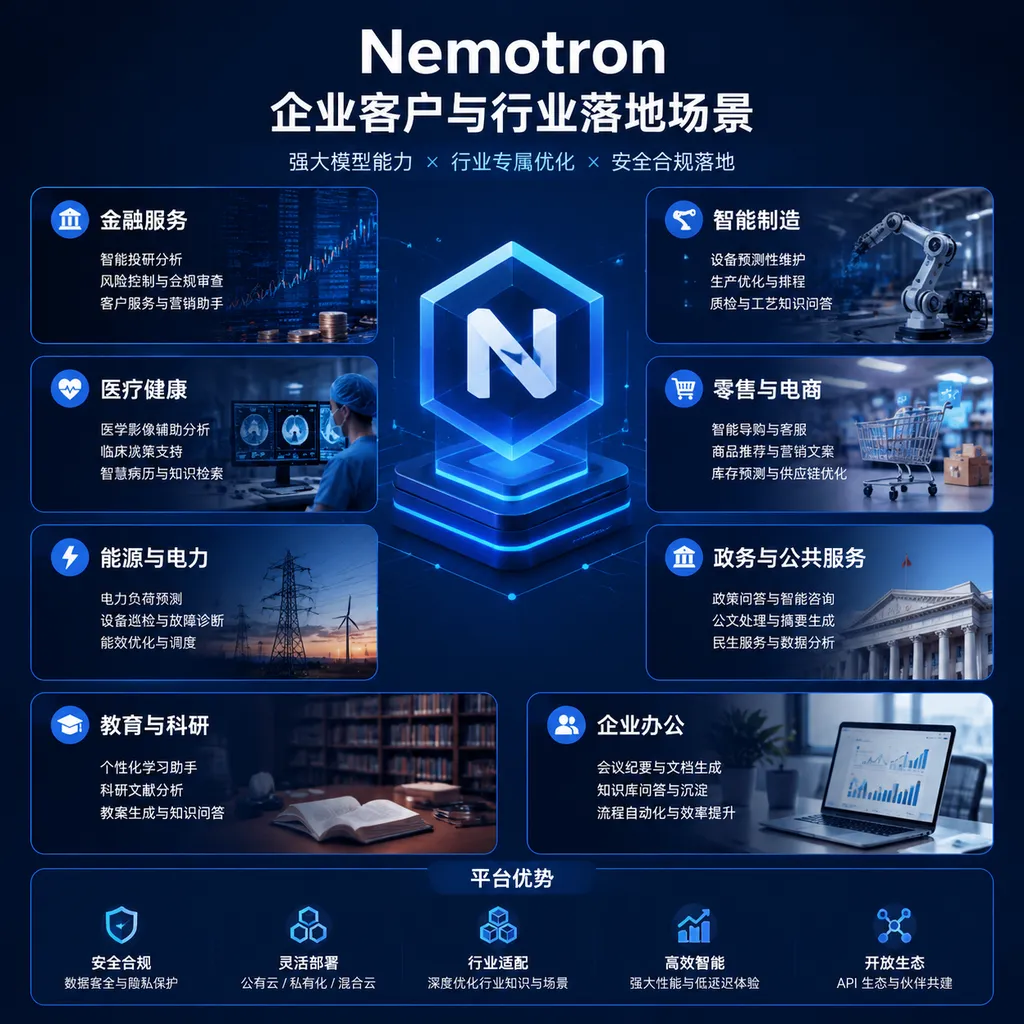
The most direct way to gauge whether an open-source model is being adopted is to look at its client list. Early Nemotron users include Accenture, Cadence, CrowdStrike, Cursor, Deloitte, EY, Oracle Cloud, Perplexity, ServiceNow, Siemens, Synopsys, and Zoom.
This list tells the story:
- Consulting & audit (Accenture, Deloitte, EY): highly sensitive data, closed APIs are a no-go
- EDA & industrial software (Cadence, Synopsys, Siemens): deep domain knowledge barriers require intensive fine-tuning
- Cybersecurity (CrowdStrike): full model auditability required
- Developer tools (Cursor, Perplexity): agent-heavy workloads, hypersensitive to inference cost
The pain points these companies faced with closed models align exactly with Nemotron’s three pillars: trustworthy, controllable, customizable. NVIDIA spells it out clearly—enterprises don’t want the “strongest brain,” they want AI that “fits into their workflows, can be trained with their data, and whose every step can be traced.”
Sovereign AI and Telco Models: The Bigger Ambition
Looking further ahead, NVIDIA’s Nemotron effort has expanded beyond the enterprise market. At MWC 2024, NVIDIA introduced and open-sourced Nemotron LTM—a 30B-parameter Large Telco Model tailored for telecom scenarios. In June, it launched the BioNeMo Agent toolkit, embedding Nemotron into biomedical agent workflows.
With multilingual support (English plus 19 languages including German, French, Spanish, Italian, Japanese, etc., and 43 programming languages), the Nemotron series effectively positions itself as the technical base for sovereign AI. Regions like Europe, Japan, and the Middle East—which don’t want national-level AI built on OpenAI or Anthropic—need a solution they can own end-to-end. NVIDIA provides that full stack—from model and data to training framework and hardware.
The strategy blends Meta’s Llama-style open-source community approach with NVIDIA’s hardware dominance—you can use Nemotron freely, but the most efficient way to train, fine-tune, or run inference is naturally on Blackwell and DGX.
Ecosystem Integration Already in Motion
For developers, Nemotron 3 Nano is already well supported:
- Inference frameworks: LM Studio, llama.cpp, SGLang, and vLLM all supported
- Cloud platforms: AWS Bedrock (serverless) live; Google Cloud, Coreweave, Crusoe, Microsoft Foundry, Nebius, Nscale, and Yotta integrating
- Inference service providers: Baseten, Deepinfra, Fireworks, FriendliAI, OpenRouter, and Together AI offering APIs
- Training ecosystem: Prime Intellect and Unsloth have integrated NeMo Gym training environments into their workflows
To try it locally, simply pull nvidia/NVIDIA-Nemotron-3-Nano-30B-A3B-FP8 from Hugging Face. For commercial deployment, NVIDIA NIM microservices offer a containerized package—though it requires an NVIDIA AI Enterprise license.
A Few Thoughts
By 2026, the open-source model landscape is clearly different from that of 2024. The old debate—“can open source catch up with closed source?”—has shifted to “how do open models differentiate?” Llama goes for ecosystem and scale, Qwen for multilingual and full-stack, DeepSeek for extreme efficiency, Mistral for European sovereignty, and Nemotron for an end-to-end enterprise stack.
NVIDIA’s strengths and weaknesses are both obvious. Its strength lies in delivering hardware, training frameworks, models, data, and evaluation tools as one cohesive package—very attractive to enterprise buyers. Its weakness is community spirit—Nemotron feels more like an “official reference implementation,” lacking Llama’s thriving grassroots ecosystem. Nemotron 3 Nano currently ranks 47th on Hugging Face’s text model leaderboard (120th overall), still trailing the top open models.
But enterprise clients don’t care about leaderboards. What matters is whether the model integrates smoothly into their compliance workflows. In that regard, Nemotron’s completeness places it firmly among the top three open-source solutions available.
For domestic developers, if private deployment isn’t an immediate priority, using aggregation platforms like OpenAI Hub to prototype with mainstream models (GPT, Claude, Gemini, DeepSeek) remains the most practical path. Once Nemotron 3 Super and Ultra launch, transitioning to a self-controlled stack for deeper customization would be a pragmatic next step.
References
- NVIDIA Nemotron 3 Nano model weights (Hugging Face) — official FP8 model weights, downloadable for deployment
- Zhihu: Redefining the AI Landscape—How NVIDIA’s Nemotron Models Achieved It — product-level overview of Nemotron’s positioning and technical roadmap


