
27B Fits into a Phone: Another Win for the Bonsai 1-bit Model

PrismML launches Bonsai 27B, compressing a 27-billion-parameter model to the point where it can run on a smartphone. The 1-bit native training approach breaks through the ceiling of edge LLMs for the first time.
27B Parameters Packed into a Phone’s Memory — PrismML Does It Again
On July 14, Caltech‑rooted startup PrismML quietly released Bonsai 27B on Hugging Face.
No launch event, no CEO manifesto—just a technical blog post and a llama.cpp fork—but this might be the most important edge‑AI model release of the year.
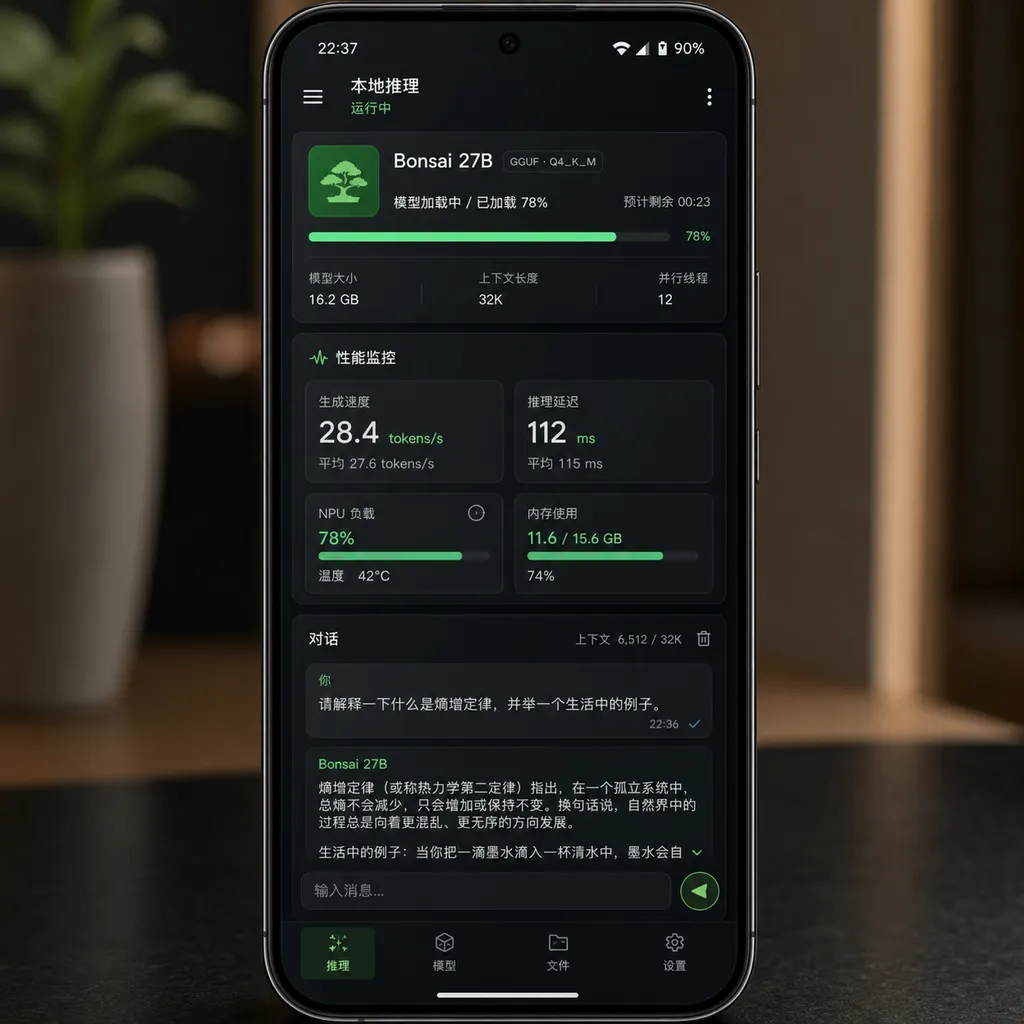
27 billion parameters, 1‑bit quantization, and it fits in the memory of a modern flagship phone to actually run.
Six months ago that combination still sounded like PowerPoint fantasy.
Today it’s something you can download, run locally for inference, and it’s open‑sourced under Apache 2.0.
In a Reddit post on r/LocalLLaMA with over 800 upvotes, a user reported 4.5 tokens / s on a Galaxy S25 Ultra, with the top comment summing it up perfectly:
“Slow, but it really runs on a phone.”
From 8B to 27B — What’s New in PrismML’s Technical Path
To grasp why 27B matters, rewind to Bonsai 8B.
That late‑2023 model first drew attention to PrismML—an 8.2 billion‑parameter network with every weight represented by just 1 bit, the entire model compressed to 1.15 GB, achieving 44 tokens / s on an iPhone 17 Pro Max.
Many assumed it was the usual BitNet‑style “post‑training quantization trick,” but PrismML’s blog clarified: 1‑bit from start to finish, trained natively.
The breakthrough lies in that phrase.
Traditional 4‑bit and 8‑bit quantization is basically a “build then demolish” strategy: train in FP16, then compress the weights.
Compression improves, accuracy drops.
True 1‑bit training means re‑engineering gradient descent, loss functions, and attention for a regime with almost no numeric resolution.
Microsoft’s 2023 BitNet paper drafted the framework, but the world hadn’t seen a working open‑source implementation—until PrismML delivered.
Bonsai 27B scales that concept up.
Compared with 8B, the difficulty doesn’t rise linearly—large models at low bit‑widths face exploding or collapsing gradients.
PrismML says they made major stability tweaks.
While the full technical report isn’t out yet, the fact that the model converges and matches FP16‑based 27B benchmarks suggests the method works for mid‑scale training.
Intelligence Density: PrismML’s Core Bet
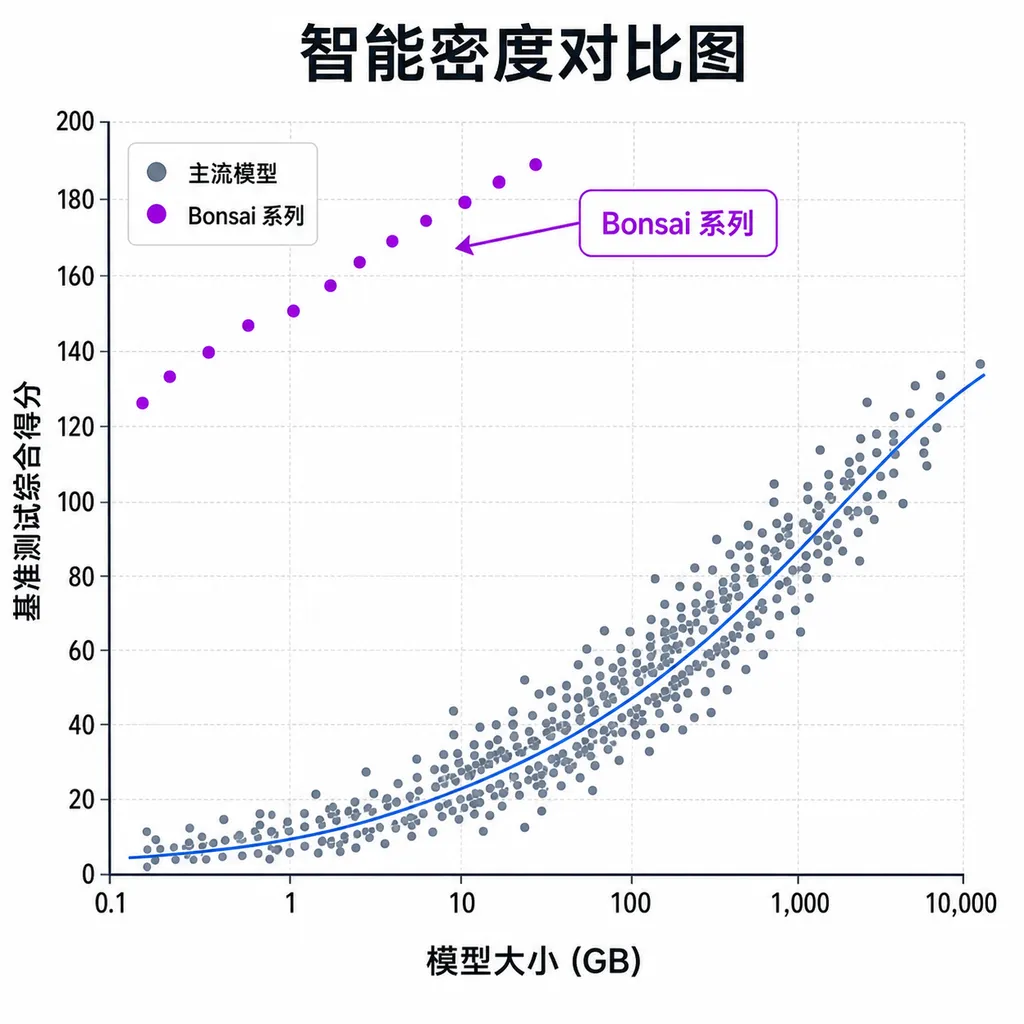
Scan PrismML’s blog and one phrase recurs: Intelligence Density—“how much intelligence you can pack per GB.”
It’s not a marketing gimmick; it’s their guiding metric.
Why does this view matter?
Because the past three years in AI have worshiped the scaling law—more parameters, more data.
Yet when it comes to real deployment, especially on‑device, there’s an inconvenient truth:
consumer memory and bandwidth haven’t scaled with model size.
An iPhone 17 Pro Max has only 12 GB of RAM; it can’t hold an FP16 Llama 3.1 70B (≈ 140 GB).
Two opposing paths emerge:
- Cloud‑centric: Bigger is better; serve models via API (OpenAI, Anthropic).
- Edge‑centric: Smaller, smarter models; maximize intelligence per GB.
PrismML clearly sides with the latter.
Its Bonsai 8B claims 10× the intelligence density, 14× smaller footprint, 8× faster inference than an FP16 model of the same size.
The “14×” is straightforward—FP16 requires 16× more storage, minus non‑quantized layers ≈ 14×.
The impressive part is that intelligence doesn’t collapse: on MMLU, GSM8K, and similar benchmarks, Bonsai 8B holds its own against many full‑precision 8B models.
The 27B edition pushes that logic into harder territory.
Normally a 27B model targets cloud GPUs; Gemma 2 27B needs 50 GB+ VRAM for FP16 and 15 GB even at 4‑bit.
Bonsai 27B’s reported memory use: ~3.5 GB—squarely within smartphone budgets.
4.5 Tokens / s — Is That Enough?
Technically speaking, 27B on a phone won’t be as zippy as 8B.
Reddit testers report 3–5 tokens / s depending on device and prompt length.
That’s roughly slow‑reading speed: you can follow sentence‑by‑sentence, but a thousand‑word passage takes half a minute.
Comparison:
- Bonsai 8B, same phone: 44 tokens / s — faster than human reading.
- Bonsai 27B, same phone: ≈ 4.5 tokens / s — hand‑in‑hand with human reading.
- Cloud GPT‑5 API: 60–100 tokens / s typical.
So it’s not meant for instant replies, but for offline document analysis, code completion, or private Q&A, 4.5 tokens / s is usable.
And don’t forget: it’s fully offline—no internet, no API fees, no data leaving your device.
Another overlooked point: power efficiency.
1‑bit matrix multiplies degrade to additions + bitwise ops, theoretically an order of magnitude less energy than floating‑point math.
Translation: you won’t nuke your battery in minutes.
PrismML hasn’t published formal power data, but community tests show noticeably less heat than 4‑bit peers during long generations.
Ecological Niche — BitNet Finally Finds a Champion
You can’t discuss Bonsai without mentioning BitNet.
Microsoft’s 2023 paper lit the spark, yet the repo stagnated and most 1‑bit efforts stayed proofs‑of‑concept.
Many wrote the line off as “great theory, dead engineering.”
PrismML changed that narrative by delivering working stuff:
- Bonsai models (8B & 27B) — weights public, Apache 2.0.
- A llama.cpp fork — the community’s go‑to inference stack, now 1‑bit‑ready.
- KV‑cache compression — paired with TurboQuant to squeeze memory further.
Together these turned 1‑bit from “research topic” into “production‑ready.”
BitNet had been called “Schrödinger’s SOTA”: supposedly achievable yet unseen.
Now PrismML opened the box—and the cat’s alive.
For developers, that means fresh opportunities:
- Re‑evaluate on‑device AI feasibility — Apps once limited to < 3B models can try 27B‑class capability.
- New privacy‑preserving options — Healthcare, legal, or internal data scenarios finally have a local open‑source path.
- Inference cost overhaul — Even on servers, 1‑bit models bring huge VRAM and throughput gains.
Points to Watch Out For
Time for realism—Bonsai 27B isn’t magic. Key caveats:
1 • Long‑context ability uncertain.
Current windows range 8K–32K, far short of commercial giants’ 200K–1M.
Weights are cheap to compress; KV cache is not.
PrismML uses TurboQuant for activation‑layer compression, but long‑text accuracy still awaits validation.
2 • Ceiling bound by data & method.
Even 27B parameters don’t guarantee parity with FP16: 1‑bit encoding stores less information.
It demands meticulous data mixing to recover capability.
Training data composition remains undisclosed.
3 • Tool‑chain compatibility.
Apart from the llama.cpp fork, major runtimes—vLLM, TensorRT‑LLM, SGLang—lack native 1‑bit support.
Enterprise adopters must patch things themselves for now.
4 • Unclear business model.
Thus far, PrismML open‑sources nearly everything—user‑friendly but profit‑murky.
Will revenue come from enterprise support, paid training, or a future closed flagship? No signal yet.
A Move Worth Watching
Ultimately, Bonsai 27B’s importance isn’t speed or benchmark glory; it’s proof that a 27B model can run on a phone.
That single fact just lifted the ceiling for edge AI.
Apple Intelligence and Google Gemini Nano operate around 3B parameters—useful but limited.
Jump to 27B and you reach the level that writes coherent code, follows complex instructions, and performs basic reasoning.
Once such ability runs locally in your pocket, app design itself will change.
Developers should:
- Grab Bonsai 27B from Hugging Face and test real‑world speed.
- Track PrismML’s llama.cpp fork and when it merges upstream.
- If you build edge AI products, re‑evaluate your tech stack now.
Open‑source models can deploy through any local‑inference route.
And if your app also needs cloud‑scale capability, OpenAI Hub now aggregates GPT, Claude, Gemini, DeepSeek, etc., under a single API key—making edge‑cloud hybrid setups far smoother than a year ago.
At last, someone has made the 1‑bit path work.
Expect the edge‑AI space to get lively over the next year.
References
- Bonsai 1‑bit Model Community Tests – r/LocalLLaMA — Community feedback and phone‑side benchmarks.
- PrismML Official 1‑bit Bonsai Announcement — Original 8B post with Q&A on technical details.
- Bonsai Model Collection – Hugging Face — All officially released Bonsai models with downloads & configs.


