
Alibaba Qwen-Audio-3.0-Realtime Released: Voice Interaction Enters the Duplex Era
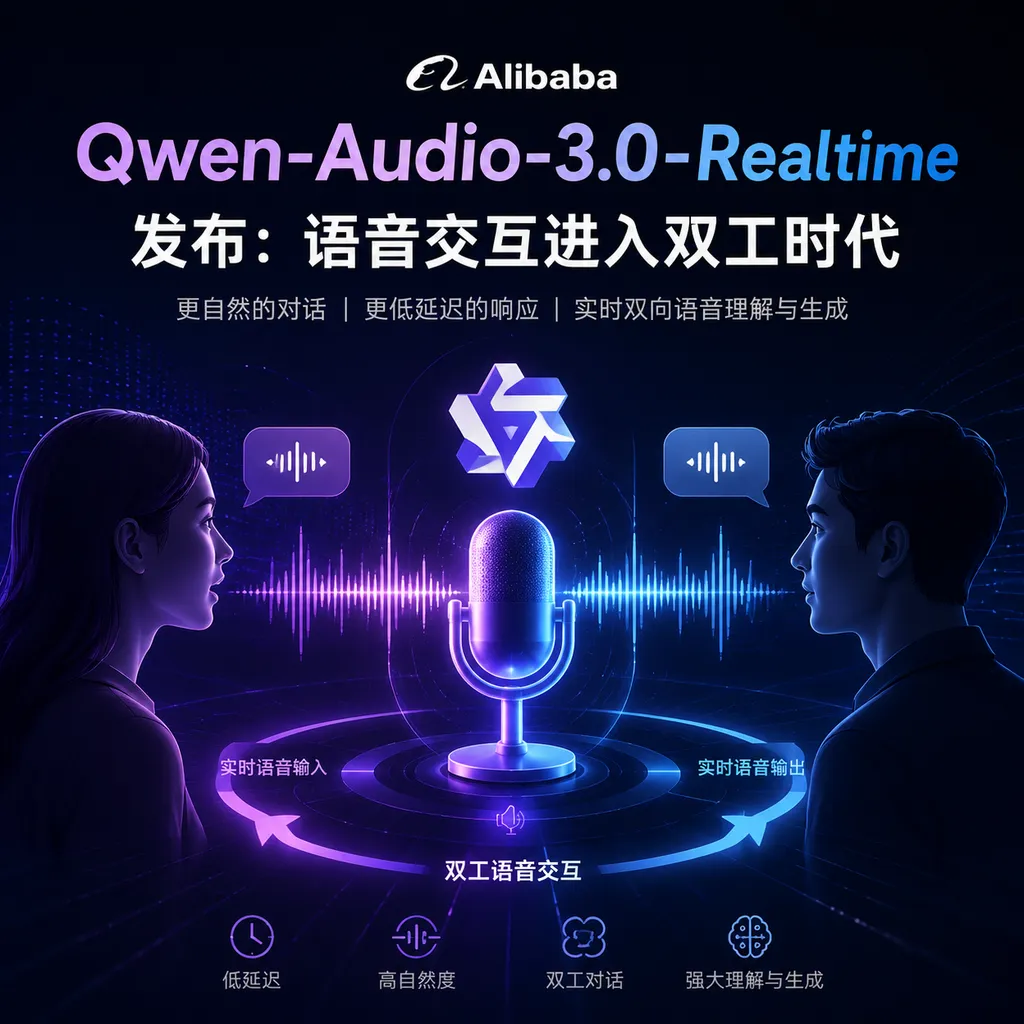
Today, Alibaba released the real-time voice interaction model **Qwen-Audio-3.0-Realtime**, featuring true full-duplex conversation and Agent tool invocation. In the *Artificial Analysis* subcategory, it ranks above **GPT-Realtime-2**, and comes in two versions: **Plus** and **Flash**.
Alibaba Releases Qwen-Audio-3.0-Realtime: True Full-Duplex + Agent, Taking Voice Interaction to a New Level
On the morning of July 15, Alibaba officially released Qwen-Audio-3.0-Realtime. Instead of just putting out another big model, this release breaks down “real-time speech” into its core aspects — intelligence, Agent tool invocation, empathetic dialogue, and duplex interaction fluency — upgrading all four together. Its clear benchmark target: OpenAI’s GPT‑Realtime‑2 launched in March.
The official tagline is “Better listener, smarter thinker.” It may sound like marketing speech, but measured against benchmarks and real use, this version actually brings substantial advances.
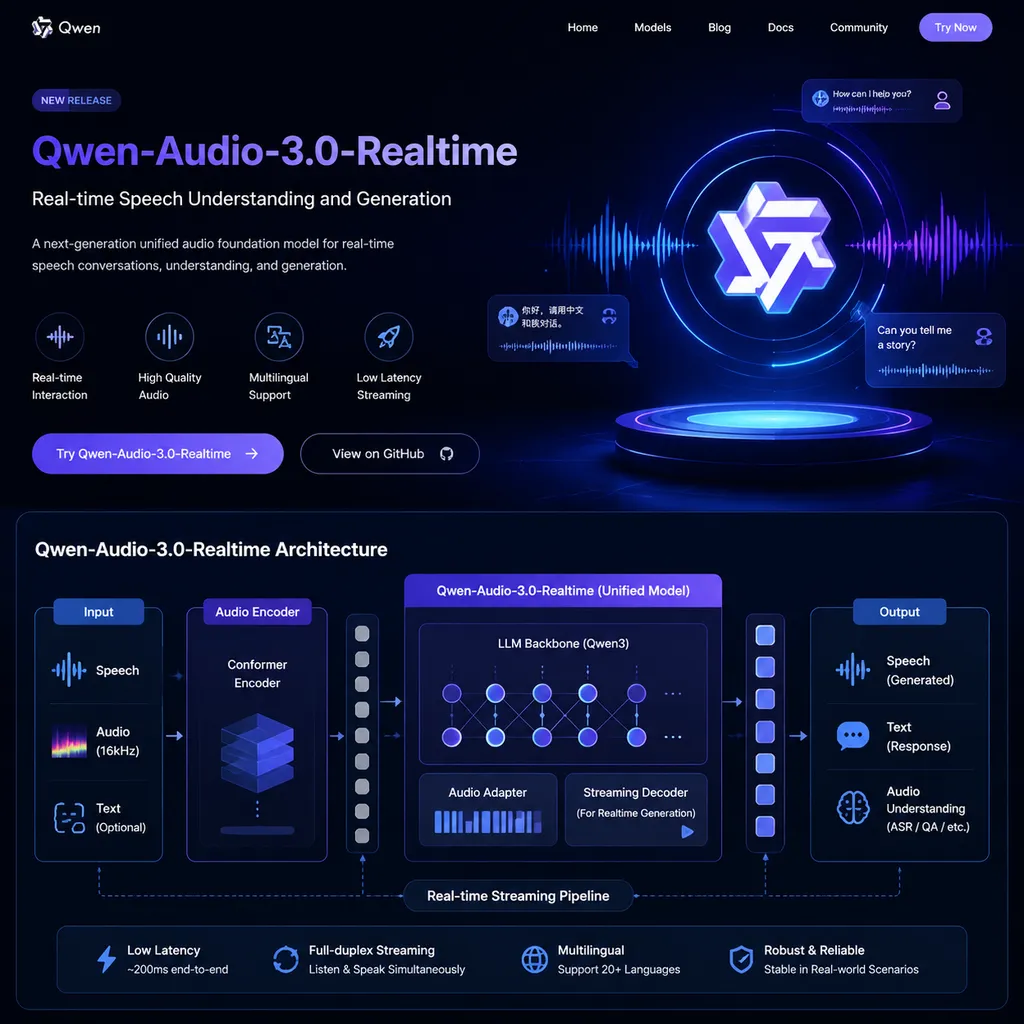
The Bottom Line: What Makes This Version Strong
Straight to the point: This is the first domestic real-time voice model to achieve both “full‑duplex interaction” and “Agent tool invocation” at a practical level.
In the past six months, local competitors’ models either had beautiful TTS voices but unbearable latency, or could chat but crashed when interrupted — almost none had agent capabilities. Qwen‑Audio‑3.0‑Realtime is the first to combine all these elements and take first place on public leaderboards.
In the “Real-time Speech” category of Artificial Analysis, Alibaba ranked first, surpassing GPT‑Realtime‑2. The leaderboard isn’t the most authoritative, but it covers diverse metrics — latency, instruction following, paralinguistic processing, interruption recovery — so being #1 suggests very balanced real‑world performance.
There are two versions of the model:
- Plus Edition: stronger reasoning power, suited for customer service or education/training scenarios that require contextual understanding and tool use
- Flash Edition: speed‑first, suited for companion, toy, or casual chat with frequent interactions
Testing access is already live under model ID qwen-audio-3.0-realtime, using the Bailian Realtime API with the WebSocket protocol.
Full Duplex Isn’t New, But This Time It’s the Real Thing
When discussing voice interaction, “full duplex” is unavoidable. Most vendors’ so‑called duplex is actually half‑duplex: you speak, then the model responds — if you interrupt mid‑speech, it either rudely cuts off or ignores you. GPT‑4o was widely praised because it could be interrupted mid‑utterance and gracefully shift to the new topic.
Qwen‑Audio‑3.0‑Realtime pushes duplexing further — speaker‑level background filtering + multi‑speaker intelligent switching.
What does this mean in practice? For example:
You’re talking to an AI assistant in Starbucks while people at the next table chatter loudly. Traditional speech models either trigger mistakenly or get confused. Qwen‑Audio‑3.0‑Realtime’s built‑in multimodal duplex control locks onto your voiceprint as the main speaker, filtering the chatter as background noise.
Even better — when your friend joins the conversation, the model can intelligently switch the primary interlocutor based on context and semantics, rather than being rigidly tied to the first speaker. This ability is crucial for multi‑party meetings, customer service transfers, or family companion scenarios.
By contrast, OpenAI’s current Realtime API relies on client‑side VAD (voice activity detection) and simple server‑side interruption handling, making multi‑speaker use impractical. Alibaba instead builds this capability directly into the model.
Paralinguistic Processing: Finally Taken Seriously
When judging how “human‑like” a speech model is, the most overlooked factor is paralinguistic information — laughter, sighs, hesitation, fillers. These cues carry massive emotional content in real dialogues, but legacy TTS systems filtered them out as noise, producing rigid broadcaster tones.
Qwen‑Audio‑3.0‑Realtime explicitly treats paralinguistic processing as a core capability:
- Understanding: recognizes emotions behind laughter, sighs, hesitation
- Generation: actively produces non‑linguistic signals like “mmm…”, “haha”, “ah”
Paired with prosody dynamics — automatic control of rate, pauses, stress based on meaning — the listening experience becomes far more natural than standard TTS.
Even more interesting is emotionally aware synthesis. When you confide work frustration, the model responds not with formulaic “I understand” lines, but with a lower, slower, more empathetic tone and pauses. Conversely, share good news, and its tone brightens.
This achieved state‑of‑the‑art results on the S2S instruction‑following benchmark VStyle, showing that its style‑switching isn’t prompt‑forced but genuinely modeled understanding of “style.”
Agent Integration: From “Chat Buddy” to “Gets Things Done”
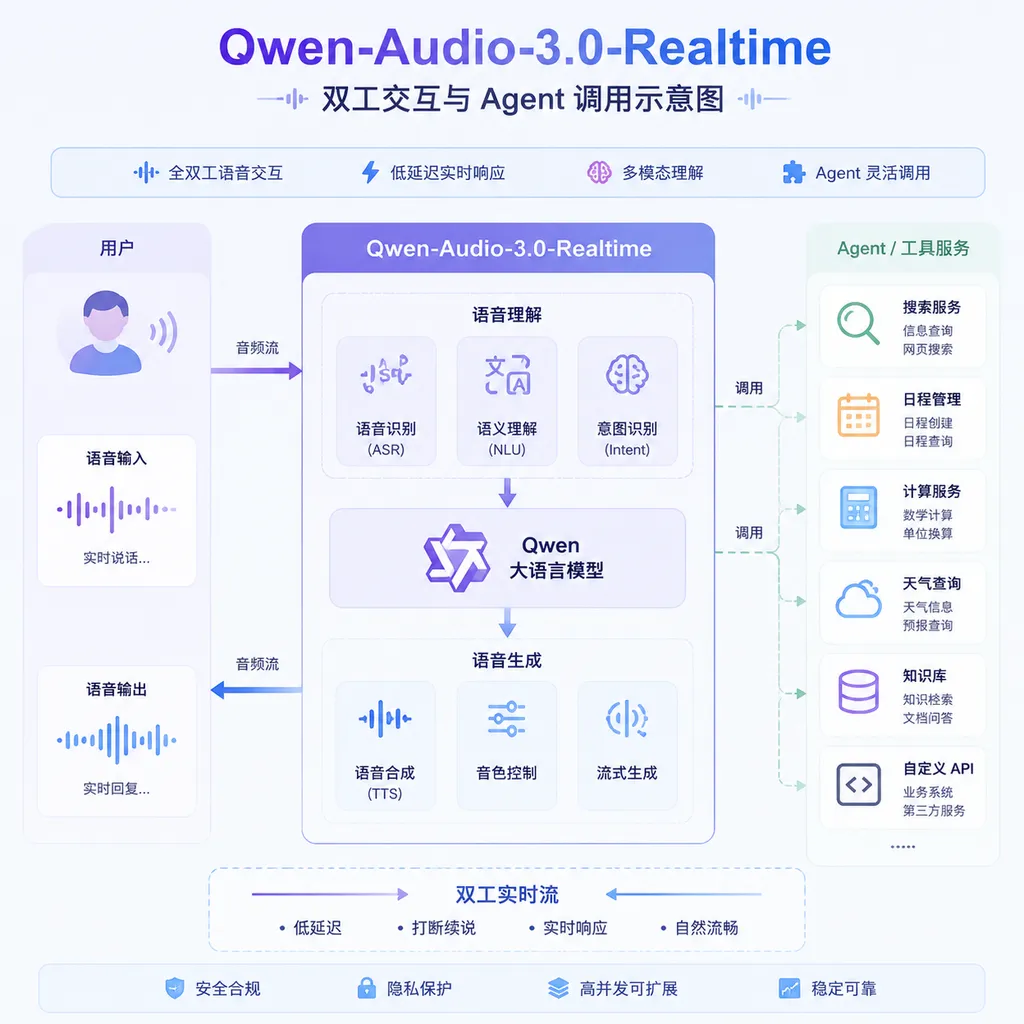
This might be the most underestimated part of this release: Qwen‑Audio‑3.0‑Realtime supports dynamic tool invocation.
Previously, most real‑time voice models were just “chatbots” — ask about the weather, they’d reply “Sorry, I don’t have real‑time data.” To call tools required a complex chain: speech‑to‑text → LLM reasoning → tool call → text‑to‑speech, producing high latency and fragility.
Qwen‑Audio‑3.0‑Realtime builds Agent capability natively into the real‑time model. The official example is route planning and information lookup for local‑life scenarios:
“How do I get to the Palace Museum from here?” — the model identifies the need to call a map API, invokes it, then replies by voice, all in one seamless interaction.
This approach aligns with GPT‑Realtime‑2’s March update, which integrated function calling into the Realtime API. Alibaba couples that with Bailian’s existing MCP service ecosystem — package tracking, book info, almanac data, EV charging station and horoscope queries — widening the voice‑agent use cases.
For developers, the real gain is unlocking smart‑hardware possibilities. Before, a voice toy or companion robot could only chat; now it can “turn on the air‑conditioner,” “check tomorrow’s weather,” or “order takeout,” without building your own pipeline.
Voice Cloning: The Final Piece for Commercial Rollout
For enterprise clients, a voice‑cloning configuration is also now open. The technology itself isn’t new — Alibaba’s earlier CosyVoice v3.5 already achieved few‑second sampling — but combined with real‑time output it’s transformative.
Typical use cases:
- Brands wanting proprietary customer‑service voices
- Digital avatars needing the same timbre as human hosts
- Education/training requiring teachers’ voices to be replicated
In the past, these required offline synthesis (high latency, poor experience) or sacrificing real‑time response. Qwen‑Audio‑3.0‑Realtime embeds voice cloning in the real‑time pipeline: once the timbre is configured, all conversations use it, with emotional expressiveness and prosody preserved.
For SaaS voice service providers, this is a major boost.
Scenario Fit: Who Should Use It
According to its positioning, the four main target use cases are:
- Intelligent Customer Service — interruption recovery + Agent tool calls for complex queries
- Education & Training — paralinguistic cues + role‑play for AI coaching
- Entertainment & Interaction — dynamic style switching for game NPCs and live streaming
- Emotional Companionship — empathetic response + voice cloning for companion robots or therapy
The Plus/Flash division follows these: Plus for reasoning‑heavy domains like education or customer service; Flash for high‑frequency short exchanges like toys or companions.
What It Means for Developers
Since GPT‑4o last year, the real‑time speech track has been hot, but few models reached truly “commercially viable” quality. Domestic players like ByteDance’s Doubao, Tencent’s Hunyuan Speech, and MiniMax’s Speech‑2.5 each have distinct focuses.
Qwen‑Audio‑3.0‑Realtime stands out with solid progress in both duplex and agent directions — duplex solves the experience problem, bringing interactions close to human conversation; agent solves the value problem, turning voice assistants from toys into productivity tools.
For teams integrating AI speech into products, viable options have clearly multiplied compared to six months ago. OpenAI Hub already supports Qwen‑Audio‑3.0‑Realtime calls, so developers can run A/B tests against GPT‑Realtime‑2 under the same key to find the best fit.
Open Questions
Some aspects remain to be tested:
- Actual latency: no official numbers; leaderboard only shows “overall experience,” not confirmed first‑token latency vs GPT‑Realtime‑2
- Code‑switching (Chinese‑English mix): VStyle mainly covers monolingual S2S tasks; mixed‑language performance unknown
- Concurrency and cost: ultimately decisive for large‑scale commercial use; pricing not yet announced
The model’s out — now it’s up to developer feedback. Real‑time speech in China will likely get even more exciting in the second half of the year.
References
- Alibaba releases real-time speech dialogue model Qwen-Audio-3.0-Realtime, claiming it’s a better listener and smarter – ITHome: official release and capability details
- Alibaba launches Qwen3‑Omni: one model for audio, video, image, and text – Zhihu: technical background on Alibaba’s Omni multimodal series


