
Alipay’s Abao Joins Hands with OPPO’s Xiaobu: The AHA Protocol Opens the Era of Cross-Platform Intelligent Agents
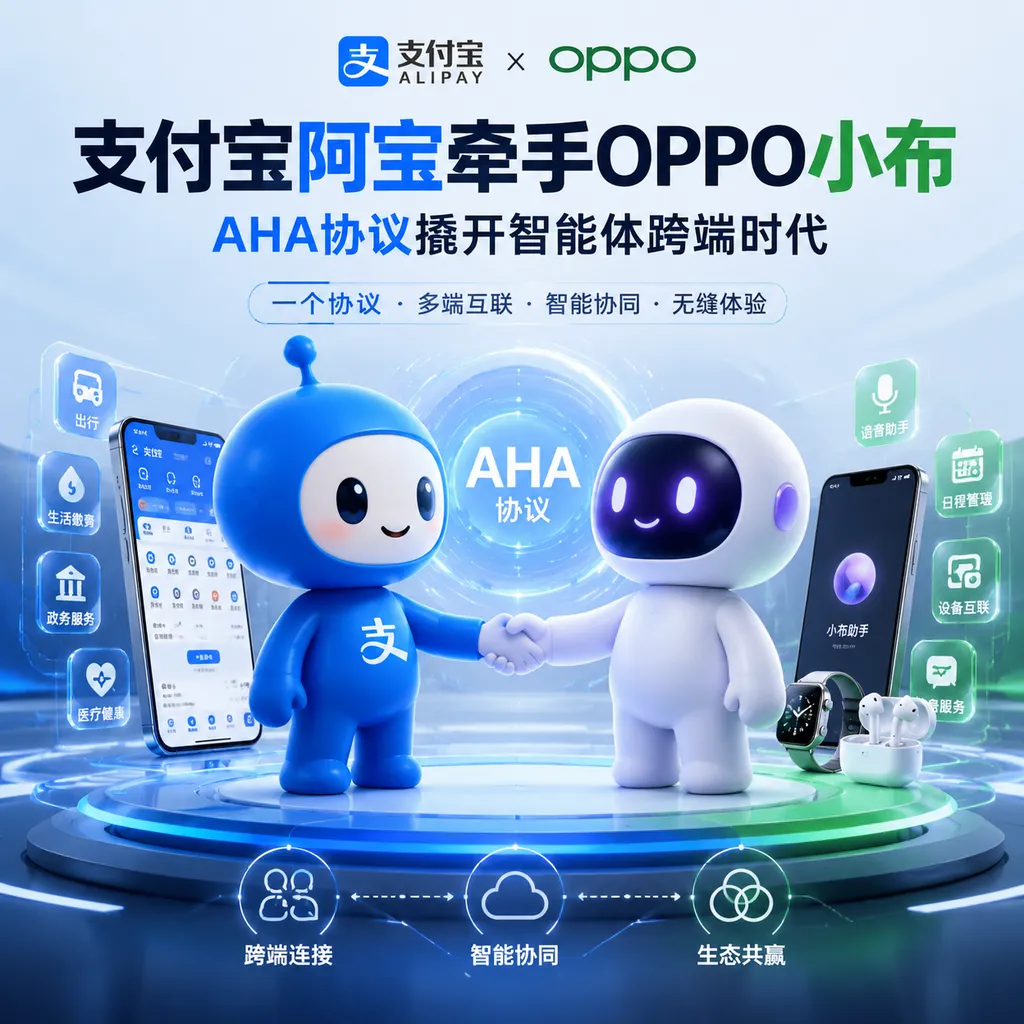
Alipay and OPPO announced today that they have achieved cross-end connectivity between intelligent agents based on the AHA protocol. With just one voice command to Xiaobu on an OPPO phone, users can access nearly 200 lifestyle services provided by Alipay’s “Abao,” covering everything from buying movie tickets to checking housing fund balances—all in one step.
Today (July 15), Alipay and OPPO officially announced something that’s been brewing in the AI‑agent community for over half a year: their respective AI assistants—Alipay’s “Abao” and OPPO’s system‑level “Xiaobu”—are now connected for cross‑platform collaboration. Starting today, OPPO users can directly summon nearly 200 lifestyle services backed by Abao through Xiaobu with a single voice command, covering high‑frequency scenarios such as movie tickets, food ordering, transportation, social security inquiries, and phone bill top‑ups.
This isn’t another PR release about a “partnership integration.” What’s really worth unpacking is the AHA (Agent Hub Access) protocol, jointly developed by both sides. It’s designed to tackle the critical issue every team building AI agents must face: how AI Agents should invoke one another.
A Three‑Stage Flow Triggered by One Sentence
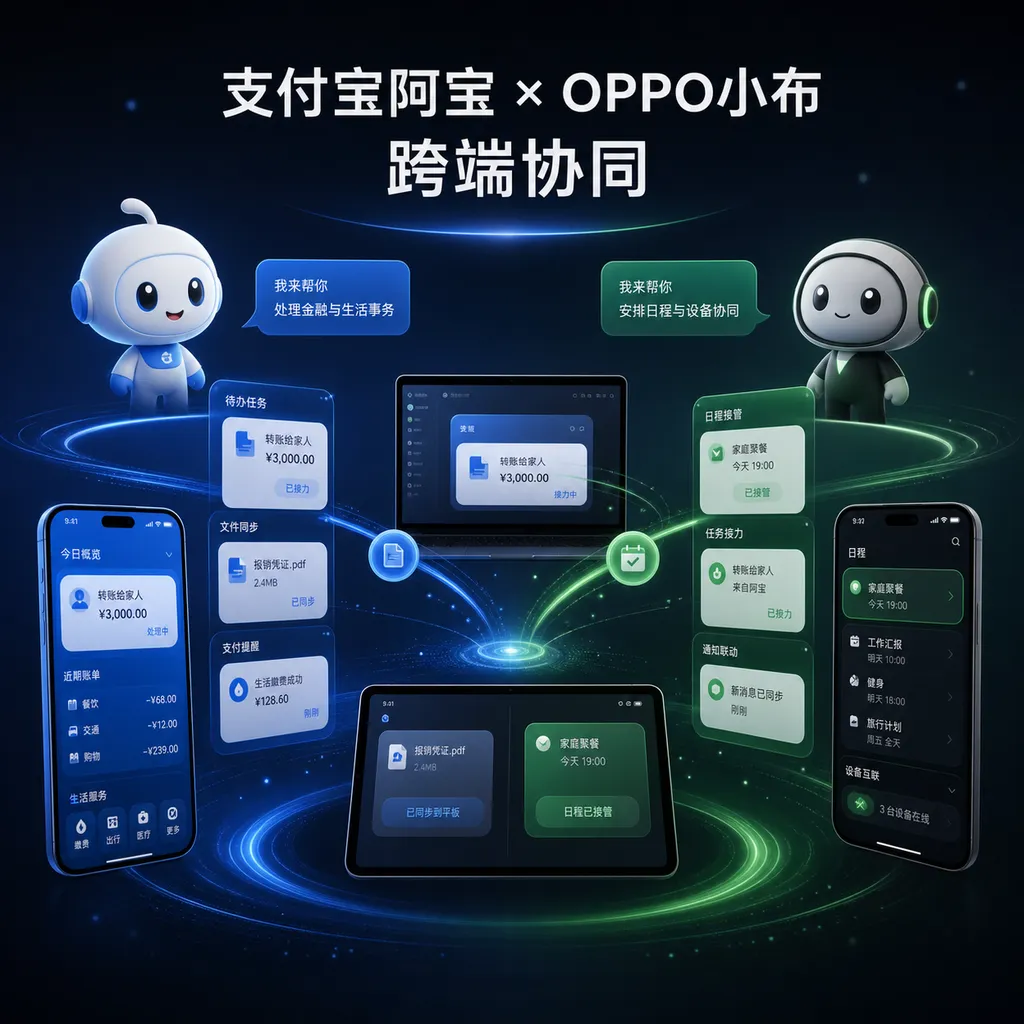
Let’s start from the user’s perspective. The entire interaction chain is compressed into three steps:
- The user tells Xiaobu their need, e.g., “Help me buy a ticket for The Wandering Earth 3 tonight.”
- Xiaobu passes the intent transparently to Abao, which matches the corresponding service and initiates the process.
- The user personally confirms critical checkpoints (authorization, payment), while the remaining steps can run silently in the background.
It sounds simple, but comparing this flow to traditional “voice assistants” reveals the difference. In the past, when you told Xiaobu, “Buy a movie ticket,” it might just open the Taopiaopiao or Meituan app, leaving you to do the rest. Now the flow is: Xiaobu recognizes the intent → passes the task to Abao via the AHA protocol → Abao matches an appropriate movie ticket provider in its service matrix → pushes the result and payment confirmation back to Xiaobu’s interface.
Each hop here is a call between Agents, not an app‑to‑app jump. For developers, the difference is as big as between a “URL scheme trigger” and a “function call.”
AHA Protocol: Clear Responsibility Boundaries
The AHA protocol first made its appearance at the OPPO Developer Conference in October last year (2025), when it was still largely conceptual. In this finalized release, the division of responsibilities is surprisingly neat:
- Xiaobu: Responsible only for receiving voice commands and conveying intents; does not access the user’s Alipay account information.
- Abao: Responsible only for invoking and executing services; does not access OPPO’s system‑level permissions.
- User: Must manually confirm any step involving funds or privacy.
- Alipay Risk Control: Runs continuously in the background, multi‑dimensionally screening for anomalies.
Technically, the two sides use on‑device data isolation and domain‑based control. In plain terms, although Xiaobu and Abao collaborate on the same device, their data domains are isolated—neither can freely access the other’s sensitive data, and all cross‑domain calls must use the interfaces defined by the protocol. The design is somewhat similar to iOS App Extensions or Android ContentProviders, but even finer‑grained, as it’s made specifically for Agent‑to‑Agent communication.
For comparison: Google’s Agent2Agent protocol is more abstract, serving as a standard specification; Anthropic’s MCP addresses model‑to‑tool connection, while Agent‑to‑Agent orchestration is handled at the application level. AHA, by contrast, is a consumer‑focused, streamlined A2A protocol—it’s not aiming for universality, but to solve one specific issue: how a phone’s AI assistant can call a platform‑level agent.
What Alipay’s “One‑Access, Multi‑Endpoint Distribution” Is Aiming For
Viewed in isolation, the OPPO partnership may not seem huge. But roll back the timeline one week, and it becomes interesting: on July 7, 2026, Alipay launched its AI Open Platform. Once a merchant integrates AI‑capability just once, they can use the AHA protocol to distribute their services to smartphone AI assistants, in‑car systems, AR glasses, IoT hardware, and more.
OPPO is among the first smartphone makers to join. That position matters—it’s not being “absorbed” into Alipay’s ecosystem, but connecting to it as an equal Agent platform.
From this perspective, Alipay’s strategy is three‑pronged:
- For merchants: Turn 2 million merchants’ service capabilities into Agents—integrate once, sell on multiple fronts.
- For device makers: Give them a ready‑made service pool with strong merchant and user awareness.
- For Alipay itself: Evolve from a “payment entry” to an “agent distribution hub.”
Li Jun, president of Alipay’s business group, put it bluntly: the AI Open Platform aims to become “a cross‑device hub for generation, distribution, interaction, and payment.” Payment remains Alipay’s moat, one that cannot be bypassed. So even though Xiaobu is OPPO’s system‑level assistant, any payment flow still goes through Abao’s payment channel.
Can This Model Work?
Here’s some analysis.
Optimistic view: This is China’s first truly operational case of “cross‑vendor Agent collaboration.” Previously, so‑called AI assistant cooperation mostly meant app‑level API integrations—essentially just API calls. AHA, by contrast, operates at the Agent layer with higher semantic granularity—Xiaobu can pass a complex intent such as “Book me a window seat on tomorrow’s train to Hangzhou” as a single request for Abao to plan and execute, rather than guiding the user step‑by‑step.
But there are also concerns:
- Intent interpretation responsibility: If Xiaobu misinterprets an intent, who takes the blame? The user perceives it as Xiaobu’s fault, but if Abao executes the wrong service, merchants may face complaints.
- Service consistency: For the same request—say, “order spicy hot pot”—if results, pricing, or discounts differ between the app and Xiaobu, users will be confused.
- Data feedback and competition: OPPO gets intent data; Alipay gets service and transaction data. Will each side build isolated user profiles? Could friction arise over time?
And an even deeper question: Will users actually use it? Xiaobu’s DAU figures have never been stellar, and among domestic brands, OPPO’s assistant presence is lower than Huawei’s Xiaoyi or Xiaomi’s Xiao Ai. Whether integrating nearly 200 services can boost Xiaobu’s engagement will depend on data in the coming months.
What It Means for Developers
If you’re developing AI agents or local life‑service products, this event sends several signals:
- AHA is very likely to become a de‑facto domestic standard. Given Alipay’s merchant scale, the cost for other phone brands to adopt AHA is far lower than building a new protocol from scratch. Honor and vivo are likely to follow.
- Agent‑style service encapsulation will become essential. Previously, offering a mini program or an H5 page was enough; now you must design services so Agents can understand capabilities, parameters, and error handling—a new engineering challenge.
- Multi‑endpoint distribution gains proven commercial value. One AHA integration can reach phones, cars, glasses, and IoT devices simultaneously—major efficiency gains for small and medium merchants.
This is still some distance from “universal Agent interoperability.” For now, AHA remains a centralized structure led by Alipay with terminal vendors connecting—not yet a fully peer‑to‑peer protocol. But in terms of usability and rollout speed, it’s arguably the most pragmatic path forward.
By the way, developers working on AI‑application integration who need to invoke multiple LLMs for intent parsing or dialogue planning can use OpenAI Hub, which provides unified key access to GPT, Claude, Gemini, DeepSeek, and other mainstream models—direct domestic connections and OpenAI‑compatible APIs—saving the hassle of managing separate accounts or network setups.
Final Thoughts
Viewed up close, this cooperation looks like a product update; viewed from a distance, it’s a concrete example of the consumer AI ecosystem transitioning from the App era to the Agent era. Phone makers, platforms, merchants, payment channels—entities that once functioned independently are now being reorganized under the new abstraction layer of Agents.
Whoever establishes the protocol standard and user perception at this layer will hold the entry point of the next decade. Alipay has moved first; OPPO has followed. The remaining players will need to make their stance clear in the next few quarters.
References
- Alipay and OPPO Announce Cross‑Platform AI Agent Collaboration – IT Home — Detailed coverage of AHA protocol tech specs and user workflows


