
Xiaomi open-sources 38-billion-parameter U0: Robots now have their own “world simulator”
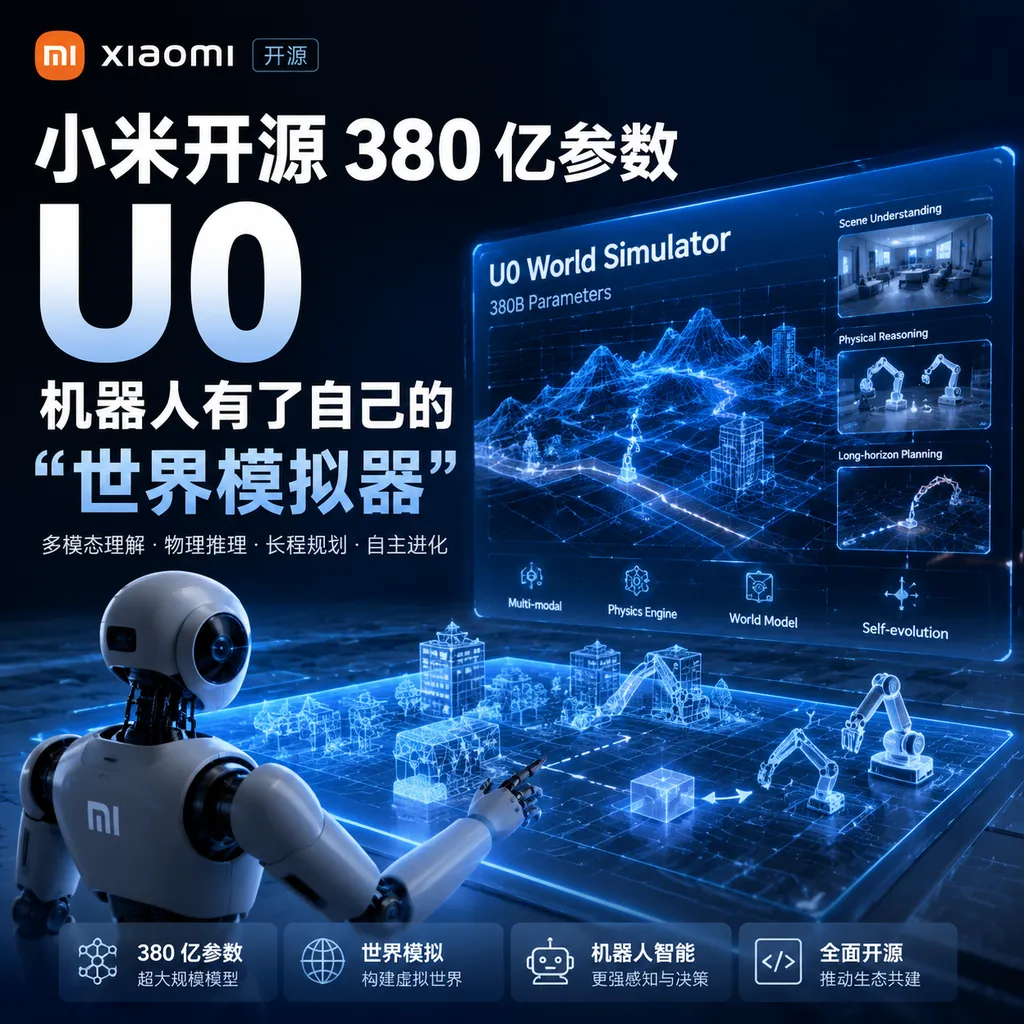
Today, Xiaomi open-sourced **Xiaomi-Robotics-U0**, a 38-billion-parameter multimodal autoregressive world model. For the first time, it unifies four types of tasks—scene generation, embodied transfer, video generation, and image editing—within a single architecture, using synthetic data to raise the real-machine policy OOD success rate from 36.9% to 63.2%.
On the morning of July 15, the Xiaomi Robotics team simultaneously uploaded the weights, code, and Gradio demo for Xiaomi-Robotics-U0 to Hugging Face. With 38 billion parameters and an autoregressive architecture, the base merges EMU3.5 and Qwen-3-32B, aiming to become a World Foundation Model.
This isn’t another VLA, nor another video generation model. It’s something that treats “imagining what a robot will see next” as a next-token prediction problem—images, videos, text, and robot observations are all packed into a shared discrete token space. In Xiaomi’s official terms, this is the first unified generative model in the embodied domain capable of handling four task types simultaneously.
Making it clear: What problem is U0 solving?
Anyone who has trained robotic control policies knows that the real cost is not compute—it’s data. To make a robotic arm reliably grasp objects across 1,000 lighting conditions, 1,000 backgrounds, and 100 object types, you’d theoretically need a fleet of operators recording 100,000 real-world VR teleoperation videos. Projects like RT-2 and Open X-Embodiment have burned through huge budgets, as everyone in the field knows.
So over the past two years, two paths have emerged.
One is to use general-purpose video generation models (like Sora, Keling, Veo) to “fill in the blanks” for robot operation videos—but these lack strict multi-view consistency or physical constraints, resulting in unrealistic or physically impossible outputs.
The other is to fine-tune pretrained world models on small-scale robotic datasets—but after fine-tuning, generalization collapses, and performance is limited to the training distribution.
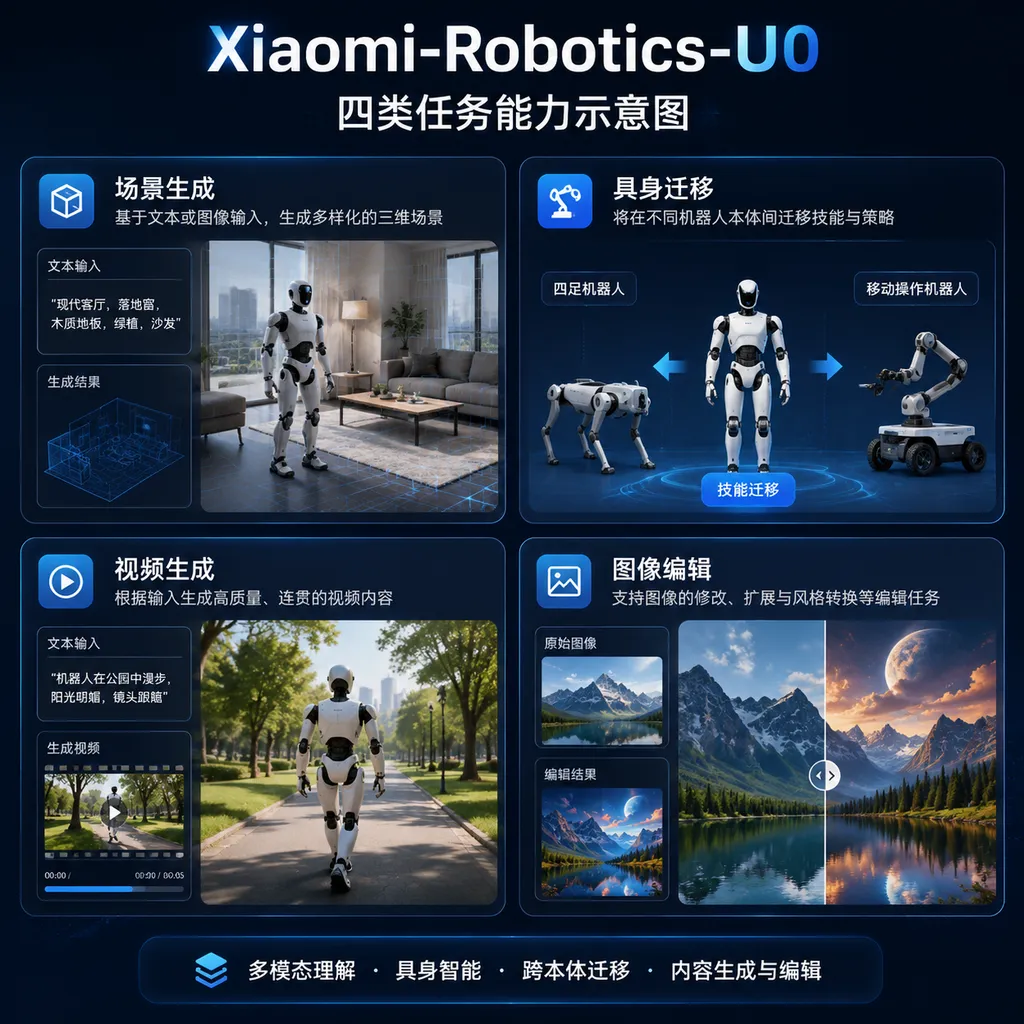
U0 takes a different approach: it jointly optimizes five tasks under one autoregressive objective—text-to-image generation, image editing, embodied scene generation, embodied transfer, and video generation. This way it retains the generalization power of internet-scale visual knowledge while enforcing robot embodiment and geometric multi-view consistency.
The idea itself isn’t new—DeepMind’s Genie and World Labs explore similar directions—but U0 is the first to do it at the 38B scale, fully open source, and with real-world data improvement evidence.
Four task types, one unified framework
Let’s break down the four core abilities:
Embodied Scene Generation – Given a text prompt and a specified robot body, output multi-view initial observations. For example, input “a red mug on a kitchen counter, Franka robot arm on the left”, and the model generates consistent front, top, and wrist-camera images. This solves the “training without real hardware” problem.
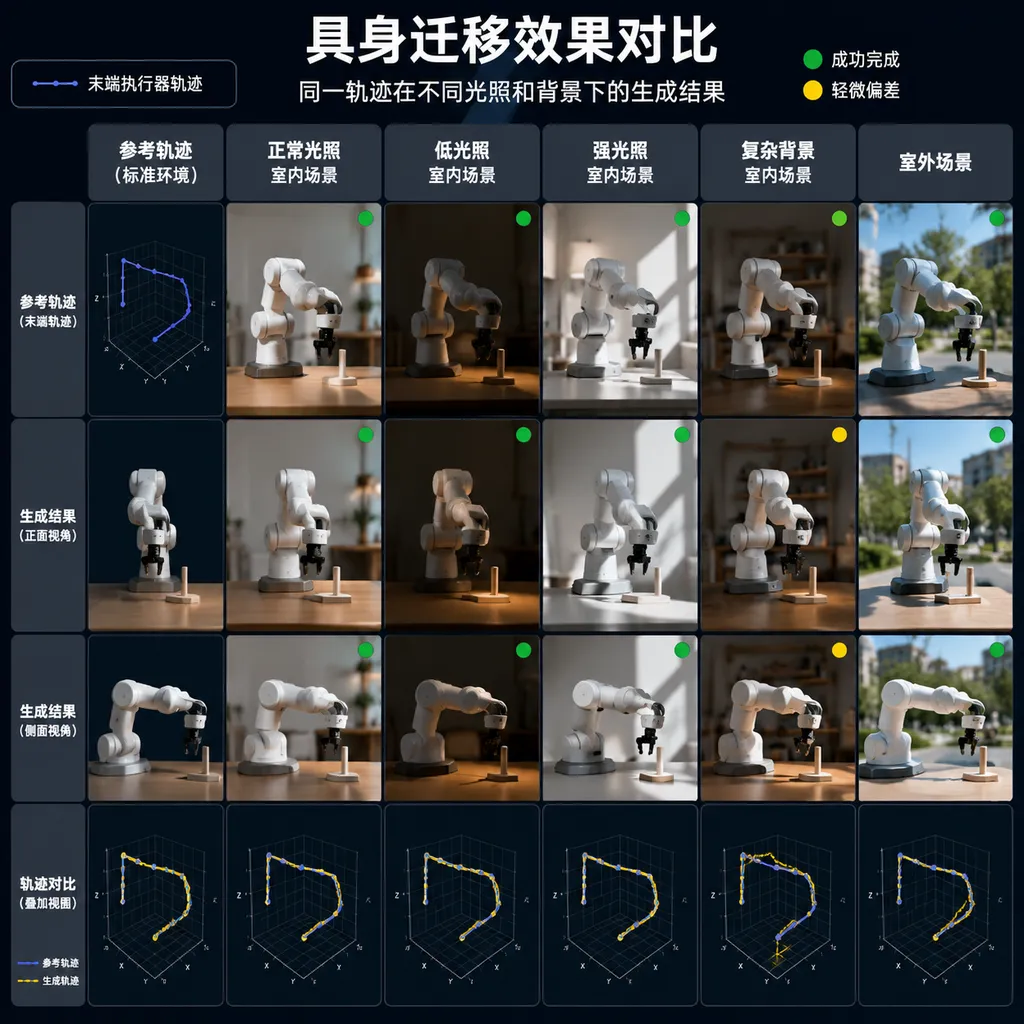
Embodied Transfer – When you already have a real-world trajectory, but it was captured in a specific setting (say, under lab lighting). U0 can “transfer” this trajectory to multiple new settings—warehouse under sunset, wooden tabletop, metal background—while preserving exact robot poses and object relations. This means “data augmentation without new collection.”
Robot Interaction Video Generation – Given an initial observation image and a natural language command (like “hand the cup to the person on the right”), the model rolls out a continuation video. The key constraints: motion continuity and physical realism—cups shouldn’t clip through fingers, gravity direction must remain consistent.
General Text-to-Image and Anything2Image – While seemingly unrelated to robotics, Xiaomi kept this task to maintain internet-scale visual priors, ensuring the model understands the world broadly, not just robots.
FlashAR+: Tackling the autoregressive speed bottleneck
Autoregressive image generation’s biggest pain point is speed. A 1024×1024 image can involve tens of thousands of tokens—decoding them sequentially can take minutes. That’s one reason diffusion models have dominated AR image generation.
Xiaomi introduced FlashAR+, an inference acceleration scheme that adds vertical prediction heads to enable parallel anti-diagonal decoding across image tokens. The numbers are aggressive: on a single H20 GPU, FlashAR vLLM generates an image in 5.44 seconds—82.86× faster than naive AR eager mode, 3.04× faster than FlashAR eager mode.
An 83× speedup turns “can generate” into “can scale.” For synthetic data generation, this difference is decisive—whether you can create 1 million samples or 10,000 per day is an entirely different engineering reality.
Real robot data: OOD success rate up from 36.9% to 63.2%
The real test of a generative model is downstream usability. Xiaomi’s team used the control policy π₀.₅ for comparison in unfamiliar lighting and backgrounds (Out-of-Distribution scenarios):
- Trained only on real data: success rate 36.9%
- Trained with real + U0 synthetic data: success rate 63.2%
That’s a 26.3 percentage point improvement—on real robots, not in simulation. For robotics teams, that means significantly less real-world data needed for far better generalization.
On the benchmark side, U0 ranked #1 overall on the WorldArena leaderboard (126 models, anonymous code name UNIS):
EWMScore 73.64, instruction following 93.86, interaction quality 87.30.
In human pairwise evaluation, U0 beat GPT-Image-2.0 in embodied scene generation and achieved much better metrics for embodied transfer (depth consistency SI-RMSE 0.1407 vs 0.4007, segmentation mIoU 0.7621 vs 0.4105).
That said, WorldArena is still in early stages, and results come from Xiaomi’s own report; community replication and failure analyses haven’t appeared yet. It’ll take a few weeks of community testing to validate.

What has been open-sourced
The openness this time deserves praise. Two checkpoints are on Hugging Face:
- 34B Base Version
- 38B FlashAR Accelerated Version
All accompanied by inference code, config files, and a Gradio demo. The project homepage is at robotics.xiaomi.com, or just search Xiaomi-Robotics-U0 on Hugging Face.
This continues Xiaomi’s steady open-source pace in embodied AI. In February, they open-sourced the first-gen VLA model Xiaomi-Robotics-0 (4.7B parameters). By June, they had dual wins at CVPR 2026 and ICRA 2026 in the WBC track. Now in July, they’ve released a 38B world model. The timeline shows a clear strategic rhythm—this isn’t random experimentation.
Where U0 stands among competitors
Horizontal comparison:
vs General Video Generation (Sora, Keling, Veo 3) – It may generalize less broadly than Sora but wins in multi-view consistency, physical realism, and embodiment constraints—areas general models struggle with. U0 aims for “sufficient general ability + specialized embodiment strength.”
vs Specialized Embodied World Models (1X’s World Model, Physical Intelligence’s approach) – Most such teams keep models closed or release small ones. U0 released full 38B weights and its acceleration scheme, currently unmatched in open embodied world modeling.
vs GPT-Image-2.0 – Xiaomi’s numbers show U0 outperforming, though GPT-Image-2.0 isn’t designed for embodied contexts; this comparison mainly highlights that “general image models struggle with embodied tasks,” so it’s not perfectly fair.
The real value lies in its “data perpetual-motion engine” role—if U0-synthesized data can continually deliver double-digit performance gains downstream, the entire cost structure of embodied intelligence could be rewritten.
Final thoughts
A few takeaways from this release:
-
The embodied AI field is shifting from “collect more real data” to “train on synthetic + real mixed data.” Teams like Tesla Optimus, Figure, and 1X are already doing it privately. Xiaomi is the first major company to open-source a full working pipeline.
-
The autoregressive + unified token space approach—proven in text by GPT and partially in images by EMU3—now reaches embodiment. The boundaries of next-token prediction continue to expand, with no visible ceiling in sight.
-
While 38B parameters are beyond consumer GPUs, enterprise labs can run inference on 8×H100s—feasible thanks to FlashAR+’s 83× speed boost.
One caveat: that impressive 26-point OOD gain was on Xiaomi’s selected benchmarks. The real test is whether the community can reproduce similar benefits across other robots and tasks. Give it a month or two, and we’ll know.
For multimodal model integration, OpenAI Hub offers a single key to access GPT, Claude, Gemini, DeepSeek, and other major closed models, compatible with the OpenAI API format and directly accessible in China—useful for hybrid setups comparing U0’s open-source side with commercial models.
References
- ITHome: Xiaomi open-sources Xiaomi-Robotics-U0, the first unified generative model for the embodied domain — Official release coverage, capability details, and benchmarks
- Zhihu discussion: How to evaluate the first unified generative model for the embodied domain — Community discussion and technical commentary on U0’s approach


