
Apple’s AI China edition has finally launched: Alibaba’s Qwen handles intelligence, while Baidu takes care of search.
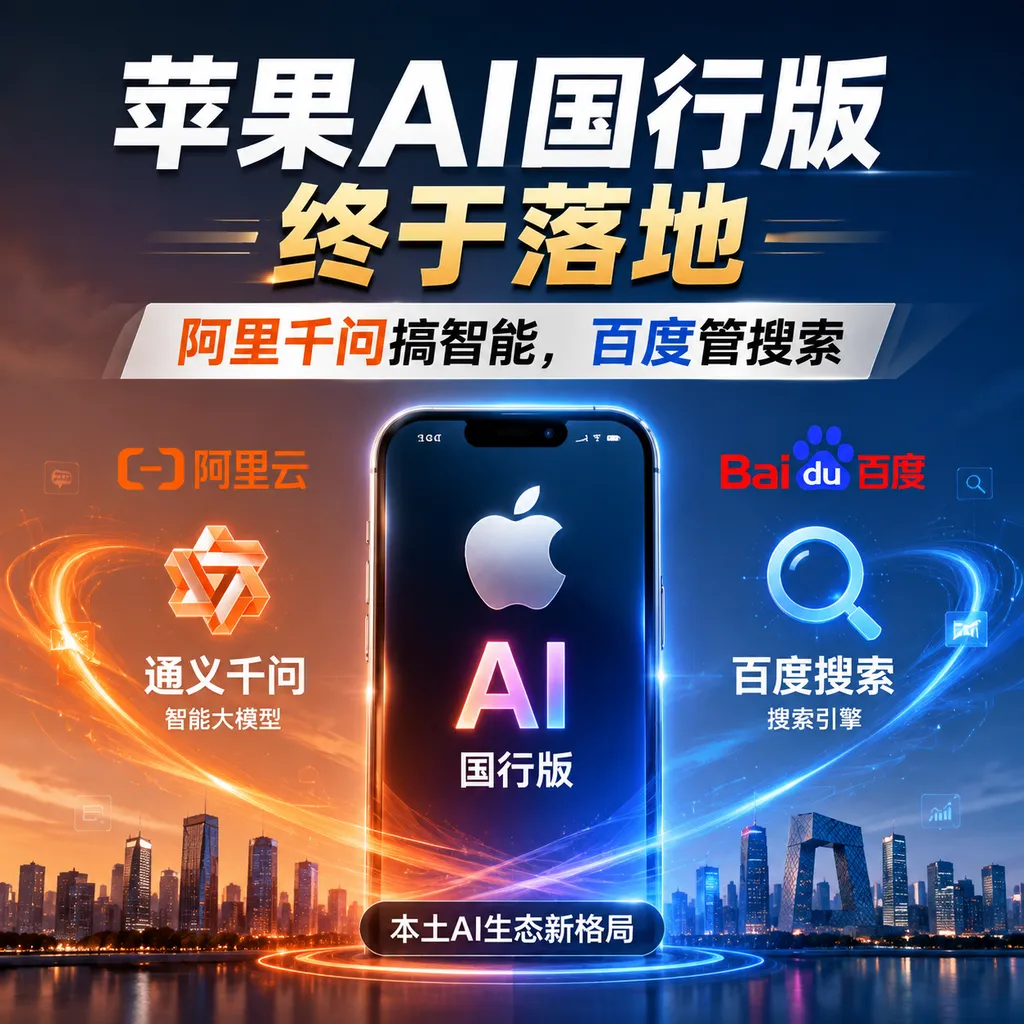
The Cyberspace Administration announced that Apple Intelligence completed its filing on July 8. The China version of Apple AI is powered by Alibaba’s Qwen for core capabilities, with Baidu handling AI search. After a one-and-a-half-year delay, iPhone users in China will finally be able to use native AI.
After a year and a half of delay, the Chinese mainland edition of Apple Intelligence is finally coming.
On July 15, the official WeChat account of the Cyberspace Administration of China, “Cyberspace China,” announced seven newly filed mobile-end generative AI services. The most watched one is: Apple Technology Development (Shanghai) Co., Ltd.’s “Apple Intelligence” large model completed registration on July 8, 2026, for use on iPhones. The same batch also included Huawei Xiaoyi, OPPO AndesGPT, vivo BlueHeart, Xiaomi Surge AI, Samsung Galaxy AI, and ZTE Nubia’s Doubao large model — the core on-device models of China’s major smartphone makers are now all in place, with Apple being the last to join the table.
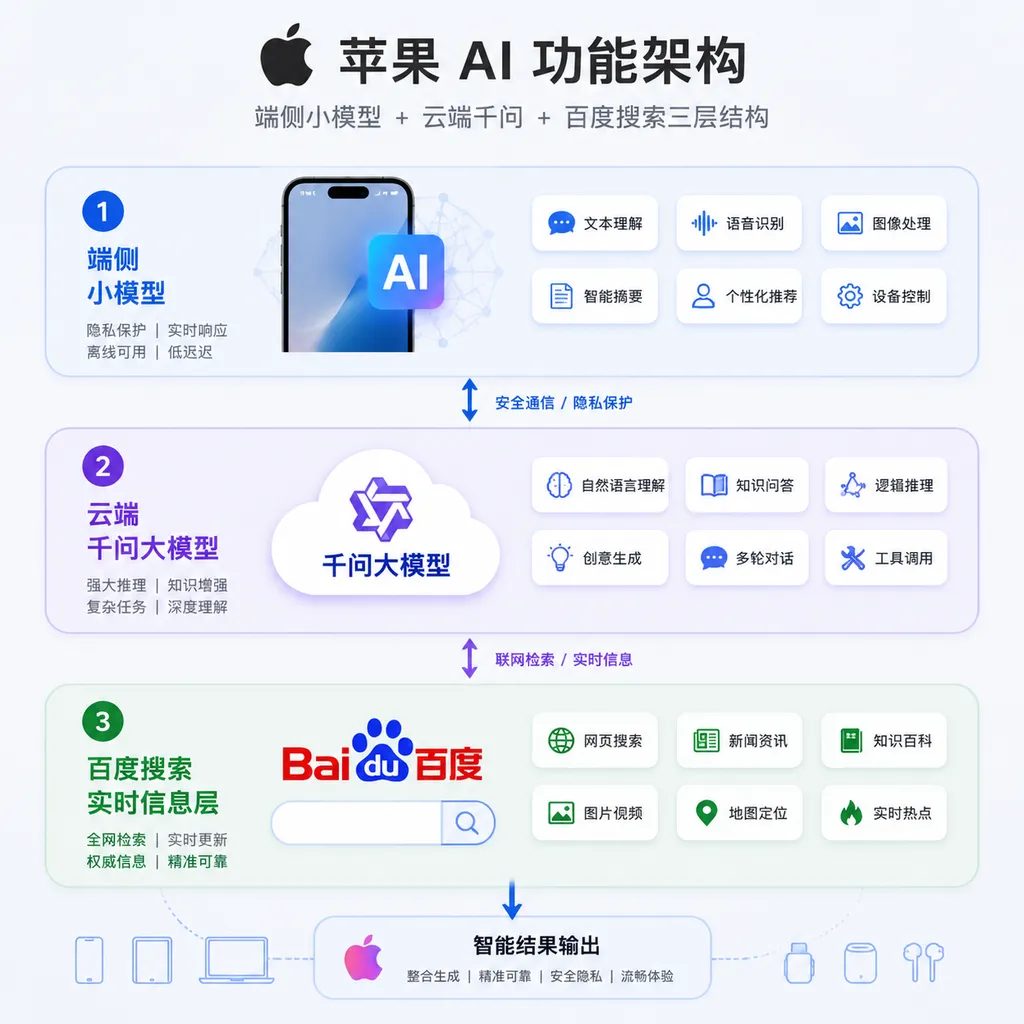
Following the filing, Alibaba and Baidu released details of their respective partnerships, revealing the technical division of labor for the mainland version of Apple Intelligence: Alibaba’s Qwen will serve as the AI capability foundation integrated into Apple Intelligence, covering iOS, iPadOS, macOS, and visionOS users in China; Baidu will focus on AI search and take part in upgrading the Chinese version of Siri. One company handles the cloud, the other handles search — a two-pronged setup.
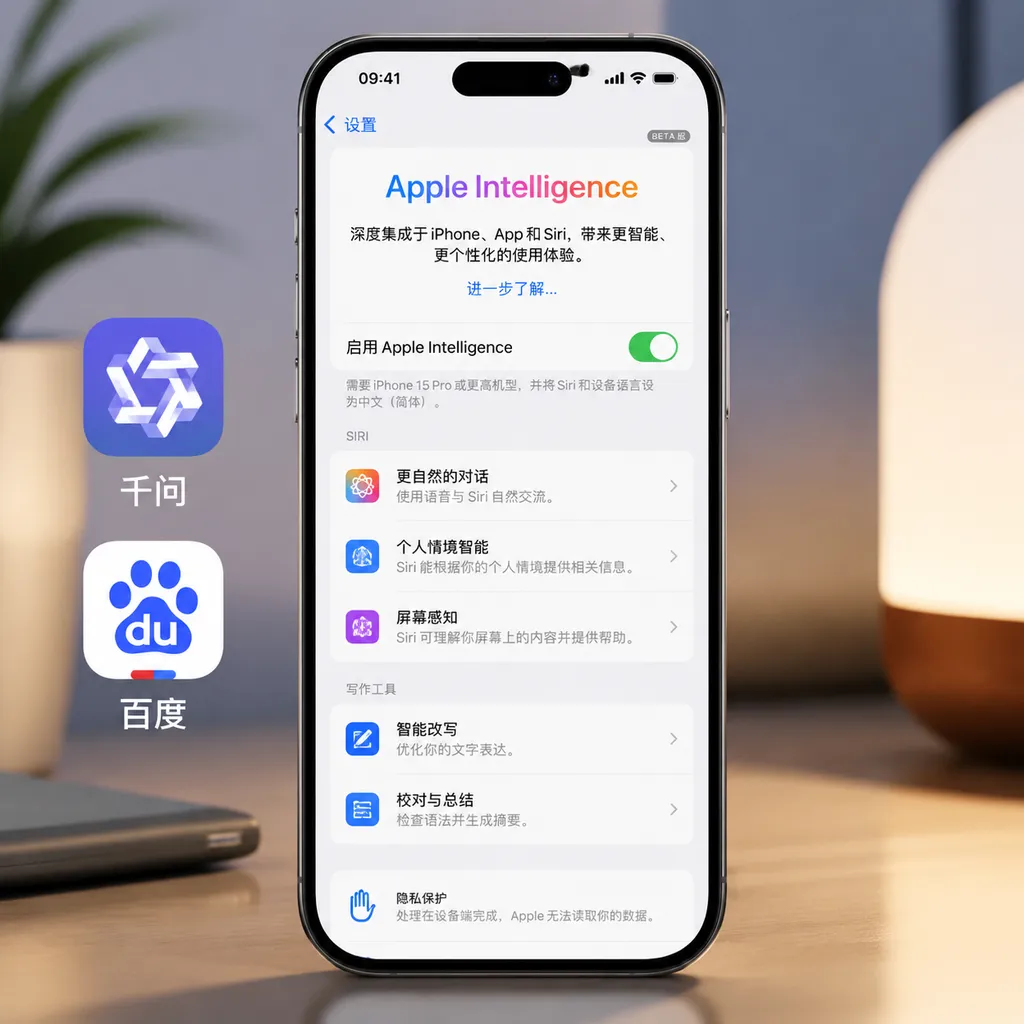
What Filing Approval Means
In short: this filing is the final, toughest hurdle before Apple can launch AI services in China.
According to the Interim Measures for the Management of Generative AI Services, any generative AI product offered to the public domestically must be filed first. This isn’t just a formality — the process scrutinizes everything from training data and content safety mechanisms to complaint channels and protections for minors. For Apple Intelligence to pass means Apple has built a full compliance framework, including localized content filtering and review mechanisms.
Previous “leaks” of Apple AI for the China market were awkward. A notable mishap occurred at the end of March when Apple Intelligence briefly became available to Chinese users for a few hours before being pulled offline. The official explanation: “operational error.” Bloomberg’s Mark Gurman predicted a release with iOS 18.6, which many assumed would be another delay. Now, it seems Apple really has done its homework.
Typically, there’s a 1–2 month window between filing and official rollout, so release with iOS 18.6 or a subsequent patch looks likely.
Alibaba Qwen: The Workhorse
Alibaba stated clearly: Qwen will be integrated as the AI capability within Apple Intelligence. Users won’t have to switch apps — Qwen’s text understanding, image comprehension, and content generation abilities will be available directly on Apple devices.
This positioning mirrors that of ChatGPT in the overseas edition — Apple Intelligence abroad combines Apple’s proprietary models with OpenAI’s technology. The Chinese version simply swaps Qwen in: Apple’s own small on-device model (around 3B parameters) handles lightweight tasks locally, while complex tasks are routed via Private Cloud Compute to a cloud-based large model, which in China is Qwen.
Key points to note:
- Platform-wide coverage: This includes not only iPhone, but also iPadOS, macOS, and visionOS — meaning even Mac and Vision Pro users (though the device isn’t yet officially sold in China) will gain Qwen capabilities.
- Multimodality by default: Support for both text and image understanding indicates that this isn’t a cut-down Qwen variant, but likely Qwen2.5-VL or the newer Qwen3 multimodal series. Given Apple features like image description and on-screen understanding, visual model quality will directly dictate how strong Visual Intelligence features are in the China version.
- Native integration: Users won’t see a “Qwen” entry point; its abilities are baked into the system layer. This is a double-edged sword for Alibaba — huge user volume but little brand visibility.
Looking back, Alibaba co-founder Joe Tsai had already confirmed the partnership at the World Governments Summit in Dubai in early 2024, saying: “Apple is extremely selective, and after talking with many Chinese companies, they chose us.” Apple reportedly also discussed with Tencent, ByteDance, Zhipu, and even DeepSeek, but none materialized. A year and a half later, Alibaba has secured its spot.
Baidu: Taking on the Search Role
Baidu’s job is more specialized — AI-powered search.
Specifically, when a Siri or Apple Intelligence user asks a question requiring live data or online retrieval, Baidu provides the search capability. Baidu will also help upgrade the Chinese version of Siri to handle more sophisticated multi-modal queries.
This division is logical. Search is Baidu’s traditional strength, with advantages in indexing scale, freshness, and Chinese language understanding; Qwen, meanwhile, is stronger in generative dialogue and multimodal reasoning. By dividing tasks between the two, Apple avoids letting one partner “eat the whole cake” — consistent with its long-standing multi-supplier balance strategy, much like how Apple works with OpenAI while also negotiating with Google and Anthropic for Gemini and Claude access.
One implicit challenge is coordination between search and generation. For example, if Siri needs to first search then generate an answer — Baidu provides the results, Qwen summarizes them — who orchestrates the workflow? Most likely Apple’s own routing layer. Response time, accuracy, and fallback behavior in weak-network or offline conditions will only become clear after rollout.
Will the China Version Be Downgraded?
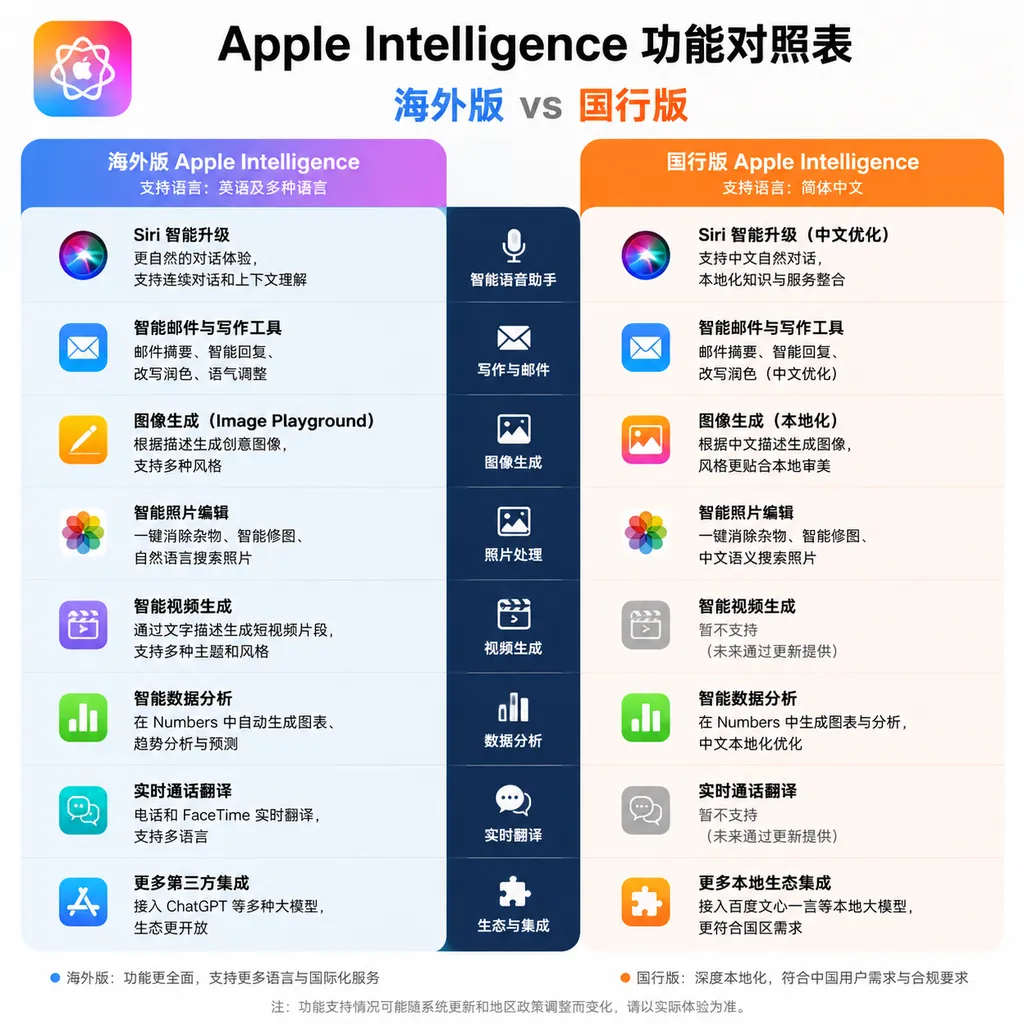
This is the developers' top concern. Frankly: some functional differences are likely, but not drastic.
Expected to be available:
- Writing tools (proofreading, rewriting, summarizing)
- Notification summaries
- Siri’s natural language upgrades and on-screen awareness
- Image cleanup (Clean Up)
- Image generation (Image Playground, Genmoji)
- Visual Intelligence (point-and-ask camera features)
Possibly limited or delayed:
- ChatGPT integration (definitely removed; the replacement could be direct Qwen calls or a wrapper layer)
- Features depending on Google services
- Early personalized Siri features (which were postponed even in overseas versions)
Overseas Apple Intelligence has had mixed reviews — Siri’s deep personalization has repeatedly slipped, writing tools often fail on sensitive topics, and image generation quality has drawn criticism. But the mainland version’s use of Qwen may excel in Chinese contexts — its training depth on Chinese corpus surpasses the GPT line, especially for idioms, dialects, and industry terminology.
However, there’s a catch: on the same iPhone, AI experiences will differ completely between Chinese and U.S. Apple IDs. Cross-border users will notice this distinction clearly, likely making it a hot topic in reviews and online chatter.
Ripple Effects on China’s AI Ecosystem
In the short term, this partnership won’t drastically boost Alibaba or Baidu’s financials — whatever Apple pays will show up as enterprise revenue. But the strategic value is immense:
- Qwen gains premium “Apple Endorsement” status. That’s real capital for B2B marketing — Alibaba Cloud’s model API sales will benefit.
- A verified template for edge-cloud collaboration. Apple’s “on-device small model + cloud large model” architecture could become a benchmark for Chinese OEMs like Huawei, Xiaomi, and vivo, who are all exploring similar paths.
- New standards for model evaluation. Beyond measuring reasoning or coding skills, being “system-integration ready” — low latency, high stability, multimodal consistency — will become key metrics.
For developers, the practical takeaway is this: after iOS 18.6, when third-party apps call Apple Intelligence-related APIs (like the Writing Tools API or Siri-integrated App Intents), they will now work natively on Chinese devices. That long-standing issue where overseas AI functions didn’t work in China will finally ease.
A Detail Worth Watching
The filing lists Apple Intelligence’s “applicable scenario” as “Apple smartphone,” with no mention of Mac, iPad, or Vision Pro. But Alibaba’s official statement explicitly includes iOS, iPadOS, macOS, and visionOS.
This discrepancy likely isn’t a conflict — the Cyberspace Administration filing primarily pertains to mobile-end services. Mac and iPad comply under different categories, while Vision Pro isn’t yet sold domestically. However, it’s possible rollout may begin with iPhone only, with others to follow. The true answer depends on Apple’s own announcement.
In Conclusion
Apple’s biggest challenge in doing AI in China has never been technology — it’s how to replicate the overseas experience within regulatory boundaries. This filing approval means Apple has found that balance — albeit at the cost of partnering with two Chinese firms and accepting stricter content controls.
For Chinese users, that’s good news. iPhone’s market share in China has been slipping since 2024, dropping to fifth place in Q1. Lack of AI features wasn’t the only cause, but certainly a major one. Once the mainland edition rolls out, Apple’s real AI battle against Huawei and Xiaomi begins.
As a side note, for developers wanting to test GPT, Claude, Gemini, DeepSeek, and Qwen simultaneously, OpenAI Hub (openai-hub.com) now supports all major domestic and international models with OpenAI-compatible APIs — making evaluation and feature comparisons much easier.
Apple has been playing this game of Chinese AI integration for a long time — and now, the endgame is finally on the table.
References
- Apple Intelligence for China officially filed; Alibaba Qwen to be integrated as core AI capability – IT Home — official Alibaba statement and filing details
- Baidu to provide AI search for Apple Intelligence – IT Home — Baidu partnership details
- Cyberspace regulators announce seven new mobile generative AI service filings – IT Home — full list of filed models


