SenseTime secures Samsung: MiniCPM to be featured in flagship phones
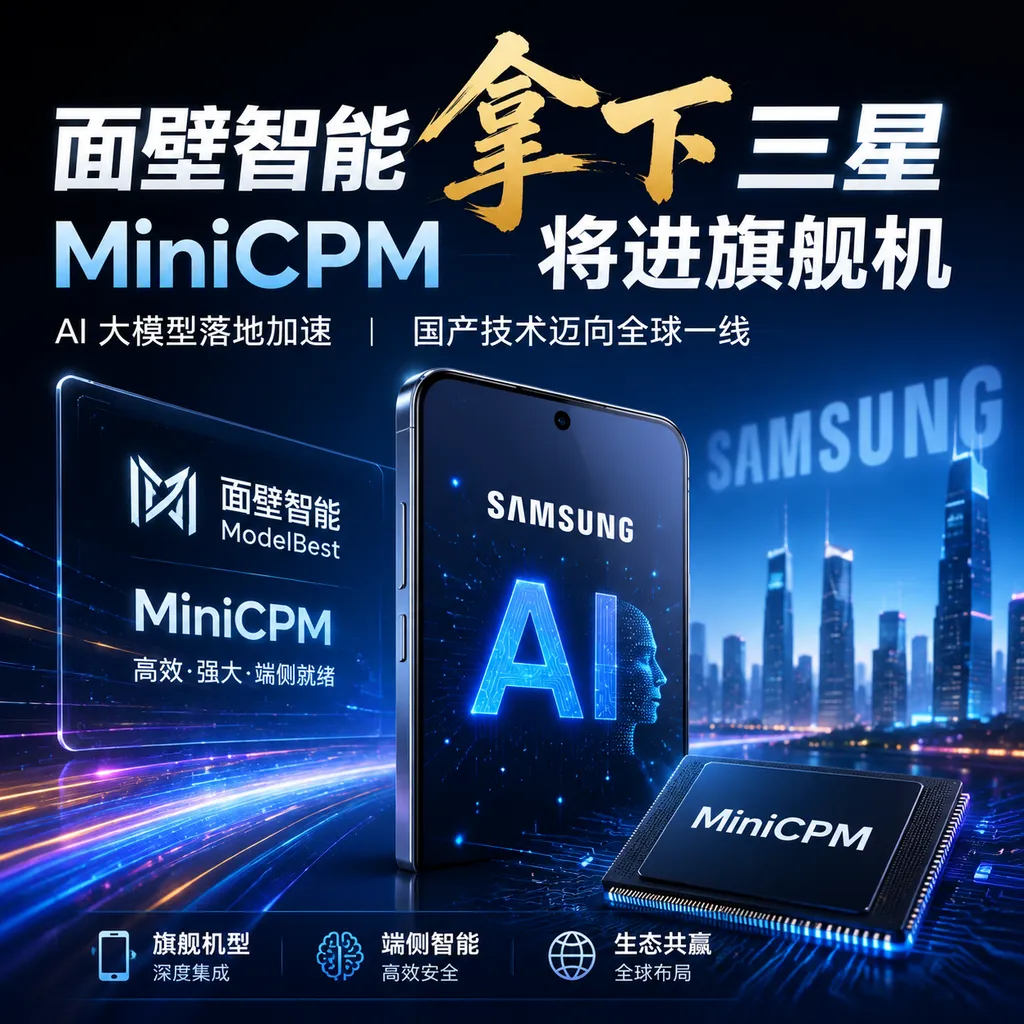
MiniCPM series on-device models from Moonshot AI have been integrated into several Samsung flagship smartphones. On the same day, the Cyberspace Administration announced the filing of seven on-device AI models for mobile phones, while Alibaba’s Qwen has also confirmed integration with Apple Intelligence — marking the large-scale rollout phase of on-device AI.
Wall-Faced Intelligence Wins Samsung: MiniCPM Enters Flagship Phones, Heralding the Era of Edge AI Division of Labor
On July 15, two major developments occurred in the edge large-model space in a single day.
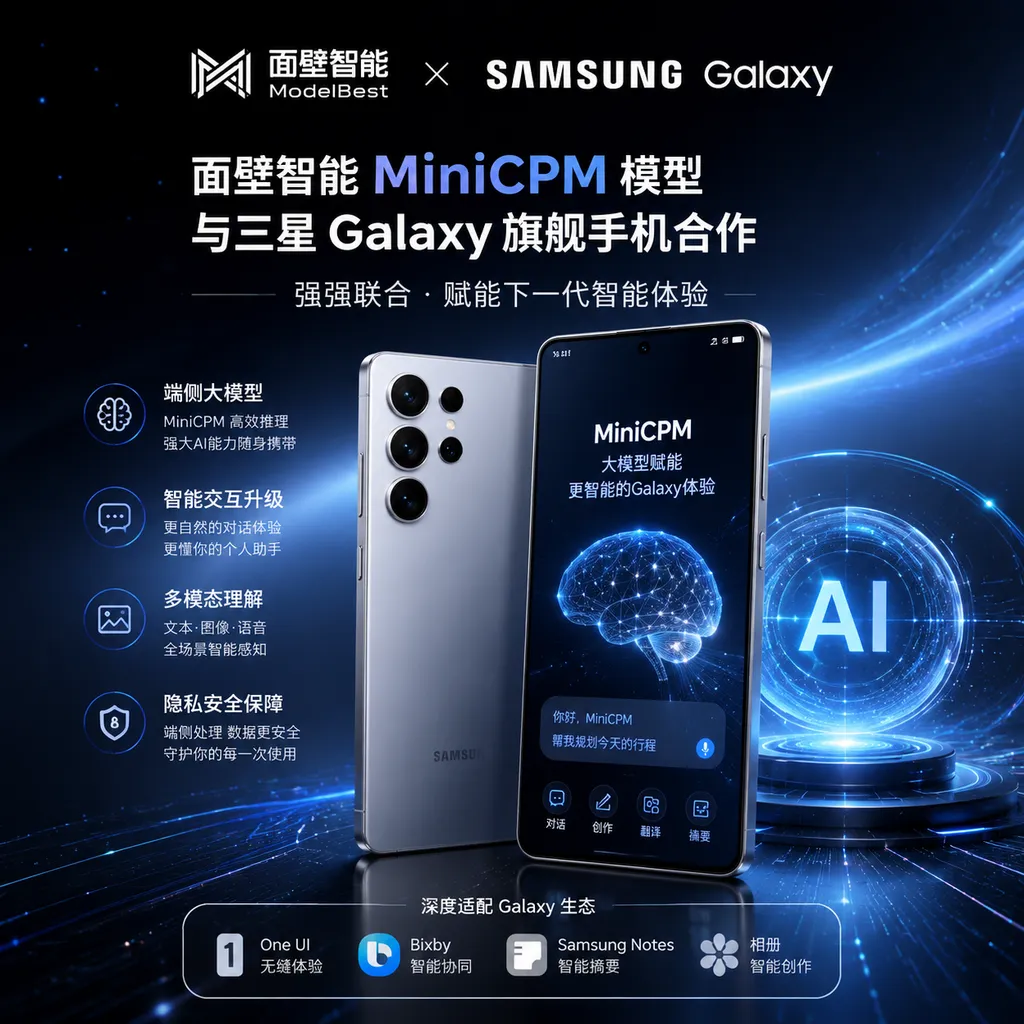
First, Intelligence Emergence reported exclusively that Wall-Faced Intelligence has reached a partnership with Samsung Mobile, and its self-developed MiniCPM series of edge models will be integrated into several upcoming Samsung flagship devices. Second, on the same day, the Cyberspace Administration released registration information for seven on-device generative AI services — Apple Intelligence, Huawei XiaoYi, OPPO Andes GPT, vivo Blue Heart, Xiaomi Surge AI, Samsung Galaxy AI, and Nubia Doubao Mobile Model all made the list. Just hours earlier, Alibaba confirmed to the media that Qwen would be integrated into Apple Intelligence as an underlying AI capability, covering iOS, iPadOS, macOS, and visionOS in the Chinese market. Following the news, Alibaba’s Hong Kong-listed stock price surged over 5% intraday.
Taken together, these three events reveal one clear message: the era of smartphone manufacturers solely developing their own on-device models is coming to an end.
Three News Items in One Day, All Pointing to the Same Thing
Over the past two years, domestic smartphone brands have primarily relied on in-house development for their on-device AI — Huawei has XiaoYi, OPPO has AndesGPT, vivo has Blue Heart, and Xiaomi has Surge AI. The reasoning was simple: AI differentiation is a selling point, and no one wants their “meat to cook in someone else’s pot.” But that landscape is now shifting.
Alibaba’s Qwen entering Apple Intelligence means that the “Siri just got smarter” features on Chinese-market iPhones are actually powered by Alibaba’s model. Wall-Faced Intelligence partnering with Samsung means that even one of the world’s largest Android manufacturers is outsourcing its on-device AI capabilities to a third-party company.
This is not a coincidence. From a concept demo in 2023, to small-scale pilots in 2024, and now to seven registered services appearing simultaneously — on-device AI has crossed the technical threshold of “can it be done” and entered the industrial phase of “who supplies whom.” Much like how smartphone brands stopped building their own SoCs over a decade ago, on-device models are becoming a modularized, specialized component for outsourcing.
For startups, this is a window of opportunity. For smartphone makers, it’s a way to stop the bleeding — developing a full end-to-end on-device model stack costs far more than it appears from the outside.
Why Wall-Faced Intelligence Was Chosen
Samsung’s decision isn’t entirely surprising. Wall-Faced Intelligence was among China’s earliest startups to go all-in on edge deployment. Back in the second half of 2023, while the industry was still racing to scale up cloud model parameters, Wall-Faced shifted its main efforts toward edge models. At that time, “going small” was a contrarian move — even considered a technical compromise by many insiders.
Its background deserves a quick review: founded in August 2022 in Beijing, incubated from the Tsinghua University Natural Language Processing Lab. CEO Li Dahai is a former Zhihu partner and CTO; Chief Scientist Liu Zhiyuan is a professor in Tsinghua’s Computer Science Department; CTO Zeng Guoyang, at age 22, led the training of China’s first large language model CPM-1. The team is a rare blend of academic and engineering expertise from Tsinghua.
Investment data shows that as of the first half of 2026, Wall-Faced Intelligence had raised more than 5 billion RMB, reaching a valuation exceeding 20 billion RMB — the highest among China’s edge-AI unicorns. Seen alongside its Samsung deal, the logic is clear: capital markets placed their bets slightly ahead of time on its commercialization prospects.
The Density Law: The Methodology That Proved Right
Wall-Faced’s full commitment to edge AI rests on one core principle: knowledge density.
In 2024, together with a Tsinghua research team, Wall-Faced proposed the “Large Model Density Law,” which posits that the top performance density of open-source models doubles roughly every 3.5 months, meaning that the parameter count required to achieve a given intelligence level declines exponentially.
In plain language: bigger isn’t always better; the parameter count needed to achieve the same capability is shrinking rapidly. What takes 70B parameters this year may take 20B next year, and just 5B the year after. If this principle holds, then “making models smaller” is not a compromise but a natural progression in technological evolution.
This hypothesis has been increasingly validated over the past year. A few recent examples from Wall-Faced:
- MiniCPM5-1B (released May 2026): just 1 billion parameters, scoring 17.9 on the Artificial Analysis Intelligence Index — surpassing multiple larger open-source base models
- MiniCPM-V 4.6: 1.3B parameters, 6GB RAM, runs smoothly on smartphones, supporting iOS, Android, and HarmonyOS
- MiniCPM-o 4.5: a 9B-parameter full-duplex, full-modal model handling speech, video, and text concurrently
A 1B-parameter model outperforming a host of larger ones — that’s the Density Law in action.
CTO Zeng Guoyang once summarized the difference clearly in an interview: “The edge side is hard-limited — if the model’s too big, it just won’t run, no matter how much you subsidize it; if it overheats, you can’t patch it with an ice cube. Efficiency is hard — bigger isn’t simpler.”
The subtext: cloud models can brute-force their way to performance with computation and budget; edge models cannot. Edge AI is an optimization problem under physical constraints — within fixed memory, compute, and power limits, it’s a contest of engineering and methodology.
Edge AI Isn’t Just ‘Making Models Smaller’
If you only look at compression and quantization, edge AI might not seem much harder than cloud AI. But real deployment on phones and cars requires full-stack strength.
Over the past two years, Wall-Faced has tackled three major challenges:
Chip Adaptation. Completed adaptation for Qualcomm, MediaTek, Intel, Rockchip, NVIDIA, AMD, and more. On Chinese chips, it participated in software stack development for Huawei Ascend and Cambricon and released China’s first ternary-quantized large model, BitCPM-CANN, cutting inference-phase memory use by about 6×.
Diverse Model Matrix. Dedicated product lines for text, multimodal, and full-modal models spanning from 1B to 9B parameters, covering a range of hardware tiers — allowing OEMs to pick the right fit per model: large models for flagships, smaller ones for mid-tier devices, without waiting for one “universal model.”
Scaled Automotive Deployment. Often overlooked: Wall-Faced’s in-house edge agent SuperMate is expected to reach over 300,000 production vehicles by the end of 2026, spanning Geely, SAIC Volkswagen, GAC, and Mazda. Running through model adaptation, hardware integration, supply chain, and final delivery in cars — these lessons transfer directly to phones.
On-device AI isn’t something solved by leaderboard scores. Zeng Guoyang put it bluntly: “Edge models aren’t judged by benchmarks alone — response time and hardware cost matter just as much. It’s hard to win on a single metric.”
Samsung’s Deal: The Collaboration Still Holds Some Mystery
It’s worth noting that Samsung, one of the world’s largest Android vendors, previously relied mainly on its self-developed Galaxy AI plus partnerships with Google. Korean media report Samsung and Google are tightly integrating Gemini into device ecosystems, with the upcoming July 22, 2026 Galaxy Unpacked in London as a key showcase.
Exactly what role Wall-Faced’s MiniCPM plays within Samsung’s system remains unclear, but several scenarios are plausible:
- Regional Differentiation: China-bound devices run MiniCPM; overseas ones run Gemini — a natural fit for compliance and network accessibility in China
- Task Division: MiniCPM handles high-privacy, low-latency tasks (input prediction, local photo analysis, system-level assistant), while Gemini handles cross-device or heavy reasoning tasks
- Model Tiering: Lightweight MiniCPM for midrange phones, dual-engine for flagships
Any of these — or a hybrid — could be true. Before Galaxy Unpacked reveals more, specifics are unlikely to surface. But whatever the mix, entering Samsung’s supply chain is a strong endorsement — Samsung’s demands for hardware efficiency and stability are famously strict.
The Era of Division of Labor in Edge AI Has Begun
Zoom out for a broader look. Together, these three developments — Wall-Faced entering Samsung, Qwen entering Apple, and seven registered on-device AI services — all point to one trend: the market-driven division of AI capabilities in smartphones is taking shape.
Previously, on-device AI was assumed to require in-house development due to tight integration with hardware and system layers. But now that model providers are outperforming OEMs on efficiency, output, and engineering, vertical integration may no longer be optimal. Like screens, cameras, and SoCs in the Android ecosystem, on-device models are developing their own specialized suppliers.
What’s the real impact for developers? As edge models proliferate, “on-device AI” will no longer be a flagship-only privilege — midrange phones, wearables, vehicle systems, and robots can all share similar intelligent capabilities. App developers can start safely assuming certain capabilities exist on-device: low latency, strong privacy, offline availability.
Another signal: once model specialization matures, cloud API and on-device SDK developers will increasingly employ hybrid combinations. Aggregation platforms like OpenAI Hub, which unify access to models like GPT, Claude, Gemini, and DeepSeek, could let developers route heavy-reasoning workloads to the cloud while keeping lightweight, private, latency-sensitive tasks on-device. Cloud + edge hybrid architectures may become the dominant design pattern for apps in the next one to two years.
A Few Final Judgments
Wall-Faced’s partnership with Samsung isn’t just luck. Its timing in betting on edge, its Density Law methodology, and its large-scale success in automotive AI together form the moat it stands on today. Behind its 5B RMB funding and 20B RMB valuation lies one core belief from investors — that edge AI will become an independent track.
But the real challenge starts now. Samsung sets the global benchmark — getting into its supply chain is only the ticket in; user experience, iteration speed, and stability on actual devices will determine survival. Meanwhile, competitors are closing in fast — Alibaba’s Qwen has entered Apple, ByteDance’s Doubao Edge Edition is shipping on Nubia phones. If MiniCPM wants to maintain its lead, it can’t afford to slow down.
Edge AI will heat up in the second half of 2026. The July 22 Galaxy Unpacked in London will be the first milestone worth watching.
References
- Report: Wall-Faced Intelligence’s MiniCPM Series On-Device Models to Launch with Samsung Flagship Phones - IT Home — Full IT Home article on the Wall-Faced × Samsung collaboration, including the Cyberspace Administration’s 7 registered AI services
- MiniCPM Official Open-Source Repository - GitHub — Open-source code and technical documentation for the MiniCPM models by Wall-Faced Intelligence
- OpenBMB Profile on Hugging Face — MiniCPM model weights and technical cards