
MiniMax M2.7 is open source — self-evolution is not just talk.
MiniMax officially open-sources its flagship multimodal model **M2.7**, featuring a “model self-evolution” pathway. After over 100 rounds of self-training without human intervention, performance has increased by 30%, hallucination rate has dropped from 89% to 34%, and it can be deployed on a single A30 GPU. Another heavyweight contender joins the open-source community.
MiniMax has finally released the M2.7 weights on Hugging Face.
Saying "finally" is fair—this model was announced back on March 18, and after a month of the community calling for open-sourcing, the official team only just got around to releasing it. But good things are worth waiting for—and what M2.7 brings is indeed worth the wait.
Let’s start with the core: What is “Self-Evolution”?
The large-model world is never short on buzzwords, but the “Self-Evolution” that MiniMax proposes with M2.7 isn’t just marketing fluff—it’s backed by a relatively complete engineering implementation.
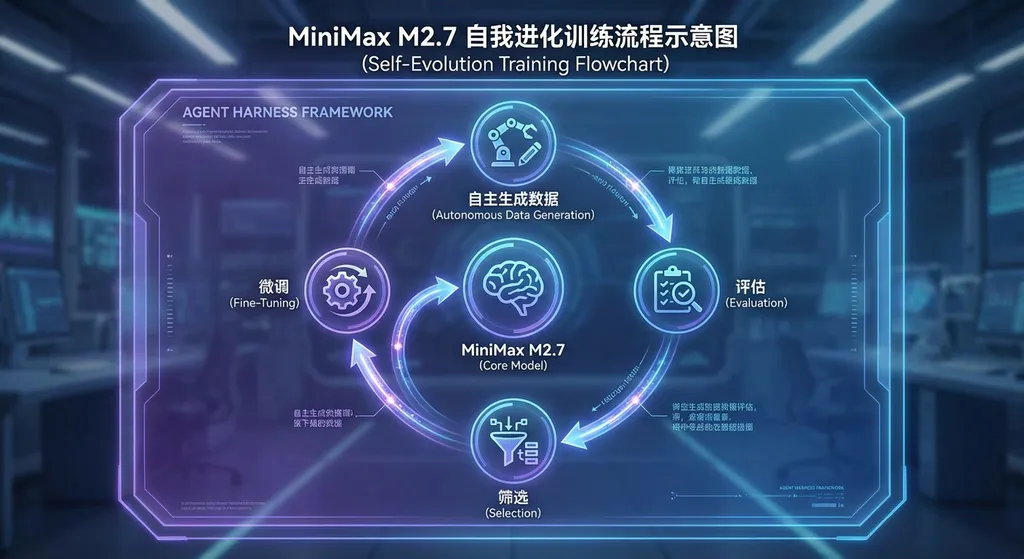
In simple terms, MiniMax built a framework called Agent Harness for M2.7. You can think of it as a “scaffold for a model to train itself”: within this framework, the model acts as an agent, autonomously generating training data, evaluating its own output quality, filtering high-quality samples, and then fine-tuning itself with those samples. This process runs for over 100 rounds with no human intervention required.
This differs fundamentally from the traditional RLHF approach. RLHF depends on human annotators for feedback—expensive, slow, and limited by annotation quality. M2.7’s approach instead lets the model be both teacher and student, forming a self-improvement feedback loop.
Sounds a bit like AlphaGo’s self-play, doesn’t it? The direction is similar, but the difficulty isn’t. Go has a clear win–loss definition, while evaluating a language model’s output quality is much fuzzier. MiniMax’s solution was to have the model verify itself through concrete agent tasks—whether it can correctly call APIs, complete multi-step reasoning, and generate executable code. These tasks have clear right-or-wrong outcomes, making them naturally well-suited for automated evaluation.
The numbers: How big is the improvement, really?
Let’s look at a few key metrics:
- Overall performance improvement of about 30% compared to M2.5
- Hallucination rate dropped from 89% in M2.5 to 34%
- Strong performance across multiple coding and agent benchmarks
- Greatly lowered deployment barrier—runs on a single A30 GPU
That hallucination rate drop deserves a deeper look. From 89% to 34%—a nearly 60 percentage point decrease. That’s an unusually large leap in the world of large model iteration. Hallucinations have long been one of the biggest obstacles to LLM deployment, and many teams only manage to trim a few percentage points after extensive effort. M2.7’s improvement likely stems from the heavy fact validation built into its self-evolution training—by repeatedly verifying its own outputs in agent tasks, the model effectively integrates a layer of fact-checking during training itself.
However, note that these figures come from MiniMax’s official sources and media reports; detailed benchmark and test set info will need further community validation. With open-sourcing, we can expect independent third-party evaluations soon.
Coding ability: The part developers care most about
Community feedback indicates that M2.7’s performance in coding scenarios is surprisingly strong.
Developers on Zhihu described it as “evolving from a strong model to a production-level engineering system.” That might sound a bit grand, but it’s not far-fetched. M2.7 shines in several coding tasks:
- Understanding context and generating code across multi-file projects
- Coordinating complex API call chains
- Debugging and error localization
- End-to-end generation from requirement descriptions to runnable code
In particular, its tool-calling ability in agent scenarios is noticeably more stable than peer open models. That makes sense—its entire training process happens inside an agent framework, so tool use gets inherently reinforced.
For day-to-day developers, M2.7’s open-sourcing means one more locally deployable option. It runs on a single A30 (24GB VRAM), which is very approachable for a flagship model. If your team has data privacy concerns and can’t send code to cloud APIs, deploying M2.7 locally is a solid choice.
Of course, if you don’t want to deal with deployment, calling it via API is also straightforward. MiniMax M2.7 supports OpenAI-compatible APIs; for example, OpenAI Hub already supports this model, and switching requires almost no code changes:
from openai import OpenAI

client = OpenAI(
    api_key="your-openai-hub-key",
    base_url="https://api.openai-hub.net/v1"
)

response = client.chat.completions.create(
    model="minimax-m2.7",
    messages=[
        {"role": "system", "content": "You are a seasoned Python developer."},
        {"role": "user", "content": "Write the core scheduler for an asynchronous web crawler framework that supports concurrency limits and retry-on-failure."}
    ],
    temperature=0.7
)

print(response.choices[0].message.content)
It uses the standard OpenAI SDK—all you need to change is the base_url and model name; your existing code almost certainly works out of the box.
In the industry context: Where does M2.7 stand?
By 2026, the open-source LLM race is highly crowded. DeepSeek, Qwen, Llama, Mistral—all have their niches. For MiniMax to carve out a position, benchmark scores alone aren’t enough.
M2.7’s differentiation is quite clear: Agent capabilities.
Not many open models are deeply optimized for agent tasks. Most can “work,” but tend to fail on complex multi-step tasks, lose context, or produce unstable tool-call formats. Since M2.7 was trained inside an agent framework, it holds a natural advantage here.
What about compared to closed-source models? Some reports suggest M2.7 outperforms the GPT series in certain benchmarks. This should be viewed cautiously—benchmarks vary widely, and it’s common to beat a closed model in specific tests. Real-world experience matters far more. However, the fact that an open model like M2.7 can match or surpass top closed models in some metrics shows that open-source progress is accelerating.
Another critical factor is deployment cost. Being able to run on a single A30 makes M2.7 accessible to small teams and even individual developers. In contrast, many similar-level models require multiple GPUs or multi-machine setups. MiniMax clearly invested in model compression and inference optimization.
The broader significance of “Self-Evolution”
Beyond the product itself, MiniMax’s proposed “Self-Evolution” path deserves attention.
Today’s large-model training faces a real bottleneck: the supply of high-quality human-labeled data is drying up. The public Internet corpus has already been used and reused multiple times, and human labeling still can’t scale in cost or speed. In this context, involving the model in its own training—using model-generated data to train the model—is almost inevitable.
Of course, this approach carries risks. If a model repeatedly trains on its own outputs without strong quality control, it may suffer model drift—a self-reinforcing degradation loop. MiniMax’s Agent Harness mitigates this by verifying output quality through concrete tasks. That’s the right idea, but the long-term effects still need observation.
From a macro perspective, if self-evolution proves viable, model iteration cycles could shorten dramatically—from six months per version to just weeks or less. That shift would profoundly reshape industry competition.
Open-source community reaction
According to discussions on the Linux.do forum, the community sentiment on M2.7’s release is: “We’ve waited ages, but we’re glad it’s finally here.” The model weights are now available on Hugging Face (MiniMaxAI/MiniMax-M2.7), ready for developers to download and use.
Community members are particularly interested in:
- Quantized versions — When are they coming? The base model already runs on one GPU, but quantization would further reduce VRAM needs and widen adoption.
- Fine-tuning support — The value of open models lies largely in fine-tuning flexibility. Developers are eager for LoRA or similar fine-tuning options from MiniMax or third parties.
- Long-context performance — Agent scenarios often involve lengthy histories and tool-call records; the usable context window is a key metric.
Answers to these will become clearer as community testing continues. The beauty of open source is just that—you don’t have to wait for official updates; the community will map out the model’s true capabilities.
In closing
The open release of MiniMax M2.7 fills a key gap in China’s open LLM ecosystem: a flagship model deeply optimized for agent scenarios, easy to deploy, and built on a unique technical path.
It’s not perfect. The official metrics need independent verification, the long-term viability of self-evolution remains to be seen, and its community ecosystem is still in early stages. Yet as of 2026, a domestic team delivering such an open-source product is already an achievement worth paying attention to.
For developers, the takeaway is simple: download it and try it yourself—especially in your own agent and coding scenarios. Benchmarks belong to others; performance hands-on is what truly matters.
References:
- Linux.do Community Discussion: MiniMax M2.7 Open Source — first reactions and developer feedback
- Zhihu Column: MiniMax M2.7 Engineering Capability Test — firsthand usage reports from developers


