
AllenAI made Shippy and went through all the pitfalls of agent collaboration.
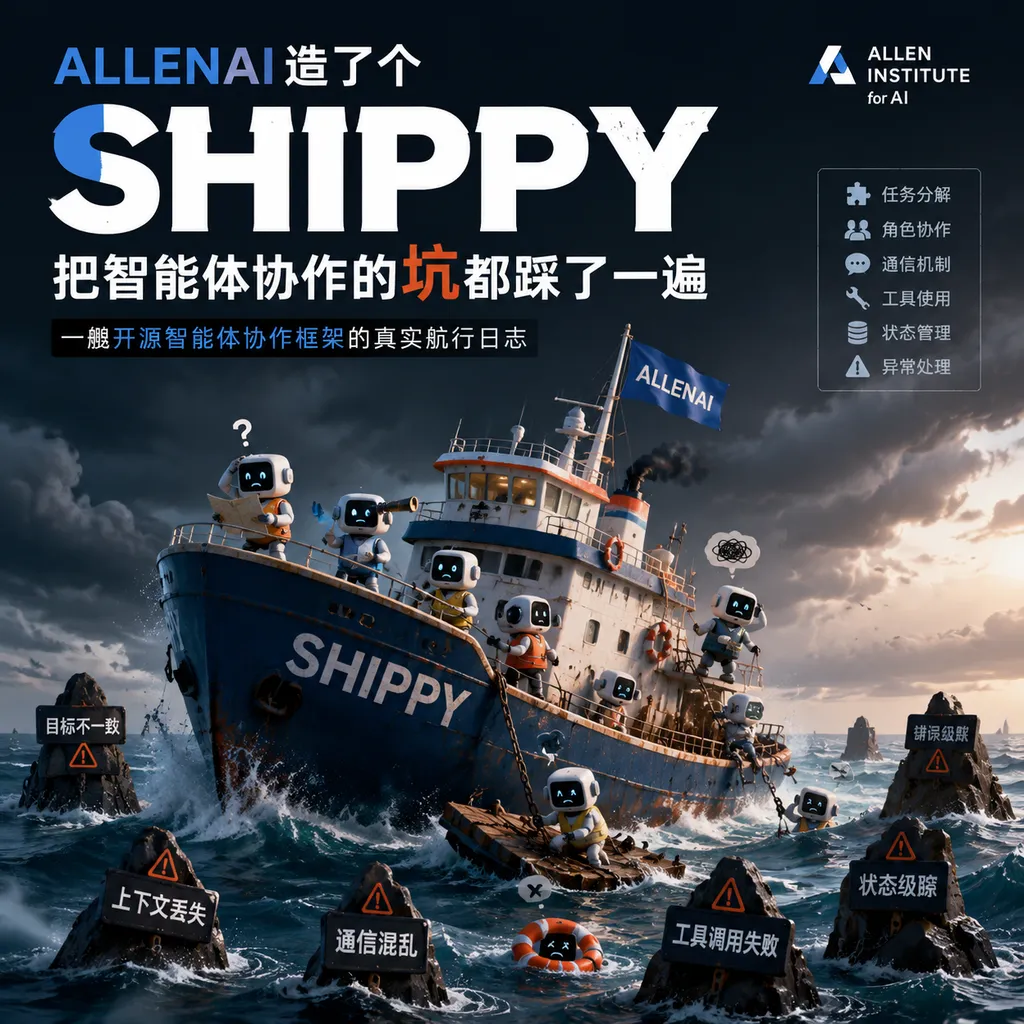
AllenAI shared a retrospective of its internal AI engineering project **Shippy** on the Hugging Face blog, openly discussing the pitfalls encountered in multi-agent collaborative development: from task decomposition to context pollution, from tool design to evaluation mechanisms—all based on hands-on, practical experience.
A Rare and Thorough Agent Postmortem
Last weekend, AllenAI published a long article on the Hugging Face blog with a modest title: What building Shippy taught us about building agents. The authors are AllenAI’s engineering team, and the protagonist is their internal project Shippy—a multi‑agent system for automating the software release process.
Such retrospectives are not rare these days, but most read like slides. Shippy’s write‑up is different; it’s more like an engineer‑to‑engineer memo that lays out every pitfall, detour, and what actually worked in the end. For any team building agent products, this kind of firsthand experience is far more valuable than the numerous “agent maturity frameworks” circulating online.
By mid‑2026, the industry’s attitude toward agents has evolved from the frenzy of 2024, through the skepticism of 2025, to the current pragmatic, sober stage. Shippy’s summary appears right at this turning point, serving as an observation sample—showing us what teams truly shipping production‑grade agents actually care about.
What Shippy Does
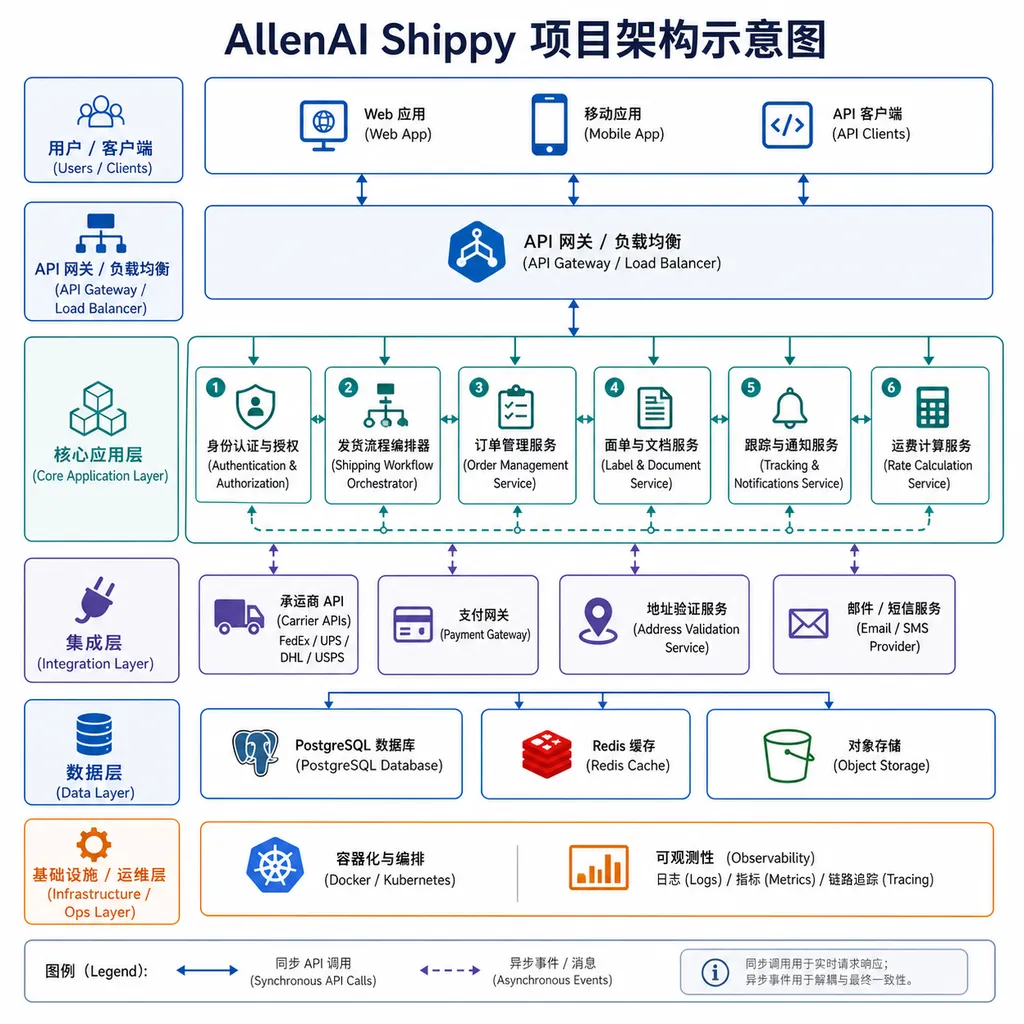
First, let’s clarify what Shippy actually is. It’s not another general‑purpose coding agent, but a highly specialized tool: it helps AllenAI’s research teams publish trained models.
Sounds simple, but model releases inside a research organization are full of chores—writing model cards, running evaluations, generating examples, uploading to the Hub, writing blog posts, tweeting, etc. After a PhD student finishes training a model, they might spend another two or three days doing all this. Shippy’s goal is to automate the process: the researcher provides a checkpoint and a few key parameters, and a group of agents cooperates to handle the rest.
The choice of such a vertical scenario is deliberate. The team didn’t start by trying to build a “general AI employee,” but chose a task with explicit steps, clear boundaries, and controllable failure costs. This ties to one of the article’s recurring points: an agent’s capability boundaries must match the scenario—don’t expect one agent to do everything.
Lesson One: Don’t Over‑Engineer Multi‑Agent Architectures
The first counter‑intuitive takeaway is that the team initially made Shippy too complicated.
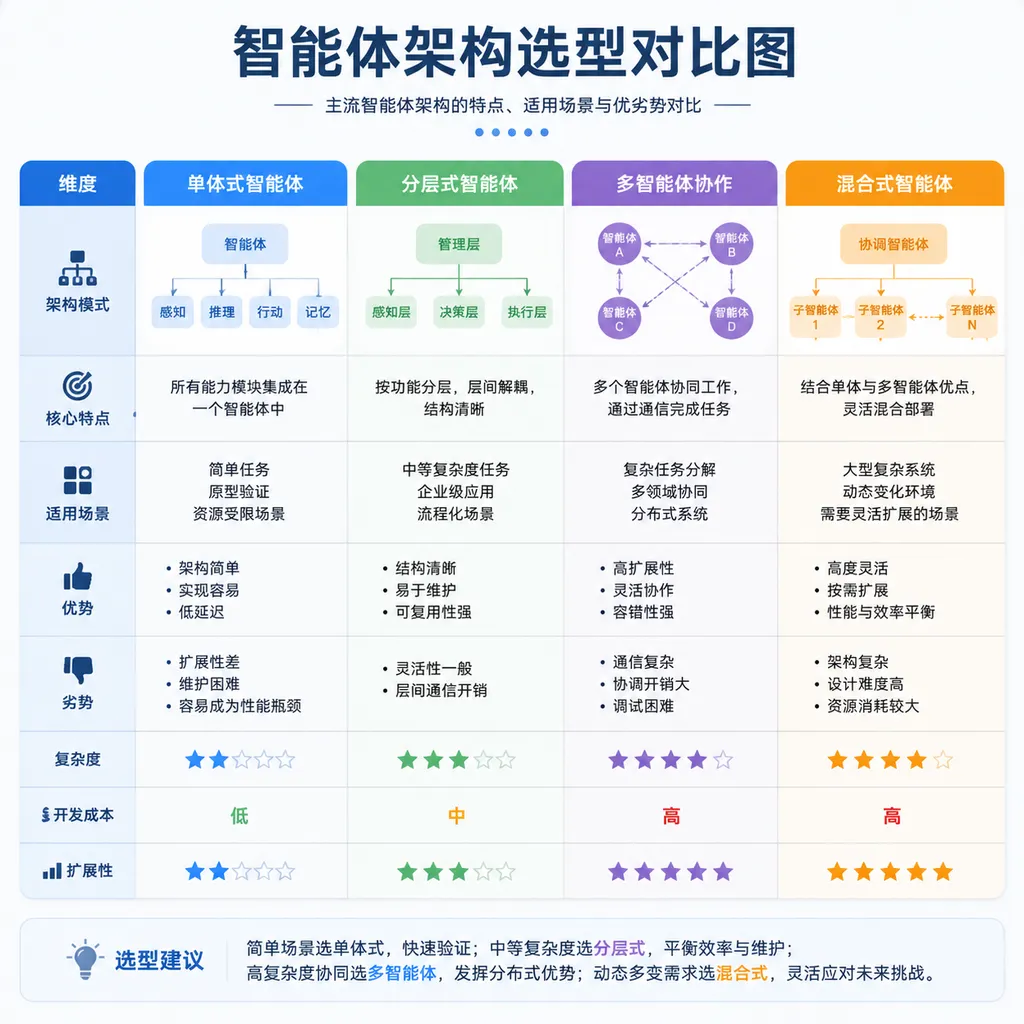
Their first design had seven or eight specialized agents—one for copywriting, one for running evaluations, one for code review, plus a “coordinator agent” on top orchestrating the rest. It all sounded very “multi‑agent collaboration,” but in practice it was a mess:
- Huge information‑passing overhead between agents. The coordinator must compress context before passing it downstream, then get compressed outputs back—half the crucial details get lost each round.
- Failure attribution became impossible. If a task failed, was it the coordinator’s planning mistake, the copywriter agent’s misunderstanding, or the evaluator agent’s wrong tool? Debugging felt like dissecting a black box.
- Stacked latency. Each agent ran its own inference; chained together, one release could take dozens of minutes.
They later drastically simplified the architecture to a “main agent + toolset” pattern. Only when real parallelism was needed (e.g., running multiple benchmarks simultaneously) would they spawn sub‑agents. That change lifted overall success from just above 40 % to over 80 %.
This reveals a widespread misconception: “multi‑agent” does not automatically mean better. Many teams treat multi‑agent setups as the default, but if a task lacks natural parallelism or distinct viewpoints, splitting it across agents only adds coordination cost. Anthropic voiced a similar stance earlier in its MCP blog—if one agent can solve it, don’t use many.
Context Management as the Real Core Competency
If architecture simplification is subtraction, then context management is the most technically demanding part of the project.
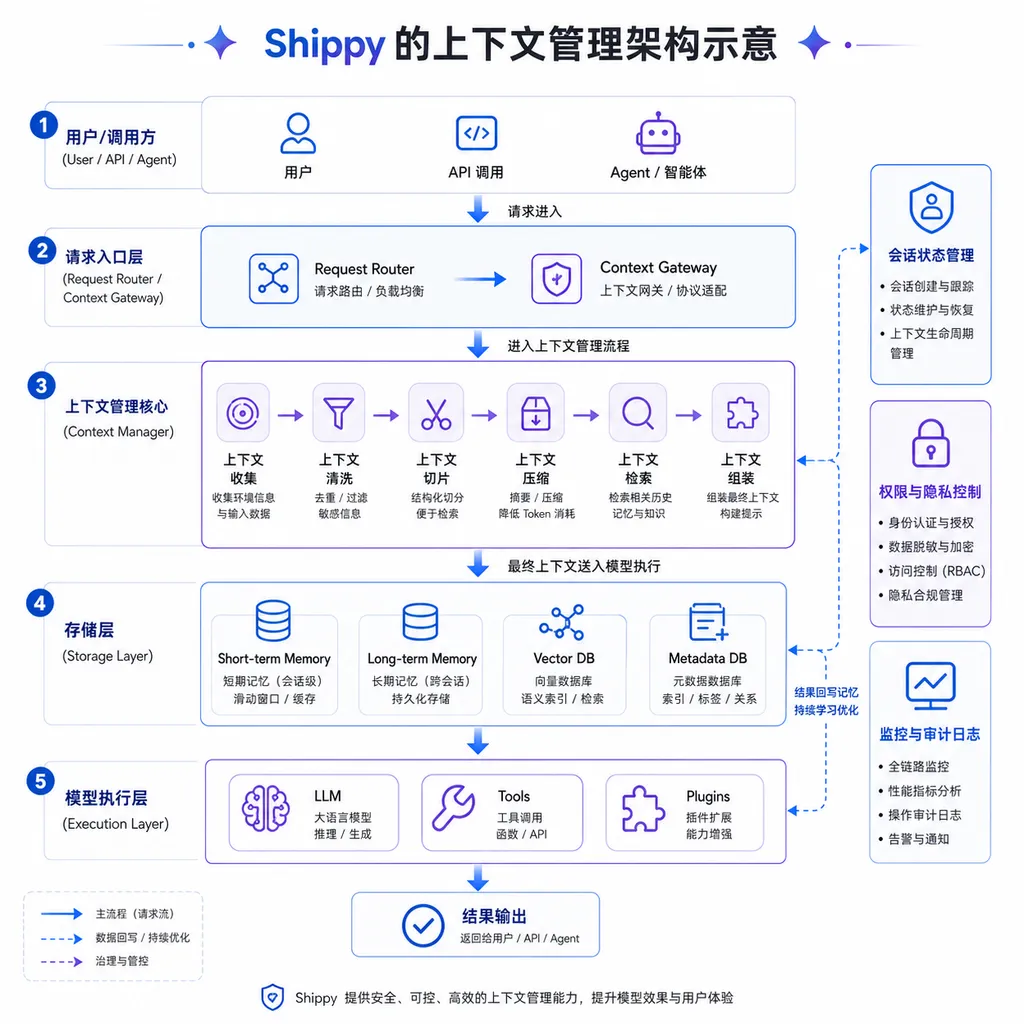
The Shippy team devoted a full section to how they handle context—not the usual “RAG‑based info retrieval” trick, but finer‑grained, task‑level context scheduling.
Their approach roughly includes:
- Persistent task state. Each release task has a structured state object recording progress, completed subtasks, and intermediate outputs. Before each decision, the agent reads the state; after acting, it updates it.
- Layered context injection. Different tool calls require different context granularity—writing the README needs full eval data, but deciding whether to upload to the Hub only needs a boolean.
- Active context compression. When conversation length exceeds a threshold, a dedicated summarization step compresses interaction history into structured abstracts.
The last point is crucial. The article notes an interesting finding: agent errors usually don’t stem from model weakness but from context stuffed with irrelevant details that “dilute” the model’s attention. This occurs especially in long tasks—after two hours of running, an agent may make odd choices simply because it “remembers” too many early, irrelevant details.
Tool Design Matters More than Prompt Engineering
This section may prompt many agent teams to rethink their tech stack.
Shippy’s conclusion: in agent scenarios, tool design quality affects outcomes far more than wording in the prompt.
One example: initially they provided a flexible run_evaluation tool, accepting dataset names, metrics, batch size, etc. The agent struggled—mixing up parameters or retrying various combinations.
Later, they split it into three tools: run_standard_eval(model_name), run_benchmark_suite(model_name, benchmark), and run_custom_eval(config_path). Fewer parameters, clearer semantics—success rate soared.
The principle is simple: an agent’s tool‑using behavior resembles that of a human programmer reading API docs—fewer parameters, clear meaning, and explicit error messages make usability higher. “Generic” tools designed for flexibility often become burdens in agent use.
They also added detailed error returns to every tool, including “why this call failed” and “what to try next.” These seemingly redundant hints let agents recover quickly from errors instead of looping endlessly.
Evaluation: From Vibe Check to Systematic Benchmark
The team admits that for the first few months their evaluation method was basically “run it once and see if it feels right”—the infamous vibe check. Fine for demos, useless for iteration.
Later, they built a formal evaluation pipeline:
- Collected ~200 historical release tasks as a “gold‑standard dataset.”
- Defined 5–10 automatically checkable success conditions per task (e.g., model card completeness, README code examples, reproducible metrics).
- After each code change, ran exhaustive evaluation to compute an overall score.
With this benchmark in place, they could finally attempt “risky” optimizations—changing models, prompts, toolsets—actions that would otherwise be guesswork.
This reflects a broader industry trend: agent engineering essentially equals engineering the evaluation system. Without reliable evaluation, every optimization is luck. What’s true in traditional ML remains true in the agent era.
A Note on Model Choice
At the end, the article discusses models. The team experimented with virtually all major ones—GPT, Claude, Gemini, and several open‑source models. Their takeaway:
For agent tasks, model gaps are much larger than generic benchmarks suggest. A model a few points higher on MMLU may perform wildly differently in real agent reliability.
They highlight two decisive factors: “accuracy of tool calls” and “instruction following under long‑context conditions.” These rarely appear in standard benchmarks but make or break real agent workflows.
The takeaway for developers: benchmark models on your own tasks—don’t worship public leaderboards. And since model iteration is fast, repeat comparison frequently. Teams doing frequent A/B tests benefit from platforms like OpenAI Hub—it unifies GPT, Claude, Gemini, DeepSeek, etc., under one API format, so switching models is just changing a parameter while keeping the same evaluation pipeline.
Hidden Conclusions Between the Lines
Reading the whole piece reveals some implicit conclusions worth calling out:
First, vertical agents are currently the most practical form. Shippy succeeded largely because the “model publishing” domain is narrow and bounded. Teams aiming for general agents should ask themselves if their domain can be sliced this way.
Second, agent engineering is more demanding than it seems. It’s not a “just call an API” endeavor. Context management, tool design, and evaluation all require real investment. Small teams should decide early whether they can afford these costs.
Third, the romantic narrative of multi‑agent collaboration needs demystifying. “A group of agents collaborating like a human team” sounds cool, but given current tech, in most cases a single agent with good tools performs better, costs less, and is easier to debug.
Conclusion
The value of the Shippy blog post isn’t in proposing a new methodology—each point has surfaced separately in past discussions. Its real value is that a team that actually built a production‑grade agent connected all the dots and explained the trade‑offs concretely.
For teams building agents in China or elsewhere, this article is worth reading in full—especially for those still torn about adopting multi‑agent architectures. See how AllenAI simplified from complexity; it might save you six months of detours.
In the second half of 2026, industry focus will likely shift further from “can we make it work” to “can we make it stable, evaluable, and maintainable.” Postmortems like Shippy’s will only multiply—may we all avoid repeating the same pitfalls.
References
- What building Shippy taught us about building agents — AllenAI’s original postmortem on Hugging Face.
- Building Moon Bot: A Slack‑Native Coding Agent Backed by HuggingFace Buckets — Another practical agent case study from Hugging Face for comparison.
- Agentic RL: Token‑In, Token‑Out Done Right — Hugging Face’s technical post on agentic RL training, covering engineering aspects of agent training.


