
Apple AI launches in China: Alibaba’s Qwen integrated into Apple Intelligence, while Baidu only gets search
The China-version Apple AI completed its filing on July 8, and on July 15, Apple officially announced its rollout plan: Alibaba’s Qwen (Tongyi Qianwen) will handle the core text and image generation capabilities, while Baidu will only provide AI search. It’s been more than a year since domestic manufacturers rolled out on-device AI, and Apple has finally secured its place at the table this time.
Apple’s official Mainland China AI has finally gathered enough chips to join the table.
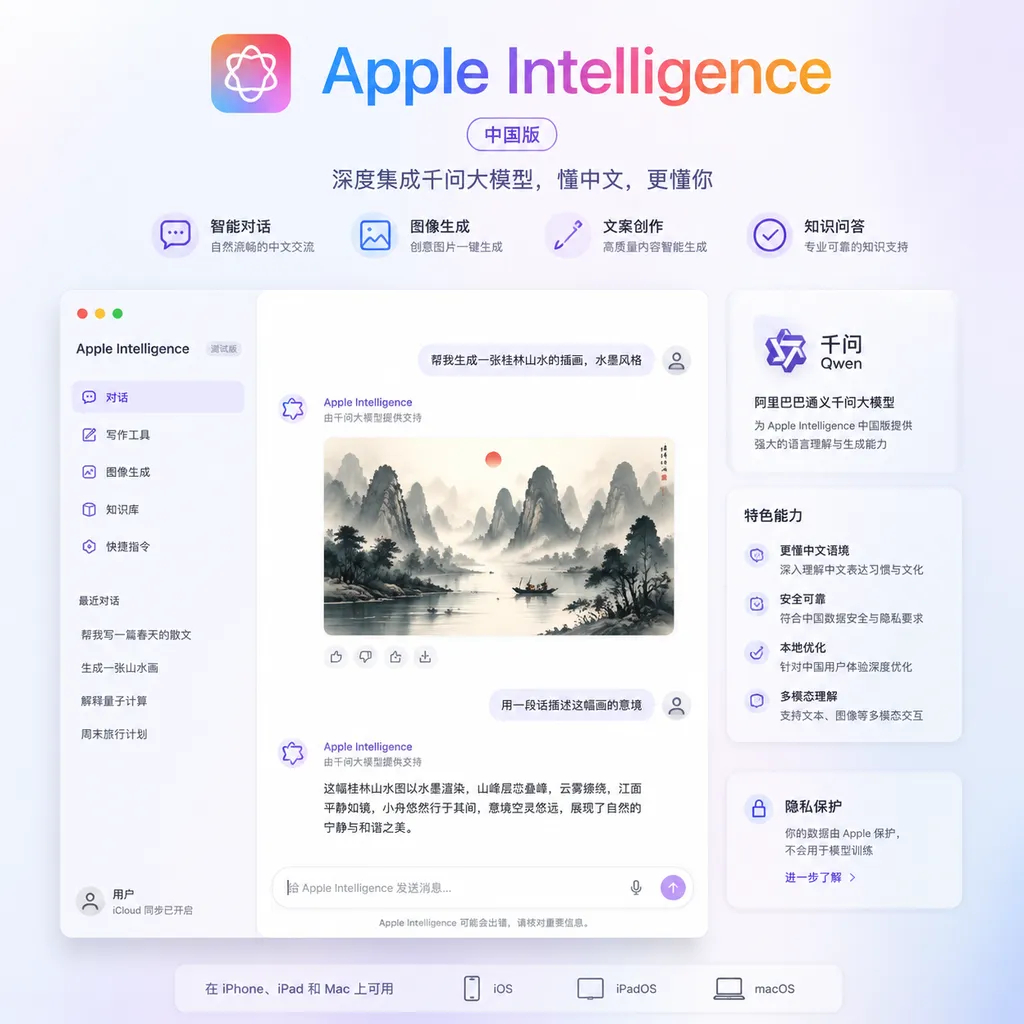
On July 15, the Cyberspace Administration of China announced the latest batch of on-device generative AI service filings. Apple Technology Development (Shanghai) Co., Ltd.’s “Apple Intelligence” large model passed the review on July 8. That same day, Alibaba confirmed that Tongyi Qianwen (Qwen) will be integrated into Apple Intelligence, covering iOS, iPadOS, macOS, and visionOS. Chinese users will not need to install any third-party apps — Qianwen’s text understanding, image understanding, and content generation capabilities can be directly invoked at the system level.
Baidu also made the list, but its share of work is clearly much smaller — it’s only responsible for the AI search function within Apple Intelligence. The core generative capabilities and the language model powering Siri’s upgrade all went to Alibaba.
A tug-of-war that lasted more than two years
What’s truly worth noting is that Apple spent more than two years choosing a domestic large-model partner.
Here’s the rough timeline:
- 2023: Apple began internal testing of several leading domestic large models.
- 2024: Initially locked in Baidu as the main partner, but internal evaluations fell short.
- Early 2025: Cooperation shifted; Apple reevaluated Tencent, ByteDance, Alibaba, and DeepSeek.
- February 2025: Foreign media revealed Apple abandoned DeepSeek and turned to Alibaba.
- March 2025: Apple held a “Harness the Power of Apple Intelligence” developer event in Shanghai.
- July 8, 2026: Apple Intelligence completed CAC filing.
- July 15, 2026: Alibaba and Baidu confirmed cooperation details.
DeepSeek was the one publicly dropped. The reason was unglamorous but realistic — Apple felt the DeepSeek team was understaffed and lacked experience serving clients of Apple’s scale. It wasn’t a technical issue but an organizational one. In hindsight, DeepSeek had spent the past year and a half busy developing the R series and preparing for an IPO (according to Bloomberg, DeepSeek is now preparing to apply for an A-share listing this year), so they likely didn’t have the bandwidth to take on a client as demanding as Apple.
Where did Baidu lose? The official explanation was “progress did not meet US company standards.” Translated bluntly: Apple’s internal testing showed that Baidu’s Ernie model couldn’t outperform Qianwen. Public leaderboards hint at this — in early 2025, Qwen2.5-Max briefly ranked seventh globally on Chatbot Arena and topped the charts in math and programming. By 2026, the Qwen series had essentially become the flagship of open-source Chinese models.
The final division of labor thus fits both companies’ product strengths: Alibaba handles generation, Baidu handles search. Baidu’s semantic understanding and indexing capabilities around search remain strong; but to make Siri smarter or power visual features like Genmoji and Image Playground, only Qianwen can manage.
Technical details worth noting
There’s more under the hood than press releases suggest. Developers should note a few technical signals.
Underlying adaptation: SearchPartnerInferenceProvider
Foreign media found a new ExtensionKit component called SearchPartnerInferenceProvider in the iOS 27 Beta 2 firmware. Its significance: Apple has reserved a system-level integration interface for third-party AI service providers, allowing dynamic regional switching of partners.
In other words, Apple Intelligence’s architecture isn’t hard-coded to one model but abstracted through a Provider layer. The China version runs Qianwen and Baidu; the US version runs Apple’s in-house models and OpenAI; Europe might get another stack. This design aligns well with real-world compliance needs for on-device AI — each country has its own filing requirements and data-transfer constraints, so hardwiring a single partner isn’t feasible.
For developers, that means Apple Intelligence features such as App Intents, Writing Tools, and Genmoji may use the same APIs on the surface, but the underlying models (and thus the quality, tone, or language coverage) will vary by region. Teams building cross-region apps should keep that in mind.
Coverage beyond iPhone
Alibaba’s official press release clearly states: iOS, iPadOS, macOS, and visionOS are all included. This means Qianwen will be the first domestic large model to run on the Chinese edition of Vision Pro, assuming the local Vision Pro ever goes on sale. macOS support also matters — later versions of predictive code completion in Xcode, for example, will likely call Qianwen through the Apple Intelligence layer.
Hybrid architecture remains
The filing itself covers “on-device generative AI services,” but Apple Intelligence fundamentally uses a three-tier hybrid design: small on-device models + Private Cloud Compute + large-model fallback. The domestic version should retain this structure, with the cloud tier replaced by Qianwen services hosted on Alibaba Cloud. The tricky part lies in how data flow and privacy computing are implemented — neither side has disclosed details.
How far Apple has fallen behind Chinese Android brands
Here’s a hard truth: Apple’s AI in China is already a full generation behind Android manufacturers.
Look at the domestic market in 2026:
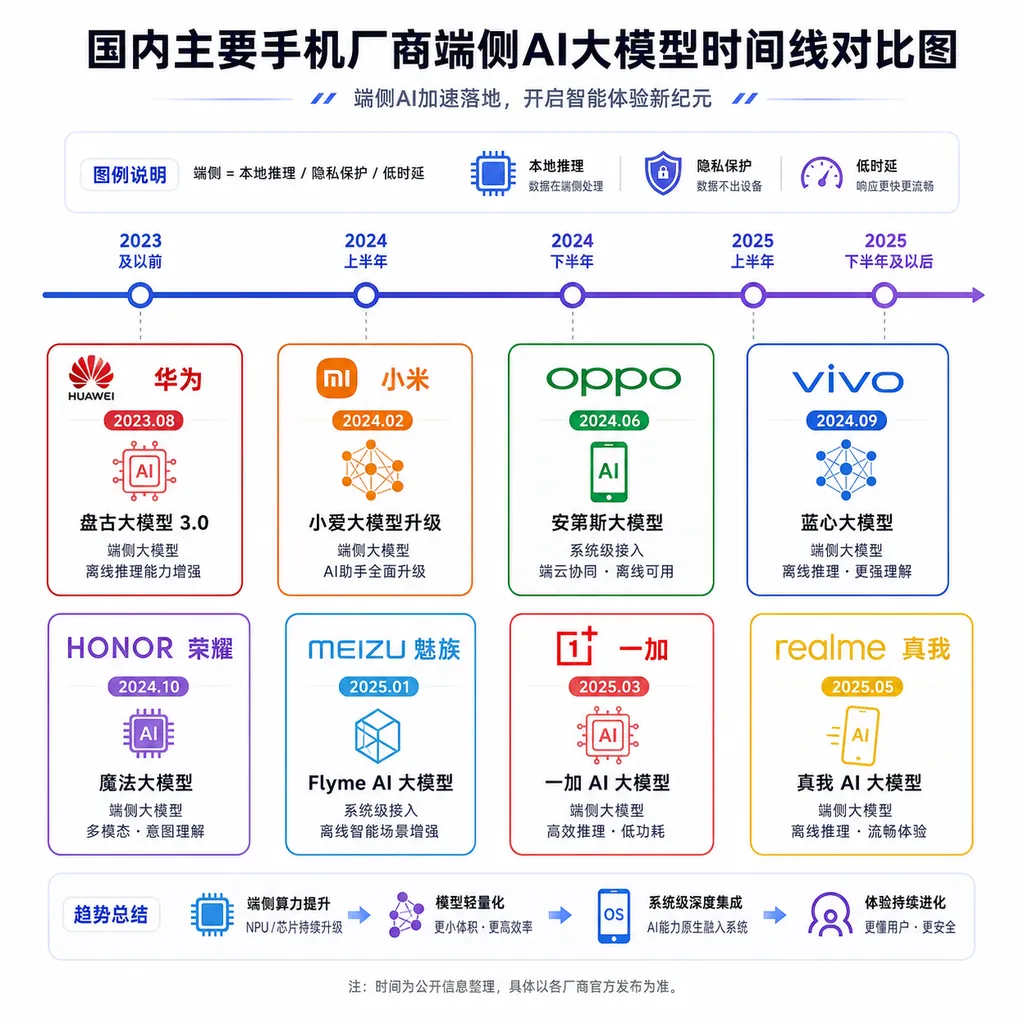
- Huawei’s Pangu + Xiaoyi were fully integrated into HarmonyOS NEXT last year.
- Xiaomi’s MiLM model now runs not only on flagships but also mid-range Redmi devices.
- OPPO’s AndesGPT, combined with the Breeno assistant, offers differentiated features like call summarization and cross-app coordination.
- vivo’s BlueLM has evolved into multimodal agent capabilities.
Meanwhile, iPhone 15 Pro and above have had the hardware to run Apple Intelligence since late 2024, but users waited over a year with no Chinese version available. During that time, customers upgrading for AI features flocked to domestic flagships instead. Canalys data shows Apple’s 2024 Q4 shipments in China fell 25% year-over-year — still the market leader, but with alarming decline.
So this filing isn’t so much a victory for Apple AI as a long-overdue entry ticket. Huaxi Securities previously predicted that localizing Apple Intelligence would drive iPhone sales and boost Apple’s supply chain — true from an industry standpoint, but from a user perspective, the novelty and excitement for Apple Intelligence have largely worn off. What really matters now is the actual experience after Qianwen’s integration, not the filing itself.
What this means for Alibaba
On the day of the announcement, Alibaba’s U.S. stock rose 4% pre-market — a measured reaction, since The Information had already reported the partnership back in February and the market had priced it in. The deeper implications lie in the value this cooperation brings to Qianwen’s ecosystem:
First, distribution. With hundreds of millions of active iPhone users in China, Qianwen’s reach will multiply many times overnight. For a large model, becoming part of a system-level call chain is far more valuable than topping an app store chart.
Second, data feedback. While Apple’s architecture emphasizes privacy, interaction patterns, task distributions, and failure cases are all crucial engineering signals for model iteration. The Qianwen team will gain exposure to one of the world’s most experience-sensitive user bases.
Third, brand endorsement. While Qwen leads in the domestic open-source community, consumer recognition still trails behind “viral” players like DeepSeek. Partnering with Apple equals free access to the world’s top consumer brand halo. The spillover benefits for Alibaba Cloud’s enterprise business may surpass the consumer side — hesitant enterprise clients may now commit simply because “even Apple chose it.”
For developers, this also sends a clear signal: the Qwen family will be one of the most ecosystem-rich domestic models in the near future. Open-source versions are available on Hugging Face and ModelScope, and commercial APIs are accessible via multiple aggregator platforms. Services like OpenAI Hub now support Qwen alongside GPT, Claude, Gemini, and DeepSeek under a unified API key, making A/B testing or multi-model fallback much simpler — and after Apple’s official cooperation, the value of such aggregation layers will only rise further.
One suspense remains: when will it actually launch?
Filing completed ≠ Available to users. Apple has yet to announce a rollout timeline for Apple Intelligence in China. Typically, after regulatory approval, Apple still needs to finish system adaptation, regional configuration, and compliance audits.
Industry optimists expect the rollout to come with a later iOS 26.x minor update (or debut with iOS 27), likely around fall 2026 — just in time for the next iPhone launch.
But there’s uncertainty: the global version of Apple Intelligence has already been marred by delays, with Siri’s “AI overhaul” postponed an entire year. Whether the Chinese version will repeat such “approved but staggered release” drama remains to be seen.
One thing, however, is certain: neither Apple nor Alibaba can afford to drag their feet anymore. Domestic smartphone AI has already moved toward intelligent agents and cross-app orchestration. If Apple’s catch-up only covers basic “text generation and image editing,” Chinese iPhone users will be even more disappointed. The real competition begins the moment Qianwen goes live.
References
- Qwen Official GitHub Repository — Source code and documentation for Alibaba’s Tongyi Qianwen series
- Qwen Models on Hugging Face — Model weights and technical cards for various Qwen versions
- Qwen2.5 Technical Discussion — One of the core model generations integrated into Apple Intelligence, with architecture and evaluation details


