
ForceMind DW0.5: Let the world model spar with the VLA

Lingji AI launches the general embodied world model DW0.5, bringing reinforcement learning into the virtual world. This reduces the demand for real-machine data by 60% and end-to-end training costs by 40%. For the first time, embodied model post-training has a proper "simulation coach."
ForceBrain DW0.5: Bringing Reinforcement Learning into the Virtual World, Cutting Real‑Machine Data Demand by 60%
In mid‑July, at the first Action Developer Conference, ForceBrain unveiled its next‑generation base model DM0.5 alongside its world model DW0.5. DM0.5 covers the “doing,” while DW0.5 acts as a “sparring partner” — the most immediate effect of this pairing is that those painfully expensive real‑machine trial‑and‑error datasets required for post‑training are cut by about 60%, with end‑to‑end training costs reduced by about 40%.
For embodied‑AI teams, this is one of the few tangible engineering breakthroughs in the first half of this year. It’s not just another leaderboard model; it fundamentally restructures the entire post‑training pipeline.
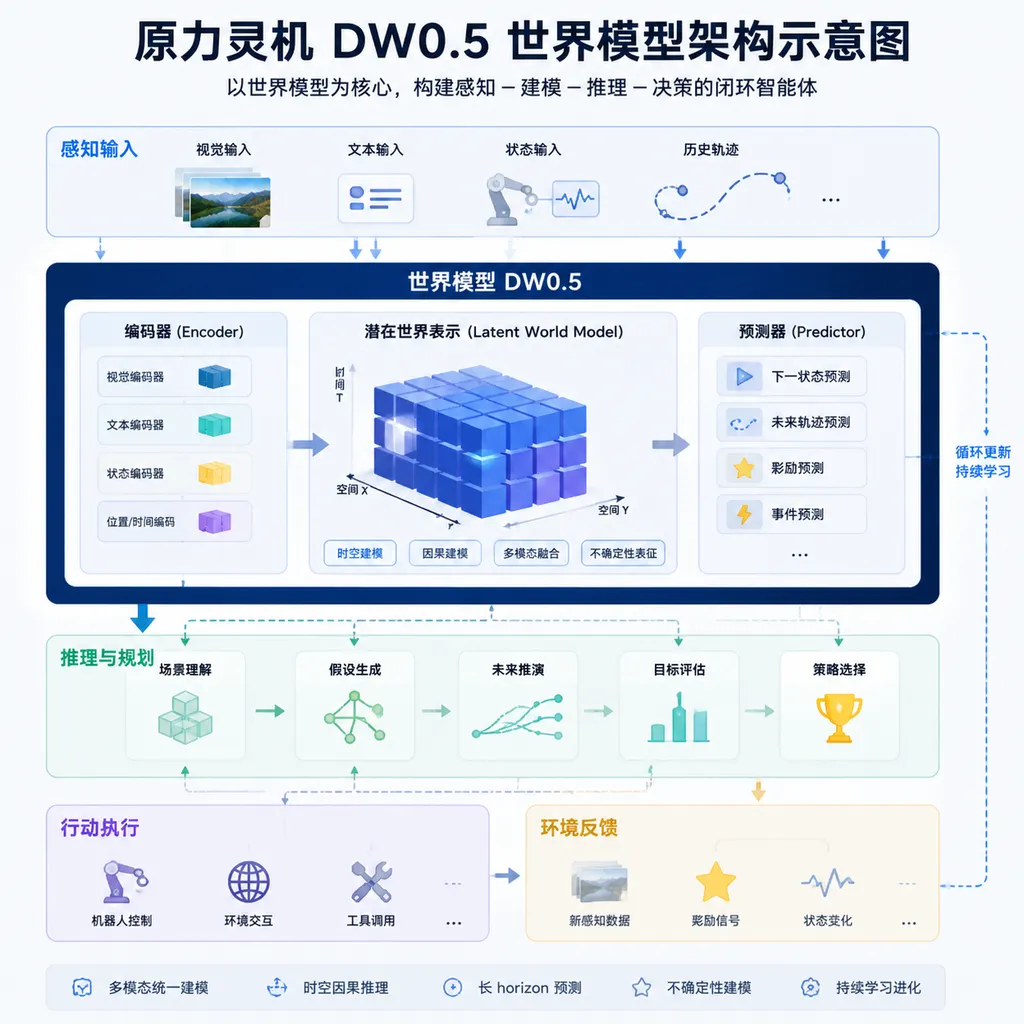
Why VLA Needs a “Coach”
Let’s start with the problem. The biggest pain point for Vision‑Language‑Action (VLA) models today isn’t pretraining — lack of data can be fixed with more collection, and architecture limits can be adjusted — but post‑training.
Embodied models, unlike LLMs, can’t align to human preferences just by reading text. Robots must physically move over and over in the real world before they can tell whether their method of gripping a cup is sound. Over the past year, the standard industry loop has been: collect real‑machine data → label → train → validate on the real machine → collect again. The most expensive segment of that loop is data collection, and the most time‑consuming part is waiting for the robot to complete endless trials in the lab.
The result: a serious embodied‑AI company spends tens of millions a year just to maintain fleets of robots, facilities, and consumables required for post‑training. Worse, the process doesn’t scale — if you want developers to use your model, can you also expect them to build a whole robot lab? Unrealistic.
DW0.5 aims to break this deadlock. The logic follows the same thread as “simulation training” in autonomous driving: if the real machine is too expensive, let the model crash into virtual walls instead. The difference is that driving simulations deal with structured environments, while embodied manipulation faces a much tougher challenge — contact physics, soft‑body deformation, and friction details raise the difficulty by an order of magnitude.
What DW0.5 Does: Rehearsing the Future
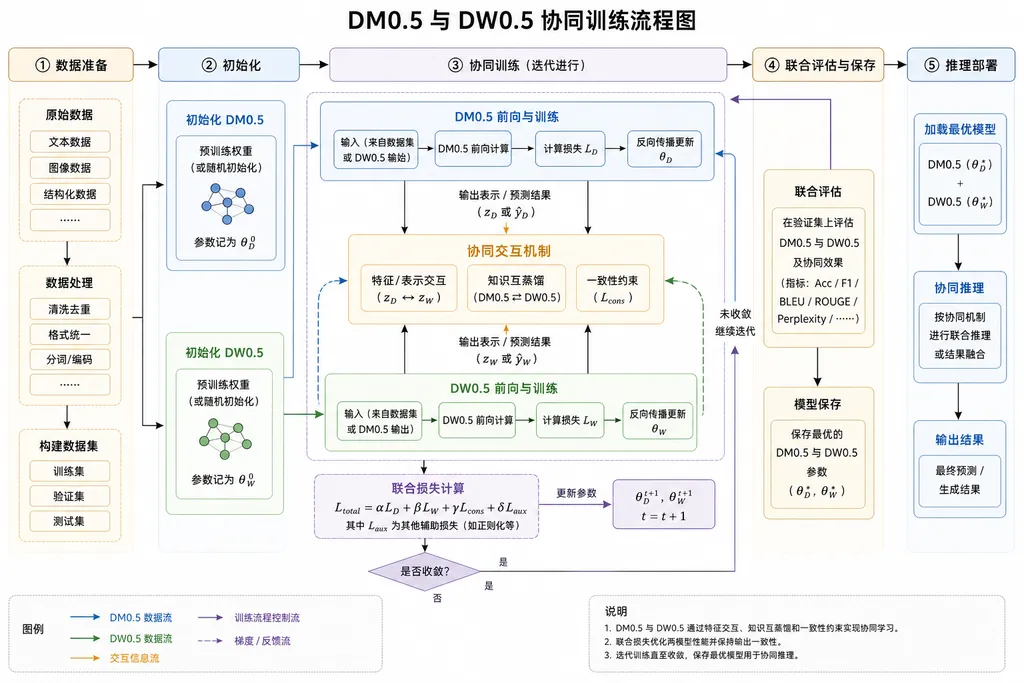
The process splits into three steps:
- DM0.5 generates candidate actions — the base model proposes a set of initial action policies;
- DW0.5 “runs” the future in the virtual world — as the world model, it bulk‑runs simulations of how those actions would unfold: successful trajectories, failed ones, and recoverable “almost‑failed” corrections;
- CFG‑RL scoring feedback — a specialized reinforcement‑learning coach module scores each trajectory’s task progress, boosting the value of success, sharply penalizing failure, and updating model weights in real time.
This loop, called DFOL 2.0, is the core of ForceBrain’s post‑training toolchain.
The key word is “batch.” A real‑world trial happens once per attempt, but in the virtual world, thousands of trajectories can run in parallel — and the system can purposely design rare but valuable edge cases, like deliberately letting the gripper slip or nudging an object off‑center to see if the model can recover. These “failure‑recovery” trajectories are almost impossible to collect in the real world but are crucial for robustness.
According to the company’s disclosure:
- Real‑machine data demand down ~60%
- End‑to‑end training cost down ~40%
If those numbers hold, the industry’s notorious post‑training cost barrier has just been broken down substantially.
The Accuracy of the World Model Is the Critical Weak Point
At this point, an experienced reader will ask: can trajectories generated by the world model really serve as training signals? If its “future” doesn’t match real physics, won’t the model just learn illusions?
This is the notorious sim‑to‑real gap in embodied‑AI training. ForceBrain tackles it head‑on: DW0.5 adopts a multimodal generative world‑model approach rather than traditional rigid‑body physics engines — the latter offer precision but poor generalization, requiring parameter retuning for each new object or material.
The generative world model benefits from large‑scale real‑machine plus human‑operation data, learning physical intuition. According to the same disclosure, DM0.5’s dataset covers 150 k hours: 50 k hours of real‑machine data, 100 k hours of first‑person human operation data (with millimeter‑level 3D hand‑keypoint labels), plus over a million high‑precision navigation samples. These data also feed DW0.5, giving it solid priors such as “how an object slides when slightly pushed.”
Of course, data‑driven world models can’t fully remove the sim‑to‑real gap. DFOL 2.0 uses hybrid training — large‑batch runs in virtual space calibrated with small‑batch real‑world trials. That’s why the real‑machine requirement “drops by 60%” rather than “goes to zero”: real data still provide validation and fine‑tuning; they simply no longer bear the main trial‑and‑error load.
Compared with Competitors: Not Simulation Training but Simulation Sparring
Placing DW0.5 in the market context clarifies its role.
Abroad, NVIDIA’s Isaac Sim and Isaac Lab exemplify traditional simulation‑based training, built on physics engines that deliver high accuracy but struggle with soft materials, fluids, and complex contacts. Google DeepMind’s RT‑X series this year takes the opposite route — pure large‑scale real‑machine data — achieving generalization at costs only Google can sustain.
Domestically, major embodied‑AI players are split: some worship the “real‑machine is king” approach, piling on robots and data; others build software‑only simulators without tight integration with their base models.
DW0.5’s differentiation lies in being designed as a “sparring partner” tightly coupled with the VLA base model, not a general simulator. Its purpose is clear: score DM0.5’s policies, generate feedback, and drive reinforcement learning. It doesn’t seek perfect physical fidelity, only a sufficiently reliable value signal.
This “good‑enough” engineering philosophy is actually the proper way to use today’s generative world models. Think back to AlphaGo’s self‑play: not every move mirrored all complexities of real Go, but as long as win‑loss judgment was accurate enough, strategy evolution thrived.
A Word on DM0.5
Though DW0.5 is the star, DM0.5 as its partner deserves mention.
DM0.5 doubles its parameters over the previous DM0 (from 2 B to 4 B) and scales training data up to 150 k hours. Three key improvements stand out:
- Native memory — supports up to 60 seconds of contextual memory from pretraining onward (not added later), enabling tasks with long dependencies like “tidy up, then return items to original places.”
- Hierarchical reasoning — separates task planning (“which subtask next”) from motion generation (the exact arm movement), linked by counterfactual task training: same intent expressed differently should yield the same result, forcing real comprehension instead of pattern memorization.
- Action alignment — switches from point‑to‑point supervision to trajectory alignment using constrained dynamic programming to compute optimal matches, training the model to learn motion rhythm rather than fixed coordinates.
In evaluations on the Franka single‑arm and Dexmal‑Mint dual‑arm platforms, DM0.5 plus PI0.5 reportedly achieved “leap‑level” improvement in instruction‑following (no precise numbers disclosed). With as little as 50 ms latency and capable of secondary post‑training on a single RTX 4090, these engineering metrics may better indicate real‑world usability than benchmarks.
Packaged into DexDev for Distribution
Having built both the model and the world model, how can others use them? ForceBrain’s answer is DexDev — a developer platform bundling post‑training tools, the robot operating system DexOS, and pay‑per‑use MaaS (Model‑as‑a‑Service).
The MaaS layer is particularly notable: it’s the first truly pay‑per‑call model service in embodied AI, mirroring LLM cloud services:
- General model — zero‑shot use via API, billed by token;
- Custom model — developers upload their robot data, adapt with ForceBrain’s base and training tools, host in the cloud, billed by GPU time.
One is “plug‑and‑play,” the other “fine‑tune‑as‑needed.” The two paths replicate the evolution of LLMs from general to fine‑tuned.
The accompanying DexOS + ECP protocol targets the N×M nightmare of model–robot adaptation — M models versus N robot bodies, each needing separate pairing. DexOS aims to be the “Android for robots,” standardizing interfaces so each side only connects once, with OS‑level abstraction smoothing differences. The ambition is large; success depends on ecosystem adoption.
Some Perspective
Within this year’s embodied‑AI progress, DW0.5’s importance lies less in its raw metrics and more in the fact that it marks a paradigm shift in post‑training — from “real‑machine data piling” to “reinforcement learning in virtual worlds.”
A similar shift already occurred in autonomous driving: early reliance on real‑car road tests gave way to hybrid high‑fidelity simulation plus real‑car calibration. The embodied domain is headed the same way; the question is who executes first and cuts costs first.
ForceBrain’s strategy is to package the entire chain in one sale: the model (DM0.5), world model (DW0.5), post‑training toolchain (DFOL 2.0), operating system (DexOS), cloud service (MaaS), hardware platform (Apex), and industry solutions (Ferrata). It’s an ambitious combo — every component must keep up. DW0.5, as the core sparring mechanism, directly determines whether the whole MaaS approach can stand: developers paying to use your MaaS are counting on a “train‑without‑buying‑robots” solution.
If that 60% reduction in real‑machine data holds true in developers’ hands, it signals an industry milestone. If it only works on ForceBrain’s internal test set, more validation is needed. The period before the second Action Developer Conference will be the test window for DW0.5’s real‑world performance.
For domestic developers, note that world models like DW0.5, centered on vision generation and multimodal reasoning, demand strong underlying multimodal‑model calls — mainstream systems like GPT‑5, Claude, and Gemini are already widely used for instruction parsing and scene understanding in embodied tasks. For similar research, aggregation platforms such as OpenAI Hub — one key accessing all major models, OpenAI‑format compatible, directly reachable domestically — can save considerable setup time, especially for multi‑model comparison experiments.
References
- DM0.5 – ForceBrain Official Model Page — Official technical introduction and release information for DW0.5 & DM0.5


