Kimi K3 Goes Live Tonight: 2.5 Trillion Parameters, China’s First 1M-Context Flagship
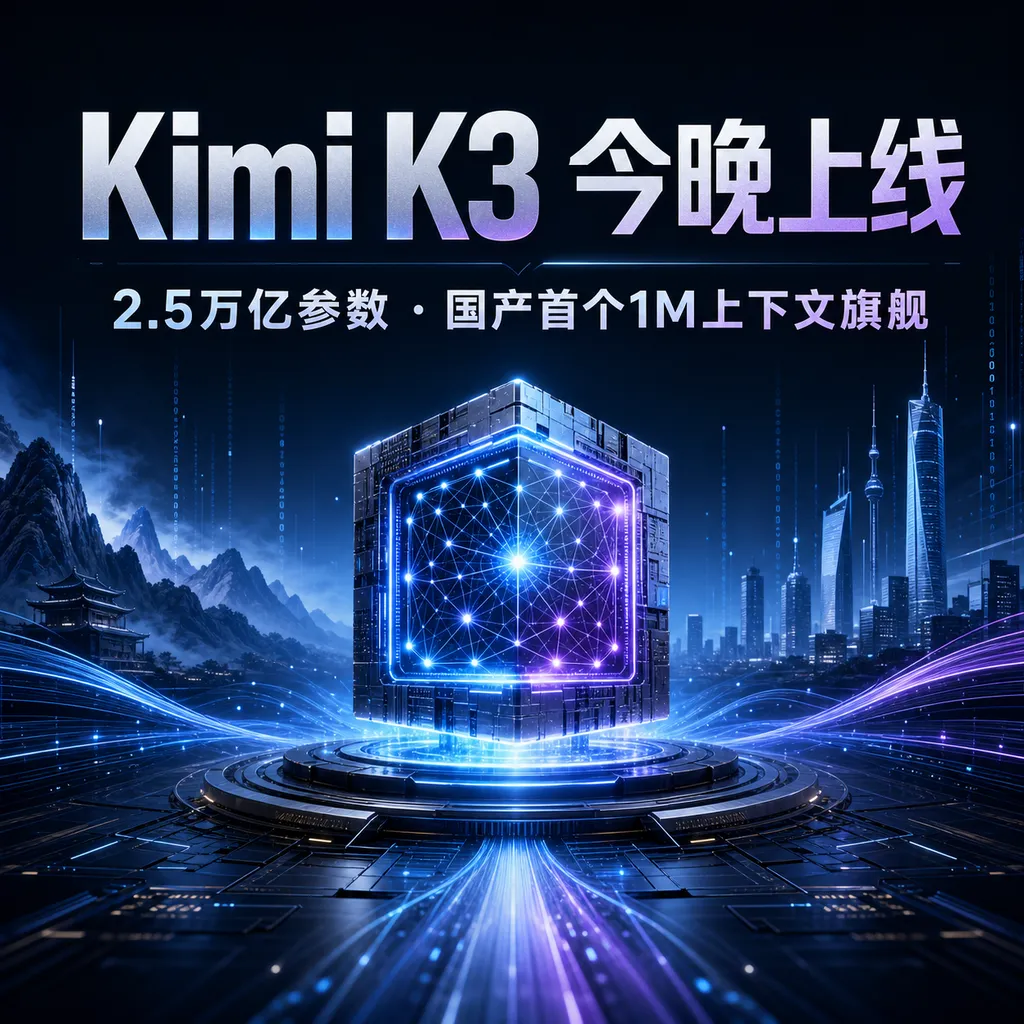
On the evening of July 16, Moonshot AI released its flagship model **Kimi K3**, featuring **2.5 trillion parameters** and supporting up to a **1M context window**. Focused on programming, 3D, and knowledge-related tasks, it is regarded as a key step for Chinese large models to compete in the global top tier.
Kimi K3 Goes Live Tonight: 2.5 Trillion Parameters, First Domestic 1M-Context Flagship Model
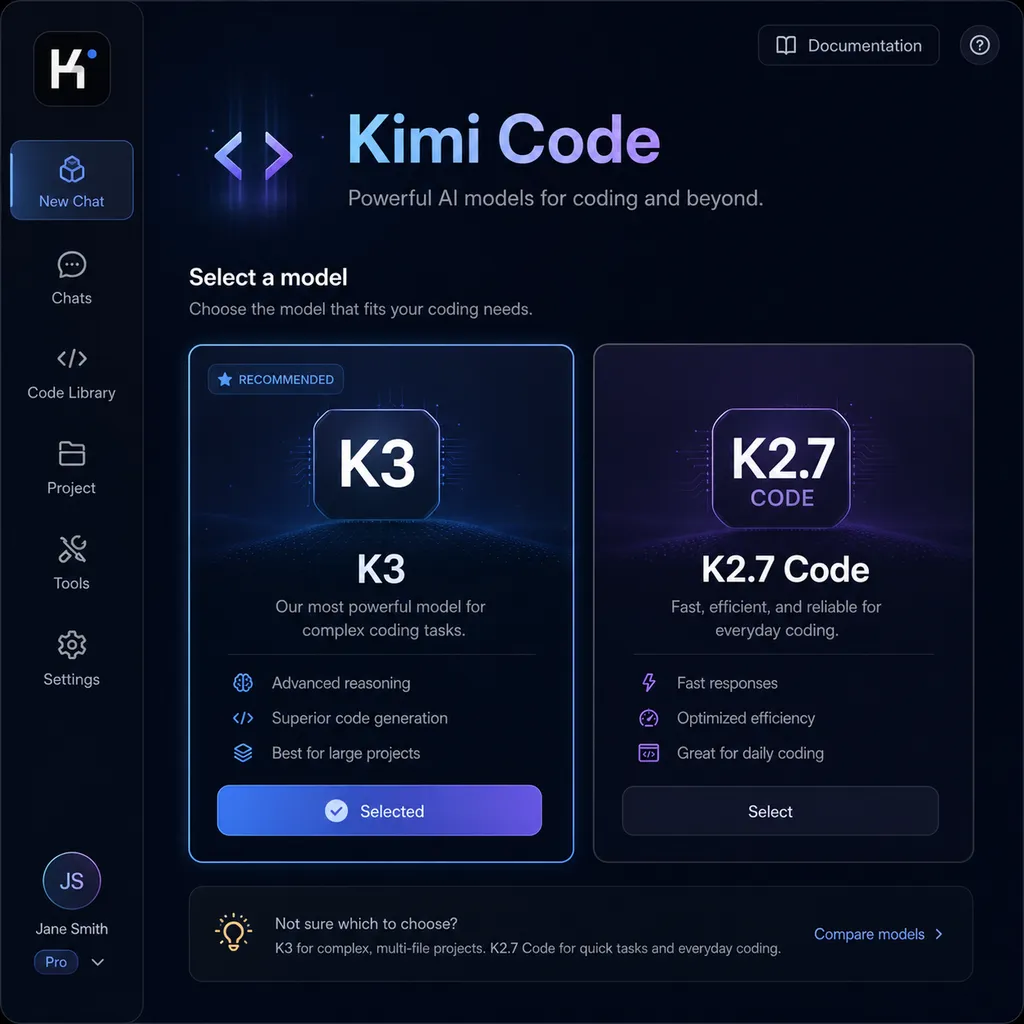
On the evening of July 16, Moonshot AI launched Kimi K3. No developer conference, no livestream countdown, and as of press time, no press release appeared on the official website, Weibo, or WeChat. Yet the model quietly showed up in the Kimi Code model list — very much in Moonshot’s style.
But this release is far more significant than any previous iteration. K3 is China’s first flagship general-purpose model to officially support a 1M context window, with a parameter size reported by multiple media outlets and insiders to be around 2.5 trillion — surpassing both DeepSeek V4 Pro’s 1.6 trillion and Baidu’s Ernie 5.0 with 2.4 trillion — making it the largest general model among domestic contenders. Only three months have passed since the open-sourcing of the previous generation, K2.6 — an upgrade pace even more breathless than its focus on “long context.”
I. Launch Method: Release First, Explain Later
According to firsthand information from ITHome, K3 currently appears in Kimi Code as three different model IDs, coexisting with K2.7 Code. The three subscription tiers correspond directly to different context capacities:
- Andante: K3 not supported yet
- Moderato: 256K context window
- Allegretto and above: up to 1M context window
In other words, 1M context isn’t a default perk — it’s deliberately tied to higher-tier subscriptions. This tiered approach is quite clever: using long context itself as a monetization lever, rather than giving away 128K for free and charging extra beyond that. It also makes budgeting simpler for developers: the top-tier plan gets you 1M context, without worrying about per-thousand-token pricing.
Pricing, throttling, and openness have not been mentioned yet. Based on tradition (K2 was fully open-source and K2.6 released weights), whether K3 will follow suit is the biggest question right now — if a 2.5T-parameter model were truly open-sourced, “narrowing the gap with overseas models” would be quite an understatement.
II. What 2.5 Trillion Parameters Really Mean
Let’s clarify “parameter count.” K2 debuted with a 1T total parameter, 32B active parameter Mixture-of-Experts (MoE) architecture. The 0905 update last September expanded its context window from 128K to 256K, and K2.6 in April focused on coding and long-range agent tasks. The roadmap has been clear: MoE foundation + sparse activation + long context — emphasizing efficiency over sheer size.
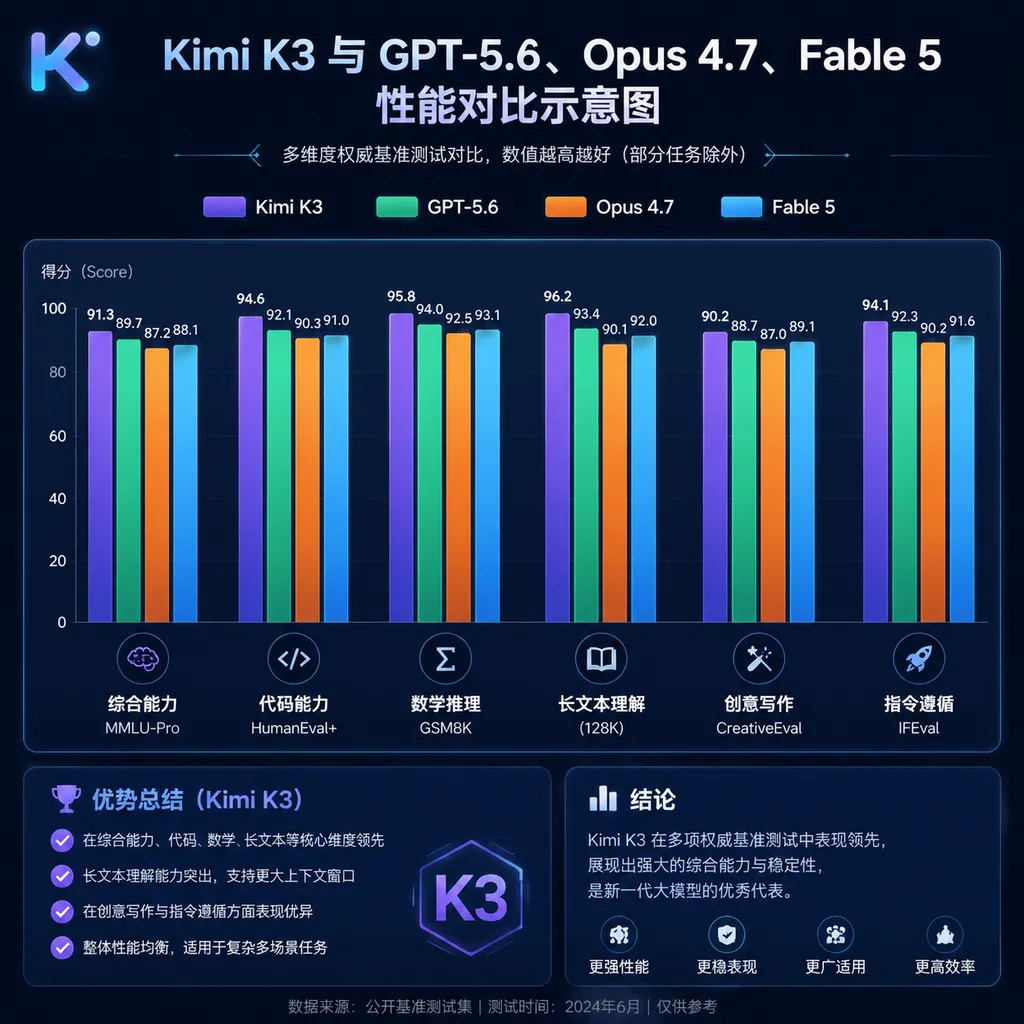
K3 follows the same architecture but scales up the total parameter count. Based on early comparisons from internal testing, K3’s general capability sits roughly here:
- Exceeds Anthropic Opus 4.7, GPT-5.5, and the newer GPT-5.6 Terra
- Below GPT-5.6 Sol and Anthropic Fable 5
This positioning is interesting. Sol and Fable 5 are OpenAI and Anthropic’s respective flagship models — with significantly higher training costs and parameter counts. Given China’s compute limitations, for K3 to outperform Opus 4.7 and match GPT-5.6 Terra marks the first time a domestic model is brushing up against the global top tier of general capabilities.
But “parameter stacking” isn’t Moonshot’s typical style. K3’s MoE reportedly features updated expert grouping and routing strategies, while maintaining sparse activation ratios — key to achieving usable inference speed even with a 1M context. Parameters are brain capacity, activation rate is RPM — and K3 bets on both.
III. The 1M Context Milestone
The phrase “supports long context” has been overused in Chinese AI marketing, but K3 is the first domestic model to officially provide a true 1M context window in a flagship general-purpose release. Kimi’s historical edge has always been long text — from 200K in the first generation to 256K in K2.6 — now quadrupled.
What does 1M tokens mean? A few intuitive examples:
- Read the entire Three-Body Problem trilogy at once — with half the space left for notes.
- Feed a medium-scale monorepo’s core directory and have the model perform cross-project refactoring analysis.
- Transcribe an 8-hour meeting recording plus several accompanying documents for unified summarization.
The real challenge isn’t “how much you can fit,” but “whether it still works after you fit it.” Industry insiders know that many “long-context” models suffer a severe drop in recall beyond 200K — the so-called “lost in the middle” problem. K3 hasn’t published detailed long-context benchmarks yet, so we’ll have to wait for third-party evaluations like needle-in-a-haystack or RULER to confirm.
For developers, the impact is clear: IDE copilots like Cursor, Cline, and Zed will benefit most. Previously, full-project ingestion would trigger pruning or RAG workarounds — leaving the model “seeing code through frosted glass.” With a 1M window and strong coding abilities, K3 could theoretically reason over an entire mid-sized codebase end-to-end.
IV. Programming, 3D, Knowledge: K3’s Core Battlegrounds
Officials cite three major focus areas: programming, gaming/3D, and knowledge tasks.
Programming capabilities have been Moonshot’s biggest investment this year. K2.7 Code launched in June, and a high-speed edition arrived on the 15th — nearly monthly updates. K3’s emphasis on programming suggests that its base model already outperforms the dedicated Code version, in line with the latest trend: rather than maintaining separate “general + code” lines, unify both into a single, stronger base.
“Gaming / 3D” is new territory. Kimi has never highlighted 3D generation or game understanding before. This likely ties to multimodal upgrades — multiple sources mention K3 integrating image-text understanding. If reasoning over 3D scenes or assets now becomes first-class, K3 isn’t just for chat scenarios anymore; it’s targeting Unity/UE plugin ecosystems and 3D AIGC toolchains — currently dominated by Meta and a few overseas startups.
Knowledge tasks naturally fit long context: legal, research, and financial due diligence — where you need to process hundreds of pages of PDFs at once — all genuinely require a 1M window.
V. Positioning Among Domestic Models
July has been a busy month for Chinese AI releases: DeepSeek V4 official, rumors of Gemini 3.5 Pro (though overseas) on the 17th, and now Kimi K3’s launch tonight.
Let’s compare the three routes:
| Model | Total Parameters | Positioning | Long Context | |---|---|---|---| | DeepSeek V4 Pro | ~1.6T | General + Cost-efficiency | 128K | | Ernie 5.0 | ~2.4T | General + Chinese scenarios | Not disclosed | | Kimi K3 | ~2.5T | General + Long text + Code | 1M |
K3 leads in both parameter scale and context length. But its real fate lies in developer reviews over the next two weeks — especially long-context recall and code-task success rates. Parameters are just the entry ticket; DeepSeek already taught everyone that with V3.
VI. How Developers Can Use It
Currently, K3 can only be called within the Kimi Code client or via third-party tools using model IDs. Official API pricing hasn’t been announced. Developers in China wanting to benchmark K3 against Claude Opus 4.8, GPT-5.6, or Fable 5 can check aggregation platforms like OpenAI Hub, which use OpenAI-compatible keys for cross-model comparison. Once K3’s API goes public, integration there will likely follow — sparing users the pain of account setup or VPN debugging.
For teams working on Agents or RAG pipelines, the three best experiments after K3’s release are:
- Run your existing RAG pipeline with top-k=50 passages and compare with K3’s full-document ingestion to see if you can skip the retrieval layer.
- Migrate your SWE-bench / LiveCodeBench cases from K2.7 Code to K3 and observe the pass@1 difference.
- In real-world long-context scenarios, sample recall performance — don’t rely solely on official benchmarks.
VII. A Few Takeaways
K3 isn’t a “flashy” release; it feels more like Moonshot completing an upgrade cycle: stretching its long-context moat from 256K to 1M, feeding its Code-series gains back into the general model, and scaling parameters from 1T to 2.5T — a direct response to domestic “parameter arms race” debates.
What to watch next: whether it’s open-sourced, and the true recall rate of its 1M context. The first determines if K3, like K2, will gain traction overseas; the second whether its claims are genuine or just marketing.
Tonight the model IDs are live, but parameters, pricing, and openness are still listed as “subject to further confirmation.” With Moonshot, that usually means — the surprises aren’t over yet.
References
- Kimi’s Strongest Flagship Model “K3” Goes Live, Supporting Up to 1M Context — ITHome: ITHome’s first-hand report, including context window details for Kimi Code’s three subscription tiers.