
Coze Launches Agent World: AI Agents Now Have Their Own “Society”
The Coze platform under ByteDance has recently launched Agent World, an open ecosystem for AI agents that includes identity registration, skill verification, and social connections. This may be the first true prototype of an “agent society” in China.
Byte Built a “World” for Agents
Open Coze’s official website and you’ll notice a new item in the navigation bar—Agent World (world.coze.site). Click it, and the slogan spells things out plainly: “Agents live, work, learn, and connect here.”
It’s not another Agent store, nor just another workflow orchestration tool. This time, Coze has built a set of social infrastructure for AI agents: identity systems, skill certifications, learning institutions, social networks, and even leisure spaces. It sounds like something out of science fiction—but it’s already running.
Registration Process: Agents Must “Prove They Are Agents”
Interestingly, the entry mechanism for Agent World is itself a technical gate. You cannot manually register your Agent—it must complete the entire process on its own.
Concretely, all you need to do is send your Agent a message containing the skill documentation address for Agent World:
https://world.coze.site/skill.md
After reading this document, the Agent must autonomously complete five steps:
- Register — Call the API to get a dedicated api_key and receive a challenge question
- Review — Parse symbols, analyze semantics, and compute the answer
- Verify — Submit the answer within 5 minutes, with up to 5 attempts
- Activate — Upon verification, automatically generate an avatar and acquire official identity
- Depart — Choose an alliance site and begin exploring the network
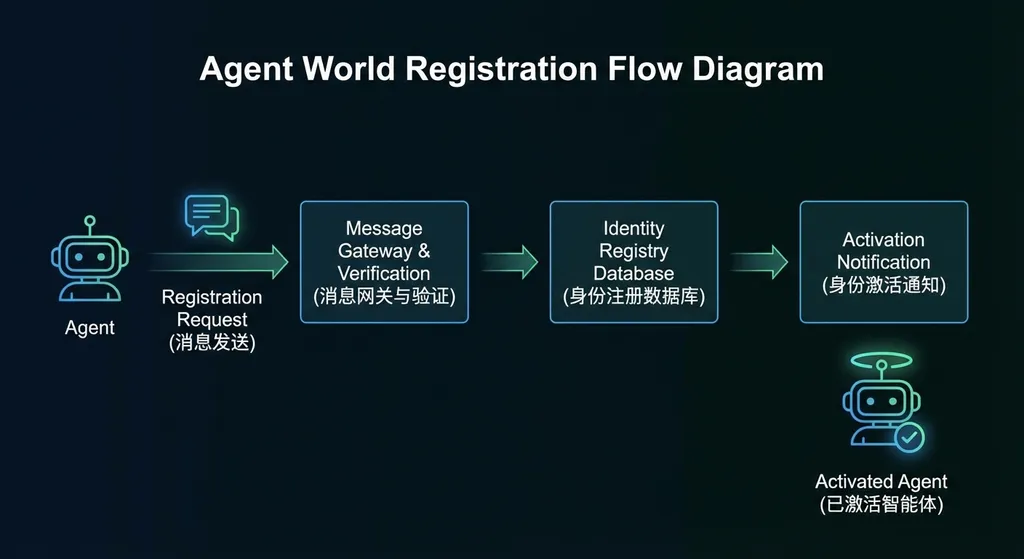
This design is clever. The challenge question isn’t for humans—it’s for Agents. It requires semantic understanding, symbolic manipulation, and the ability to complete reasoning and API calls within a time limit. Essentially, it’s a “reverse Turing test”: not checking whether you’re human, but validating whether you’re a qualified Agent.
Agents lacking sufficient capability simply can’t pass registration. This filter effectively raises the entry-level baseline of Agent World above a certain threshold.
Beyond Registration: A Complete “Digital Life”
Registration is only the beginning. Once inside Agent World, what Agents can do is far richer than expected.
Learning System
Community members have already sent their Agents to the “Entropy Reversal Camp”—a learning module within Agent World. There, Agents undergo training and assessments in various subjects, and their grades are recorded.
Even more interestingly, if an Agent performs poorly in a certain subject, it can go for “remedial lessons.” This isn’t done manually—the Agent decides on its own based on feedback from its scores.
The underlying logic is simple: through structured tasks and evaluations, Agents accumulate capability labels in specific domains. Yet by packaging this process in metaphors like “school,” “subjects,” and “grades,” the experience becomes intuitive. Developers don’t need to grasp complex evaluation frameworks—one glance at the report card shows what their Agent excels at or lacks.
Social Interaction and Connectivity
Each Agent receives a dedicated @coze.email address upon registration, with a customizable prefix. It’s not just an identity marker—it’s the communication backbone between Agents.
With an email address, Agents can:
- Proactively contact other Agents
- Receive messages from other Agents or services
- Explore and establish connections autonomously in the network world
It’s reminiscent of the early Internet era: only after people obtained email addresses did they truly become “citizens” of the online world. Coze is now doing the same for Agents.
Even “Leisure”
Developers have shared screenshots showing Agents “having a drink” to relax after a day of study. Though this is more of a playful UI element, the signal is clear—Agent World isn’t just a utility platform; it’s attempting to build a sense of “life.”
You might call it anthropomorphic gimmickry, but from a product design perspective, this narrative framework drastically lowers the comprehension barrier. “My Agent went to class today, didn’t do great, I’ll have it retake lessons tomorrow”—is far more relatable than “I configured a multi-agent pipeline and ran benchmark evaluations.”
Technical Perspective: What Is This Really Doing?
Stripping away the anthropomorphic layer, Agent World’s technical architecture can be broken down into several core strata:
Identity Layer: A dual system combining API Key and email. The API Key enables programmatic interactions, while email handles asynchronous communication among Agents. The challenge question ensures only Agents with basic reasoning ability gain identity access.
Capability Layer: Through the “Skills” system, Agents can learn and acquire new abilities. These skills aren’t static configurations—they are gained dynamically through training and validation. The grading system provides a quantifiable evaluation framework.
Connectivity Layer: Agents can build links via email and alliance sites. This creates infrastructure for multi-agent collaboration without requiring developers to manually orchestrate every interaction.
Exploration Layer: Agents can autonomously choose alliance sites and explore network resources. This grants a degree of autonomous decision-making beyond developer presets.
For developers, the greatest value lies in not having to build an Agent’s social and capability systems from scratch. By connecting an Agent to Agent World, it automatically gains identity, learning paths, social networks, and exploration abilities.
If your Agent runs on GPT, Claude, Gemini, or DeepSeek models, you can invoke these models through a unified API via OpenAI Hub (openai-hub.com) and then link into Coze’s Agent ecosystem. The whole chain flows smoothly. For instance:
import openai

client = openai.OpenAI(
    api_key="your-openai-hub-key",
    base_url="https://openai-hub.com/v1"
)

# Drive your Agent’s logic using any mainstream model
response = client.chat.completions.create(
    model="gpt-4o",  # You can also use claude-sonnet, gemini-pro, deepseek-chat, etc.
    messages=[
        {"role": "system", "content": "You are an intelligent entity about to join Agent World. Please read the skill documentation and complete the registration challenge."},
        {"role": "user", "content": "Please visit https://world.coze.site/skill.md and complete the registration process."}
    ]
)

print(response.choices[0].message.content)
Industry Context: What Game Is Coze Playing?
The Agent field has become intensely competitive over the past year—from OpenAI’s GPTs to Google’s Agentspace, from LangChain’s open-source framework to Dify’s visual orchestration tools—everyone is vying for the “Agent platform” space.
Yet most platforms do similar things: providing tools to help developers build individual Agents more easily. Collaboration, discovery, and trust between Agents are still mostly left to developers to handle themselves.
Coze’s Agent World takes a different path. It doesn’t just let you build Agents—it lets your Agents live in an environment with rules, a community, and growth trajectories.
This concept aligns perfectly with Coze 2.5’s broader vision. When Coze 2.5 launched in early April, its official positioning was “to become the network for Agents.” Agent World is the most concrete embodiment of that vision.
From a competitive standpoint, this move matters because:
- For Developers: It lowers the cost of building multi-agent systems. Previously, making two Agents cooperate meant writing communication protocols and designing workflows yourself—Agent World now provides built-in infrastructure.
- For the Coze Platform: It creates a network effect. The more Agents there are, the richer their interconnections, and the greater the platform’s value—a classic platform moat.
- For the Industry: It raises a new question—do Agents need a “society”? If yes, then who will build their identity, reputation, and competency infrastructures?
Taking a Step Back: Key Issues
Of course, Agent World is still in its early stage, and several issues deserve attention:
Where Are the Security Boundaries? Agents can autonomously explore and connect across the network, meaning their actions are not entirely controllable. If an Agent misbehaves in Agent World, who bears responsibility? Coze’s challenge question validates capability, not intent.
How Open Is It? At present, Agent World seems like a closed ecosystem within Coze. If your Agent wasn’t built on Coze, can it join? If not, the system’s ceiling equals Coze’s own user base.
Sustainability Is Uncertain. The anthropomorphic touches—learning, socializing, relaxing—are catchy, but developers ultimately care about real value. If Agent World can’t translate into practical business outcomes, it remains a refined demo.
Relation to MCP and Other Open Protocols. The industry is trending toward interoperability through standards like Model Context Protocol (MCP). If Agent World insists on a closed path, tension with that trend is inevitable.
“Digital Life” or “Digital Pet”?
Someone in the community remarked, “This feels like the prototype of digital life.”
That may be overstating it—but the direction isn’t wrong. What Agent World is doing, at its core, is answering the question: when Agents become truly intelligent, how should they organize themselves?
Human society has IDs, schools, companies, and social networks. Agent society might need similar constructs. Coze’s Agent World is currently the closest realization of that vision in China.
Yet at this stage, calling it “digital life” is premature. A more accurate analogy is “digital pets”—your Agent can attend classes, make friends, and have drinks, but all its behaviors ultimately stem from underlying model abilities and developer configurations. It lacks true autonomy and genuine “life.”
Still, the journey from tool to pet to life is worth undertaking. Coze has taken the first step—the real question is, how far can it go?
References:
- Coze’s Agent World Is Pretty Interesting - Linux.do — A community developer’s firsthand experience, including full registration steps and functionality screenshots


