German Alliance Open Sources Soofi S: 30B Hybrid Architecture Tops Bilingual Benchmarks
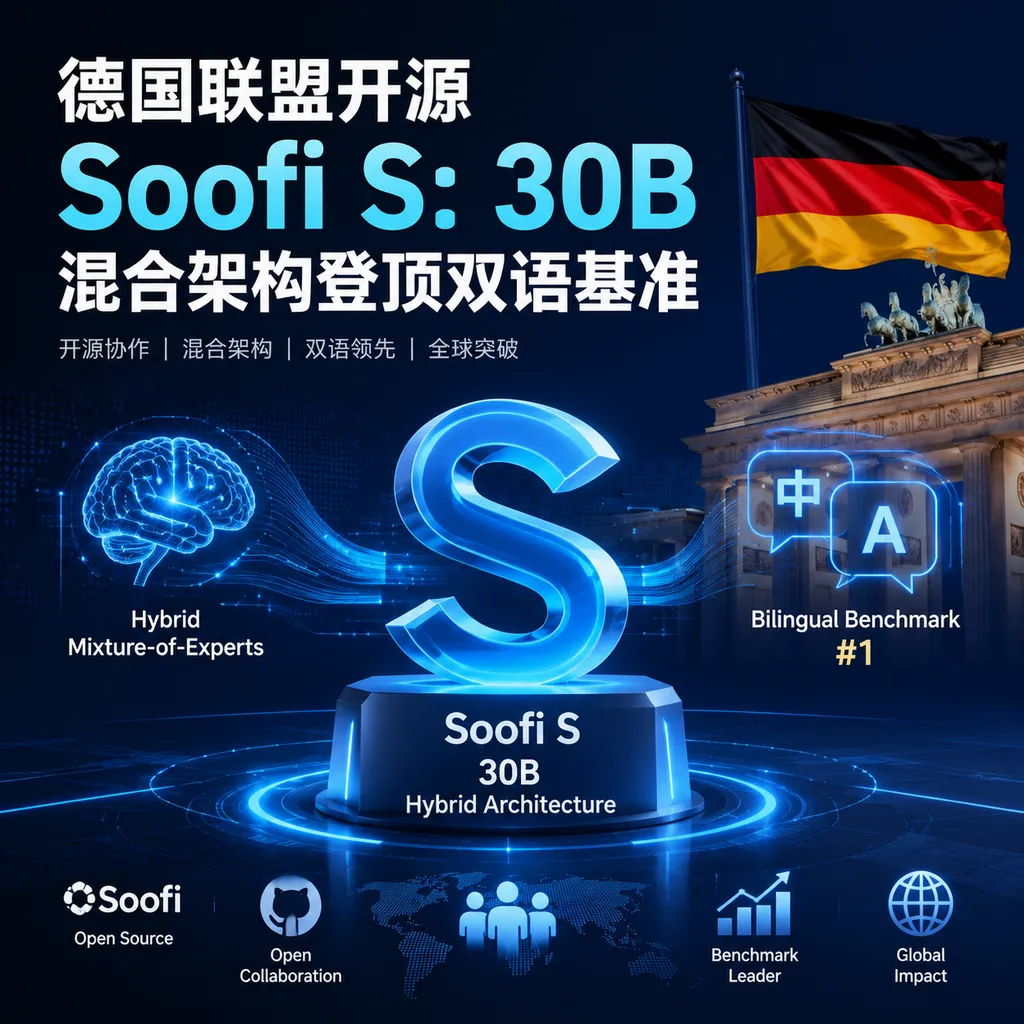
The industry-academia alliance led by the German AI Association released **Soofi S 30B-A3B** on **July 13**, featuring a **Mamba-2 and attention hybrid MoE architecture**. It set new records on the **German-English bilingual** and **code benchmarks** among fully open-source models, with the entire training process conducted on **Deutsche Telekom’s AI Cloud**.
This Time Europe Isn’t Just Talking About Sovereignty—It’s Released a Model That Can Really Compete
On July 13, an industry-academia-research alliance spearheaded by the German AI Association (KI Bundesverband) released Soofi S 30B‑A3B through a public channel. According to its official pretraining report, this 31.6‑billion‑parameter model outperforms the two previous open‑source benchmarks—Ai2’s OLMo 3 32B and EPFL/ETH Zurich’s Apertus 70B—in English, German, and code benchmarks. In short: this is the first time Europe has claimed the top spot under the stricter definition of fully open.
Within the community, fully open is a loaded term. It doesn’t just mean downloadable weights—it means the full stack is released: training data, training code, intermediate checkpoints, and evaluation scripts. Meta’s Llama, Alibaba’s Qwen, and DeepSeek’s models all count only as open‑weights, not fully open. Until now, the only ones truly committed to this standard have been Ai2’s OLMo series and the veterans of EleutherAI. With Soofi S joining the race, Europe has finally shown up in this tougher league—and not by brute‑forcing parameters: its active parameters total only 3.2 B.
Hybrid Architecture: Mamba‑2 Plus Attention—Half the Hardware Budget, Twice the Mileage
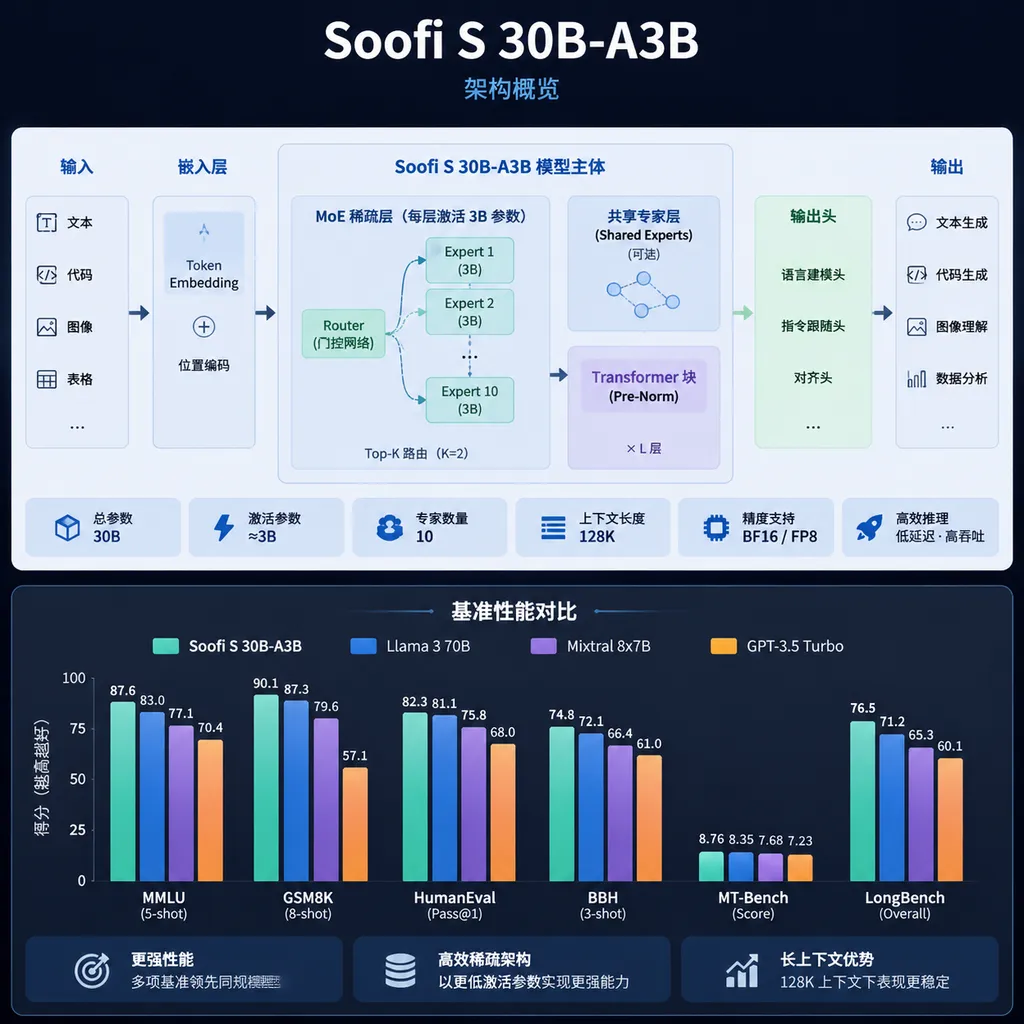
On to the technical details. Soofi S employs a hybrid structure that alternates Mamba‑2 state‑space layers with Transformer attention layers, plus a top‑level MoE (mixture of experts). Total parameters: 31.6 B; per‑token activation: ~3.2 B. This combination has been gaining traction in the open‑source world over the past year for simple reasons:
- A pure Transformer’s long‑context KV‑cache cost in memory and compute grows as O(n²), consuming most VRAM for long texts.
- SSM layers such as Mamba‑2 scale almost linearly with sequence length—lightweight and stable.
- But pure SSMs lag in precise token recall (e.g., copying code or extracting numbers).
Alternating them captures the best of both worlds. The Soofi S technical report puts it plainly—its inference speed stays nearly constant even on very long inputs. In RAG, long‑code, or bulk table‑extraction scenarios, that materially bends the deployment‑cost curve. Roughly speaking: a single A100 that used to handle only short prompts can now run inputs tens of times longer without crashing.
The MoE layer needs no long explanation. With 3.2 B active parameters, each token’s forward‑pass compute is smaller than a dense 3 B model’s, yet it accesses knowledge capacity equivalent to 32 B. That’s become the global norm—DeepSeek V3, Qwen3, Kimi’s K2 all follow that route. More parameters, less compute—it’s the new baseline.
Trained Entirely on Deutsche Telekom’s Cloud—A Real Sovereign Project
Even more notable is the model’s infrastructure lineage: the entire pretraining ran on Deutsche Telekom’s AI Cloud. This isn’t PR fluff. Europe has been preaching “AI sovereignty” for two years, but projects that truly combine “data in‑country, compute in‑country, model fully open, and team in‑country” are rare. France’s Mistral went closed and commercial; Switzerland’s Apertus exists but lags; Germany had only Aleph Alpha, which has since pivoted away from frontier pretraining.
KI Bundesverband’s organizational model is also key. It’s not a corporate initiative but an industry‑academia‑research alliance—the association leads, research institutes design training strategies, Deutsche Telekom provides compute, and multiple SMEs supply data and benchmarks. That setup is natural in Europe yet rare in the U.S. or China. Think of it as a “national‑team + cloud vendor + university” consortium whose outputs go straight into the public domain for anyone to commercialize.
From a policy standpoint, this is a tangible deliverable for last year’s German Federal Economy Ministry program supporting open‑source foundation models.

Benchmark Results: Dominant in German, a Pleasant Surprise in Code
Three highlights stand out in the pretraining report:
German benchmarks: as expected. Soofi S’s corpus heavily favors German, and it trounces OLMo 3 32B and Apertus 70B on MMLU‑de, HellaSwag‑de, TruthfulQA‑de, and other localized tests. For practical users—European legal, medical, government, and telecom clients long complaining that mainstream open models are “usable but unprofessional” in German—this is the first fully open model whose performance slide deck can rival closed alternatives.
English benchmarks: this shows true skill. Despite a German‑centric training target, the model still beats the U.S.‑made OLMo 3 32B on general English tasks—proof its data mix and recipe were finely tuned rather than brute‑forced by corpus imbalance.
Code tasks: the report says Soofi S performs “surprisingly well” on code generation. Hybrid + MoE architectures tend to do well in code, but topping Apertus 70B was unexpected—remember, active params = 3.2 B.
A caveat: the ceiling for the fully‑open track is lower than that for open‑weights. Soofi S 30B‑A3B still trails top open‑weights models like Qwen3 or DeepSeek V3 in overall capability. Its real value lies in “reproducible, auditable, research‑ready” openness—not replacing DeepSeek or Qwen in production. Keep that perspective; don’t let the word “top” mislead you.
How to Use It—and Where
For developers, three practical matters:
- Where to get weights and data: they’re expected on Hugging Face with full checkpoints and training datasets—gold for fine‑tuning, domain adaptation, and interpretability research.
- Inference costs: 3.2 B active + hybrid design means single‑GPU A100/H100 deployment is feasible, and long‑context workloads are far cheaper than dense Transformers of similar size.
- German‑language alternative: building for the DACH (Germany‑Austria‑Switzerland) market? If running GPT‑4o or Claude in German is expensive or raises data‑sovereignty concerns, Soofi S offers a self‑hostable, serious option.
At OpenAI Hub, we’re already evaluating integration. As a one‑click switch among GPT, Claude, Gemini, and DeepSeek, adding Soofi S as a fully open European baseline makes sense for cross‑model comparisons in EU‑language scenarios. Go‑live timing will follow evaluation results.
The Bigger Signal: The Definition of “Open Source” Is Tightening Again
The real headline isn’t a benchmark score—it’s that the bar for “fully open” is being raised again. Last year’s flood of open‑weights models led many to treat Llama 3.3 or Qwen3 as the pinnacle of “open source,” while true full‑openness advocates (Ai2, EleutherAI) faded in voice. Soofi S, emerging from Europe’s “third camp,” reminds the industry that openness isn’t binary—it’s a gradient.
This matters especially to researchers: without data you can’t study bias sources, reproduce training dynamics, or build genuine model‑science work. Soofi S’s full‑stack release will become a key substrate for ablations, scaling‑law tests, and interpretability research over the next 6–12 months.
From a broader geopolitical view, Europe has endorsed its “AI sovereignty” narrative most completely yet—with a consortium project, domestic telco compute, and full open‑source release. Whether Soofi S becomes a continuously iterated line or another one‑off European project now depends on KI Bundesverband’s ability to secure sustained funding and compute. But at least this first step is done.
References
- Hugging Face – Soofi S 30B‑A3B Model Page: expected full downloads of weights, tokenizer, training datasets, and intermediate checkpoints
- GitHub – Open‑Model Comparison Discussions: community discussions on architectural and benchmark differences between Soofi S, OLMo 3, and Apertus
- Reddit r/LocalLLaMA – Soofi S Launch Thread: first‑hand developer reports on hybrid Mamba‑2 + Attention performance in long‑context scenarios