LM Studio releases Bionic: the local Agent finally has a decent framework.
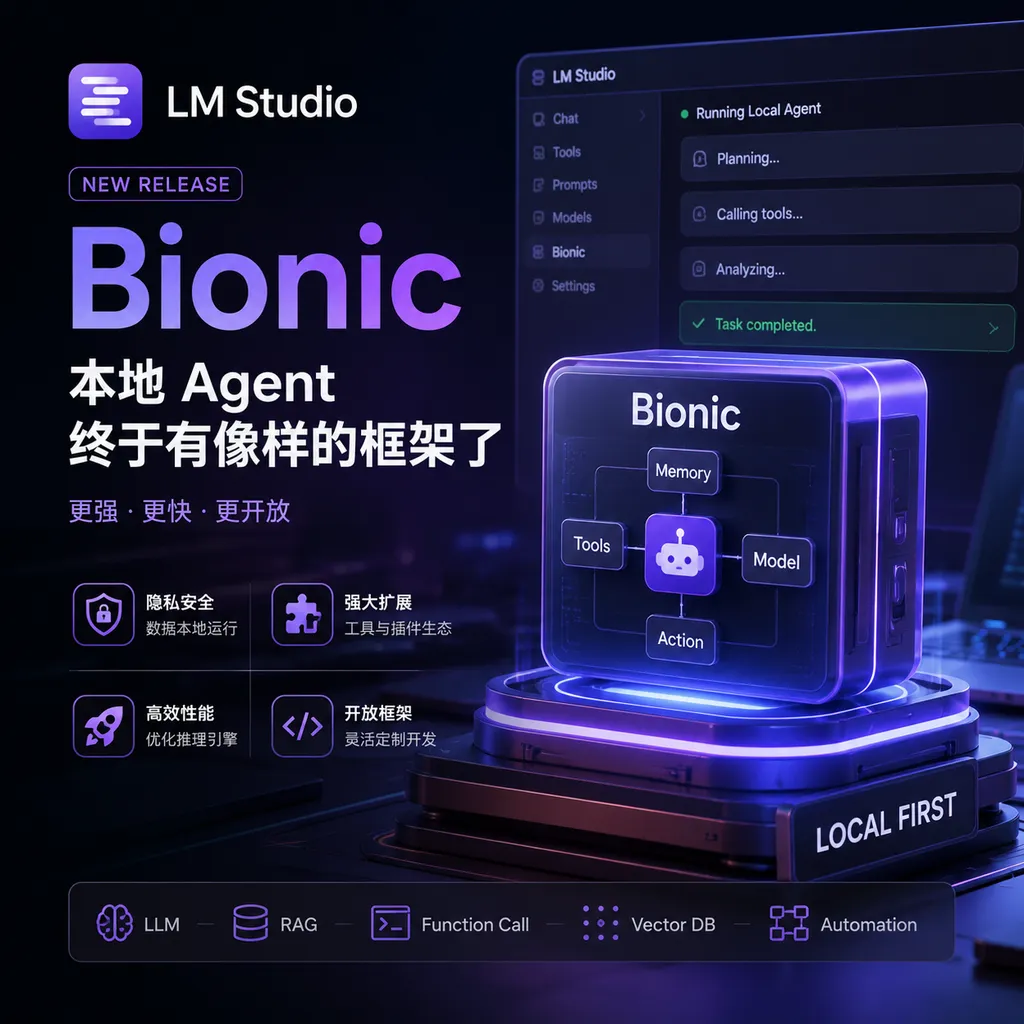
LM Studio launches **Bionic**, an integrated local framework that combines open models, tool invocation, MCP, and agent loops, aiming to solve the long-standing problem of open-source models lacking a cohesive backbone when running agents.
LM Studio Has Launched an Agent Framework
On July 15, LM Studio released something called Bionic—officially described as “an AI Agent for open models.” In short: it’s not another model downloader. It’s an integrated framework that combines local inference, tool use, MCP, and Agent loops, directly embedded into LM Studio’s existing desktop app.
This is quite a noteworthy move. Over the past year, running Agents using local models has been stuck in an awkward state: models (Qwen3, DeepSeek-R1 distillation, GLM, Gemma 3) have caught up in capability, but if you want them to actually do things—use tools, read files, run multi-step tasks—you’ve had to cobble together LangChain, AutoGen, or CrewAI with a bunch of glue code, while also dealing with inconsistent local inference server outputs, tool call parsing errors, and context overflow issues. LM Studio now aims to absorb that entire scaffolding layer.
What Exactly Does Bionic Do
Bionic is essentially a combination of three things.
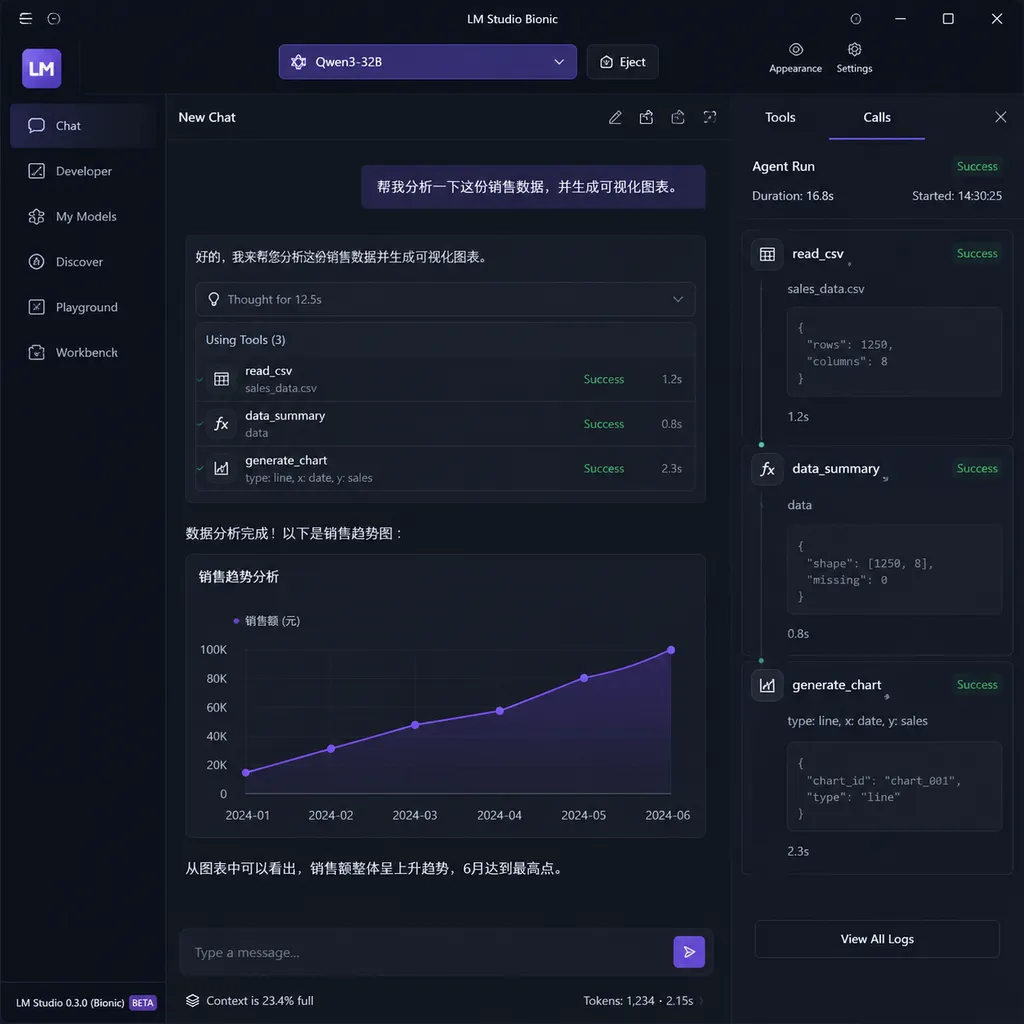
1. A built-in Agent runtime. No need to pip install a pile of packages. Choose a local model (preferably one that supports tool use, e.g., Qwen3-30B-A3B, Llama 3.3, DeepSeek-R1-Distill), select a set of tools, enter a task, and it will automatically run the plan → act → observe loop. LM Studio visualizes this whole flow—the thinking, tool calls, and tool results at each step are displayed in a sidebar, which makes debugging much friendlier than CLI-only solutions.
2. Native MCP support. This is Bionic’s most crucial step. The Model Context Protocol, launched by Anthropic last year, is an open protocol now supported by hundreds of community servers (filesystem, browser, Git, Postgres, Slack, etc.). LM Studio now includes an MCP client, meaning that all the MCP servers you can use in Claude Desktop can be ported to Bionic almost effortlessly—barely requiring config changes. This effectively solves the tools ecosystem problem: LM Studio doesn’t need its own tool library; it inherits a growing protocol ecosystem.
3. Deep adaptation for open models. This is where the dirty work hides. Each open-source model has its own tool-calling format: Qwen uses a Hermes-style structure, Llama uses Llama 3.1’s JSON schema, Mistral uses yet another. LM Studio has unified them at the inference layer, so Bionic’s upper layer sees a standardized tool call interface. Developers no longer have to reimplement parser logic every time they change models—a pain anyone who’s experienced knows well.
Why Now
The timing is intriguing. Just last week, LM Studio released stable version 0.3.29 with a /v1/responses API layer compatible with OpenAI, allowing it to work with frameworks like Microsoft Agent Framework and AG2. Bionic essentially advances “running an Agent locally” from “developers must cobble it together” to “desktop users can do it with a few clicks.”
The broader context: the local Agent field has been heating up rapidly over the past six months. DeepSeek R1-0528 distilled the inference power of a 671B model into an 8B version; Qwen3-VL 4B/8B can now run full multimodal tasks on low-VRAM devices; and Apple’s M5 and NVIDIA’s DGX Spark have raised the ceiling for on-device computing. The combination of small models and powerful local hardware is turning “50–80% of daily tasks stay local” from slogan to executable strategy.
A recent GSR Ventures (Jiazi Guangnian) analysis nailed it: local Agents have been blocked by two factors—first, non-technical users can’t deal with concepts like GGUF, quantization, and context length; second, tools like Ollama or LM Studio were fundamentally “container managers” whose infrastructure wasn’t optimized for Agent scenarios. Bionic marks LM Studio breaking out of that old mold—upgrading from a “local model runner” to a “local Agent platform.”

How It Compares to the Competition
A side-by-side comparison of the main current routes for running local Agents:
Ollama + self-built framework: Flexible, but you have to connect every component yourself—choose the inference backend, install LangChain/AutoGen, write tool wrappers, adjust prompt templates, and handle tool call parsing. Great for engineering teams, not ideal for individuals wanting quick testing.
Claude Desktop + MCP: Smoothest experience and most complete MCP ecosystem, but tied to Claude’s cloud models—privacy and cost sit with Anthropic. Want local models? No chance.
Vertical products like GreenBitAI Libra: Deeply optimized—1–3 bit models reach 100 tokens/s on M3—but they’re full application products, not developer frameworks.
Bionic: Sits in the middle—more open than Claude Desktop (freedom to swap models), less hassle than bare Ollama (built-in Agent loop and MCP), broader than Libra (a framework, not an app). This middle ground is largely unoccupied, making LM Studio’s entry strategically sound.
Of course, there’s a caveat. The main bottleneck for running local-model Agents has never been the framework—it’s the model’s tool-calling stability and long-context inference quality. No matter how good Bionic is, feed it a 4-bit quantized 8B model and a five-step multi-agent task and it can still crash. The official demo uses models starting at 30B, implying real hardware demands: not something you can run smoothly on an average laptop. Think 32 GB RAM minimum, ideally M3 Pro/Max or an NVIDIA card with 24 GB VRAM.
What It Means for Developers
Here are a few notable scenarios:
Private data processing: Lawyers editing contracts, investment managers doing due diligence, doctors reviewing case files—these involve data that can’t leave the device. In theory, Bionic + a 30B-scale open model + a local filesystem MCP can accomplish “have the Agent read a project folder and summarize/analyze it” fully offline.
Offline development environments: On trips, planes, or intranet machines where Copilot-like tools can’t run, now you can pair a local DeepSeek-Coder or Qwen3-Coder with Git/filesystem MCP for basic code assistance.
Education and research: If you want to really understand how Agents work—how tool calling looks internally, what each step in the ReAct loop transmits—Bionic’s visual panel is far clearer than reading logs.
A quick note: if you still want cloud-based flagship models for comparison alongside local Agents, platforms like OpenAI Hub let you hit GPT, Claude, Gemini, and DeepSeek with one key via OpenAI-compatible APIs. A hybrid deployment—local for main workloads, cloud for hard cases—is a pragmatic setup for now.
Some Perspective
Bionic won’t revolutionize anything in the short term. It’s not a new paradigm, and technically there’s nothing radically original—it just integrates an MCP client, an Agent loop, and a tool panel into a desktop app. But it’s doing the right thing: lowering the entry barrier for local Agents from “developer-only” to “accessible for technically literate users.”
The bigger story is LM Studio’s strategic shift. For the past two years, the company has been quietly building a reputation as a solid “local model runner.” Good reviews, but limited ceiling—the runner-only value is being diluted as Ollama and llama.cpp mature. Bionic is its first open move toward becoming an Agent platform. Looking ahead, if LM Studio can keep deepening its work in MCP integration, model adaptation, and Agent orchestration, it could become the desktop entry point for local AI—much like VS Code is for code editing.
The real competitors aren’t Ollama—they’re whether Anthropic ever opens up Claude Desktop to local models (unlikely), and when Apple turns its Foundation Models framework into something truly developer-usable (in progress but slow). In that window of opportunity, Bionic has made its move.
References
- Local Model Deployment Powerhouse: LM-Studio—You Might Be Using Only Half of It — Zhihu article introducing LM Studio’s early positioning and features, for background context.