Libretto threw out the PR Agent: Playwright crashed itself and fixed it

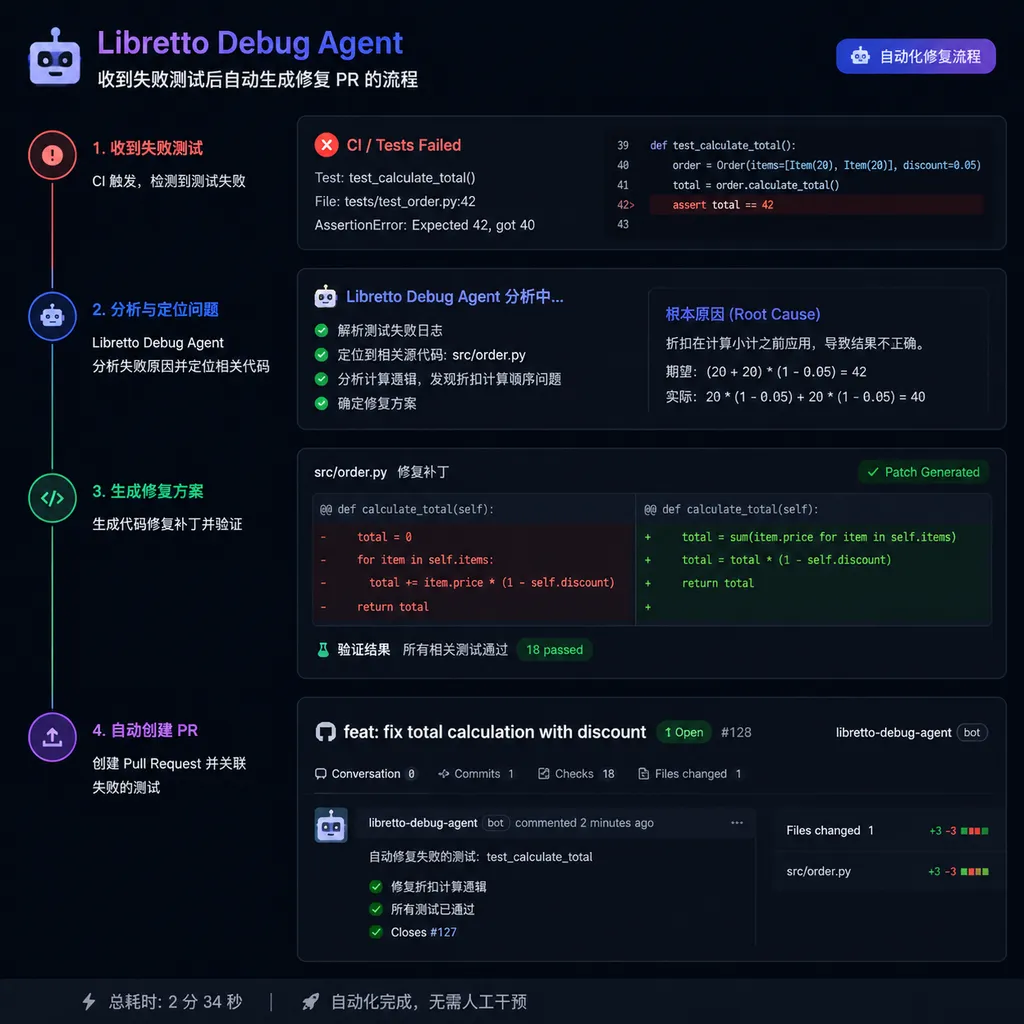
Libretto has launched a debugging Agent that automatically fixes Playwright scripts and pushes the repaired tests back to the repository directly as a PR, directly taking on Playwright v1.56’s official Healer Agent.
Libretto Turns Playwright Script Fixing into an Auto‑PR Agent
On July 15, the testing‑tool startup Libretto released Debug Agents on Hacker News. In one sentence: when Playwright breaks in your CI, it automatically fixes the script, opens a PR, and waits for your review.
Sounds familiar? Back in October last year, Playwright v1.56 officially introduced the Healer Agent, bundling the planner, generator, and healer trio into the CLI. TestSprite also sells similar self‑healing capability; its official numbers claim one iteration raised the pass rate from 42% to 93%. But Libretto’s angle differs—it doesn’t ask you to loop inside your local IDE; instead, it takes over the entire “diagnose → fix → open PR” flow inside the CI pipeline. Two distinct product philosophies: one is an editor plug‑in for test writers, the other a hosted service for teams that no longer want to maintain tests themselves.
A Small Thing That Hits the Most Painful Spot of E2E Testing
Anyone who’s done end‑to‑end tests knows the “fragility” of Playwright scripts isn’t mysticism. A front‑end developer changes a data-testid, swaps a <button> for a <div role="button">, or wraps one more Suspense layer that slows the first paint—any of these can flood your CI with red. In theory, the tests should change in sync, but in reality that checkbox “I’ve updated related tests” on a front‑end PR is rarely ticked seriously.
This creates an awkward loop:
- When a test fails, it’s usually not a product bug but an outdated selector
- QA or whoever wrote the test must drop everything to fix it
- 90% of the fix is just re‑running the page and finding new locators—pure muscle work
- Next front‑end change? It fails again
Libretto’s Debug Agent targets exactly this drudgery. Its pipeline goes roughly like this:
CI triggers a Playwright failure → webhook hits Libretto → Agent spins up a browser sandbox to replay the test → locates the root cause (selector invalid? assertion timeout? changed network call?) → generates a minimal patch → opens a PR in your repo.
Key point: it never merges, only opens a PR. That’s a smart decision. Auto‑modifying test code is riskier than production code—one “fixed” assertion might silently sidestep a real bug. Keeping manual review means the Agent acts as a junior QA, not a replacement.
How It Differs from the Official Playwright Healer
We can’t avoid the October 2023 Playwright v1.56 update. Official Playwright Agents come built‑in via npx playwright init‑agents, supporting VS Code, Claude, and opencode loop environments. The Healer Agent is a local‑dev assistant: while writing a test, if it fails, Healer diagnoses and repairs it.
Libretto takes another route—think “Healer as a Service.”
| Dimension | Playwright Healer | Libretto Debug Agent | |------------|------------------|----------------------| | Trigger scene | Manually invoked in local IDE | Auto‑triggered on CI failure | | Delivery form | In‑editor suggestions | GitHub PR | | Environment | Your own machine | Hosted sandbox | | Model | Uses your configured LLM | Their own backend choice | | Human in the loop | Required | Not required |
Which path is better depends on team size. Individual devs or small teams can stick with the official Healer—it’s natural to open the IDE when CI fails. But a mid‑size team with hundreds of E2E cases and dozens of failed CIs weekly can’t justify the hours of manual Healer runs. Libretto’s “no‑human‑in‑loop” model sells saved engineer hours.
Interestingly, the Playwright team hasn’t ignored the CI use case; they just prefer to build infrastructure and let others extend it. Libretto happens to be the first mature integration.
Technically, the Hard Part Is Knowing Why It Failed
Auto‑editing code is the easy bit—modern LLMs lower the bar for typing out TypeScript. The real challenge is determining why the test failed.
Classic Playwright failure patterns:
- Locator outdated:
page.getByRole('button', { name: 'Submit' })no longer matches—maybe the label changed to “Send,” or the button split into two steps. - Timing issue:
await page.click(x)is followed by an assertion while a 300 ms transition runs—flaky chaos. - Real bug:
API response change, state‑management error, reversed mount order—functional regression. - Environment difference:
Headless Chromium in CI behaves differently from local headed—font rendering or viewport size causes false failures.
The first two warrant test fixes, the third needs product fixes, the fourth demands CI config changes. A competent Debug Agent must distinguish among the three—and getting it wrong is disastrous. You don’t want it quietly “fixing” a real bug into a looser assertion.
Libretto’s blog doesn’t detail its heuristics, but from the PR‑only design we can infer a cautious stance: fix the most confident class (locator drift) and flag uncertain cases in the PR description as “possible regression—please review.” Pragmatic, safer than over‑promising “full automation.”
A Not‑So‑Rosy Observation: This Track Is Heating Up
The AI + E2E testing space has grown crowded in the past half‑year:
- Playwright Official Agents (2025.10): infrastructure‑oriented, free
- TestSprite: SaaS model, focused on self‑healing API tests
- Gemini CLI + Browser MCP: Google’s codelab path, abstracting browser control as MCP services
- Libretto Debug Agent (2026.07): CI‑integration path, PR delivery
With the MCP protocol, coupling between browser automation and LLMs has dropped to historic lows. Previously, giving an Agent “eyes and hands” required lots of glue code; now Chrome DevTools and Playwright both have MCP servers, so any MCP‑compatible model can control a browser out‑of‑the‑box. When infrastructure flattens, startups differentiate mainly by workflow design.
Libretto chose the CI niche—a smart move. Generic Agents do everything poorly; specializing in “your Playwright failed, I’ll fix it” is more usable. But the moat is thin—Playwright could roll out a GitHub App tomorrow and cover the same ground.
Adoption Cost—and a Psychological Barrier
Integration reportedly requires only granting a GitHub App permission and pointing it to your Playwright project path; your existing CI setup stays intact—entry barrier already very low.
The real hurdle is psychological: do you trust an Agent with permission to modify test code?
Tests are the last wall protecting product quality. If an Agent learns “when tests fail, relax assertions,” that wall crumbles. This isn’t paranoia; back in GPT‑3.5 days, many Copilot‑generated unit tests had this flaw—turning green by asserting less.
So Libretto’s long‑term credibility depends less on how many cases it fixes and more on whether users believe it isn’t secretly lowering test standards. PR‑only delivery is a first step; more vital are transparent reasoning chains behind each fix, small and focused diffs, and clear explanations—“what the original assertion checked, and why this change is valid.”
How We Use It
If your team suffers from flaky tests, it’s worth a try. Playwright’s Healer suits individuals and small teams developing tests daily; Libretto fits teams with mature E2E suites seeking to cut QA workload. They’re complementary—even stackable: local Healer, Libretto in CI as a safety net.
Just don’t expect it to fix everything. Current Agent products can automatically close roughly 40–60% of flaky tests; the rest still need human eyes. That proportion already improves team experience but won’t make QA obsolete.
Lastly, Libretto and peers mainly run on mainstream LLMs like Claude and GPT. If you’re building similar automation workflows domestically, OpenAI Hub’s single‑key multi‑vendor interface can save integration hassle—especially when comparing bug‑fix accuracy across multiple models within one Agent.
Sources
- Playwright Test Agents Arrive: UI Automation Testing Finally Goes Beyond “Just Writing Scripts” — A detailed Zhihu breakdown of Playwright v1.56’s official three‑agent suite, useful for understanding how Libretto differentiates itself.