Kimi K3 Open Source: 2.8 Trillion Parameters Competing Head‑to‑Head with Fable 5
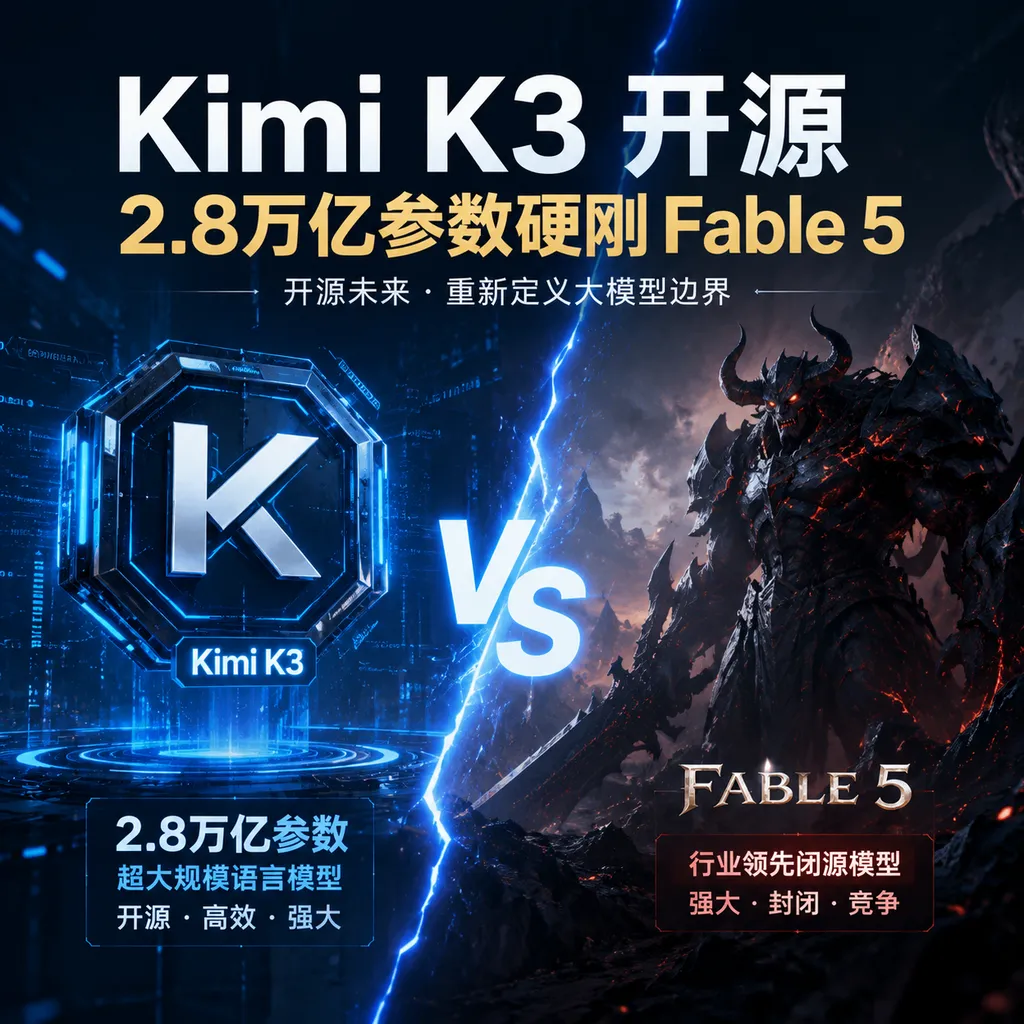
Moonshot AI officially open-sources **Kimi K3**, featuring **2.8 trillion parameters** and a **million-token context window**. It adopts **KDA linear attention** and achieved a **Frontend Code Arena score of 1679**, surpassing **Claude Fable 5** to take the top spot. It is the world’s **first open-source model at the 3-trillion-parameter level**.
On July 17, Moonshot officially launched Kimi K3 — 2.8 trillion parameters, 1 million token context window, native visual understanding, and fully open source. This is the world's first open-source model reaching the 3-trillion-parameter class, and Kimi’s strongest debut to date.
The news actually surfaced a day earlier (July 16) when the model quietly went live on the Kimi Open Platform under the name kimi-k3. The Financial Times broke the story first, then the official announcement filled in the details. The rollout strategy is similar to last year’s K2 — release early for developers to test, follow up later with the full announcement.
An Architecture That Bet on the Right Direction
What stands out most about K3 isn’t just the parameter count, but its architectural choices.
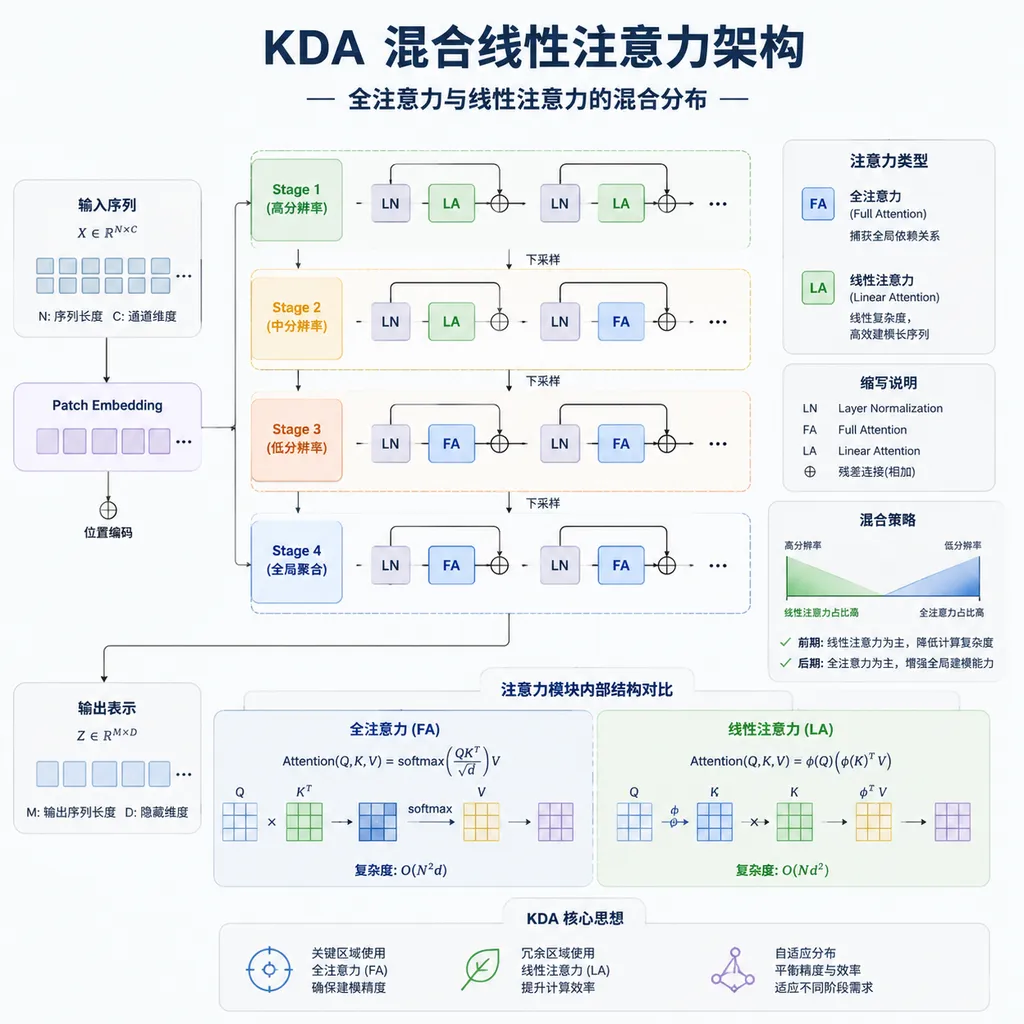
Since the overseas AMA in November last year, Moonshot has been teasing the KDA (Kimi Delta Attention) architecture. At that time, some in the industry doubted whether linear attention could scale to the trillion-parameter level. In January, at Tsinghua’s summit forum, Yang Zhilin made it clear: K3 would continue optimizing the Kimi Linear architecture and commit to the linear attention path. Six months later, the results are in.
The KDA approach is quite clever — use full attention where it matters, and linear attention where it doesn’t, and employ NoPE (No Position Encoding) for stable long-sequence processing. Combined with Attention Residuals, it essentially addresses an old question: how to reduce training and inference costs without sacrificing long-context accuracy.
This takes a different direction from DeepSeek’s MoE sparsification or Anthropic’s pure Transformer optimization. Moonshot’s bet is that as context lengths stretch toward tens of millions of tokens, the O(n²) complexity of traditional attention will hit a hard ceiling — whoever first makes linear attention work at scale wins the next round.
K3 is the first revealed card in this bet.
Frontend Code Arena: What Does a 1679 Score Mean?
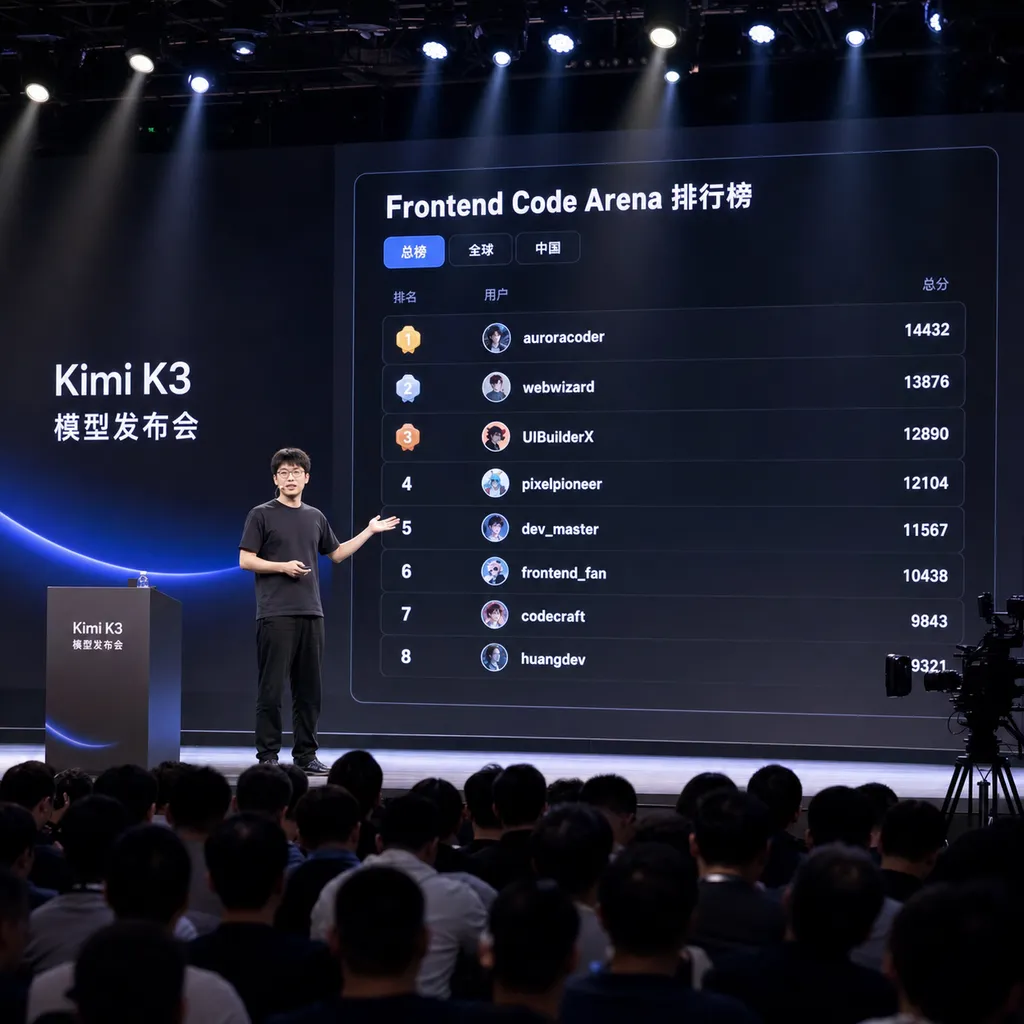
On the performance side, the most eye-catching result comes from the Frontend Code Arena — K3 scored 1679 points, surpassing Claude Fable 5 to rank first. The official Arena account released detailed rankings:
- Brand & Marketing: #1
- Reference-based Design: #1
- Data & Analytics: #1
- Consumer Products: #1
- Simulation: #1
- Content Creation Tools: #1
- Games: #2 (lost to Fable 5)
Six first places out of seven, with the only loss in gaming — Fable 5’s home turf. This is telling: K3 excels in structured, engineering-style front-end generation tasks, aligning with Moonshot’s positioning for “long-range programming and end-to-end knowledge work.”
In other words, if your task is for AI to help you build a marketing landing page, a data visualization report, or a product prototype, K3 is currently the strongest open-source option. But if you want it to write a silky-smooth tower defense game, Fable 5 still better understands players.
From K2 to K3: From Agent to Full-Stack Knowledge Worker
Comparing the two makes Moonshot’s direction over the past year clear.
K2, released in July 2025, had 1 trillion total parameters (32B active) and focused on “agent” capabilities — essentially following a sparse MoE path. One year later, K3 jumped to 2.8 trillion total parameters — note, that’s total, not active — while discarding the MoE dispatch logic K2 still relied on and pivoting to KDA hybrid attention.
Here’s a lesser-known fact: K3’s training cycle was compressed to 5–6 months. Compared with the industry’s usual 8–12 months, this speed reflects the hardware efficiency benefits of the KDA design. Yang Zhilin said in January that “even if K3 isn’t 10× stronger, it’ll be much stronger,” and now that doesn’t sound like exaggeration.
Vision capabilities are finally natively integrated. Previously, Moonshot’s roadmap was “text first, then vision, then multimodality.” The earlier Kimi-VL was a separate 16B MoE multimodal model (2.8B active) independent from the main line. K3 embedding vision into the base model means that in future agent workflows — “see image → reason → write code” — no model switching will be needed.
Pricing: Cheap, But Not Too Cheap
Kimi Open Platform’s pay-as-you-go pricing is as follows:
| Item | Price (RMB / million tokens) | | --- | --- | | Input (cache hit) | 2 | | Input (cache miss) | 20 | | Output | 100 |
Among open-source models, this is slightly above midrange. Compared with DeepSeek V3’s rock-bottom rates, K3 is clearly pricier; but against closed-source flagships like Claude or GPT-4.5, it’s still about an order of magnitude cheaper.
Setting the cache-hit price at 2 RMB sends a clear message — Moonshot wants developers to build large-context, repeated-calling applications such as codebase analysis, long-document QA, or Agent loops. Without caching, 1M-token contexts would be cost-prohibitive, but with cache hits, costs drop to one-tenth.
Teams with their own compute can self-host since the model is open source. Of course, a 2.8T-parameter model can’t run on consumer GPUs, but medium-to-large companies with H100 clusters can directly deploy it as a near-SOTA foundation.
Moonshot’s Open-Source Gamble Is Bigger Than It Looks
This open-sourcing move deserves reflection.
Globally, models with over 2 trillion parameters and open weights are extremely rare. Meta’s Llama series already won plaudits at the hundred-billion level, and DeepSeek V3’s 671B shocked the industry. K3 setting the open bar at 2.8T essentially “gifts” to the global community the scale advantage that Anthropic and OpenAI paid fortunes to achieve.
From a business standpoint, this clearly isn’t a simple “open-source for ecosystem” trade. Moonshot’s thinking likely follows:
- Architectural voice. Once KDA is open-sourced, researchers worldwide will experiment and publish around it, turning Kimi Linear from “Moonshot’s path” to “one of the industry’s recognized paths.”
- Talent magnet. Open-sourcing a top-tier model is the best recruitment ad — especially valuable now with China’s AI talent market in flux.
- Keeping up with DeepSeek. DeepSeek built international influence through open source; Moonshot can’t lag or risk losing its place in China’s “open-source roster.”
But the risks are real — training a 2.8T-parameter model costs several hundred million RMB at least by estimates. With open-sourcing, API payback is unlikely; returns will have to come from Kimi’s consumer business, enterprise services, and follow-ups like K3.5 or K4.
What It Means for Developers
If you’re working on the following scenarios, K3 is worth immediate testing:
- Long-range programming agents: 1M-token context fits an entire mid-size codebase; native vision can interpret design mockups.
- Frontend code generation: Its #1 rank on Frontend Code Arena isn’t a fluke — for landing pages, dashboards, and prototypes, K3 is the open-source ceiling.
- Knowledge work automation: For financial reports, legal docs, or industry studies requiring “read long text → reason → structured output,” KDA’s efficient long-context handling shines.
Less recommended:
- Game logic generation (Fable 5 still leads)
- Ultra-low-latency real-time chats (2.8T inference isn’t fast)
- Budget-sensitive, high-frequency calls (DeepSeek more suitable)
OpenAI Hub integration for K3 is underway, enabling OpenAI-compatible API calls. You’ll be able to switch between GPT, Claude, Gemini, and K3 using the same key — ideal for side-by-side benchmarking.
A Few Judgments
Technically, K3’s greatest significance isn’t its size, but proof that linear attention works at ultra-large scale. This will have far deeper long-term impact than that 1679 Arena score — if KDA succeeds, scaling to 5–10T won’t be monopolized by compute giants, and mid-sized labs will get to play too.
In the near term, Kimi K3 will form a homegrown open-source “big three” alongside DeepSeek V4 and the next-gen Qwen. Competition will be fierce — but developers are the biggest winners.
The claim that the China–US gap is narrowing has been said for years.
This time, it really seems true.
References
- ITHome: Kimi’s strongest model K3 launches, tops the Frontend Code Arena ahead of Claude Fable 5 — Details on K3’s pricing, architecture, and performance
- Zhihu: Technical analysis of Kimi K2 trillion-parameter agent model — Background on the technical evolution from K2 to K3