Gemini 3.5 Pro Difficult Birth: Programming Capabilities Have Stuck Google

Google’s flagship model **Gemini 3.5 Pro** has been delayed for several months, mainly because its programming capabilities have not met internal expectations. Even after switching training data in late June, test results remained unsatisfactory. Internal factional conflicts and limited computing resources have only made the situation worse.
Bloomberg today, citing information from ten current and former Google employees, raised a question that has the entire AI community talking: Google’s most powerful flagship model, Gemini 3.5 Pro, has been delayed for several months. Originally scheduled for release in June, the model has yet to appear, with the main stumbling block being its programming ability not meeting internal targets. Following the news, Google’s stock price briefly dropped by more than 5% that day.
This is not an ordinary product delay. In a time when Anthropic and OpenAI are releasing new versions every few weeks and pushing programming benchmark scores higher, Google’s postponed flagship model puts real pressure on the entire Gemini product line, the developer ecosystem, and Google Cloud’s commercialization pace.
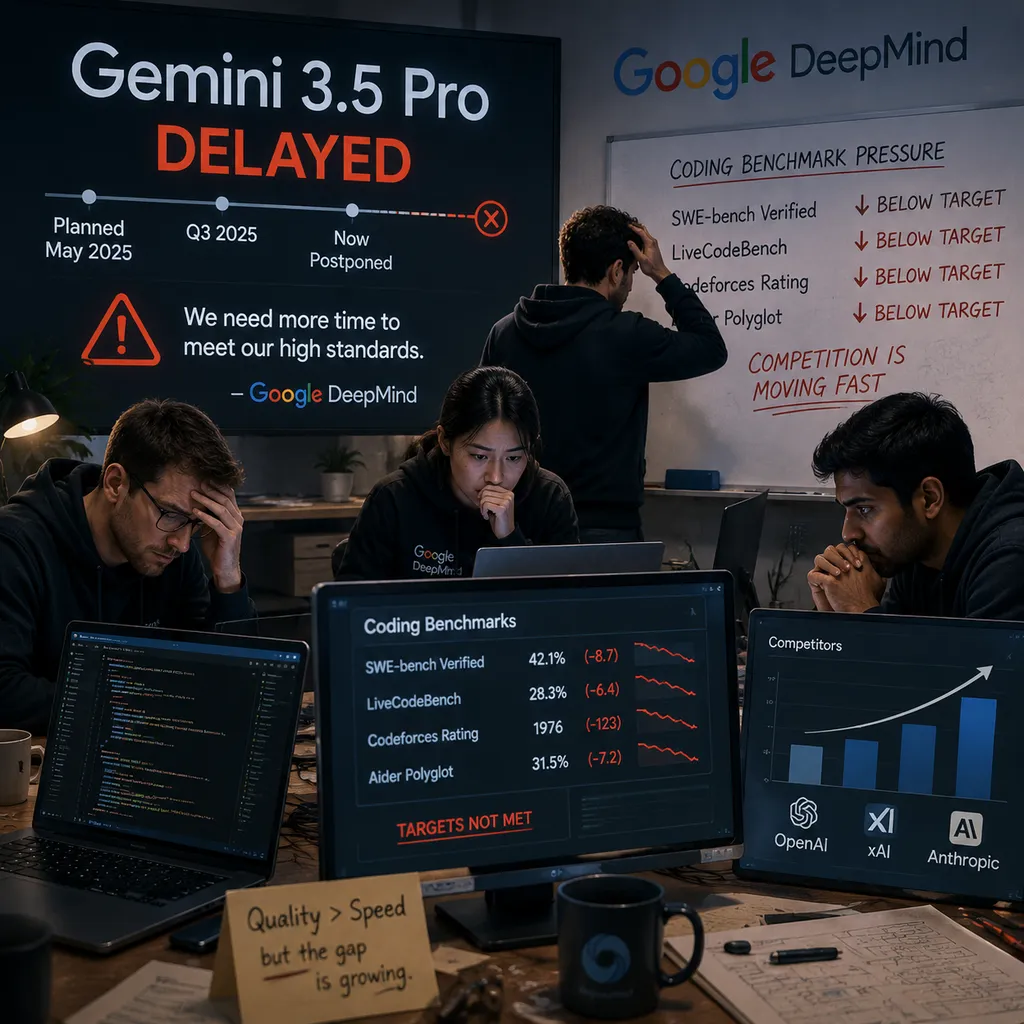
Originally planned for June, now pushed back to mid-July
According to the timeline, Gemini 3.5 Pro was originally targeted for release in June, following Google I/O’s product cadence. However, sources told Bloomberg that in late June Google adjusted part of Gemini’s training data, aiming to specifically improve code generation ability. After running the tests, the results were disappointing—it failed to meet the internally set performance threshold.
As a result, the release plan was delayed again. Google’s spokesperson made a rather intriguing statement:
“We are rapidly launching multiple models while maintaining high cost efficiency for our customers. We are currently testing 3.5 Pro, an upgraded Flash version, and other models with our partners, and are engaging in productive discussions with the U.S. government on model testing and broader regulatory frameworks.”
In other words: the model is still being tested, regulatory checks are still in progress, and there’s no specific release date. The statement’s emphasis on “regulatory framework” and “government communication” seems to provide a graceful excuse for the delay—since simply saying “our programming capability isn’t good enough yet” wouldn’t look great.
Programming ability — the decisive factor for this generation of flagship models
Why would Google rather delay Gemini 3.5 Pro for months than release a version with only “slightly lacking” programming ability?
The answer lies with its competitors. Over the past six months, AI programming has evolved from simple “assistive completion” to “taking over engineering.” Claude’s Sonnet and Opus models have continually pushed the SWE-bench scores higher, and OpenAI has focused heavily on long-context code understanding and multi-file refactoring. The rising adoption and paid conversions for AI programming tools like Cursor, Windsurf, and Cline all prove one fact: developers are willing to pay for models that can actually modify code.
In real-world programming scenarios, Gemini’s current flagship version has a reputation of being strong in long-context understanding but “a bit weak” in code editing. In developer circles, the saying goes: Gemini is great for analyzing entire repositories and summarizing architecture, but when it comes to writing production code, people still prefer Claude.
That explains Google’s insistence: if 3.5 Pro launched with that same reputation, it would effectively concede the developer market to Anthropic. Especially in enterprise procurement, programming ability has already become one of the core indicators in API bidding.
Internal factional wars more difficult than technical problems
One detail in Bloomberg’s report is more telling than the “delay” itself: there are at least four competing AI programming teams inside Google.
- Google Cloud: focuses on enterprise-facing Gemini Code Assist products
- DeepMind: formed an AI programming team earlier this year, led by research engineer Sebastian Borgeaud
- Android Team: integrates Gemini’s programming capabilities into Android Studio
- Consumer Product Team: develops AI programming tools for general developers
Four groups, reporting to different VPs, all competing to define “Google’s AI programming product.” Co-founder Sergey Brin has reportedly been personally involved, urging faster AI programming product development to gain market share. But with so many factions, no one yielding to the other, progress has inevitably slowed.
Google’s Chief AI Architect Koray Kavukcuoglu now has a key task: unifying these dispersed teams and standardizing Google’s internal AI programming toolchain. It sounds like a management “centralization” move, but anyone familiar with large corporations knows such consolidation often takes several quarters to materialize.
The “code purity” of conservative engineers
There’s also a subtler issue—a group of relatively conservative senior engineers at Google insists that “critical code must be entirely human-written to meet Google’s standards.” This obsession isn’t new; Google’s code review culture is famously strict.
Previously, Google even restricted employees from using Gemini to write or analyze internal code, citing concerns that proprietary code might be used as training data. Although this policy has since relaxed, that early limitation slowed engineers’ adoption of AI-assisted development by at least half a year compared to the outside world.
Now, Google has reversed course and requires engineers to use AI-generated code—but another problem has emerged: internal compute capacity is insufficient. Bloomberg reports that engineers frequently encounter “insufficient capacity” errors when using AI programming tools. For a company that manufactures its own TPUs, the fact that its employees struggle to use in-house AI tools smoothly is telling in itself.
How long can Anthropic and OpenAI’s window last?
From a developer’s perspective, these months of Gemini 3.5 Pro’s delay represent a window of opportunity for Anthropic and OpenAI to extend their lead in AI programming.
Judging by recent iteration paces:
- Anthropic has already made Claude’s programming ability a key differentiator, with the Claude Code CLI expanding rapidly
- OpenAI continues increasing investment in multi-file code understanding and agent-style programming
- Meta’s latest open-source models are also catching up in coding benchmarks
Google isn’t without strong cards—TPU v5p and even more advanced compute power, DeepMind’s research prowess, and distribution across Search, Android, and Workspace are enviable assets. Yet the challenge lies in converting these resources into products, as each step consumes time through organizational alignment, regulatory processes, and internal politics.
Product-wise, releasing a new model at Google is far more complex than at OpenAI—it must integrate into Search, Maps, YouTube, Workspace, Android, and Cloud. Each integration requires coordination across product teams. The advantage: massive distribution. The downside: an ocean liner that’s hard to turn.
What this means for developers
In the short term, several takeaways:
- Don’t expect to use Gemini 3.5 Pro this month. Google’s mention of “regulatory communication” suggests there’s still some waiting to do.
- The upgraded Flash version is likely to launch first. Since “3.5 Pro, upgraded Flash, and other models” are under testing, and Flash iterations are known to be faster, it’s likely to debut as an “interim release.”
- Expect a more aggressive programming catch-up strategy from Google. Watch for the rollout of the Antigravity agent-based development platform, Gemini updates in Android Studio, and new features in Code Assist.
- Multi-model strategy is essential. Serious developers should never rely entirely on one model vendor—flagship delays can happen to anyone.
OpenAI Hub supports using a single key across GPT, Claude, Gemini, DeepSeek, and other mainstream models, directly accessible from within China, and fully compatible with the OpenAI format. Once Gemini 3.5 Pro is online, it will be available immediately—developers can use Claude or GPT for programming tasks for now and simply switch model IDs when Gemini is released.
A bigger question
Zooming out, the delay of Gemini 3.5 Pro points to a deeper issue: as large models begin to rival human engineers, whoever can translate “research capability” into “product capability” will win.
Google’s research prowess is indisputable—it invented the Transformer, and created AlphaCode and AlphaGo. But when it comes to turning research into product, OpenAI and Anthropic have moved faster and more decisively. The reason is simple: a company without Search Ads to protect, YouTube to integrate, or Workspace compatibility to maintain can focus entirely on the model itself.
For developers, that’s not necessarily bad—fiercer competition means better, cheaper tools. But for Google, it now faces a critical question: how can a company of hundreds of thousands move at a startup’s speed?
When Gemini 3.5 Pro finally launches—and whether it makes a splash—will be Google’s first public test in answering that question.
References
- Report: Google’s flagship AI model Gemini 3.5 Pro delayed for months, performance below target - IT Home: Full Chinese version of Bloomberg’s report, including details from 10 current and former employees and Google’s official statement.