Roblox puts game creation into your phone: Build generates complete gameplay with a single sentence.
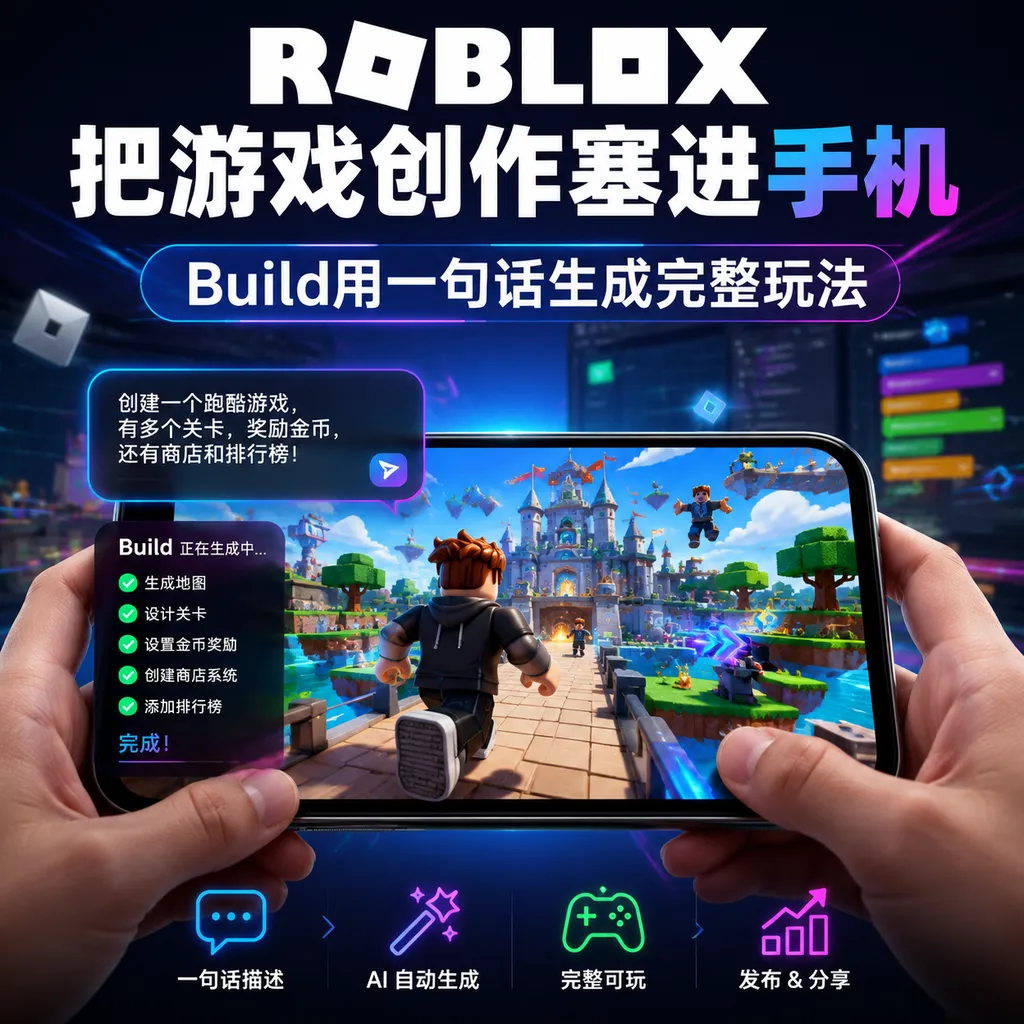
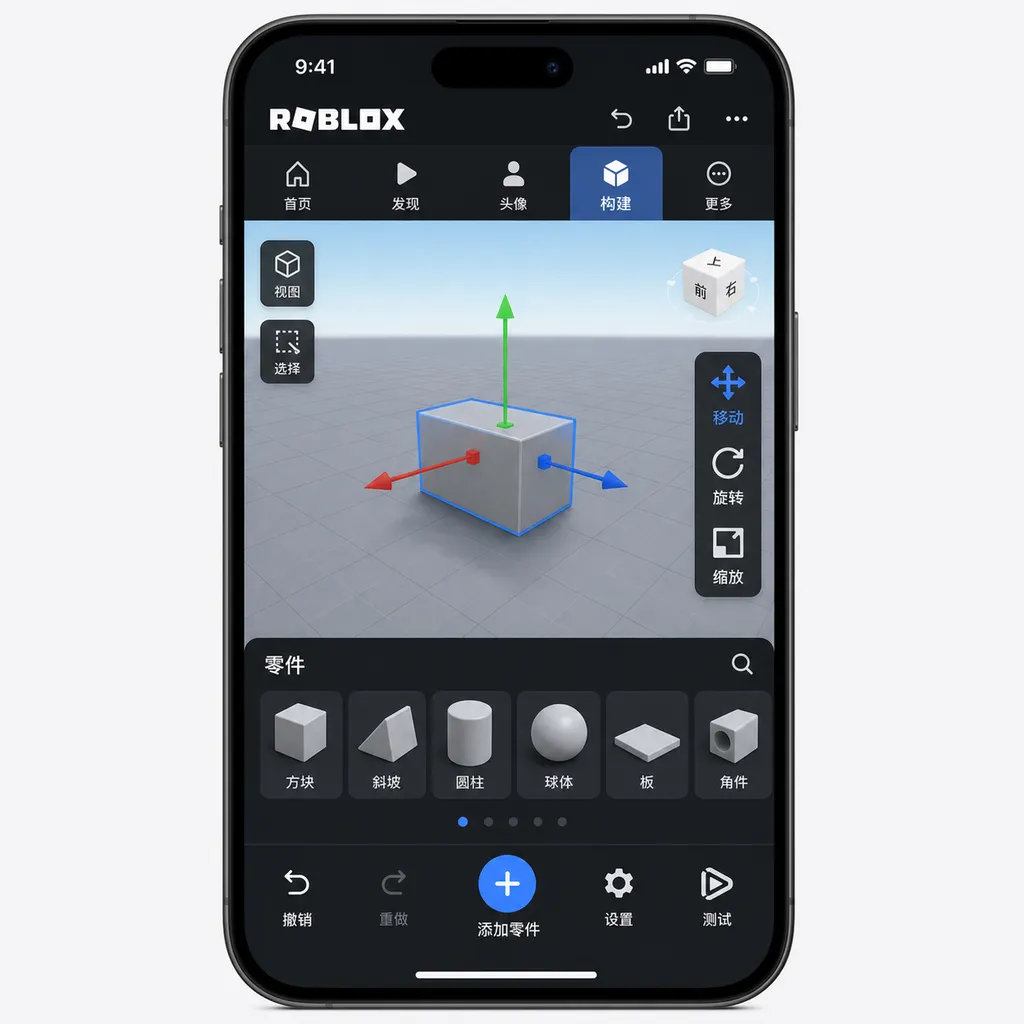
Roblox announced that on July 28, it will launch the alpha test of its mobile AI creation tool **Build** in New Zealand. Users can generate playable game prototypes on their phones by simply entering a sentence — including gameplay, scenes, characters, and sound effects. Users aged 9 and above can create, while those aged 16 and above can publish globally.
Yesterday, Roblox dropped quite a big announcement: a new mobile feature called Build. With it, users can type a sentence on their phone, and an entire playable game will be generated. The Alpha test starts in New Zealand on July 28, available to age‑verified users aged 9 and up; those 16 or older can publish their creations directly to players worldwide.
The news itself isn’t totally unexpected — since last year, Roblox has been adding AI tools into Studio, from the Cube 3D base models to Procedural Models, one after another. But moving creation directly onto mobile, and making it simple enough for nine‑year‑olds, marks the first time in twenty years that Roblox has truly fulfilled its old slogan: “By You.”
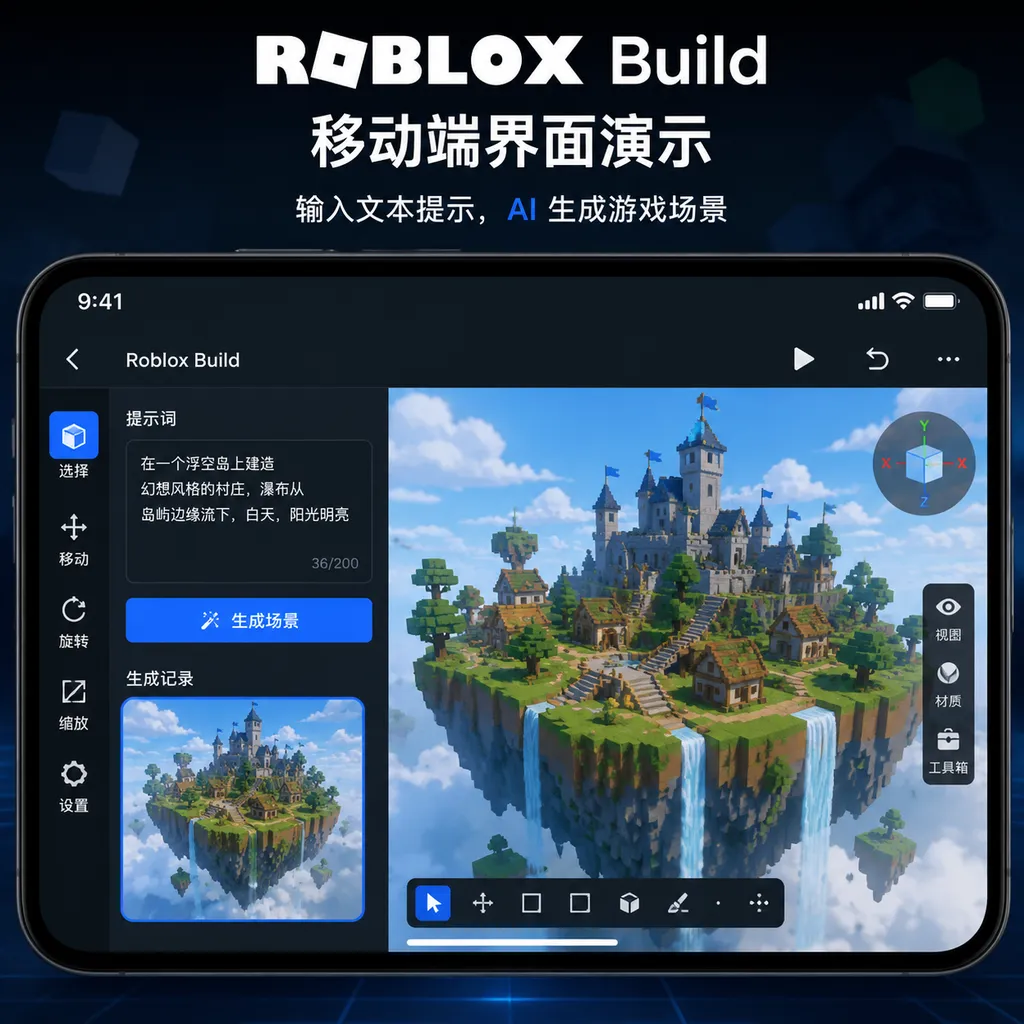
How far can “one‑sentence game generation” really go?
The official demo prompt is: “Let’s make a cozy adventure game in a dense forest with environmental obstacles.”
Build automatically assembles a playable prototype based on that text, which users can then iterate on.
Notably, Build doesn’t just output a concept image or a design document — it produces a real, runnable game inside Roblox that friends can join and play. According to Roblox’s official blog, it handles several elements at once:
- Gameplay mechanics: core loops such as jumping, collecting, or combat
- Environment: terrain, buildings, lighting, weather — the skeleton of a 3D world
- Characters: NPC appearance, animations, and basic behavior
- Visual style: overall stylistic tone — cartoon, realistic, pixel, etc.
- Audio: ambient sounds, interaction cues, background music
Behind this system is a blend of open‑source and Roblox‑built models. Roblox notes that its own models are trained on “an unprecedented‑scale 3D‑model and game‑specific dataset,” which allows them to output runnable 3D objects and complete scenes directly, rather than intermediate assets requiring conversion. That’s key: most text‑to‑3D solutions on the market produce either static meshes or assets needing retopology, rigging, and scripting before use. Build’s assets drop straight into the Roblox engine — physics‑ready and script‑attachable.
Another interesting point is how Build integrates with Studio. As Roblox puts it, they “share the same backend, models, and chat history.” Users can start building on mobile, then open Studio on desktop for deeper editing; or conversely, run long AI tasks in Studio and monitor progress from a phone. This “draft on mobile, refine on desktop” workflow is a smart move already validated by tools like Figma and Notion.
Lowering the bar to age 9 — Roblox knows who its users are
Veteran players know Roblox Studio was never designed for elementary schoolers. It looks like a simplified Unity; you need to understand Lua (now Luau), handle scripts, events, tweens, and grasp the hierarchy of Parts, Models, and Scripts. Though Roblox has long said “anyone can create,” building a real game has required genuine skill.
Thus the true disruption isn’t “AI‑generated games” — Tencent, Microsoft, and Google are all exploring that — but the way Roblox is slashing the entry bar from “teens who can code” to “nine‑year‑olds who can type.” Out of 132 million daily active users, most are consumers rather than creators; Build aims to grow the creator base from millions to tens of millions.
That also explains why New Zealand was chosen for the first test: small user base, convenient time zone for iteration, looser regulatory environment — a textbook Alpha testbed. The age‑9 threshold isn’t arbitrary; Roblox has been rolling out Age Verification since early this year — face recognition plus ID check — building toward exactly this use case.
Business‑wise, Build will have a free basic tier and a paid premium tier. Roblox hasn’t said what’s included yet, but by industry convention it’ll likely mean faster generation, more iterations, higher output quality, or access to stronger model tiers. This “free for onboarding, pay for quality” model mirrors AI‑coding tools like Cursor, v0, and Bolt.new.
Will this flood the platform with AI junk?
That’s the first question every developer asks — and Roblox knows it. In this year’s GDC State of the Game Industry survey, 52 % of professionals saw generative AI as a negative for gaming, citing homogenization, low quality, and displacement of human devs.
Roblox’s answer is clever: don’t forbid, but don’t promote either.
“Our discovery system is designed to highlight games with long‑term retention … if no one plays it, no one will find it.”
In plain terms: you can generate whatever you want, but appearing on the front page and gaining traffic depends on real player retention. This ranking logic is Roblox’s core recommendation system, akin to TikTok’s completion rate or YouTube’s watch time. AI‑built and human‑built games share the same candidate pool and metrics — no special treatment, no extra bias.
One more safeguard: any AI‑generated game seeking inclusion in Roblox Kids or Featured listings must pass an additional content review. That essentially erases the financial incentive for mass‑produced low‑quality spam.
Whether this system truly blocks an AI trash wave remains to be seen. Retention‑based ranking has an inherent weakness: cold starts. New games have no data – so how are they bootstrapped? If Roblox relies on social sharing for that initial exposure, the contest among AI‑generated games will hinge on “whose first impression is good enough for friends to share,” which in turn demands high generation quality from Build itself.
Compared with competitors, Roblox is betting harder
A quick cross‑industry snapshot:
- Microsoft – The Muse model explores AI‑assisted game design; mostly research demos, not yet consumer‑facing
- Google DeepMind – Genie 2 generates interactive 3D worlds from a single image — a research milestone, but far from practical game production
- Tencent – Focuses on NPC, narrative, and art‑asset generation inside its own studios
- Rosebud AI, Ludo.ai, and similar indie tools – Serve independent developers, with isolated ecosystems
Roblox’s unique edge is that it holds all four: creation tools, distribution platform, user community, and monetization system. Build a game and you don’t need to worry about publishing, finding players, or getting paid — the whole pipeline is integrated. That’s a moat no pure tool startup can match for now.
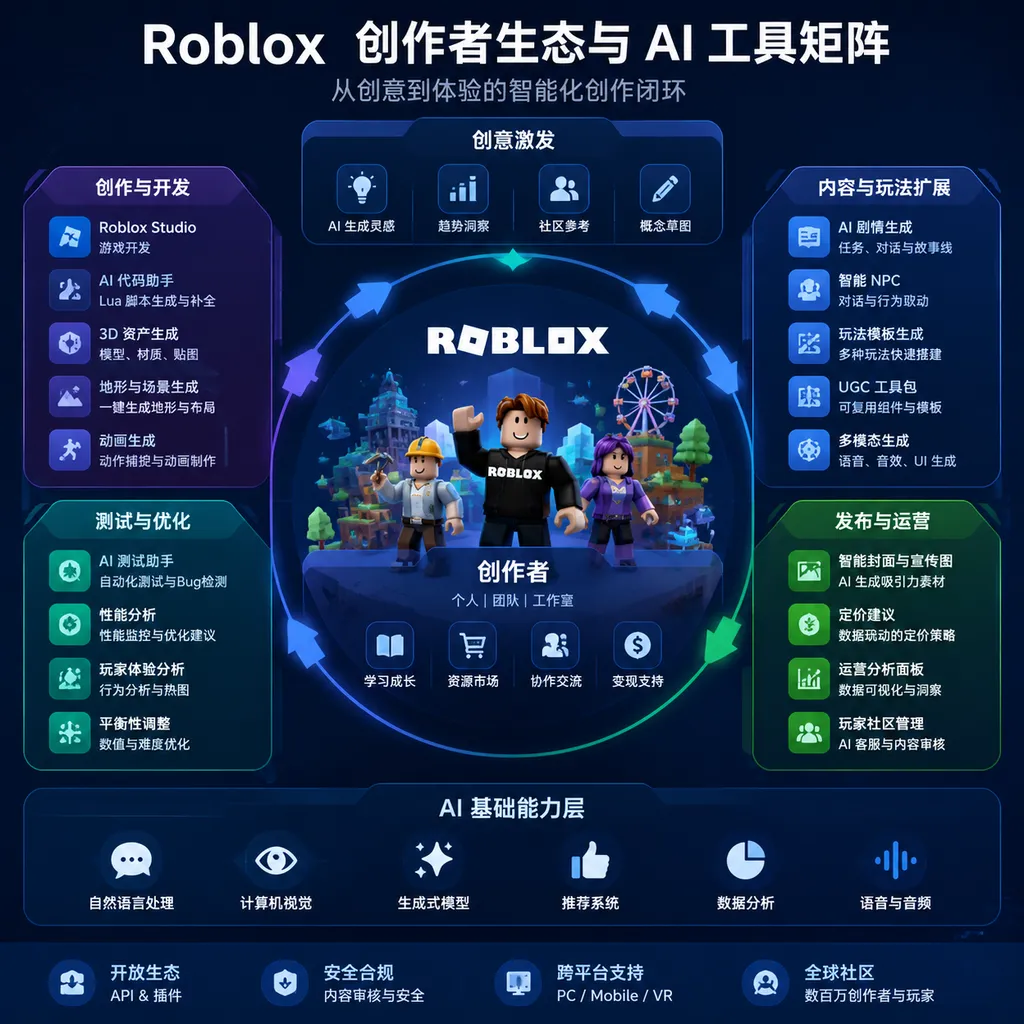
From Roblox’s own roadmap, Build is just the tip of the iceberg. Upcoming pieces include:
- Procedural Models – Text‑ or image‑based generation of parameterized 3D assets, adjustable via parameters
- Cube 3D Base Models – Turn prompts into ready‑to‑use in‑game objects, from props to vehicles to weapons
- Scene Generation Models – Produce editable 3D levels from a single prompt
- AI Testing & Analytics Assistants – Automate testing and data analysis for developers
Taken together, Roblox is inserting AI into every link of the game‑development chain:
from idea → prototype (Build),
prototype → product (Studio + Procedural Models + Cube),
to product → operations (AI testing + analytics).
It’s end‑to‑end coverage.
Points to watch
Hype aside, several caveats deserve attention:
1. Demo videos prove little. All current demos are hand‑picked officials. Real user output — what a first‑timer can generate, whether a game remains fun after ten iterations — won’t be known until the Alpha goes live on July 28. “Flashy demo, weak productivity” has plagued text‑to‑3D for years.
2. Copyright and content safety with child creators. When nine‑year‑olds use AI to create, issues like IP infringement, inappropriate material, or manipulative monetization become trickier than with adults. Roblox mentions “expanded review processes,” but moderation costs scale linearly with generation volume. Whether that’s sustainable is an open question.
3. Impact on the existing creator economy. Many Roblox developers earn real money; top studios make millions annually. When game‑creation time drops from weeks to minutes, supply will explode. Even if retention ranking filters the junk, it still dilutes discovery for each title. How veteran creators react — and whether they leave — is a near‑term challenge for Roblox.
4. Business model uncertainties. Pricing, subscription vs. credit system, integration with Robux — all undisclosed. AI hype is cooling: that same day, U.S. markets saw a tech pullback, with the Nasdaq and chip stocks down sharply. To convince investors, Roblox must show real user data; buzzwords alone won’t cut it.
In a sentence
Putting game creation on mobile, lowering the bar to nine years old, and filtering AI junk through retention instead of manual review — this move carries far more weight than an ordinary feature update. Roblox isn’t just giving creators a new tool; it’s redefining who counts as a creator —from “teens who know Luau” to “anyone who can type.” The July 28 Alpha in New Zealand will be the first test: can AI truly handle the initial 80 % of game creation, leaving only the final 20 % polishing to humans?
If it works, Roblox could once again redefine what a UGC platform means for the next five years.
References
- AI game‑creation tool for mobile: Roblox mobile version to add “Build” feature — ITHome — ITHome’s first report on the Build release, summarizing Roblox’s official announcement.