
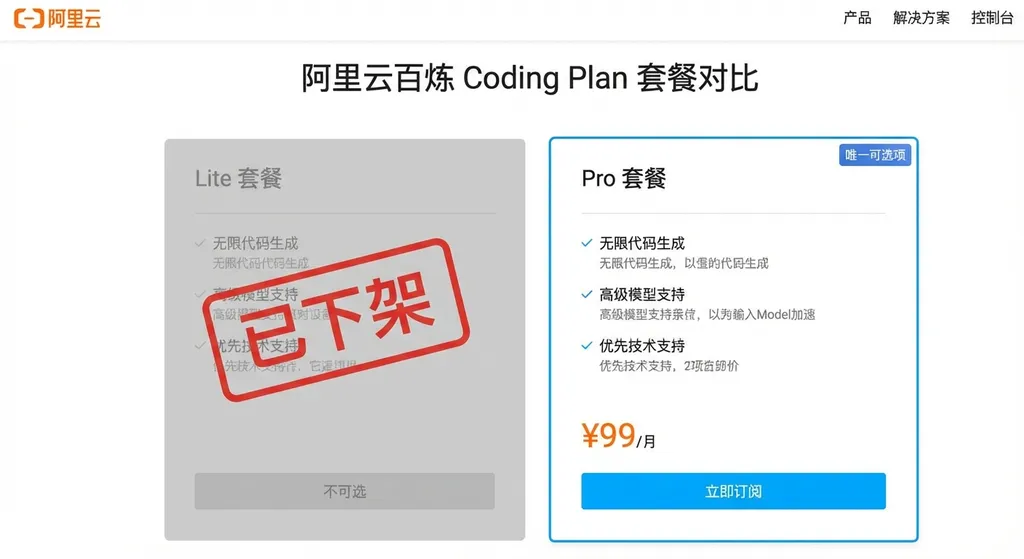
The Lite version of Bailian has been discontinued; only the Pro subscription remains for AI programming.

Starting April 13, the Alibaba Cloud Bailian Coding Plan Lite package will be completely discontinued from renewal—existing users can continue until their remaining balance is used up. The subscription for AI programming models is officially moving toward a high-end tiered system, while the Pro version is in extremely high demand.
Alibaba Cloud has made a move.
Starting from 6:00 PM on April 13, the Coding Plan Lite basic package under Alibaba Cloud’s Bailian platform will officially stop renewals and upgrades. This means that this entry-level AI programming subscription—launched only two months ago at 40 RMB per month—has reached the end of its short lifecycle. Existing users can continue to use their packages until they expire, after which no renewal will be possible.
The news didn’t come out of nowhere. As early as March 20, Alibaba Cloud had already stopped new purchases of the Lite plan, keeping only renewal and upgrade options for existing users. Now, even that final option is closing.
Two Months: The Life and Death of a Package
Coding Plan was launched in February this year, with a clear positioning: a fixed-monthly-fee, multi-model bundled AI programming subscription.
Developers no longer have to juggle multiple API keys or pricing rules — they pay once and can access models from Qwen, GLM, Kimi, and MiniMax as they please.
The concept itself is solid. Anyone who has done AI coding knows how exhausting it is to switch between API docs from different providers. Not to mention that some charge by token, some by usage count, and others hide various rate limits. Coding Plan simplified all that into a single monthly fee, addressing a real pain point.
There were two tiers:
- Lite (Basic) — 40 RMB/month (7.9 RMB promo for first month), 18,000 requests per month
- Pro (Advanced) — 200 RMB/month (39.9 RMB promo for first month), 90,000 requests per month
The Lite plan was aimed at individual or student users and light debugging, while Pro targeted professional developers and teams.
But the Lite plan survived less than two months before being discontinued.
Why Cancel Lite?
Alibaba Cloud’s official explanation cites “product strategy adjustment” and “continuous improvement of product experience”—standard PR language with little information.
But some clues point to the reasoning behind it.
First, the Lite pricing was too aggressive. At 7.9 RMB for the first month, 20 RMB thereafter, and 18,000 requests, each call cost less than ¥0.002.
Considering the package included flagship models like qwen3-max, kimi-k2.5, and glm-5, the actual cost per call is much higher. Alibaba Cloud was almost certainly losing money on Lite, which likely served its purpose as a low-price user acquisition tool.
Second, the demand for Pro speaks volumes. It’s been sold out for an extended period, with limited stock released every morning at 9:30 AM and gone within minutes.
This shows developers truly value such bundled subscriptions and use them heavily. The light users on the Lite plan might not be Alibaba Cloud’s target demographic.
Third, data value. The Coding Plan service agreement contains a clause: model inputs and outputs may be used to improve and optimize services—which means user code data is used for model training. From that perspective, high-quality code data from Pro users is far more valuable than scattered light-use data from Lite users.
In short, the Lite plan accomplished its growth mission and has now given way to the more commercially valuable Pro tier.
The Pro Plan: Great, But Hard to Get
With Lite gone, only the Pro plan remains. Let’s see what it offers.
Model lineup
Current key recommended models include:
- qwen3.6-plus (supports image understanding)
- kimi-k2.5 (supports image understanding)
- glm-5
- MiniMax-M2.5
Other available models include qwen3.5-plus, qwen3-max-2026-01-23, qwen3-coder-next, qwen3-coder-plus, and glm-4.7—covering essentially all top-tier domestic coding models.
Usage limits
It uses a three-level rolling quota system:
- 6,000 requests per 5 hours
- 45,000 requests per week
- 90,000 requests per month
The 5-hour quota automatically replenishes over time—every minute releases whatever quota was used 5 hours earlier.
For example, if you used 100 requests at 10 AM and 200 at 11 AM, you’ll get back 100 at 3 PM and 200 at 4 PM.
This rolling mechanism is more flexible than daily limits and suits uneven coding schedules—say, when you code intensively in the afternoon and review at night.
Compatibility
Coding Plan supports both OpenAI-compatible and Anthropic-compatible protocols, meaning it can plug directly into Cursor, Claude Code, Cline, OpenClaw, and other major AI coding tools.
That’s one of its main selling points—no need to change your tooling; just swap out the API key and base URL.
After subscription, you receive a dedicated API key beginning with sk-sp-, and the base URLs are:
# OpenAI-compatible
https://coding.dashscope.aliyuncs.com/v1

# Anthropic-compatible
https://coding.dashscope.aliyuncs.com/apps/anthropic
Gotcha: Coding Plan’s API keys and base URLs are not interchangeable with those from Bailian’s pay-per-use APIs.
Some users mistakenly used their general sk-xxxxx keys, causing them to be charged per use instead of deducting from their subscription quota.
If you notice your plan active but still getting billed, this is likely the reason.
The real issue with Pro isn’t the product—it’s availability. With the daily 9:30 AM restock vanishing in minutes, that’s a frustrating experience for developers. No one wants to set an alarm every morning just to grab a coding subscription.
What If You Can’t Get Pro?
In reality, many developers can’t get the Pro plan. Complaints in the Alibaba Cloud community are plentiful.
Here are several alternative options:
The simplest solution is to switch to pay-as-you-go mode under Bailian. The model capabilities are identical; only billing differs—from fixed monthly fee to per-token or per-request pricing.
For low-volume users, pay-as-you-go might even be cheaper overall. But for heavy users, the Pro package remains a better deal—if you can snag one.
Another option is to use API aggregation platforms.
Platforms like OpenAI Hub allow you to call GPT, Claude, Gemini, Qwen, DeepSeek, and other major models with a single key, using an OpenAI-compatible format and connecting domestically.
For developers needing multiple models, these platforms have a natural advantage—they’re not vulnerable to any single vendor’s subscription changes.
If you’re using tools like Cursor or Cline, connecting via OpenAI Hub might look like this:
import openai

client = openai.OpenAI(
    api_key="sk-your-openai-hub-key",
    base_url="https://api.openai-hub.net/v1"
)

response = client.chat.completions.create(
    model="qwen-max",  # can also be claude-sonnet, gpt-4o, deepseek-chat, etc.
    messages=[
        {"role": "system", "content": "You are an experienced code review assistant."},
        {"role": "user", "content": "Please review the following Python function for performance issues and suggest optimizations: \
\
def find_duplicates(lst):\
    duplicates = []\
    for i in range(len(lst)):\
        for j in range(i+1, len(lst)):\
            if lst[i] == lst[j] and lst[i] not in duplicates:\
                duplicates.append(lst[i])\
    return duplicates"}
    ],
    temperature=0.3
)

print(response.choices[0].message.content)
A standard OpenAI SDK workflow—just change the base URL and model name, no tooling changes required.
Industry Trend: Layered AI Coding Subscriptions
The removal of the Lite plan reflects a broader stratification in AI programming services.
Over the past year, AI coding has evolved from a novelty to a necessity.
The explosive popularity of Cursor proves developers are willing to pay for effective AI programming tools. But “willing to pay” and “how much you’re willing to pay” are two different things.
From the supplier side, model providers face a dilemma:
Low-priced plans attract users quickly, but inference costs remain high.
Lite’s 18,000 calls for 40 RMB (≈¥0.002 per call) can’t possibly turn a profit under current inference economics.
So the trend is clear: entry-level plans are disappearing, and vendors are focusing on high-value users.
This follows the classic SaaS trajectory—start with free or low-cost plans to educate the market, then gradually move users to higher-value subscriptions once dependence is built.
For developers, this means:
-
Don’t put all your eggs in one basket.
Subscription policies can change anytime. Flexibility—being able to switch models or platforms quickly—is a key survival skill. -
Pay-per-use and subscriptions will coexist.
Light users save money by paying per call; heavy users prefer predictable subscriptions.
The trick is knowing your real usage and not being anchored by promotional prices. -
Multi-model capability is becoming standard.
Whether through Bailian’s Coding Plan or API aggregator platforms, the core selling point is “one interface, many models.”
Different models excel in different areas—Qwen for Chinese code understanding, Kimi for long context, Claude for complex reasoning—so developers who can flexibly switch models will be more productive.
What Current Lite Users Should Do
If you already purchased the Lite plan:
- You can keep using it until it expires.
- Auto-renews will stop 30 days after the announcement.
- You can still manually upgrade to Pro before expiry (if you can secure a spot).
Advice: use this time to assess your actual request volume.
If you average under 18,000 requests per month, pay-as-you-go might be cheaper afterward.
If you frequently max out your quota, consider upgrading to Pro or finding an alternative.
Either way, prepare your transition ahead of time—don’t wait until expiry day and scramble.
Final Thoughts
Alibaba Cloud Bailian’s decision to discontinue the Lite plan is essentially a user segmentation move.
The phase of low-price acquisition is over; now comes the stage of targeting high-value customers.
For the industry, this isn’t bad news. AI coding services need sustainable business models—constant subsidies aren’t viable.
But for beginners and budget-limited developers, the barrier to entry has undeniably risen.
Fortunately, there are still plenty of choices—pay-as-you-go, aggregator APIs, even local deployments of open-source models.
The key is not being locked into any single platform.
Flexibility is the most important survival strategy for developers in this fast-evolving AI era.
References
- Alibaba Cloud Bailian Coding Plan Lite Subscription to End Renewals and Upgrades on April 13 — IT Home report including timeline and user rights details
- The 2026 Alibaba Cloud Bailian Coding Plan Sellout Dilemma — Zhihu article analyzing Pro plan shortage and alternatives


