WeRide launches the physical AI large model WITT, reconstructing the AI cognitive framework with "factual units"

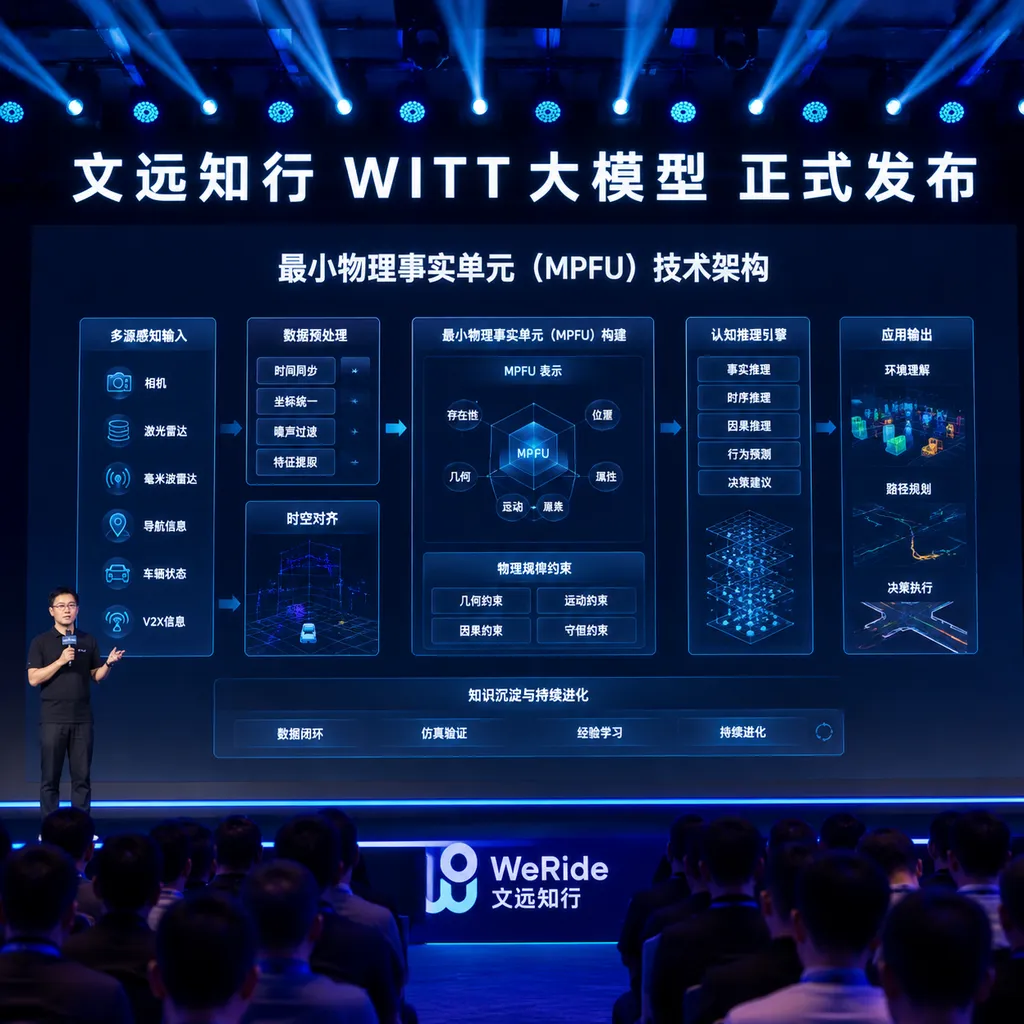
On July 17, WeRide officially released its self-developed physical AI cognitive foundation model, WITT, pioneering the concept of the "minimum physical fact unit." The model aims to integrate multimodal information—including video, image, and text—to establish a cognitive foundation for autonomous driving and, more broadly, for physical AI.
There was some noticeable movement in the autonomous driving circle today.
On July 17, WeRide officially released its self-developed physical AI cognitive foundation model WeRide WITT (WeRide Intelligent Thinking Transformer). This is not another leaderboard-chasing VLM, nor a policy model for end-to-end driving strategies — this time, WeRide aims at something more fundamental: enabling AI to truly “understand” the physical world, not just convert images into tokens.
The core concept is simple — the Minimal Physical Fact Unit (MPFU). It may sound abstract, but the logic is clear: slice continuously changing real-world scenes into identifiable and verifiable “atoms of fact,” and then reconstruct AI’s understanding of the world using these fact atoms.
Why Build a “Physical AI” Model
Let’s be clear: current mainstream vision-language models (VLMs) — whether GPT-4V, Gemini, or domestic open-source ones — are essentially “image semantic understanding models.” They excel at answering “What’s in the picture?” or “What is this person doing?”, but when asked “Will this car skid in the next second?” or “Is that cardboard box ahead empty or full of bricks?”, they often make things up.
The reason is simple: VLMs learn correlations between images and text, not physical laws. They have no concept of mass, friction, or momentum — only statistical correlations between pixels and descriptions.
In the past two years, the autonomous driving industry has been swept up by the end-to-end paradigm. That approach can work, but it’s a black box — when an accident happens, it’s impossible to explain why the car made a certain decision. WeRide’s approach inserts an interpretable and verifiable physical cognition layer between perception and decision-making — the system must not only see “there’s an obstacle ahead,” but also understand that obstacle’s physical properties, motion state, and how it’s likely to move next according to physical laws.
That’s the problem WITT aims to solve.
What Exactly Is the “Minimal Physical Fact Unit”
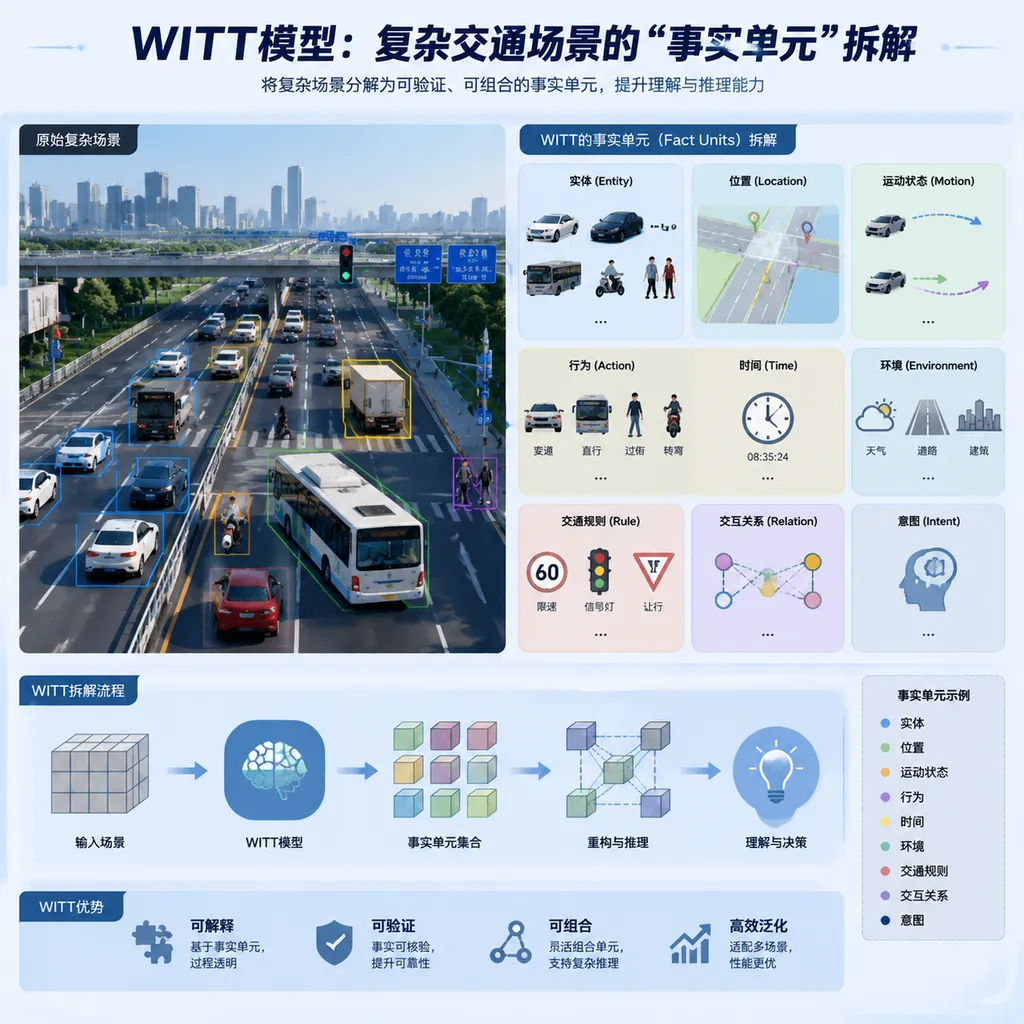
According to WeRide: continuously changing real-world scenes are decomposed into identifiable and verifiable units of fact. In plain language:
- A traditional VLM looks at a video clip and outputs a text description, or some feature vectors.
- WITT looks at the same video and tries to output a structured set of “facts,” each corresponding to a verifiable physical statement.
For example, in a video of “a truck changing lanes in the rain,” MPFUs might look like this:
- Fact 1: Target vehicle category = heavy truck, length ≈ 12 m, located 15 m ahead on the right.
- Fact 2: Road surface wetness = high, estimated friction coefficient ≈ 0.4.
- Fact 3: Target vehicle lateral velocity = +0.8 m/s, moving toward the ego lane.
- Fact 4: On this surface, the target’s braking distance ≥ 40 m.
Each statement can be independently verified — LiDAR can verify distance, IMU can verify lateral speed, and friction tests can verify coefficients. That’s the difference between “fact” and “feeling.”
For autonomous driving, the value isn’t about making models “smarter,” but making them accountable. When a decision goes wrong, you can trace which “fact” was mistaken — did it fail to see the truck, misestimate friction, or misjudge speed? End-to-end black boxes can’t tell you that.
How It Differs from Tesla’s “World Model” and NVIDIA’s Cosmos
The “physical AI” track has heated up this year.
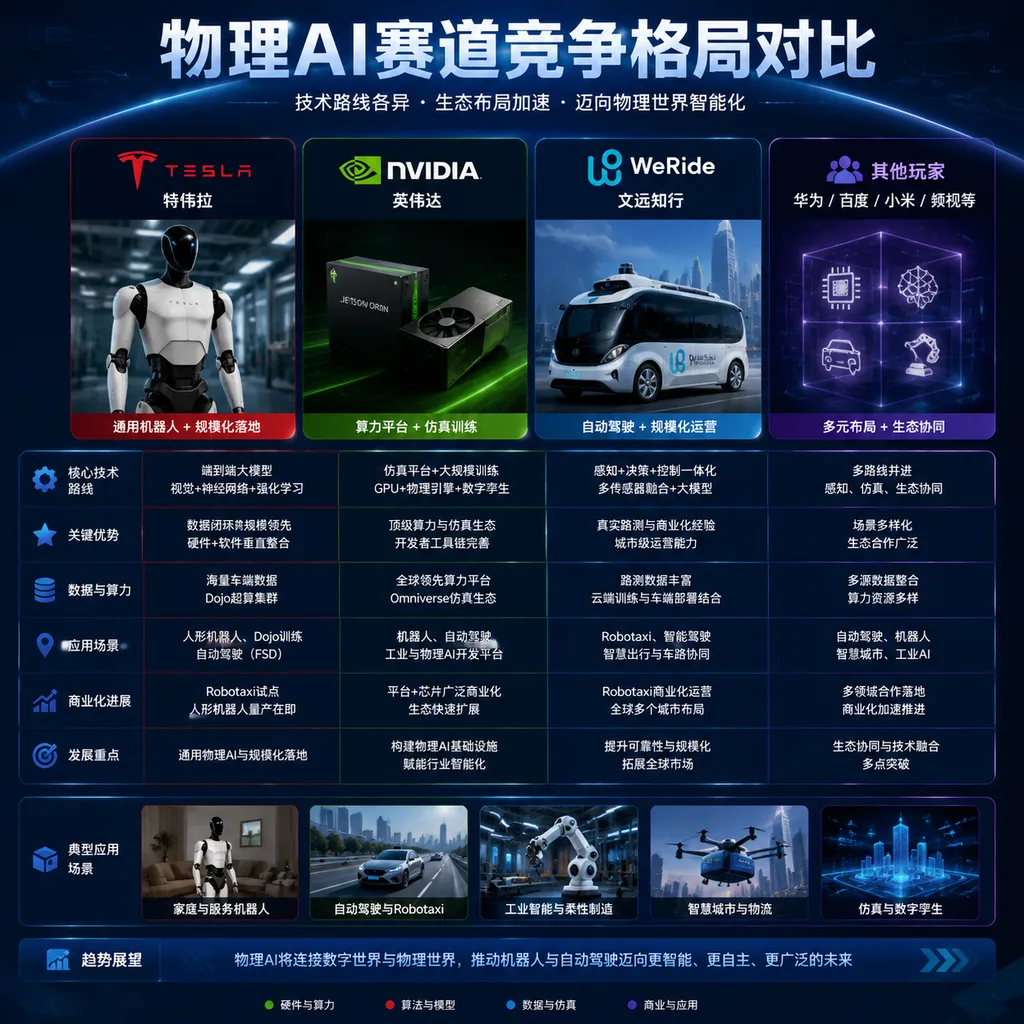
Tesla talked about its world model last year — the idea is to make the model “predict the next frame” and implicitly learn physical laws from prediction. It’s fully end-to-end and data-driven, but the downside is zero interpretability — you can’t tell what physical rules it has actually learned.
NVIDIA’s Cosmos takes a simulation + foundation model route, using vast amounts of synthetic data to train a general physical world foundation model — a generative world model at scale. It’s massive and data-rich, but still lacks clear real-world deployment.
Fei-Fei Li’s World Labs focuses on spatial intelligence — reconstructing interactive 3D worlds from single images, leaning more toward visual geometry.
WeRide’s WITT takes a different route — it doesn’t do generation, no video prediction or 3D reconstruction. Instead, it focuses on structured fact extraction. To use a loose analogy:
- Tesla/NVIDIA/Fei-Fei: want AI to “imagine” the physical world
- WeRide WITT: wants AI to “record” the physical world’s facts
Which is the right path? Too early to say. But from an engineering perspective, the “record facts” approach integrates more easily with existing autonomous driving stacks — each factual output can feed directly into downstream planning and control modules, or serve as fallback inputs for safety policies. Even the best generative world models must still be converted into a decision space — and that conversion layer is the tricky part.
Technically, How WITT Is Implemented
From public information, WITT is built atop VLM capabilities, integrating video, image, and text modalities. A few key aspects stand out:
1. Video as a First-Class Citizen
Many VLMs claim to handle video but actually just sample frames as images. Yet many physical facts can only be recognized through temporal sequences — acceleration, steering intent, friction changes all require consecutive frames. WITT takes video as a native input, so in theory it captures more physical dynamics.
2. Fact Extraction ≠ Classification
Traditional perception models output fixed categories (car/person/bicycle) and fixed attributes (position/velocity). WITT’s “fact units” form an open set — you can’t enumerate every possible physical fact. This suggests WITT’s output structure is more like a language model than a conventional detection head.
3. Verifiability Is the Key
If “fact units” can’t be verified, they’re just hallucinations. WeRide emphasizes that facts must be “identifiable and verifiable,” implying they likely have a verification mechanism — either cross-checking with other sensors (LiDAR, radar, IMU) or applying rule-based physical consistency checks. This validation mechanism, if robust, could become WITT’s real moat.
Industry Impact
WeRide is dual-listed on the HKEX and NASDAQ, operating Robotaxi deployments in the Middle East and Southeast Asia. For a deployment-focused company to release a foundation model is unusual — it usually means one of two things:
- Existing open-source or commercial models can’t meet their needs, so they had to build one.
- They want to productize the tech and provide it to the industry.
The second point is quite interesting. Beyond autonomous driving, physical AI applies to embodied intelligence, industrial robots, AR/VR, and more. At the 2026 WAIC held today, Zhifang also unveiled a brain-like model and general-purpose robot for semiconductor and retail applications — physical AI is evolving from a vague concept into a concrete product-centered track.
If WeRide can make WITT a general-purpose physical cognition foundation, its business imagination space will go far beyond Robotaxi.
Questions Still Unanswered
The launch event left several key questions open:
- Model size: How many parameters? 7B, 70B, or larger?
- Training data: How many hours of real driving footage? Any synthetic data?
- Inference cost: Can it run onboard, or is it cloud-only?
- Openness: Will it be open-sourced or offer an API?
- Benchmarking: On what datasets was it evaluated? How does it compare to mainstream VLMs?
Notably, there’s no standardized benchmark for physical AI yet. If you claim your model understands physics better — how do you prove it? That’s a challenge the entire industry faces.
Final Thoughts
Since GPT-4V’s release in 2023, multimodal large models have raced ahead for over two years. Yet an awkward truth remains: these models keep getting smarter in the digital world but have barely advanced in the physical one. If you show GPT-4V a car crash video, it can describe the scene, but it won’t tell you “that car couldn’t have stopped at that speed.”
That gap is exactly what physical AI aims to bridge. Whether WITT is the final answer remains to be seen, but the “Minimal Physical Fact Unit” concept precisely identifies the core problem — AI doesn’t lack perception, it lacks the ability to anchor perception to physical facts.
For developers, the key question is whether WeRide will open its API or share technical details. If WITT truly emerges as a general physical cognition foundation, embodied intelligence companies will likely be its first adopters.
Currently, OpenAI Hub already aggregates APIs from GPT, Claude, Gemini, DeepSeek, and others — all accessible with a single key, directly within China and compatible with the OpenAI format. If WITT eventually offers an API, such aggregation platforms will likely integrate it quickly — after all, for physical AI, developers need instant access, not one-key-at-a-time applications.
References
For further technical discussion on physical AI and multimodal foundation models:
- Hugging Face - Multimodal Model Collection: Find all major open-source VLMs here
- Zhihu - Discussions on Physical AI and World Models: Chinese community discussions on world models and physical AI
- GitHub - Awesome World Models: Comprehensive list of related papers and projects
- Reddit - r/SelfDrivingCars: International discussion community for autonomous driving technologies