The National Supercomputing Internet Takes Action: Building an Ecosystem for Scientific AI Agents
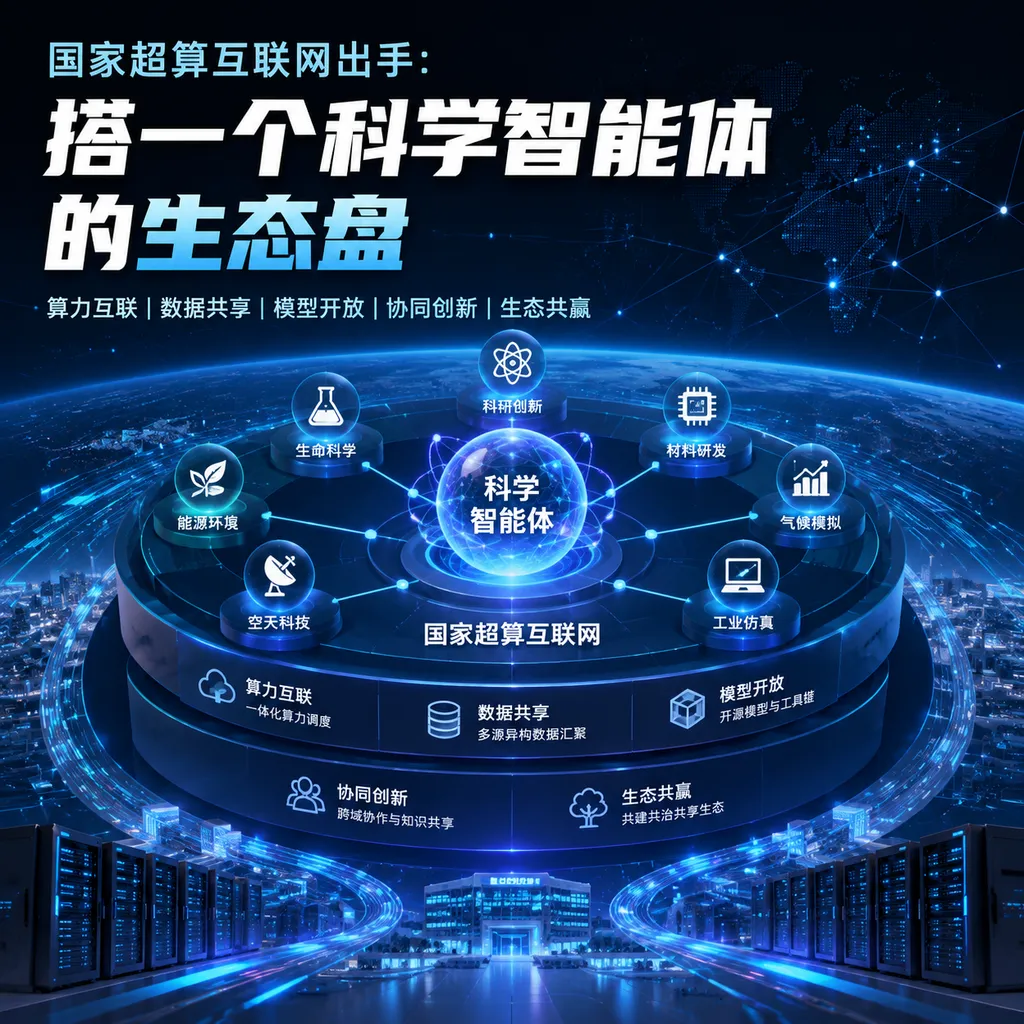
At the WAIC on July 17, the National Supercomputing Internet launched a six-month Co-Creation Program for Scientific Agents, inviting universities, individual developers, and enterprises to submit intelligent agents, scientific research models, MCP tools, and Skills, in an effort to shift its computing infrastructure focus from simply "selling machines" to "running an ecosystem."
National Supercomputing Internet Makes Its Move: Building an Ecosystem for Scientific Agents
On July 17, at the 2026 World Artificial Intelligence Conference (WAIC), the National Supercomputing Internet unveiled an ambitious initiative—the "Scientific Computing Agent Ecosystem Co‑Creation and Developer Recruitment Program." The six‑month program targets universities, research institutes, independent developers, and enterprise R&D teams, seeking contributions of agents, scientific models, MCP tools, and Skills.
In essence: the nation's top‑tier computing infrastructure is stepping in to build an ecosystem itself.
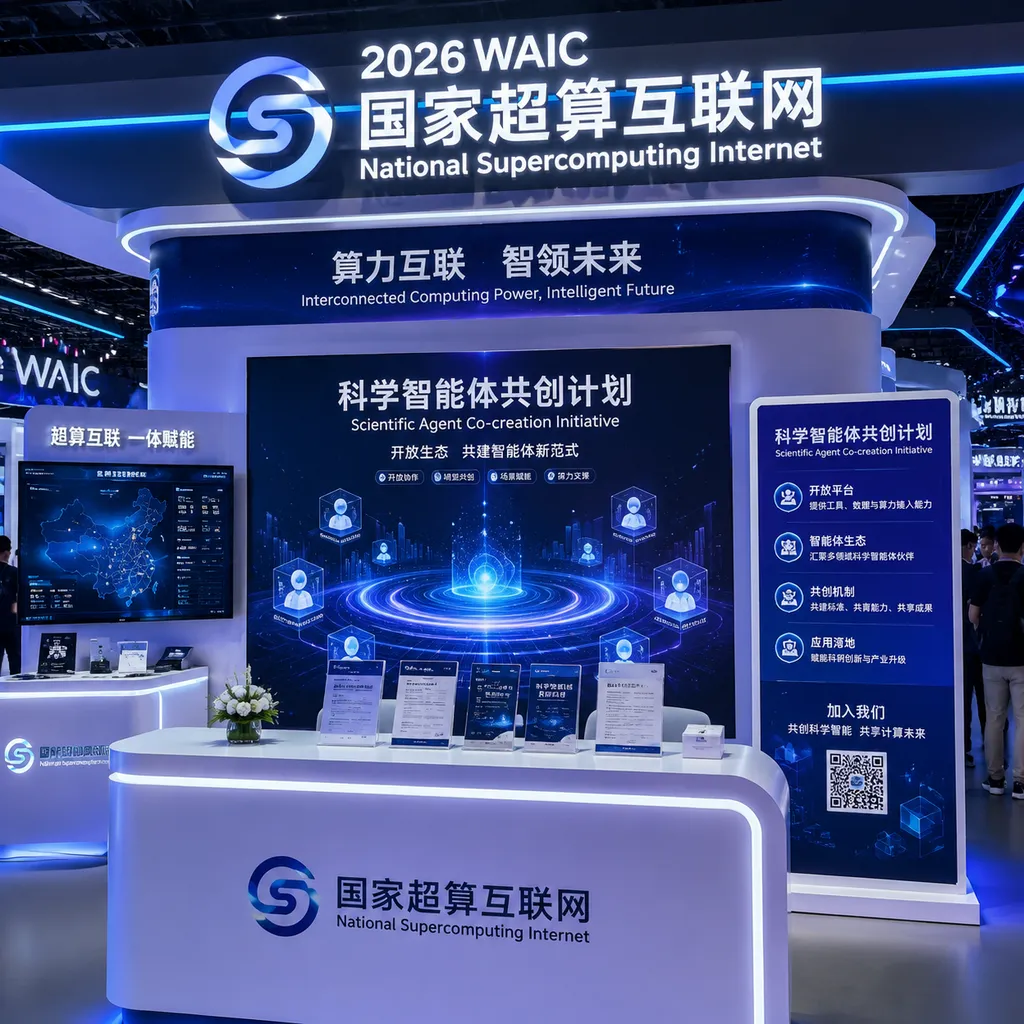
A Signal: Supercomputing Doesn’t Want to Be Just a “Compute Hours Vendor”
Over the past few years, China’s national supercomputing network has played a rather passive role—users submit projects, the supercomputing centers allocate nodes and bill by CPU hours, the job runs, and that’s it. This model worked in the traditional HPC era but feels awkward in the age of large models and intelligent agents.
Why awkward? Because there’s a disconnect between compute supply and top‑level applications. Writing a CUDA kernel to run molecular dynamics is one thing; enabling a full chain of AI4Science reasoning, tool calls, and multi‑model collaboration is another. Supercomputers excel at the former, but the latter requires a full‑fledged ecosystem—models, agent frameworks, tool protocols, datasets, evaluation benchmarks—none of which can be missing.
This co‑creation program essentially shifts the National Supercomputing Internet’s role from a “compute wholesaler” to an “ecosystem catalyst.” The call for contributions lists four categories—agents, scientific models, MCP tools, and Skills—and seen together, their intention is clear: they want not just standalone models but a self‑composable, self‑extensible network of capabilities.
MCP Appearing in the Official Call Is Worth Discussing
The most interesting term in the call for contributions is MCP (Model Context Protocol).
Those familiar with the field know that MCP is the open protocol Anthropic launched at the end of last year to standardize how large models call external tools and access data sources. After more than a year of evolution, MCP has become the de facto common connection layer in the agent ecosystem—used by products such as Claude, Cursor, and Cline. OpenAI announced support earlier this year, and in the Chinese community, tools from DeepSeek, Qwen, and GLM ecosystems are gradually adopting it.
Including MCP explicitly in the National Supercomputing Internet’s collection categories is a significant gesture:
- Acknowledging the reality of open protocols. Instead of reinventing a “China‑specific” version, they are directly embracing what already works in the global community—good news for developers, as it boosts tool reusability.
- Lowering barriers for scientific tool integration. Previously, integrating a simulation program, database, or post‑processing script into a model’s reasoning chain required writing a function‑calling schema and handling boundary cases. With MCP, you just deploy a server, and different agents can use it right away.
- Implying an architectural direction. The National Supercomputing Internet will likely run an MCP gateway or registry in the future, allowing contributed tools to be discovered and invoked by other agents in the ecosystem. Once this system is in place, the stickiness will far exceed that of a simple API key service.
As for Skills, the concept is closer to Anthropic’s recently introduced idea of reusable capability packages—bundling prompts, tools, and domain knowledge into attachable modules. In scientific contexts, examples like a “Crystal Structure Analysis Skill,” “Literature Review Skill,” or “Bioinformatics Pipeline Skill” are quite intuitive.
The Gap in Scientific Models Is Larger Than Expected
Another focus of the program is “scientific models.” Here, “models” refer not to general‑purpose large models but to discipline‑specific ones—protein structure prediction, materials property prediction, climate modeling, astronomical image recognition, and similar areas.
Why crowdsource them? Because general LLMs perform poorly in such domains. GPT‑5 and Claude Opus 4 excel at general reasoning, but to compute reaction transition states or predict alloy phase diagrams, domain‑trained scientific models are still needed. Their creators—often PhD students or postdocs—train them, publish papers, release them on Hugging Face—and that’s it. They lack compute resources for inference, engineering capacity to deploy services, and channels to reach downstream users.
This is exactly where the National Supercomputing Internet adds value:
- Compute guarantee. Co‑created models can run directly on supercomputing nodes, removing cost concerns.
- Distribution channel. Other agents in the ecosystem can directly call these models, providing authors with real usage data.
- Incentive mechanism. A six‑month program likely comes with compute resources, funding, and ranking incentives.
From a market‑structure perspective, this brings together the most fragmented, least commercialized part of AI4Science—domain‑specific small models—under a national platform. If it works, the impact could be substantial.
What Could Be Achieved in Six Months?
Some realism is warranted. Ecosystem building is always easy to say, hard to do.
Six months is neither short nor long. Based on past experiences with domestic “developer programs,” a co‑creation project’s viability typically depends on three factors:
- Transparency of review and selection. The research community has low tolerance for favoritism—if most selected projects come from major institutions, individuals and small teams will quickly lose interest.
- Practical usability of the toolchain. Announcing the plan is easy—but will deploying MCP servers on supercomputing nodes require a long approval process? Is there a unified Skill packaging standard? How is inter‑agent authorization handled? Such engineering details define developer experience.
- Sustainability of incentives. What happens after six months? How are contributed models and tools maintained, updated, or deprecated? If it’s merely a one‑off event, it won’t build a lasting ecosystem.
Zooming out, the timing aligns with global trends. In the first half of this year, the AI4Science field saw plenty of movement overseas—Google DeepMind partially lifted AlphaFold 3’s commercial restrictions, Anthropic launched its “Claude for Research” initiative, and NVIDIA’s BioNeMo ecosystem continues expanding. Domestically, leading laboratories have been working independently—there hasn’t been a national‑level coordination layer.
The National Supercomputing Internet’s move comes at the right time. Whether it can truly foster a thriving scientific‑agent ecosystem will depend on execution over the coming six months.
Some Advice for Developers
If you’re a developer in a relevant field, this window is worth attention:
- If you have a trained domain‑specific model without a proper distribution channel, consider submitting it.
- If you’ve built scientific toolchains with existing CLIs or Python libraries, wrapping them as MCP servers comes at low cost and worthwhile ROI.
- If you’re an agent‑application team, check whether the call includes capabilities that can plug directly into your product.
Additionally, developers working on multi‑model orchestration might care about this: on aggregation platforms like OpenAI Hub, mainstream models such as GPT, Claude, Gemini, and DeepSeek can all be invoked with a single key, fully OpenAI‑format compatible and accessible domestically—useful for rapid agent prototyping or comparative experiments. When the scientific ecosystem meets general‑purpose LLM capabilities, such unified access points significantly reduce integration costs.
In the long term, the National Supercomputing Internet’s initiative may not be the flashiest piece of news, but it could mark a turning point for China’s AI4Science shift from “paper‑driven” to “ecosystem‑driven.” In six months, we’ll know whether this step holds.
References
So far, detailed technical specifications, MCP integration documents, and review standards for the program have not been fully disclosed on open developer platforms. Follow official channels for updates if a GitHub repository or technical documentation is later released.