Ali Tongyi Wan-Streamer v0.2: AI video call latency reduced to 550 ms
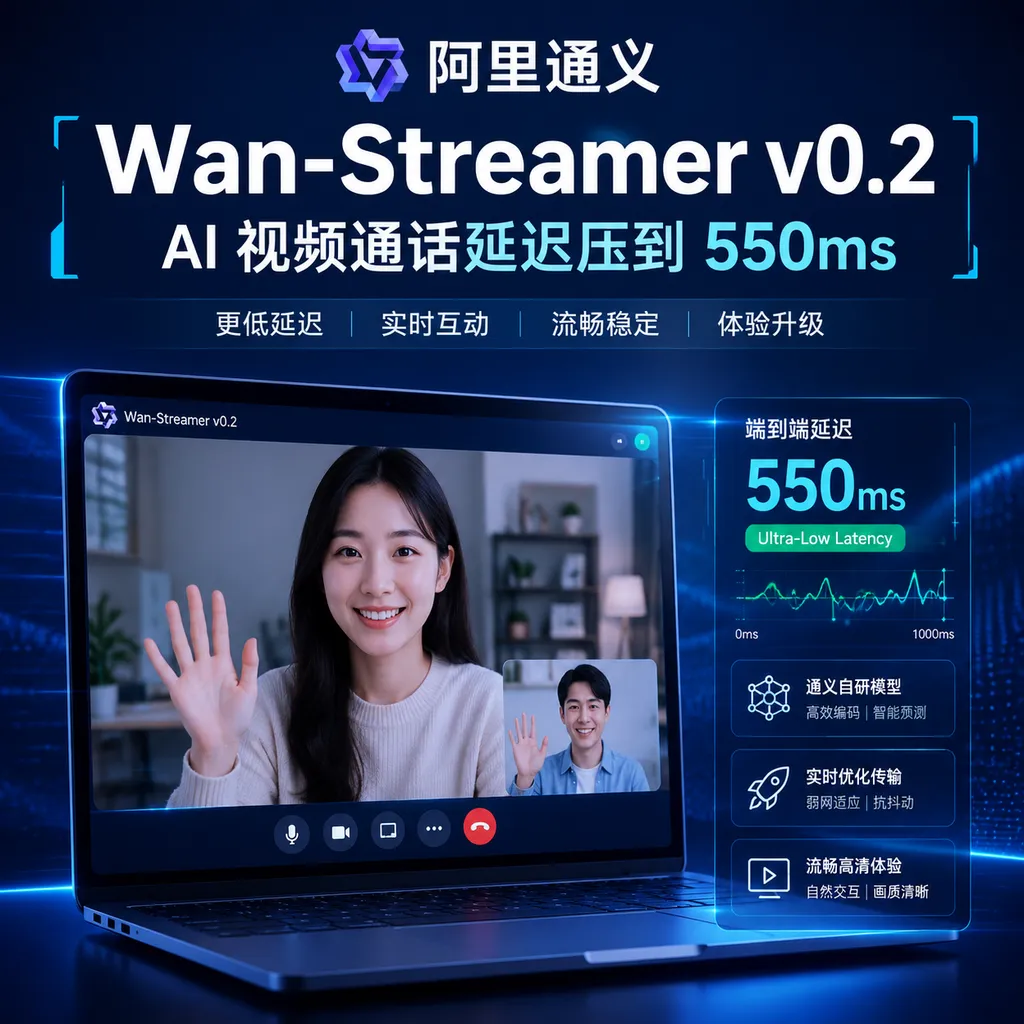
Alibaba Tongyi Laboratory releases the end-to-end full-modal real-time interaction model **Wan-Streamer v0.2**, featuring a model-side latency of only **200 ms** and a total latency (including network transmission) of **550 ms**. The resolution has been upgraded from **192×336** to **640×368 @ 25 FPS**, enabling AI digital humans to truly **listen, see, and speak simultaneously**.
Today, Alibaba Tongyi Lab dropped Wan‑Streamer v0.2.
One number: end‑to‑end interactive latency 550 ms — of which the model itself accounts for only 200 ms, and the remaining 350 ms is network transmission. In the field of real‑time audio and video, this figure already matches the natural human reaction time in conversation — in an ordinary phone call, the gap between the other person finishing and you beginning to speak is typically 300 – 600 ms.
In other words, for the first time, AI video calls show no visible latency difference from real human video calls.
Not “think after speaking,” but listening, thinking, and acting simultaneously
To understand why Wan‑Streamer deserves attention, we need to look at how it differs from mainstream real‑time speech models.
Over the past year, OpenAI’s Realtime API, Google Gemini Live, and several domestic “digital‑human” companies have followed essentially the same path — stitching together ASR (automatic speech recognition), LLM (large language model), TTS (text‑to‑speech), and even talking‑head generation modules. No matter how much optimization is applied, each step in that chain must wait for the previous one to finish; total latency is hard to push below one second. Worse, this architecture is half‑duplex — you talk, it listens; only after you finish does it respond. Real human conversation isn’t like that: we interrupt, interject, and nod halfway through.
Wan‑Streamer takes a different route: it packs listening, seeing, speaking, and performing into a single Transformer trained end‑to‑end. The user’s text, audio, and video inputs, plus the agent’s own outputs, are all mapped onto the same causal timeline.
The key design is the Streaming Unit — a fully closed loop completed every 160 ms:
- Perceive the current 160 ms of user audio‑video input
- Update the shared interaction state and context
- Generate synchronous speech and video latents
- Decode and output the previous unit’s audio‑video response
This means the AI doesn’t wait for you to finish speaking before “thinking.” In every tiny slice of time while you speak, it simultaneously completes perception → understanding → generation → decoding. This native streaming modeling forms the foundation of full‑duplex interaction.
Compared with the modular approach, how different is it? Imagine the modular path as an assembly line, where each worker performs a step and must wait for the previous one’s output; Wan‑Streamer is more like a simultaneous interpreter — listening, translating, and speaking all at once, with multiple internal modules running in parallel.
From v0.1 to v0.2: From a “floating head” to a person you can see at the table
Version v0.1 (last year) proved the concept, but resolution was only 192 × 336 — essentially a close‑up focusing on face and lips. You could converse with it, but visually it looked like a floating head.
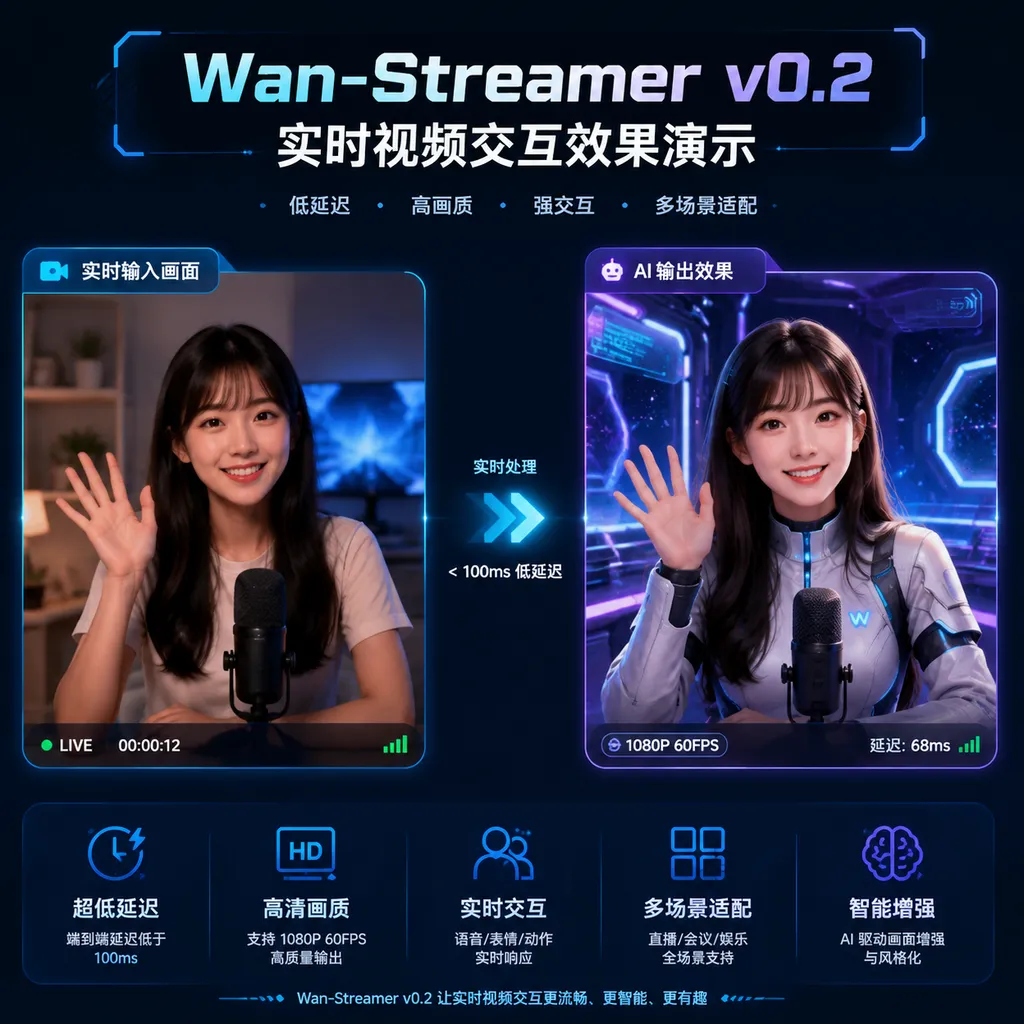
v0.2 lifts output to 640 × 368 @ 25 FPS — about 3.6× more pixels, and the improvement goes far beyond that.
At this new resolution, you can clearly see:
- The AI’s gaze direction — whether it’s looking at you
- Body posture — leaning forward, leaning back, relaxed or tense
- Hand gestures — natural finger movements and pointing
- Even the table in front and the room layout behind
The composition upgrades from “close‑up call” to “scene‑based mid‑shot interaction.” For applications, this matters greatly — digital‑human customer service, AI interviewers, remote companionship, education: experiences that previously felt incomplete can now present genuinely humanlike visuals.
Tripled resolution — how is latency still low?
That’s the real technical highlight of v0.2.
Generating video latents is computationally heavy; higher resolution means workloads scale linearly or worse. If this were all crammed into the low‑latency path, maintaining a 200 ms model response would be impossible.
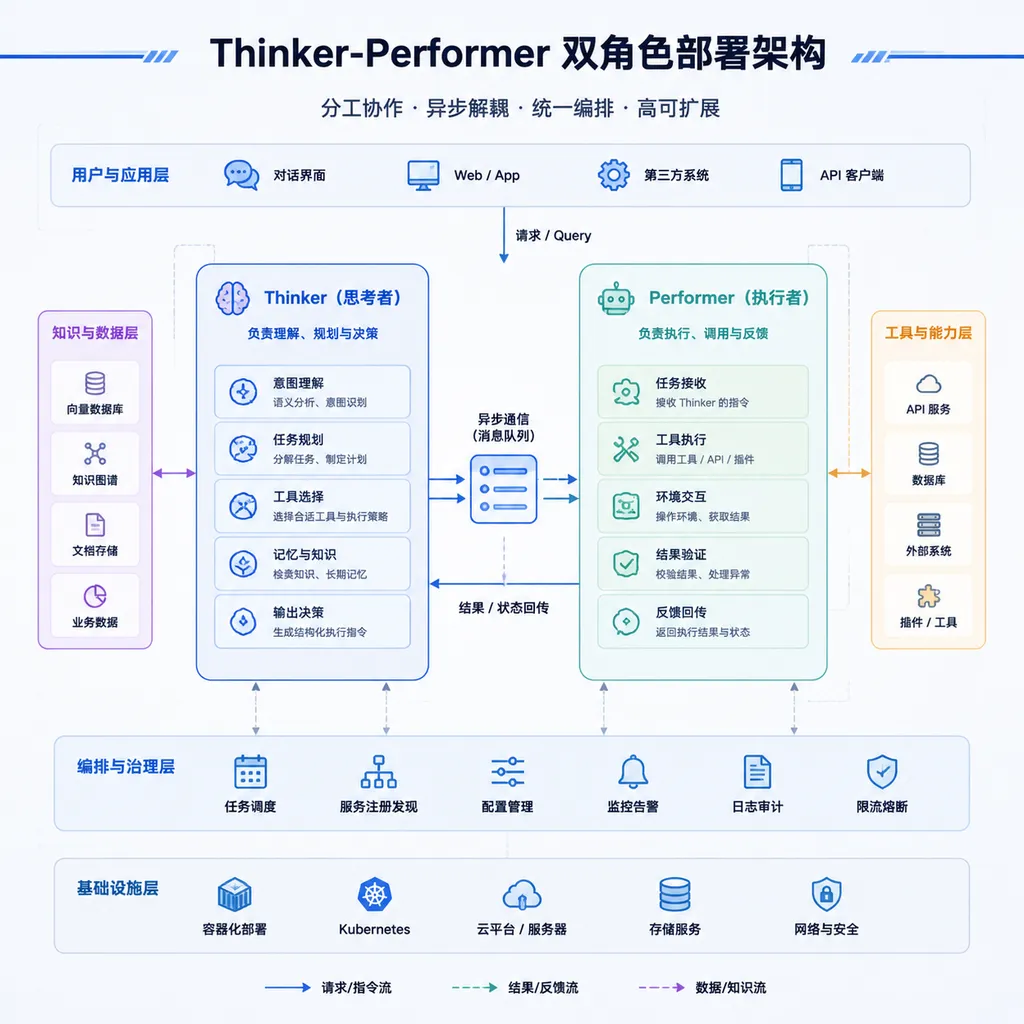
The Tongyi team solved this by splitting the system into two roles running on different hardware topologies:
Thinker — single GPU
Handles the core interactive control path:
- Streaming perception of user input
- Language and state updates
- Building K/V cache
- Final causal decoding
It converts results into K/V slices and broadcasts them to the Performer.
This route must remain lightweight, because it determines the key “user speaks → AI starts responding” latency.
Performer — multi‑GPU
A Ulysses‑style context‑parallel cluster dedicated to the heavy‑duty video‑latent generation.
- Sequence parallelism: high‑resolution video‑latent sequences split across different ranks for denoising, with all‑to‑all/gather communication via the Ulysses protocol
- Pre‑sharded K/V cache: each Performer rank maintains pre‑sharded K/V cache, receiving Thinker conditioning directly
- Audio not sharded: audio‑latent sequences are much shorter than video; sharding would add overhead, so they’re generated intact by the Performer
The core idea is decoupling: move compute‑intensive visual generation into the context‑parallel Performer group, while keeping the Thinker’s interaction path light. Latency penalties from higher resolution are contained inside Performer and don’t contaminate the Thinker’s critical path.
In plain terms: a team of GPUs handles the heaviest work in parallel, while a single card focuses on the latency‑sensitive responses. Clear division of labor keeps latency stable.
Compared with other real‑time interaction systems — where Wan‑Streamer shines
The Tongyi team published a comparison table worth noting:
| Capability | Mainstream real‑time speech models | Mainstream digital‑human solutions | Wan‑Streamer v0.2 | | --- | --- | --- | --- | | End‑to‑end latency | 1 – 2 s | 1.5 – 3 s | ≈ 0.55 s | | Video perception | ❌ | Partial | ✅ | | Video output | ❌ | ✅ | ✅ | | Full duplex | Partial | ❌ | ✅ | | End‑to‑end architecture | ✅ | ❌ | ✅ |
Combine all these and keep latency < 1 s? Currently only Wan‑Streamer does.
OpenAI Realtime API excels at speech but lacks video output; HeyGen and D‑ID produce video but usually have 2 s or more of delay and don’t handle video input.
To temper the hype: all numbers are from official data. In production, the Thinker + Performer multicard setup has hardware‑cost requirements; it won’t run on just any server or with a simple API key. It’s more of an infrastructure‑level model, likely deployed first via Alibaba Cloud’s own stack.
Application scenarios — more than you might imagine
With latency down to 550 ms and mid‑shot resolution, what new use cases open up?
- AI video customer service: no longer just an avatar over text; a true “face‑to‑face” able to see the customer’s raised product and respond accordingly.
- Remote AI interviewer: perceives posture and facial expression, producing more natural follow‑ups.
- Companionship & emotional support: visible micro‑expressions greatly enhance emotional communication compared with voice‑only.
- Education & training: the AI teacher can literally “watch” you solve problems and prompt you when distracted.
- Live streaming & content creation: low latency lets digital hosts interact with chat in real time, not awkward 3‑5 s delays.
Note: enabling video perception means the AI can see what’s in your hand and your facial changes — something voice‑only systems could never do. When AI not only hears you but sees what you do, the semantic bandwidth of interaction increases dramatically.
Some unanswered questions
The official blog and paper released architecture and latency metrics, but left several issues unclear:
- Model parameter size — tens of billions or hundreds? This affects whether it can be open‑sourced or locally deployed.
- Open‑source plan — none mentioned. Tongyi Wan series (Wan 2.1, Wan 2.2) were open‑sourced; it’s unknown if Streamer will follow suit.
- Multilingual capabilities — demos were mainly in Chinese; English and other languages remain to be tested.
- Long‑conversation stability — 550 ms latency is great short‑term, but over 10–20 minutes, will K/V cache growth cause drift?
Answers will likely come in future technical reports or third‑party evaluations.
A quick take
For two years, the real‑time audio‑video interaction race has awaited a truly end‑to‑end contender. GPT‑4o’s launch briefly wowed audiences with Her‑like demos, but true video‑in/video‑out full‑duplex models hadn’t landed. Wan‑Streamer is the first native streaming model that fully integrates seeing, hearing, speaking, and performing with corresponding architecture and latency data.
Its value isn’t to replace GPT‑4o or Gemini Live — those are general assistants. Wan‑Streamer digs deeper into real‑time interaction itself. It’s separate from the Wan 2.6 path focused on high‑quality video generation: one pursues the ceiling of content quality, the other the floor of interaction responsiveness.
For developers, the key watchpoint: if Alibaba Cloud eventually exposes it via Bailian Studio (or even limited public beta), the barrier to real‑time digital‑human apps will drop sharply. On aggregator platforms like OpenAI Hub, real‑time audio‑video APIs are still scarce; plugging in Wan‑Streamer would be an interesting addition.
Remember this number: 550 ms — as of July 2026, the new benchmark for real‑time AI video‑call latency.
References
- ITHome: Alibaba Tongyi Lab releases Wan‑Streamer v0.2 model — AI video‑call latency only 550 ms — original announcement and technical details
- Zhihu: Analysis of Alibaba Wan‑Streamer end‑to‑end real‑time audio‑video interaction model — technical deep‑dive on 200 ms model latency and full‑duplex capability