The China Meteorological Administration has open-sourced its trillion-parameter meteorological model "FengHe".
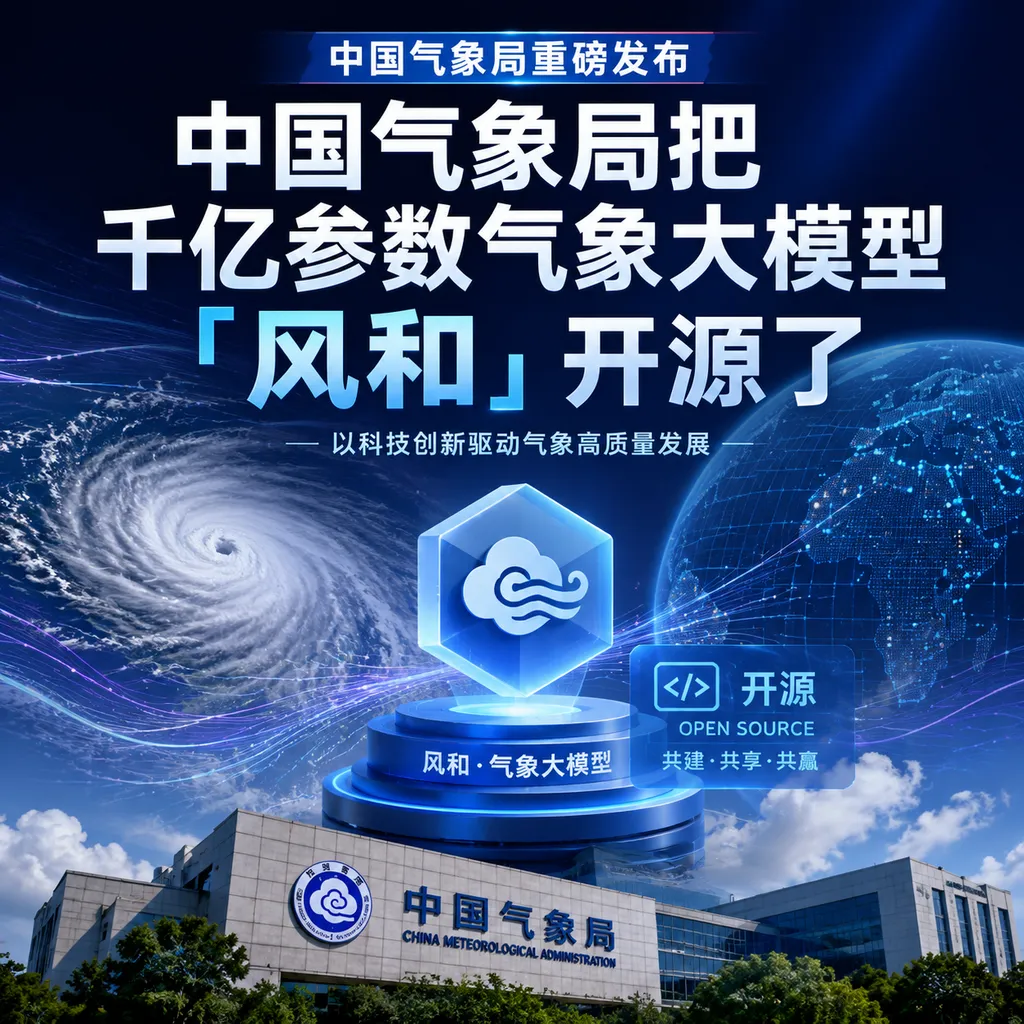
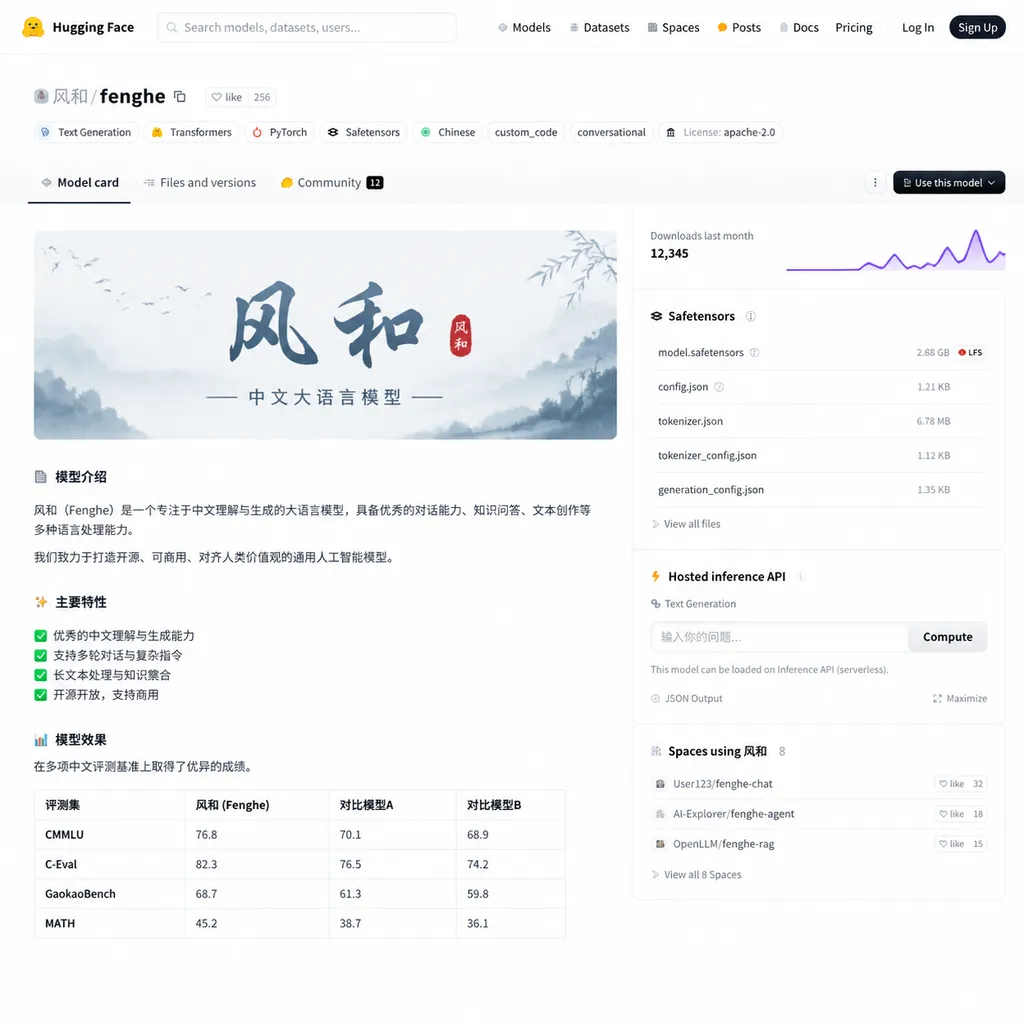
At the 2026 WAIC, the China Meteorological Administration open-sourced its 100-billion-parameter meteorological large language model **"Fenghe"**. The model weights have been released on GitHub and Hugging Face, with APIs and cloud services opened simultaneously. It is the world's first open-source meteorology domain model at the 100-billion-parameter scale.
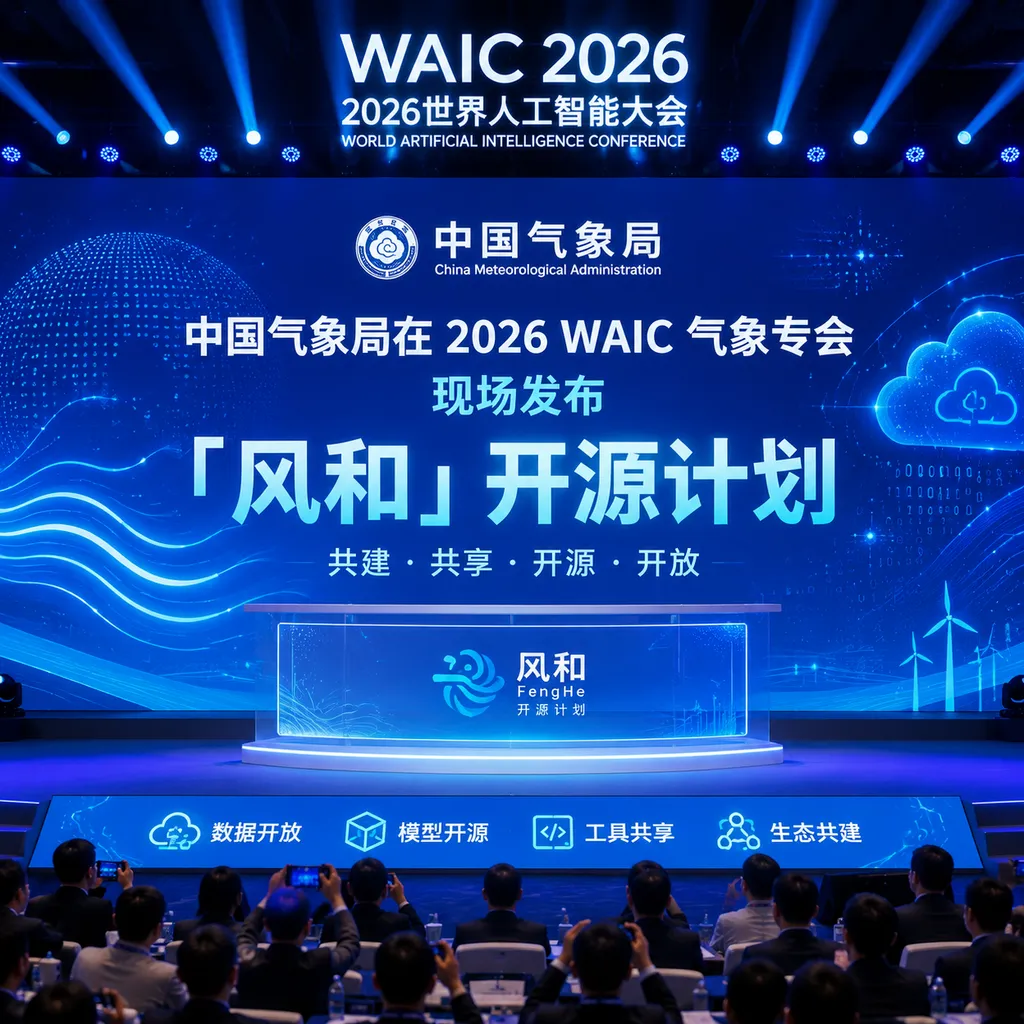
On July 17, at the 2026 World Artificial Intelligence Conference (WAIC) Meteorological Session, the China Meteorological Administration (CMA) released the full weights of its “Fenghe” large language model on GitHub and Hugging Face, simultaneously launching a global open-source program. This is the world’s first trillion-parameter meteorology-focused large model, and the first in the CMA’s “Feng” series intended for public and industry use rather than internal-system operation only.
Those familiar with this track will know that “Fenghe” did not appear out of nowhere. It originated as the “AI Meteorological Service Officer” launched domestically on October 28 last year, which already sparked discussion at the time — a trillion-parameter model, based on a self-developed general large model, specifically for meteorological services. The lingering questions then were: would it be open-sourced? And to what extent? WAIC now gives the answer, more completely than expected: full weights, standardized APIs, cloud services, and customizable deployment plans are all being released together.
First, let’s clarify one thing: “Fenghe” is not a weather prediction model
This is easy to confuse, so it needs to be stated first.
Over the past few years, the CMA has released a series of models named with the character “Feng” (wind): “Fengqing” for global short-to-medium-range forecasts, “Fenglei” for nowcasting, and “Fengshun” for sub-seasonal to seasonal forecasts. These three are AI alternatives to numerical weather prediction models, comparable to the ECMWF’s IFS, DeepMind’s GraphCast, and Huawei’s Pangu-Weather. The “Fengqing” model’s globally available forecast period is up to 10.5 days, already surpassing mainstream European and American AI forecast models.
“Fenghe” doesn’t do that. It’s an LLM — a generative system based on a large language model architecture. According to Wang Muhua, a senior engineer at CMA’s Public Meteorological Service Center, it acts more like an “AI meteorological service officer”: upstream, it connects to “Fengqing,” “Fenglei,” and “Fengshun,” and downstream, it provides service-oriented translation, interpretation, and decision support for the public and industries.
So you can think of this product line’s structure as follows:
- “Fengqing,” “Fenglei,” and “Fengshun” are the back-end — they calculate “Will it rain tomorrow?”
- “Fenghe” is the front-end — it answers “Should I go out tomorrow if it rains, which route should I take, and when should I leave?”
This division has long been a challenge in the meteorological field. Numerical forecasts are increasingly accurate, yet the public still receives vague phrases like “cloudy to overcast, local showers possible.” The missing middle layer — converting physical data into actionable human advice — used to rely on manual forecaster work or rule-based templates in apps, both low in efficiency and precision. “Fenghe” aims to fill this gap.
One trillion parameters, 50 million tokens of data — where does the expertise come from?
While a trillion parameters is no longer rare among general LLMs, this is the first time it’s been done in the meteorological domain. The 50 million tokens of high-quality meteorological service corpora may sound small in quantity, but note that these are high-quality domain data — not scraped weather news, but the CMA’s proprietary question–answer pairs, forecast texts, risk assessment cases, and industry service records.
This approach mirrors that of medical and legal domain models in recent years: start with a powerful general base model, then fine-tune using high-quality domain data to elevate professional reliability and safety. The key difference is that meteorological data barriers are lower than in medicine or law — physical model data from numerical forecasts are already open; the real know‑how lies in “how to explain physical data in human language.” That’s exactly what’s being open-sourced here.
The model is built atop the “Earth System Data Resource Base,” integrating authoritative meteorological data and completing compliance filings for generative AI. This matters for domestic developers — using the open-source weights for secondary development and product deployment avoids many regulatory hurdles.
Open-source means more than just a checkpoint drop
It’s worth emphasizing just how complete this open-source release is.
Many so-called open-source models merely dump weights on Hugging Face with a bare README and leave the rest to users. In contrast, “Fenghe” offers a full package:
- Complete model weights: on both GitHub and Hugging Face
- Standardized API interface: no need to build inference frameworks yourself
- Cloud services: available for those who prefer not to self-host
- Custom deployment solutions: designed for industry clients
The announcement specifically mentions: “Global users are permitted to embed ‘Fenghe’ into embodied intelligence, apps, mini‑programs, and various terminals.” That “embodied intelligence” point is intriguing — integrating a meteorological model into robotic decision-making lets outdoor work robots, drones, and autonomous vehicles assess weather risks on their own, which opens a much larger imagination space than consumer weather apps.
“Mazu” and global early warning: another layer of intent behind open‑sourcing
The international version of “Fenghe” has already launched, built into a meteorological intelligent early warning scheme called “Mazu,” offering bilingual (Chinese–English) Q&A, weather queries, and risk analysis. Behind it lies the UN’s Early Warnings for All initiative — a goal to ensure everyone worldwide receives early warnings by 2027.
The challenge is practical: many African, Southeast Asian, and Pacific Island nations lack the capacity to build modern meteorological early warning systems. The traditional approach—data and tech transfer from developed countries—faces barriers in language, computing resources, and localization. By open‑sourcing a trillion‑parameter meteorological LLM, local developers can adapt and deploy it themselves—a far more effective “teach a man to fish” engineering strategy.
Seen this way, the CMA’s open‑sourcing move is not just technical outreach but a strategic bid to claim a position in meteorological AI akin to what DeepSeek represents for general large models—using open‑source to seed an ecosystem. Mainstream Western meteorological institutions have no direct counterparts yet: ECMWF’s AI work still centers on numerical forecast replacement; NOAA remains conservative; commercial weather companies like The Weather Company and AccuWeather pursue closed‑source SaaS models. This window of opportunity is brief—but presently wide open.
A real‑world comparison
The official example of a weekend outing neatly illustrates the difference between “Fenghe” and a traditional forecast.
Traditional forecast:
Cloudy, turning overcast in the suburbs this weekend, with isolated showers.
A camper reading that is left clueless — which areas exactly? At what times? Should they bring children or cancel the trip?
“Fenghe” is expected to output something like:
The southern slope of Mount X will be sunny from 2 p.m. – 4 p.m. Saturday with winds below level 3; the northern slope will experience continuous drizzle during the same period; dense fog will form atop the mountain after 4 p.m. Recommend choosing the southern trail and descending before 4 p.m.
Several capabilities combine here: ultra‑high‑resolution microclimate simulation (slope differences), fine‑grained multi‑factor forecasting (sunlight, wind speed, precipitation, visibility), and scenario‑based actionable advice (route and timing). The first two capabilities originate from backend numerical models like “Fengqing” and “Fenglei”; “Fenghe’s” added value is organizing these data into recommendations humans can act on directly.
This transformation—from regional forecasts to point‑to‑point forecasts, from passive reception to proactive intelligent guidance—is what weather apps have aspired to for a decade but failed to achieve. The reason is simple: rule engines and templates can’t perform this level of causal reasoning; only a general‑purpose LLM integrated with domain data can make it work.
Some points to watch
That said, optimism should be cautious. Several issues remain unclear and will only surface as the community engages:
- Model architecture. Are the trillion parameters dense or MoE? Which base model is used? Given Zhipu’s collaboration, it likely stems from the GLM series, but this is unstated.
- Inference cost. A trillion‑parameter model isn’t cheap to run. For global developers to use it in mini‑programs or IoT devices, will there be quantization or distillation options?
- Data timeliness. Meteorological data are highly time‑sensitive. How will the model integrate in‑model knowledge with real‑time external data (RAG? tool calling?)—no details yet.
- Evaluation. Domain models risk being self‑referential. Will there be benchmark comparisons against GPT‑4, Gemini, or Claude for meteorology Q&A? Such data are crucial; without them, “professional accuracy” remains unproven.
The CMA is expected to release technical reports and benchmarks over time—worth watching the GitHub repo’s issue section.
In closing
Viewed broadly, the open‑sourcing of “Fenghe” stands out in China’s two‑year AI open‑source wave. It’s not a general model (that field is crowded) nor a coder/agent tool model, but rather a national public‑service agency consciously open‑sourcing an entire domain‑specific model—weights, APIs, cloud services, and deployment guides inclusive. If this model succeeds in meteorology, others in public domains such as healthcare, transport, and energy may follow.
The success of any open‑source ecosystem ultimately depends on developer uptake. With “Fenghe’s” weights, APIs, and code on both GitHub and Hugging Face, interested developers can simply pull and test for themselves—see if it really can tell you whether to bring an umbrella tomorrow.
For domestic developers seeking to integrate “Fenghe” with other large models—for instance, using Claude or GPT for general reasoning and “Fenghe” for meteorological expertise—aggregator platforms like OpenAI Hub let you call multiple models with a single key, providing direct domestic connections and OpenAI‑format compatibility without separate adaptation layers for each model.
References
- ITHome: The world’s first trillion‑parameter meteorological model! CMA launches the global open‑source plan for “Fenghe” — Original report with key WAIC release information and open‑source plan details
- Hugging Face — one of the platforms hosting “Fenghe’s” open‑source weights
- GitHub — another open‑source platform for “Fenghe’s” code and weights