Shanghai AI Lab unveils a 397B science-oriented foundation model, Mobius bets on non-Transformer architecture

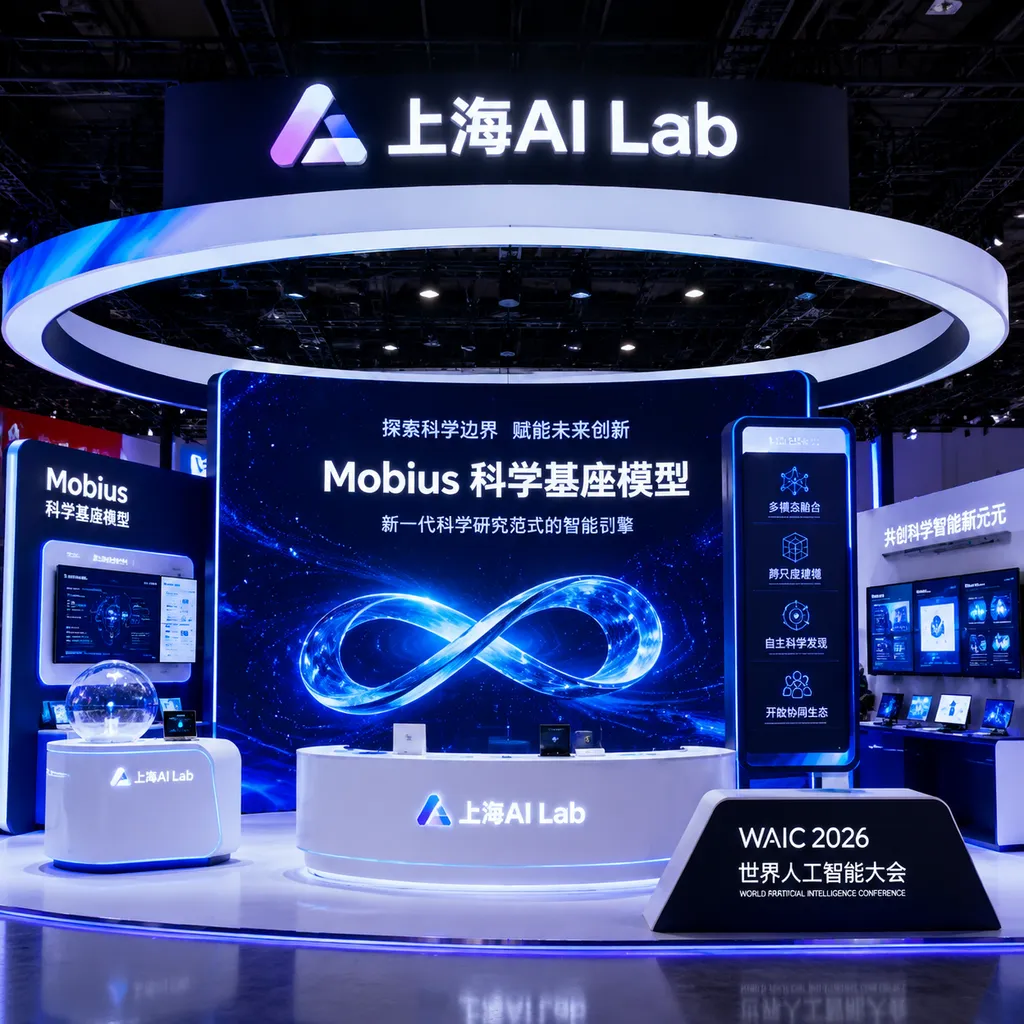
At WAIC 2026, Shanghai AI Lab released *Mobius*, a 397B-parameter scientific intelligence foundation model built on a non-Transformer architecture. Its performance is benchmarked against trillion-parameter models, and the lab has explicitly stated that it will not engage in general question-answering, serving only scientific research purposes.
397B Parameters Rival Trillion-Scale Models — But This Time, the Star Is Not a Transformer
At WAIC 2026 in Shanghai, the Shanghai Artificial Intelligence Laboratory unveiled something unusual: a 397‑billion‑parameter foundational model for scientific intelligence, codenamed Mobius. Its parameter count isn’t earth‑shattering by today’s standards, but two details put it squarely in the spotlight — it’s not a Transformer, and it has no interest in chatting with you.
Over the past two years, virtually every large model calling itself a “general foundation” has used the same sales pitch: longer context, stronger reasoning, better agent capabilities — usually capped off with “applicable to every industry.” Shanghai AI Lab did the opposite. From the outset, Mobius drew a clear boundary around “general Q&A capability” — it is designed solely for research scenarios: literature retrieval, paper comprehension, computation, experiment automation, and report generation, forming a well‑defined chain.
This is a deliberate narrowing of capabilities — and one that goes further than you might expect.
Why a Non‑Transformer?
Let’s start with the architecture. Transformers have been nearly deified in recent years, yet they come with several pain points in scientific research contexts:
- Memory costs for ultra‑long contexts: A top‑tier paper may contain tens of thousands of tokens; a project’s lifetime of data can easily reach millions. KV cache’s O(n²) scaling makes GPU memory usage painful.
- Architectural baggage for multimodal integration: Scientific data isn’t plain text — it includes molecular formulas, gene sequences, spectra, microscopy images, and temporal signals. Forcing these modalities into Transformer tokenization loses structural information.
- Instability in reasoning chains: Scientific reasoning often involves tens of sequential tool calls. Transformer drift over long dependencies becomes magnified there.
Mobius’s “non‑Transformer” path — according to disclosed information — follows a State Space Model (SSM) direction, integrating elements of linear attention and structured memory. This lineage, popularized by models like Mamba and RWKV, shares a core advantage: reducing the quadratic attention complexity to linear or near‑linear, while preserving long‑range dependencies through state compression.
This isn’t Shanghai AI Lab’s first gamble on this route — models from the Mamba and Hyena families have made waves — but operating at 397B parameters and explicitly targeting production‑grade scientific workflows makes it a first in China. This is not a research prototype — it’s meant to run real R&D pipelines.
For developers, the core message is simple: Mobius makes context costs bearable again. Previously, asking a model to “read all lab notebooks from the past five years before answering” was computationally prohibitive. With linear‑complexity architecture, such workflows become commercially viable.
397B vs. Trillion‑Scale — How?
Mobius diverges sharply from trillion‑parameter models’ brute‑force data strategy. According to on‑site disclosures, over half of its training corpus comprises scientific data, covering life, material, earth, and mathematical sciences, plus millions of tool‑use traces. By contrast, general models are dominated by web text, code, and conversation data — genuine high‑quality scientific text often makes up less than 5%.
In other words, Mobius was trained in a curated, higher‑density dataset pool. Within such data, 397B parameters can absorb as much — if not more — scientific knowledge as trillion‑scale models trained on open web data. That’s the confidence behind the claim to “rival trillion‑parameter models” — not on MMLU or GPQA leaderboards, but specifically on scientific tasks.
It’s also noteworthy that Shanghai AI Lab explicitly stated Mobius will not compete in general Q&A benchmarks. Run it on GSM8K or MMLU, and it may underperform equivalently sized general models. The positioning is crystal‑clear: a specialist for scientific tasks, not a universal all‑rounder.
Comparison highlights the contrast:
| Dimension | General LLMs (Claude/GPT etc.) | Mobius | |---|---|---| | Architecture | Transformer | Non‑Transformer (SSM route) | | Parameter count | Hundreds of billions–trillions | 397B | | Corpus composition | Web + code + conversation | Scientific literature + experiment data + tool traces | | Context cost | Quadratic | Linear / near‑linear | | Target scenarios | General Q&A + Agents | Full‑cycle scientific research | | Evaluation metrics | MMLU / HumanEval / AIME | Discipline‑specific research tasks |
Above Mobius Lies a Whole Agentic Science Stack
Mobius wasn’t launched in isolation. It’s part of Shanghai's broader “Agentic Science at Scale” narrative. At a January 29 symposium, academician Wei‑Nan E outlined the big picture: AI4S infrastructure is mature, and the “GPT moment” for large‑scale scientific research has arrived.
Alongside Mobius, several related projects were showcased:
- Innovator Scientific Foundation: Led by Prof. Zhang Linfeng’s team at SJTU, supporting 20+ scientific modalities and claiming to surpass 30× larger general models in scientific programming; orchestrates tens of thousands of research tools.
- SciMaster Research Agent: From Dr. Chen Siheng’s group — described as “autonomous scientific research driving,” reportedly accomplishing in six hours what a senior theoretical physicist would take one to three months to finish.
- SciencePedia Foundation: From the CAS Institute of Theoretical Physics — integrates 3M reasoning chains and 30K tools to build traceable reasoning graphs.
- Agent‑Ready‑at‑Scale Tool System: From DP Technology, focused on lowering integration barriers for scientific software.
- AI4S Evaluation Framework: From Prof. Zhu Tong’s team at ECNU — featuring dynamic, process‑based, and practical task evaluations.
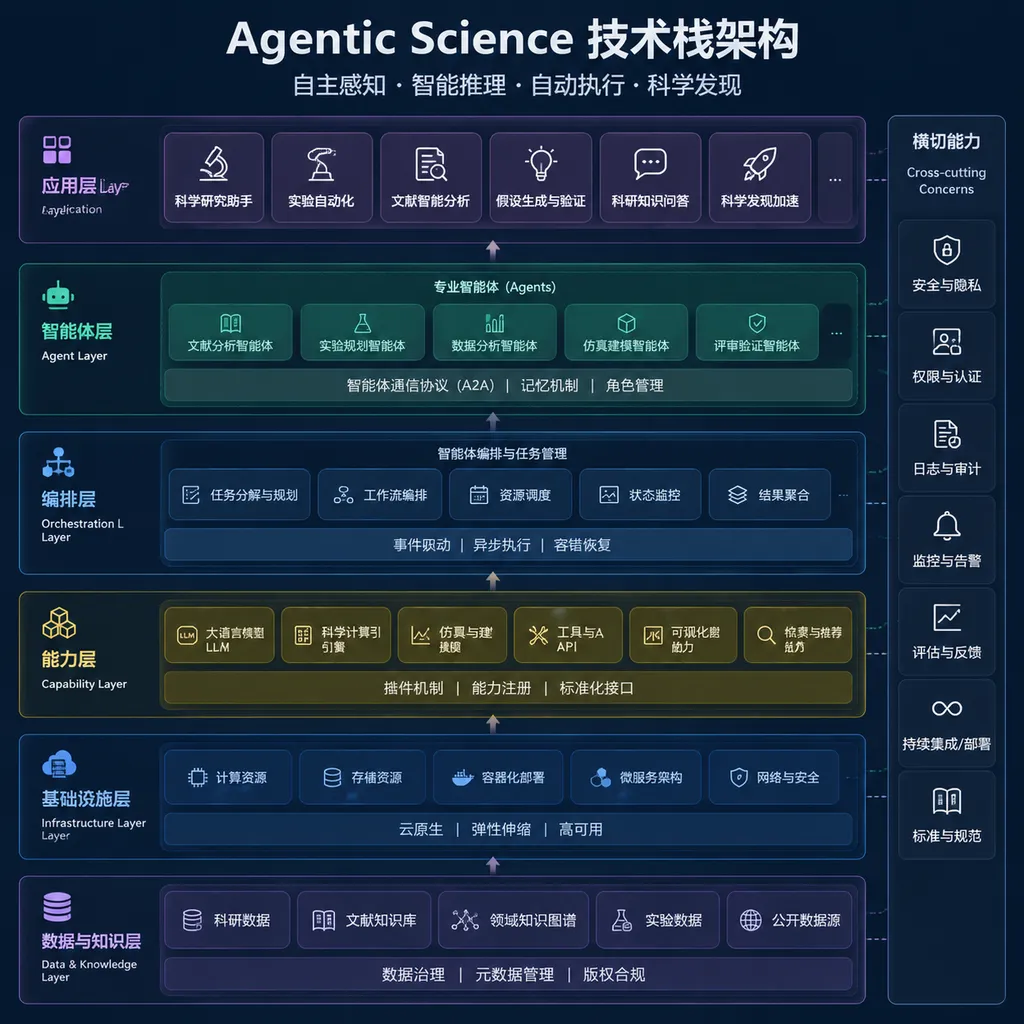
This division of labor is intentional: foundation (model) → tools (capabilities) → agents (orchestration) → evaluation (measurement) — forming an end‑to‑end loop for scientific production. Within this loop, Mobius’s role isn’t to serve as “the most intelligent brain,” but as the central scheduler most fluent in the language and semantics of science tools.
What Does This Mean for Developers?
In short: if you’re building AI4S applications, or Agents dealing with long documents and large‑scale tool orchestration, this release is worth attention. If you simply want a stronger general assistant, Mobius isn’t for you.
Some specific takeaways:
1. Architectural diversification is becoming clear.
For years, Transformers monopolized both mindshare and compute. Now, top Chinese labs are betting a full 397B parameters on non‑Transformer paths. Expect more work on inference frameworks — current systems like vLLM and SGLang optimize for Transformer attention. SSM‑based stacks will need dedicated support. Infra teams should start tracking this now.
2. The business logic of vertical foundations has been validated.
Previously, everyone chased bigger general models. Yet scientific research demonstrates that in domains with high data density and well‑bounded tasks, specialized models with hundreds of billions of parameters can outperform trillion‑scale general models. Expect this logic to replicate in medicine, law, finance, and code.
3. The “last‑mile” problem for Agents is being addressed head‑on.
The biggest pain point for using general LLMs in research agents isn’t reasoning — it’s their inability to use tools. Molecular docking, quantum chemistry packages, genomic pipelines — these require domain knowledge in parameter tuning, error handling, and result interpretation. Mobius embeds tool semantics into its foundation — a weakness general models struggle to patch.
4. The evaluation‑standard war has begun.
By deliberately avoiding general benchmarks, Shanghai AI Lab is emphasizing scientific task evaluations instead. Behind that is an effort to define new metrics—and thus new authority. ECNU’s three‑tier evaluation framework will likely become a core national standard for AI4S.
Unanswered Questions
Despite the buzz, practical deployment still raises some issues:
- Openness and licensing. No clear policy yet: will it be fully open‑source, partially open, or API‑only? This will determine how quickly an ecosystem can form.
- Hardware compatibility. Operator support for SSM models on domestic chips remains patchy. Real‑world performance outside Nvidia H100/A100 needs testing.
- Division of general and domain tasks. Real research still involves mundane requests like “fix this Python snippet” or “translate this abstract.” Mobius might need either a small built‑in general model or a hybrid‑agent setup.
- Effectiveness of long contexts. Linear complexity saves memory, but how much information loss results from state compression? Precision retention at multi‑million‑token scale requires real workload testing.
A Broader Shift
Stepping back, Mobius’s significance lies less in its 397B parameters or non‑Transformer core and more in what it represents: a shift in how models are conceived and released.
For years, the storyline was always “bigger, stronger, more general.” Mobius flips it to: more specialized, more efficient, more domain‑savvy. This mirrors the logic behind Anthropic’s Claude Sonnet optimizations for specific contexts and DeepMind’s AlphaFold focused on one problem.
AI is moving from “making gods” to “building factories.” You only need one god, but you need many factories, each different in purpose. Shanghai AI Lab’s bet, backed by significant funding, is precisely on this industrial turn.
For developers integrating multiple models, this architectural diversity is good news. Aggregators like OpenAI Hub already allow one API key to access GPT, Claude, Gemini, DeepSeek, etc. Future domain‑specific foundations like Mobius could join such unified access layers, removing the need for separate accounts and SDKs. Whether Mobius will open its APIs this way depends on the lab’s policy.
In summary: the focus isn’t on architecture or parameter size — it’s on taking AI models seriously as “scientific instruments,” not as chatbots. That shift might prove more consequential than any doubling of parameters.
References
- For community discussions on AI4S foundation models and research agents, follow the AI4S topic on Zhihu
- For open‑source non‑Transformer architectures (Mamba/SSM), check related projects on GitHub to understand Mobius’s technical lineage
- Several SSM‑based models are available for benchmarking on Hugging Face Model Hub