SenseTime releases a compute–electricity collaborative Agent: unit electricity token output increased by 80%

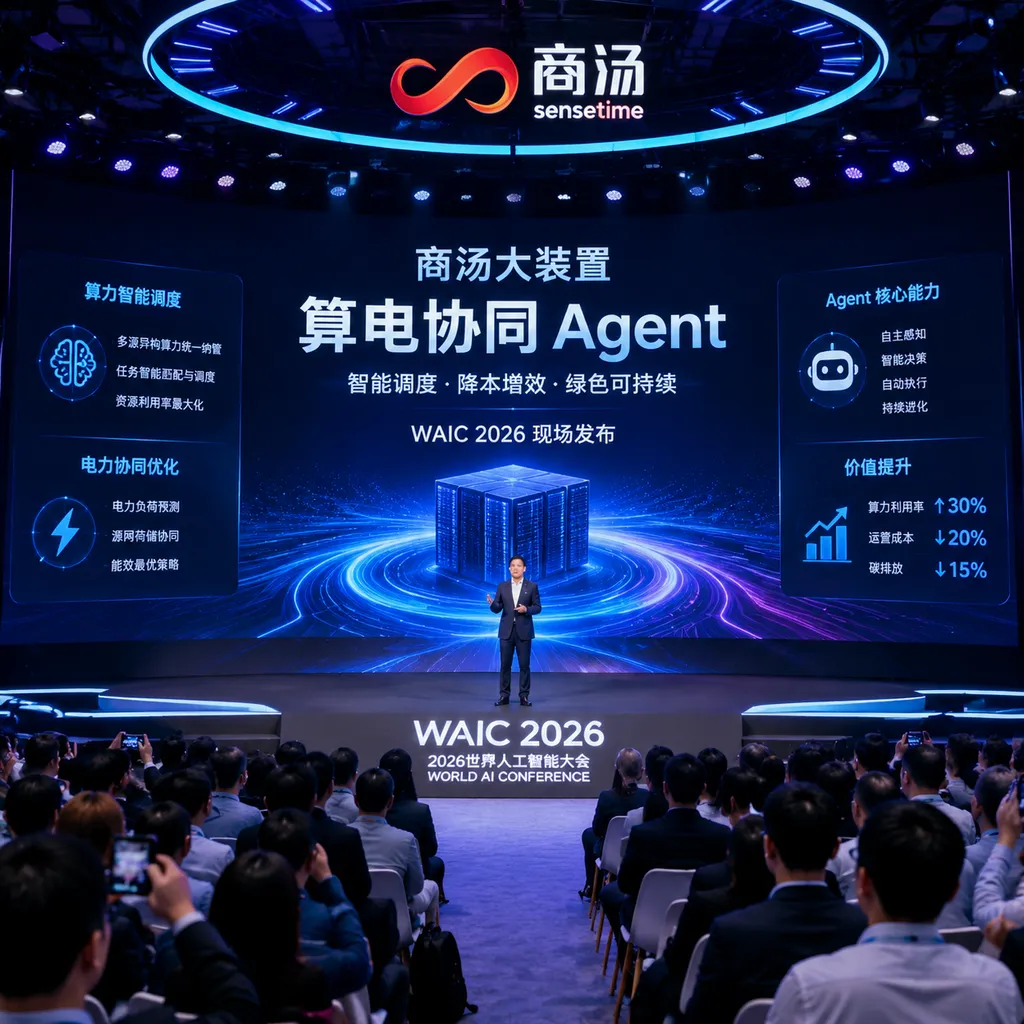
At WAIC 2026, SenseTime’s Large Model upgraded last year’s computing–power coordination platform into an Agent, enabling true bidirectional scheduling between electricity and computation. Each kilowatt-hour of electricity can now produce 80% more Tokens, making it the industry’s first computing–power coordination Agent platform to pass the capability test by the CAICT.
One Year: From Platform to Agent
On July 17, the opening day of WAIC 2026, SenseTime’s “MegaDevice” upgraded the Lingang AIDC Compute–Power Coordination Platform—first released at the same event last year—into an Agent-based form. Its core metric was a single one: an 80% increase in token output per unit of power consumed. It also became the industry’s first Agent platform to pass the China Academy of Information and Communications Technology’s (CAICT) evaluation for compute–power coordination capabilities.
That “80%” might sound like marketing, but put another way—it means that with the same kilowatt-hour of electricity, the system can now generate almost twice as many tokens as before. For enterprises running large-scale model inference, electricity costs are taking up an increasingly alarming share of total cost of ownership (TCO). Flattening this curve could bring welcome relief to the pricing of cloud inference services.
Let’s Clarify What Problem SenseTime Is Solving
If you only pay attention to large‑model benchmarks, “compute–power coordination” may sound abstract. But anyone who has managed an inference cluster knows that since 2025, the core bottleneck for AIDC (AI Data Centers) is no longer enough GPUs, but enough electricity, sufficient green power ratio, and low enough PUE.
China’s National Development and Reform Commission stated it clearly in its 2024 Implementation of the “East‑Data, West‑Compute” Project report: by the end of 2025, newly built data centers in national hub regions must source over 80% of power from green energy, and a dual‑coordination mechanism for computing and electricity must be initially formed. This is not a suggestion—it’s a hard target.
So since last year, top AIDC vendors have all been working toward one thing—linking power‑system dispatch with computing‑system scheduling. The logic is simple:
- Training tasks are volatile and irregular—tens of thousands of GPUs can start or stop at any time.
- Inference tasks are stable and cyclical—daytime peaks, nighttime troughs.
- Green‑power supply is also variable—solar by day, wind by night, with storage buffering in between.
Previously, these three curves were tuned independently, with peak‑shaving dependent on manual expertise and gut feel. SenseTime’s goal is to hand all three curves over to an Agent for unified orchestration.
From “Platform” to “Agent”: What’s Upgraded
At WAIC 2025, SenseTime, together with Damao Technology and CATL’s Puquan Capital, announced the “Compute–Power Coordination Platform,” essentially rule‑driven plus large‑model‑assisted—energy prediction using an energy model, execution via a heterogeneous compute scheduler, connected by human decision rules.
A year later, upgrading to an Agent mainly means enhanced closed‑loop autonomy:
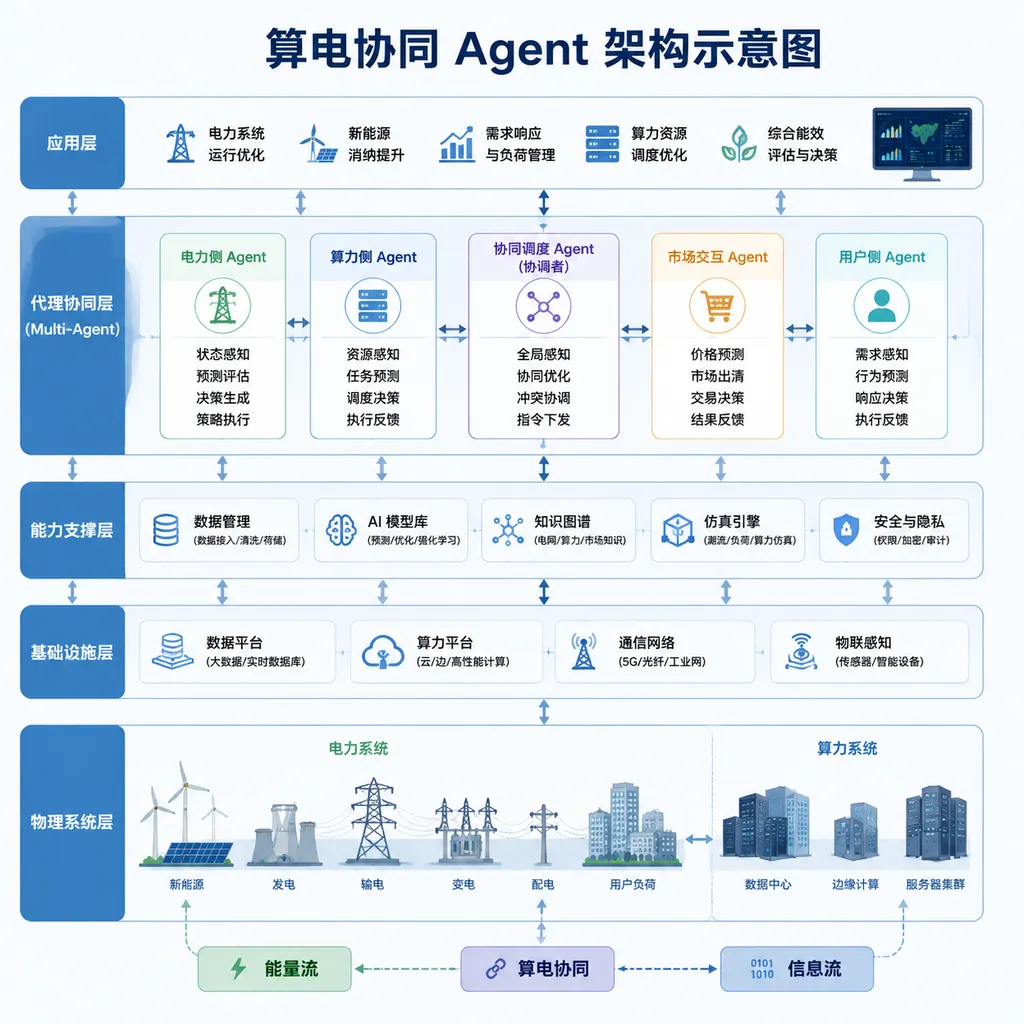
- Perception layer: retains the original “Energy Block” abstraction—binding intrinsic energy data, user power‑use characteristics, energy‑balance rules, and compute‑server info into a tokenized unit. Clever idea: since LLMs process tokens, tokenizing power and compute data lets the model inherently “understand” them.
- Decision layer: evolved from 15‑minute predictions and 5‑minute manual adjustments into fully autonomous scheduling. It decides when to charge or discharge storage, when to shift or fill training peaks, when to scale or throttle inference—end to end by the Agent.
- Execution layer: now dispatches across systems directly, no longer requiring human confirmation.
For comparison, in 2025 the Energy Block model achieved over 88% demand‑prediction accuracy and over 93% decision accuracy. At that time, Lin Hai (GM of SenseTime MegaDevice’s Intelligent Computing Center) projected that by year‑end accuracy would reach 90–95% for prediction, above 95% for decisions. Judging from the new Agent version, that trajectory is on track.
Where the 80% Gain Comes From
Let’s break it down. SenseTime’s 2024 H1 financial report disclosed this number: in inference scenarios, QPS increased 4× under equal compute and power cost. This means that purely with scheduling and framework optimization, SenseTime had already achieved a major boost in per‑watt inference efficiency.
So where does this additional 80% improvement come from?
The answer lies on the electricity side. The 4× QPS before came from the compute side—training–inference integration, dynamic scheduling, checkpoint resumption, peak‑shaving—all focused on GPUs. The compute–power coordination Agent, however, optimizes the data center’s power‑use structure itself:
- Run heavy workloads when green power is cheap
- Postpone non‑urgent tasks during price peaks
- Use storage to follow PV output for load leveling
- Adjust cooling systems dynamically with load variation
Lingang AIDC this year has achieved 10,000 P compute capacity with 36 MWh of energy storage—not just for show, but as dispatchable capacity. With storage, the Agent can perform “temporal arbitrage”: store cheap power now, use it when expensive; feed excess stored energy back to the grid during low load for demand‑response revenue.
Thus, the “80% increase in token output per power unit” is an interaction of compute optimization × power scheduling × storage arbitrage, not a single‑factor gain.
Energy Block: An Abstraction Worth Detailing
The most interesting design in this system is the “Energy Block.”
Traditional data‑center scheduling works at the server or rack level. Power and compute management are separate systems, interfaced via legacy SNMP/IPMI, coarse‑grained and slow to respond.
SenseTime binds each compute server with its intrinsic energy data (rated power, actual consumption curve), user energy profile (who’s using it, for what task, with what priority), and energy‑balance context (grid state, storage SOC, green‑power ratio) into one Energy Block, the Agent’s basic decision token.
This abstraction offers two advantages:
- LLMs can natively process it. With Energy Blocks tokenized, an energy model can directly output dispatch sequences—no cumbersome rule‑engine translation needed.
- Adjustable granularity. An Energy Block can represent a single server, rack, pod, or even a virtual cluster. Different scales map to different dispatch frequencies—15‑minute global forecasts, 5‑minute local corrections, and second‑level failovers.
In a sense, it’s the same philosophy as OpenAI’s recent Agent tool‑calling abstraction: tokenizing real‑world objects so an LLM can act as the brain—except one controls software APIs, the other governs power and chips.
Ecosystem: Damao’s Energy Model, CATL’s Storage
SenseTime is not fighting alone. Within this compute–power coordination Agent, the division of labor among three parties is clear:
- SenseTime: multimodal foundation model, heterogeneous compute scheduling, AIDC ops data
- Damao Technology: energy large model (domain know‑how of generation–grid–load–storage)
- CATL/Puquan Capital: energy‑storage hardware and power‑trading resources
From CATL’s industrial fund view: intelligent computing centers are key loads in a new‑type power system; storage is the essential regulating resource; AI models are the scheduling brain. These once‑separate industries are now stitched together via SenseTime’s Agent architecture into a replicable industrial combo.
For developers, this could reshape AI‑compute leasing models—from simple CNY per card·hour to a composite index like CNY per token·kWh. Whoever achieves the highest tokens per kWh gains pricing power in the inference market.
Some Sober Judgments
All benefits noted, let’s add caution.
First, compute–power coordination has a high entry barrier. SenseTime can do it because it owns the Lingang AIDC, its own foundation model (RiRiXin), and partnerships built over two WAICs. For small and medium AIDCs, just the capex for storage integration is astronomical. So for now, it’s an arms race among top players, not a universal technology.
Second, the 80% gain has a baseline. SenseTime’s inference clusters were already heavily optimized, so another 80% on top is much more meaningful than improvement from scratch. But for other AIDCs deploying the same Agent, the uplift may vary; more third‑party data are needed.
Third, green‑power direct link and demand‑response programs are still pilot policies. Lingang’s success owes much to its status as China’s first 5A‑grade intelligent‑compute center with preferential policies. Whether other hubs can secure equivalent power‑trading privileges remains uncertain.
At a November compute–power coordination forum, Lin Hai put it plainly:
“What SenseTime MegaDevice is building is not a single technical platform, but a system of core competencies and practical methodologies integrating AI and energy technologies.”
In other words—it’s not a SaaS product but a full‑stack solution requiring hardware–software synergy, power‑resource matching, and cross‑industry collaboration. To “copy the homework,” you must first have the same notebook.
What It Means for Developers
Practically speaking, if you’re just calling inference APIs, this compute–power coordination Agent may simply mean cloud inference will get cheaper. SenseTime MegaDevice already manages over 25,000 P of compute capacity; every minor PUE or CUE optimization is passed down to final token pricing.
In the long run, as more AIDCs adopt similar architectures, domestic inference costs could fall faster than expected—a boon for AI‑application teams: higher margins or lower prices for market share.
By the way, if you need to compare actual cost and latency across domestic and international models, aggregate platforms like OpenAI Hub are handy—one key to access GPT, Claude, Gemini, DeepSeek, etc., with OpenAI‑compatible SDK, direct domestic connection, and unified authentication.
In Closing
From August 2024, when SenseTime MegaDevice surpassed 20,000 P, to November 2025 exceeding 25,000 P, and now WAIC 2026 unveiling the compute–power coordination Agent passing CAICT’s test—the timeline is clear:
Competition in AI infrastructure has moved from “stacking GPUs,” to “scheduling,” and now to “scheduling electricity.”
Whoever secures systemic advantage at the energy layer will endure longer in the next inference‑price war. SenseTime’s current path is short‑term efficiency optimization—and long‑term redefinition of the intelligent‑computing‑center business model. When other players follow suit—that’ll be for WAIC 2027 to tell.
References
This report is based on WAIC 2026 on‑site information and public sources. For further discussion:
- Hugging Face – Chinese AI Infrastructure Models – open‑source models and technologies around Chinese AI infrastructure
- Zhihu – Compute–Power Coordination Topic – industry analysis on compute–power coordination, green data centers, and energy‑storage dispatch