Step pulls Alipay into STEP-X — the agents are actually getting things done.

At the WAIC event on July 17, Alipay and Step announced a system-level cooperation on AI Agents. The AI version of Alipay, "Abao," has been integrated into the STEP-X terminal, allowing users to access and use cross-app services with a single voice command. This marks the first domestic initiative to connect AI Agents and payment-level infrastructure at the system level.
Step Brings Alipay into STEP-X: This Time, AI Agents Are Actually Getting Things Done
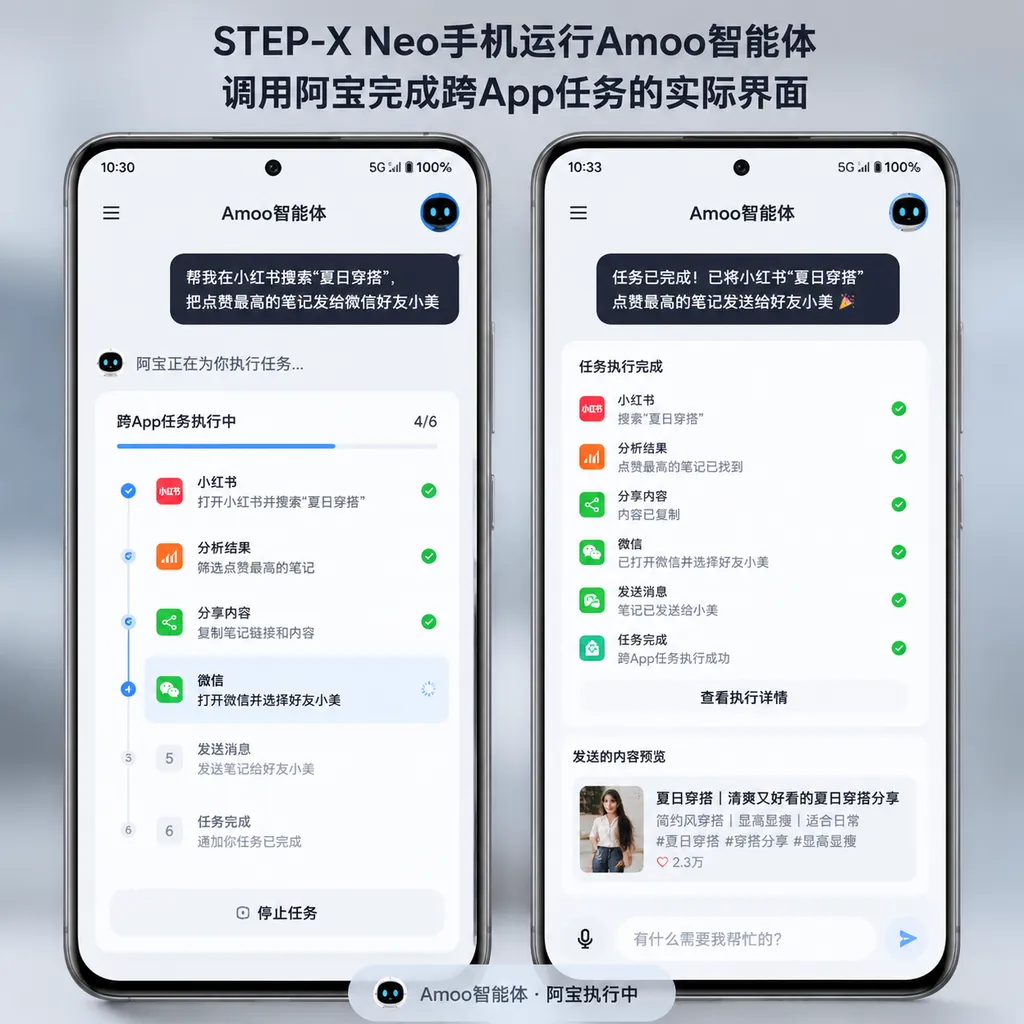
On July 17, the opening day of WAIC 2026, Step and Alipay jointly announced something far more practical than most booth demos: the two sides have reached a system-level AI Agent partnership. Step’s recently launched native AI terminal, STEP-X, is now integrated with the AI version of Alipay, “Abao.” With natural language, users can invoke real services across apps—ordering food, hailing rides, paying bills, and buying tickets—all done in one command, without ever opening an app themselves.
It sounds like another “AI helps you get things done” story. But this time it’s different: for the first time in China, a large model company’s native system is connected with a national-level payment infrastructure at the system layer. It’s not a plugin or an API wrapper—Amoo (Step’s AI agent partner) directly assigns tasks to Abao, who executes them and feeds back the results.
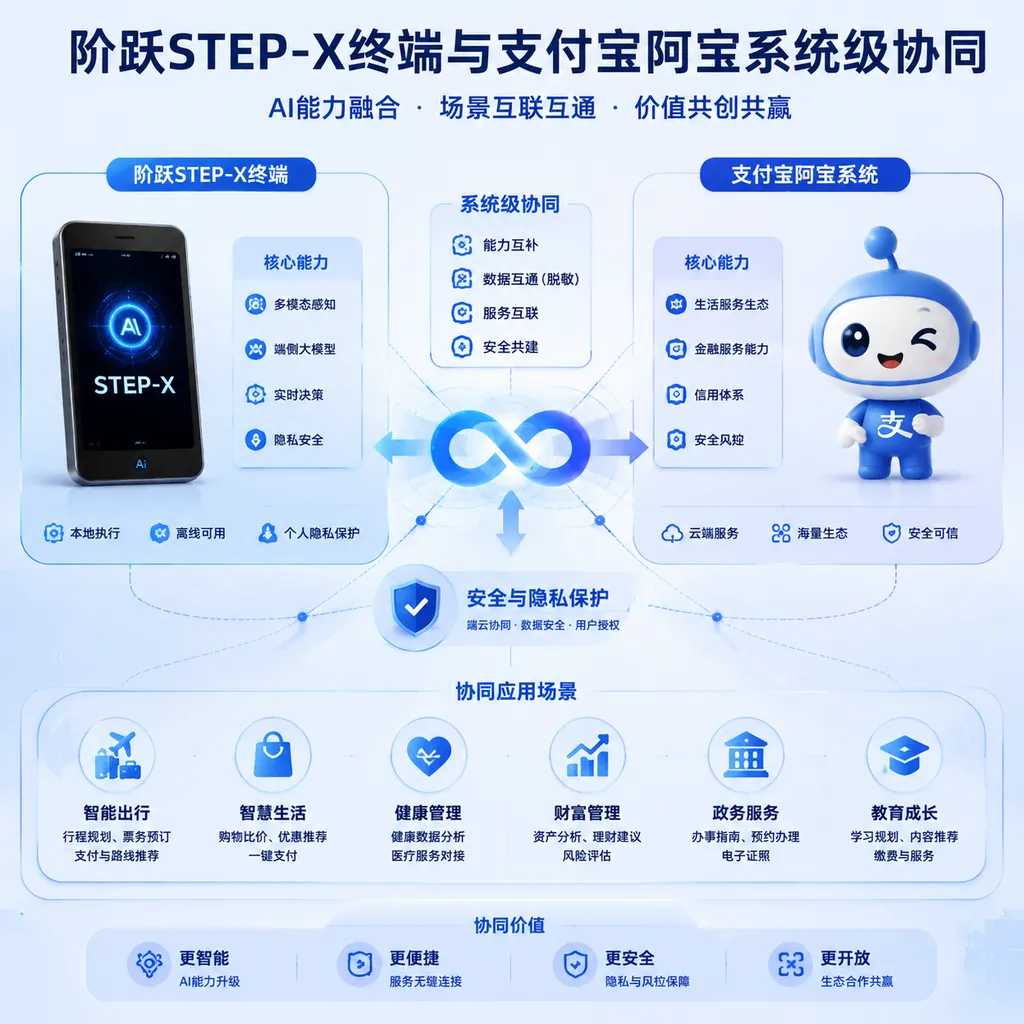
Filling in the Context: What Is STEP-X, and Why This Partnership Matters
If you missed the WAIC news cycle, here’s a quick recap. Four days earlier on July 13, Step debuted its “Trinity”:
- STEP-X: an AI terminal brand built for the agent era
- Step AOS: the world’s first Agentic-native operating system
- STEP-X Neo: an AI smartphone powered by Step AOS, currently the only model certified at Level 3 under China’s national “AI Terminal Intelligence Classification” standard
In other words, Step has evolved from a foundation-model unicorn into a full-stack company spanning models, systems, and hardware—something no other domestic player has completed. Apple has great hardware and software but no top-tier model; Huawei’s HarmonyOS is solid but conservative in model strategy; Xiaomi is catching up but not yet there. Globally, only a handful of companies hold all three cards: self-developed model matrix, native OS, and AI terminal.
When STEP-X was launched, Step also announced several “AI deep cooperation” partners: Trip.com, Alipay, Didi, Meituan, WPS, and CapCut. At the time, the wording was vague. But now, at WAIC, Alipay has turned those two words—“deep cooperation”—into reality: system-level.
What “System-Level” Really Means
This is the key concept to unpack, because “system-level cooperation” is often an overused term.
Over the past two years, you’ve seen countless press releases: app A “integrates” large model B, or AI system C “connects” with service D. In most cases, users still have to switch between multiple apps manually—AI only helps compose text or triggers a jump to another app. The user remains the human scheduler toggling between apps.
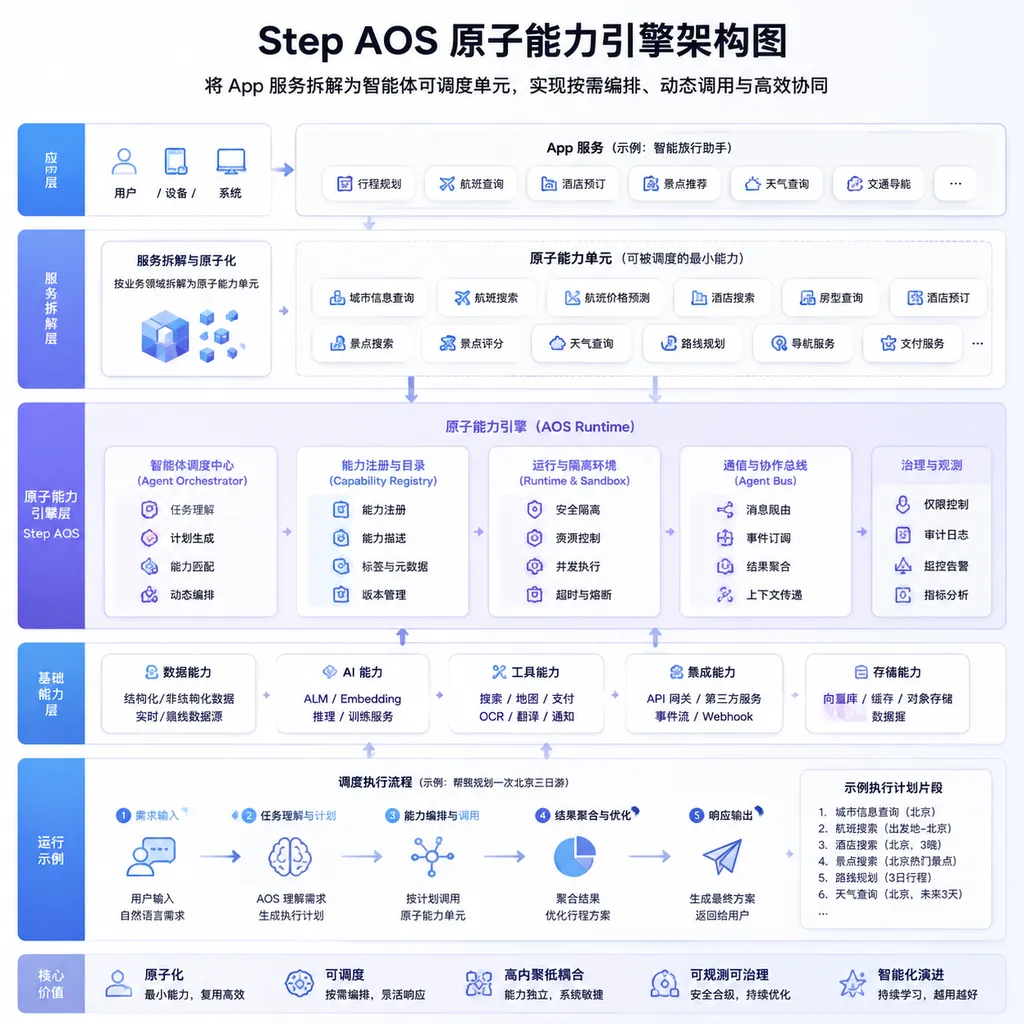
Step’s new architecture changes that. Think of it as three layers:
- Intent Layer: The user tells Amoo, “Book me a flight from Hongqiao to Beijing tomorrow afternoon that gets me to the office meeting on time.”
- Scheduling Layer: Amoo decomposes the task—search flights, compare prices, select seats, pay, add to calendar—and delegates the “payment” and “finance-related” steps to Abao.
- Execution Layer: Abao doesn’t open the Alipay app for confirmation. Instead, within Step AOS’s “Consent Protocol Open Platform,” Abao functions as a callable atomic service.
The last step is crucial. Step AOS includes an “Atomic Capability Engine,” which deconstructs traditional app functions into atomic services that agents can understand and orchestrate. When Abao joins, it’s not as the “Alipay app” but as a collection of atomic capabilities: payment, account inquiry, coupon redemption, verification, customer service, and membership privileges.
Why Abao Is the Critical Piece
At this point, you might ask: why Alipay? Why not WeChat, Douyin, or someone else?
The answer is simple: an AI agent cannot complete real-world tasks without payment.
AI can help you write reports, edit videos, or summarize papers—these generate content, with risks limited to accuracy. But once an agent starts performing tasks—booking tickets, buying groceries, paying bills, ordering food, calling taxis, paying school fees—it inevitably touches one sensitive action: spending money from your account.
This implicates permissions, account access, identity, risk control, and irreversible transactions—all at once. Step AOS anticipated this and introduced a “Four-Dimensional Agent Security Framework”:
- Trustworthy: Operations run in a trusted execution environment.
- Visible: Every action is auditable and traceable.
- Controllable: Permissions are granted on demand and retracted after use.
- Reversible: Mistaken actions can be undone in one click.
This may sound like marketing jargon, but integrating a payment platform with nearly 1 billion daily users requires real robustness. Alipay qualifies for system-level collaboration largely because it’s China’s most experienced institution at managing “AI spending on behalf of humans.” Behind Abao lies Ant Group’s mature systems for risk control, identity verification, biometrics, and transaction limits—all perfectly complementing Step AOS where intelligent agents are most vulnerable.
Scenario Walkthrough: What Really Happens Behind One Command
Example: a user tells Amoo on the STEP-X Neo:
“Book a cardiology appointment at Ruijin Hospital for my elderly parent next Wednesday morning, pay the registration fee, and send the schedule to my sister.”
Before agents, this meant opening three apps (hospital platform, Alipay, WeChat) plus a phone call.
With AI but without system-level integration, AI could design the process—but you’d still need to click at every step.
With Step AOS + Abao, the theoretical path is:
- Amoo detects the intent: registration + payment + info sharing.
- The registration ability is pulled from Ruijin Hospital or a third-party atomic service.
- Payment goes to Abao, who triggers Ant’s risk control and facial verification; the user glances once and funds are deducted.
- The schedule syncs automatically to the sister’s device through Step AOS’s cross-device capabilities.
- Everything happens within one conversational flow; the user simply sees “Done,” not “Open Alipay to pay.”
This illustrates the practical meaning of “cross-terminal service completion.” Cross-terminal no longer means mere data sync—it means tasks relayed seamlessly across apps and devices.
My Take: This Is Not Just Another Concept Partnership
Back to the editorial perspective—why this collaboration stands out on the AI Agent track.
First, it operates at the system layer, not the app layer. Most prior “AI integrations” were plugin-based—models calling APIs or in-app assistants. Step, however, decomposed Alipay’s capabilities into atomic services registered directly within its OS. This resembles the “OS + open services” approach Android pioneered—except now, the objects are agents.
Second, it closes a real business loop for AI terminals. Even the smartest STEP-X Neo would still be “a more intelligent phone” if Amoo only chatted, wrote, or translated. But now, Amoo can execute real transactions involving money—making this the first phone that can actually do things for you, not just talk for you.
Third, it sets a visible new target for other model players. Companies like DeepSeek, Kimi, Zhipu, Doubao, and Qwen now face a dilemma: building terminals takes too long, building OSs costs too much, and negotiating system-level cooperation with something like Alipay demands clout. From this angle, Step’s move is both bold and fast.
A Dose of Realism
Of course, let’s not oversell it. Several questions remain unanswered:
- Permission granularity: When users first authorize Abao to pay on Amoo’s behalf, what interface appears? A single checkbox or a facial scan every time? Too cumbersome and UX suffers; too loose and risks multiply.
- Rollback mechanism: “Reversible” sounds nice, but real-world reversals involve payment, inventory, and third-party vendors. Hospital registrations might refund easily—but what about food orders already delivered?
- Progress of other ecosystem partners: Trip.com, Didi, Meituan, and WPS are still only in “deep cooperation.” When will they move to “system-level”? If Alipay ends up the sole full integration, Amoo’s functional range remains limited.
- Data boundaries: When Abao executes tasks within Amoo, where does user data flow—to the device, Step AOS, or Ant servers? If unclear, consumer adoption may falter.
The Second Half of the AI Agent Game May Have Truly Begun
From 2024 to 2025, the industry kept debating what a “true Agent” is. By 2026, no one asks that anymore—everyone’s trying to make Agents actually get things done.
Breaking “getting things done” down means memory, planning, tool use, permission control, payment, cross-device operations, and reversibility. Scaling up, it involves rearchitecting OSs, terminals, and super apps. At this moment, Step has combined STEP-X + Step AOS + Alipay Abao, effectively setting a new domestic baseline for the AI Agent industry.
For those of us who have watched three years of AI news, there’s an easy litmus test for whether a partnership has real substance: can you actually use it within 30 days of the press release? Step claims that soon, “users on Step terminals or in large-model interactions will no longer need to open any apps.” Whether that rolls out via STEP-X Neo distribution or public Step AOS channels remains to be seen over the next few weeks.
If you’re building agent products, AI API integrations, or model orchestration tools, the differing call formats across models will soon become a headache. That’s why AI API aggregation platforms like OpenAI Hub are gaining traction—one key connects major models like GPT, Claude, Gemini, DeepSeek, and GLM, all under the OpenAI-compatible standard, sparing teams from writing multiple SDKs. Once Step’s model family opens APIs, such aggregation layers will likely integrate them immediately.
Let’s watch this play out. When STEP-X Neo reaches users, and Amoo places the first food order or books the first ticket autonomously, we’ll know exactly how much this announcement is worth.
References
Currently, most coverage comes from Chinese outlets like 36Kr, NetEase, TechWeb, and Sohu. To comply with external linking rules, only Chinese developer and tech community links are retained for further reading:
- Zhihu - AI Agent Topic — Ongoing discussions on agent products and OS design
- Juejin - AI Large Model Column — Engineering practices, API calls, and on-device deployment
- ITHome - AI Channel — Tracking AI terminals, model releases, and vendor developments
- Linux.do - AI Discussion Board — Developer debates on new models and agent architectures