The National Supercomputing Internet releases 100,000 GPUs: science AI developers, come claim computing power
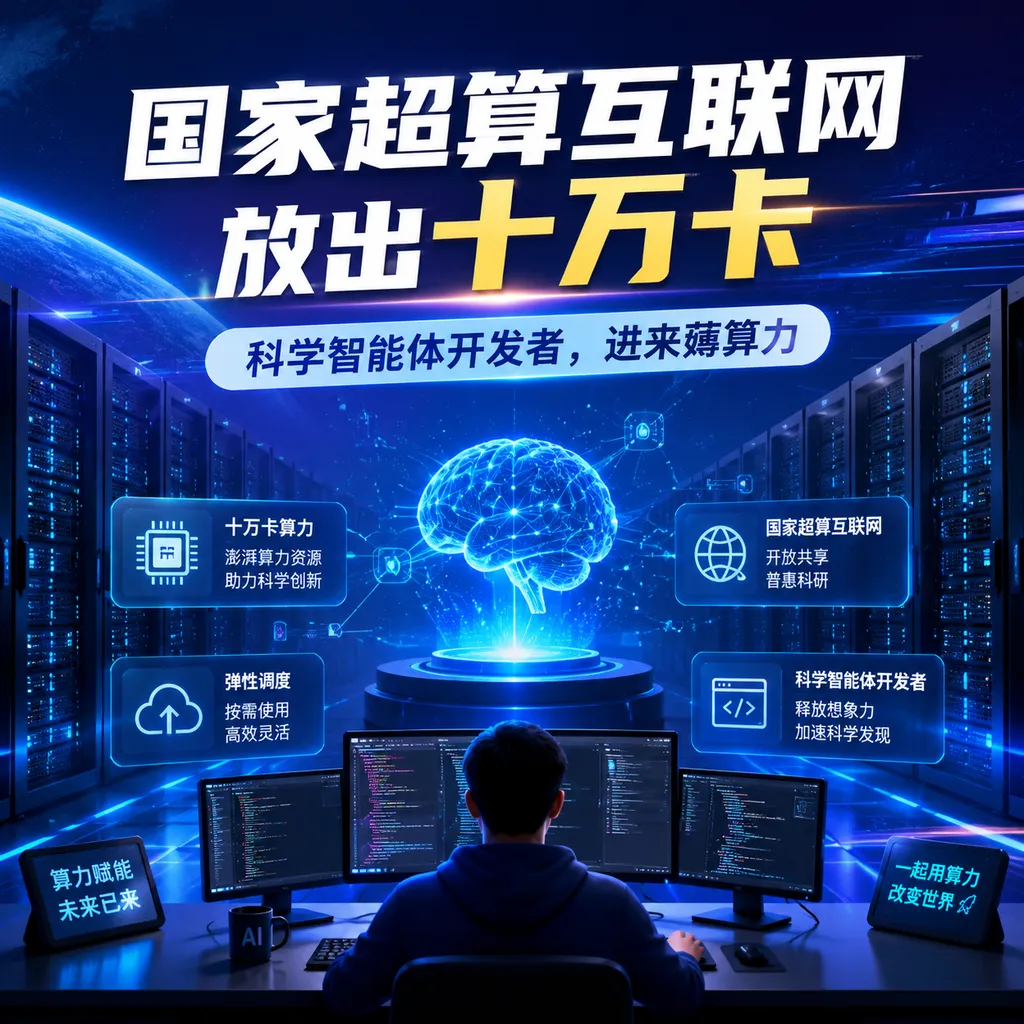
At WAIC 2026, the National Supercomputing Internet launched a co-creation program for scientific computing agents. China’s first fully domestically produced 100,000-GPU AI supercluster, **Dawning 8000 (Summit)**, is now open to universities, enterprises, and individual developers, with accompanying cash and token incentives.
On July 17, at the 2026 World Artificial Intelligence Conference (WAIC), the National Supercomputing Internet dropped a major announcement — the official launch of the “Scientific Computing Agent Ecosystem Co-Creation and Developer Recruitment Program” (hereinafter referred to as the “Co-Creation Program”). The six-month program targets universities, research institutes, individual developers, and enterprise R&D teams.
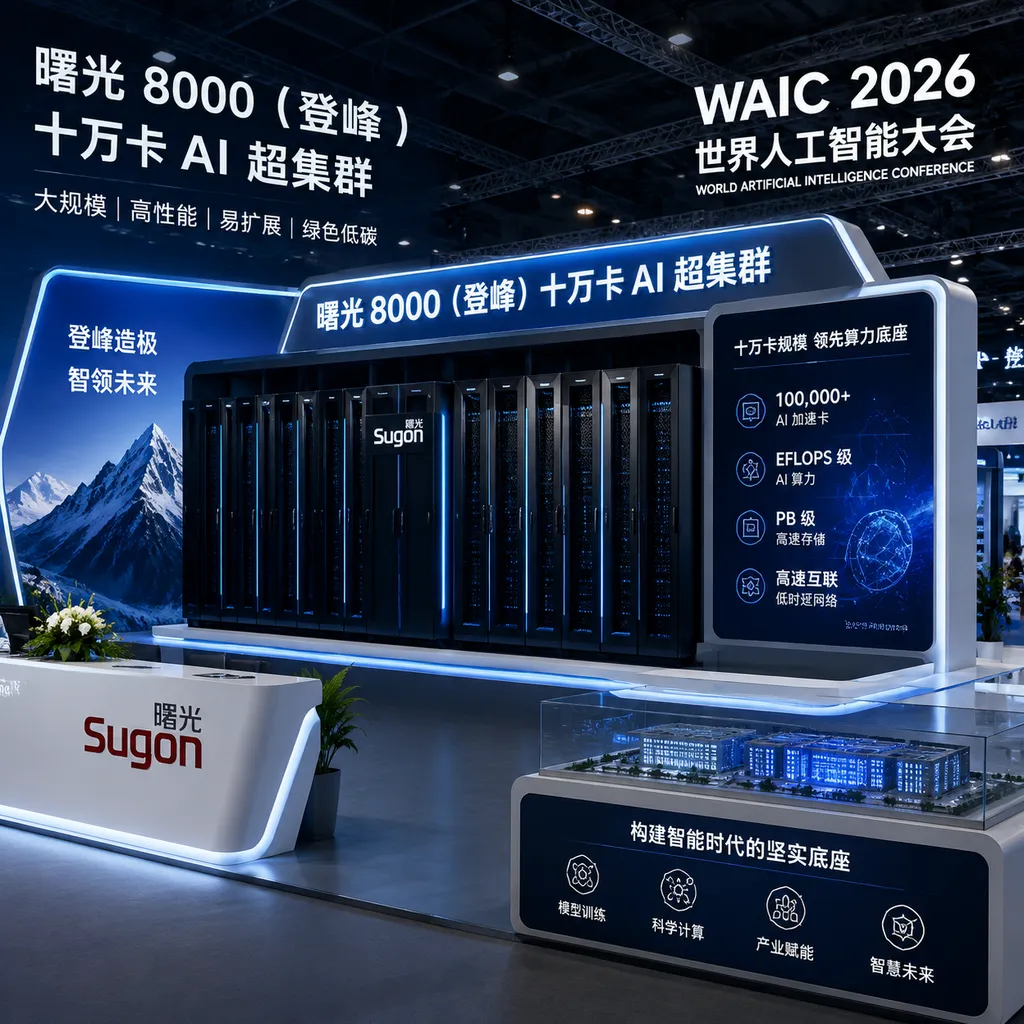
At first glance, this seems like just another ecosystem recruitment PR move. But put in context, it’s a different story: Behind that recruitment channel is China’s first fully domestic 100,000-card AI supercluster — Sugon 8000 (Dengfeng) by Dawning Information Industry Co., Ltd. (Sugon). The machine made its live debut at WAIC the same day and was even selected by the organizers as a “treasure of the pavilion.”
In other words, this isn’t your usual “sign up and get an API key” type of activity — it’s the national team opening up a 100,000-card compute pool and inviting developers to actually use it.
1. What Exactly Does the “Co-Creation Program” Offer?
Let’s make it clear what developers actually get — this matters more than the PR slogans.
Participants (individuals or organizations) will receive a full-stack package of computing power, data, and tools based on the first 100,000-card AI supercluster in China. This isn’t about borrowing a small fraction of a cluster for a few days of inference. The foundation is a 100,000-card hybrid AI-supercomputing resource pool covering full precision from FP64 to INT8. That means whether you’re running protein folding simulations, training a 100-billion-parameter LLM, or orchestrating low-precision inference-heavy agents, you can do it all on one unified infrastructure.
The incentives combine cash and tokens:
- Cash rewards: For outstanding teams and results
- Token quotas: API call credits on the platform
- Domestic GPU compute hours: Equivalent to GPU-hours for training/inference
- Promotion resources: To help incubate and scale successful projects through the Supercomputing Internet’s ecosystem
An even bigger carrot is the “fast track” for individual developers — top performers can gain direct platform access and exemption from campus recruitment tests. Clearly, this aims to attract top talent, especially PhDs and young PIs working on AI4S (AI for Science). For them, a career fast track can be far more alluring than cash rewards.
2. Sugon 8000 (Dengfeng): Not Just Another “PowerPoint Cluster”
The foundation of the Co-Creation Program is Sugon 8000 (Dengfeng), inaugurated on July 10 at the 2026 Intelligent Computing Application Conference in Zhengzhou. This machine deserves its own section — it’s the most valuable hardware asset in this initiative.
Key points:
1. Fully Domestic, Full Precision, Hybrid Intelligence
Sugon 8000 follows a “hybrid intelligence” native architecture, discarding the traditional partitioning between “scientific computing” and “AI computing.” It natively integrates high-precision and low-precision computing, supporting full precision from FP64 to INT8 — a rare feature in 100,000-card clusters. Most clusters of this scale are optimized for LLM training (BF16/FP8 only), leaving scientific computing out; Sugon 8000 bridges that gap.
At the hardware layer, it’s powered by Hygon and other domestic chips; the network uses a self-developed scaleFabric IB-class native RDMA high-speed network; storage runs on ParaStor distributed architecture; cooling is through immersion phase-change liquid cooling — each rack supports megawatt-level density with year-round natural cooling. This full-stack “chip–compute–storage–network–cooling–application–service” domestically developed architecture represents China’s only complete closed-loop implementation at the 100,000-card level.
2. Real Applications, Not Just Numbers
Many clusters fade into obscurity after their launch, but Sugon 8000 has already achieved over 300 hybrid application optimizations across more than twenty fields, including LLMs, robotics, automotive, drug discovery, new materials, quantum computing, and meteorology. Over 70 applications have scaled to >10,000 cards.
Its workloads speak for themselves:
- Protein folding simulations
- Trillion-atom water molecular dynamics simulations
- Hundred-trillion-grid turbulence simulations
These are near top-tier loads in traditional supercomputing — excellent for stress-testing stability under real massive workloads, far more meaningful than benchmark scores.
3. Integrated into the National Supercomputing Internet
When Sugon 8000 went live on July 10, it was simultaneously connected to the National Supercomputing Internet (SCNet). The Co-Creation Program launched at WAIC represents the next step — giving regular developers direct access to this computing power.
3. Platform Capabilities: 16,000 Components, 5,000+ MCP Tools
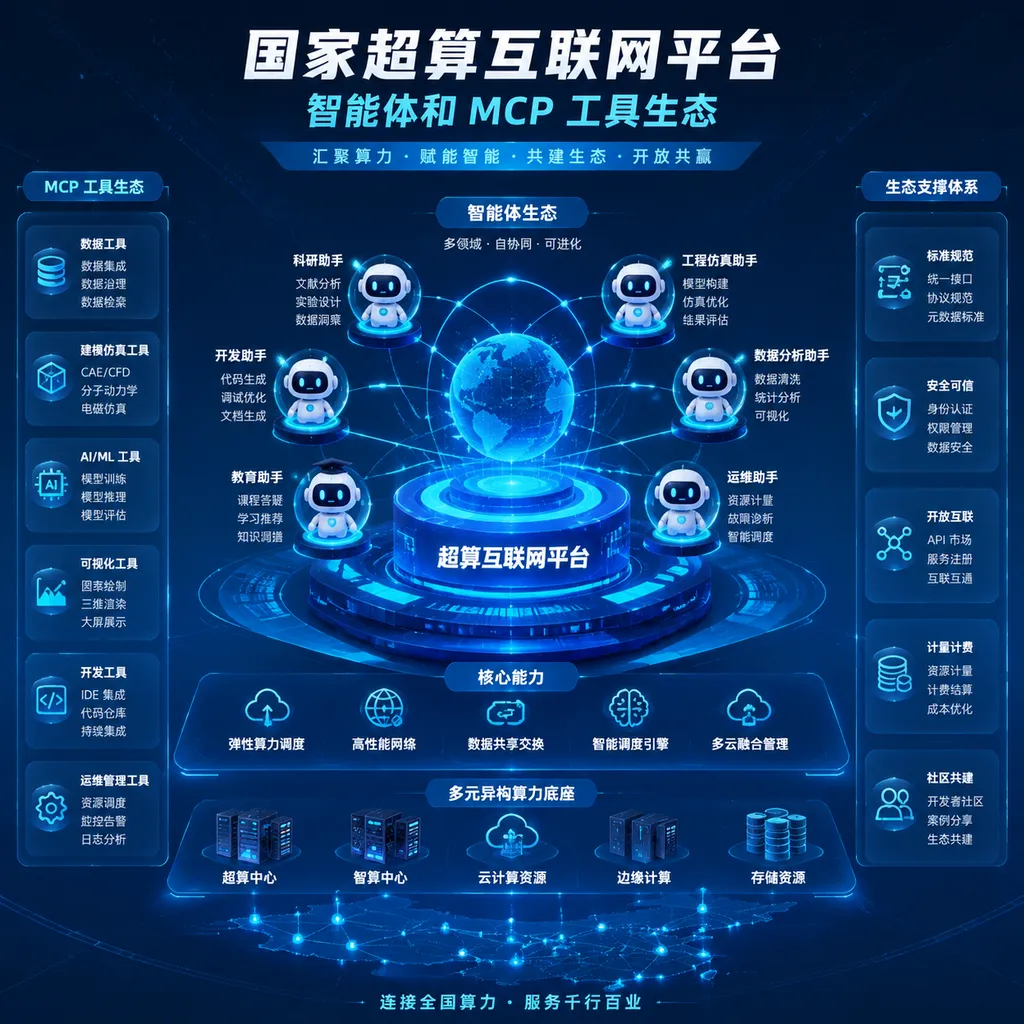
Computing power alone isn’t enough — the key is the ecosystem. Here’s what the National Supercomputing Internet platform currently offers:
- 16,000+ content components
- 10,000+ skills
- 5,000+ MCP tools
- 1,000+ knowledge bases
- 350+ intelligent agents
Combined with a low-code development environment, users can quickly assemble their own agents using these modular components. The platform also supports multi-agent collaboration pipelines — from problem classification and task planning to execution and reporting.
One detail worth emphasizing is the MCP tool count. While “5,000+ MCP (Model Context Protocol) tools” sounds impressive, what really matters for developers is how complete the tool ecosystem is, especially for scientific-computing agents.
For instance, a meteorological agent would need ERA5 data APIs, NCL plotting, and WRF models; a drug discovery agent would use AlphaFold, AutoDock, and PubChem. If these are readily available, developers save weeks of work.
Of course, the actual usability and scientific-computing coverage weren’t disclosed. The Co-Creation Program aims to address that — by letting developers contribute domain-specific MCP tools and skills to fill critical gaps in the ecosystem.
4. Taking a Step Back: The Bigger Picture
If we treat this as “just another developer incentive program,” we’d be underestimating it. Let’s look at the timeline:
- July 9, 2026 — Zhengzhou AI Conference: Launch of SCNet’s core node and the nation’s first 100,000-card hybrid compute pool
- July 10, 2026 — Sugon 8000 (Dengfeng) completed and connected to SCNet; partnership signed with Beijing Institute of General Artificial Intelligence (BIGAI) for a second 100,000-card system
- July 17, 2026 — WAIC 2026: Co-Creation Program goes live, and Dengfeng makes its debut
Three major moves in one week. The national strategy is clear: build the cluster, connect the network, then bring developers in.
This systematically tackles old pain points — long application cycles, high deployment barriers, prohibitive costs — that used to make supercomputing underutilized or inaccessible.
Compare that to:
- Oracle’s OCI Zettascale10, recently provisioning 800,000 NVIDIA GPUs for OpenAI and the “Stargate” project — focusing compute sales on AI giants.
- The National Supercomputing Internet, in contrast, splits its 100,000 cards into smaller unit allocations (e.g., per 1,000 cards or Tokens) and distributes them widely to researchers, SMEs, and individual developers.
Neither model is inherently “better,” but the latter drastically improves accessibility for local developers.
New users can get a starter pack with 200 card-hours + 10M tokens + 500GB storage, plus another 20 card-hours after completing a research profile, with referral bonuses stackable — a “gamified giveaway” model, but applied to a national supercomputing network for the first time.
5. Questions Developers Actually Care About
As someone who’s worked in the AI industry for years, I know which pain points developers usually bring up. Here are a few:
1. Can domestic chips run mainstream training frameworks smoothly?
Sugon 8000 relies on Hygon and other domestic chips. Can it truly support PyTorch/DeepSpeed/Megatron “out of the box”? Officially, the system is “open and compatible with multiple acceleration cards,” but real testing will tell. A hidden value in this program is letting early adopters validate compatibility and feed improvements back into the toolchain.
2. What’s the scheduling granularity of a 100,000-card cluster?
For individual developers, “100,000 cards” is just a big number — in reality, you’ll be using 8, 64, maybe 1,000 cards. The ability to do fine-grained partitioning, isolate tasks, and support preemptive scheduling will make or break user experience. So far, these details remain undisclosed.
3. How is external data accessed from within the cluster?
Scientific-computing agents often need to access external datasets (PDB, UniProt, meteorological reanalysis). Network policies, download quotas, and external API whitelists can all determine project feasibility.
The program doesn’t directly answer these yet, but inviting developers in to test and iterate is the start of those answers.
6. Final Thoughts: Real Movement Toward Compute Inclusion
In recent years, “compute democratization” has been much discussed but slow to materialize. This time, the National Supercomputing Internet has integrated domestic 100,000-card superclusters, 3.5 million CPU cores, and 250,000 GPUs into a unified access network — enhanced by a cash + token incentive model — marking an unprecedented level of commitment.
Takeaways for developers:
- If you work in AI4S / scientific agents with domain data, this is worth applying to.
- If you’ve built MCP tools or skills, contribute them directly to earn token quotas.
- For PhD students and young researchers, the green channel incentives alone make this a solid opportunity.
A side note: for developers who need to orchestrate multiple closed-source models simultaneously — e.g., comparing GPT, Claude, and Gemini in one workflow — platforms like OpenAI Hub enable single-key access to all major models. Pairing this with domestic compute from the Supercomputing Internet allows you to train local models while benchmarking against global ones — a highly practical setup today.
Now that 100,000 cards are open, the question is whether developers can truly put them to use.
References
- ITHome: National Supercomputing Internet recruiting scientific AI agent developers, offering access to China’s first 100,000-card AI supercluster — Initial coverage of the Co-Creation Program at WAIC 2026, including incentive details.