Hugging Face Teams Up with NVIDIA: No More Building Your Own Tools for Multimodal Fine-tuning

NeMo Automodel and Diffusers are now deeply integrated. From Flux to Wan 2.1, the large-scale fine-tuning pipeline for video and image models has been completely rewritten. Developers no longer need to manually wrestle with FSDP, sequence parallelism, or CP.
A Handshake That Should Have Happened Long Ago
On July 17, Hugging Face published a blog post unveiling its joint initiative with NVIDIA: NeMo Automodel is officially integrated with Diffusers, bringing large-scale multimodal fine-tuning workflows onto PyTorch DTensor’s native distributed training stack.
How big a deal this is depends on whether you’ve ever actually tried to fine-tune a 14B-parameter video diffusion model.
Previously, the situation looked something like this: Diffusers offered inference and loading for virtually all mainstream open-source image/video models—from SD3, Flux, HunyuanVideo to Wan 2.1—all callable in one line with from_pretrained. But if you wanted to do full fine-tuning on 8 or even 32 GPUs, the training scripts built into Diffusers were basically “example level.” Anything beyond ZeRO required writing your own distributed strategy; sequence parallelism, context parallelism (CP), and expert parallelism (EP) were all DIY. Once the model got big, the engineering burden could exceed that of the model itself.
That’s exactly the gap NeMo Automodel fills.
What Exactly Is NeMo Automodel?
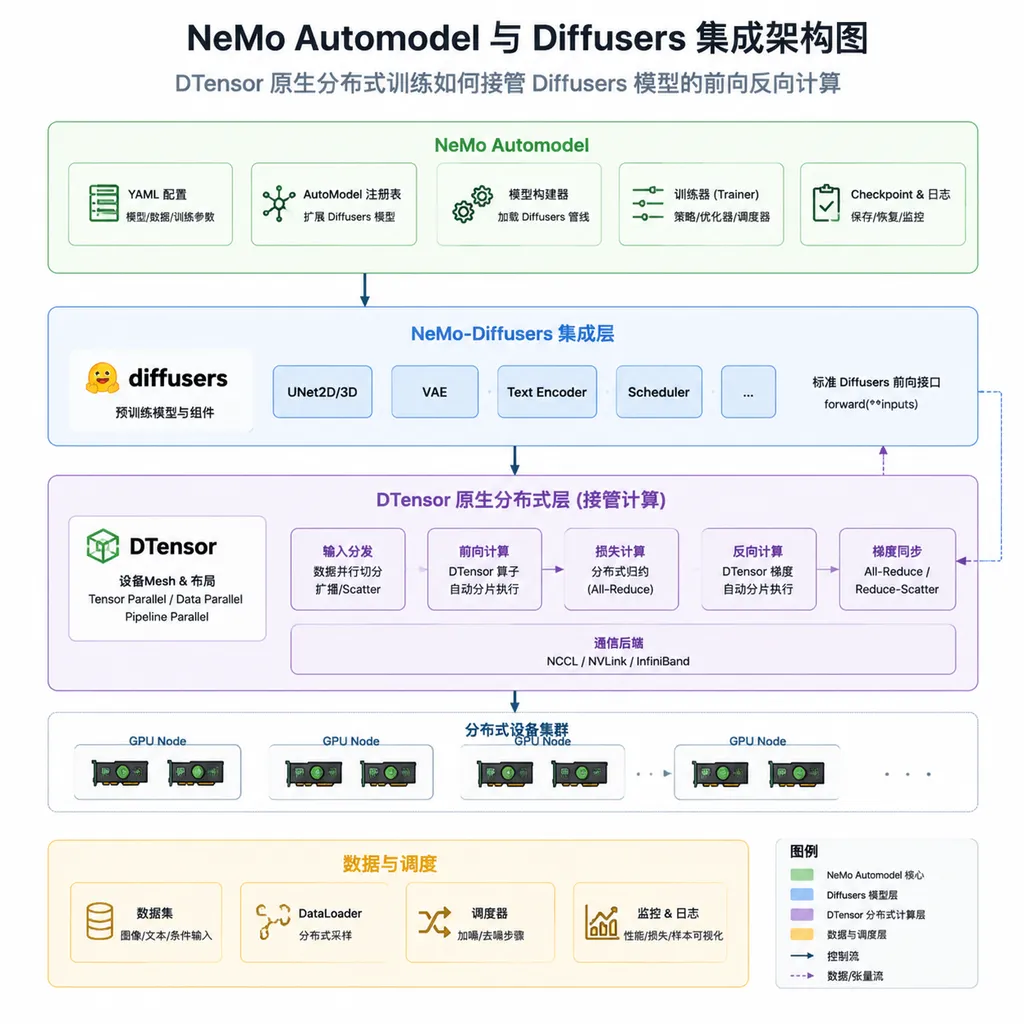
Let’s clarify the positioning first. NeMo Automodel is not a new model library—it’s a standalone, pip-installable PyTorch-native training library carved out of NVIDIA’s NeMo framework. Its one defining feature: DTensor-native.
DTensor is a distributed tensor abstraction that PyTorch began promoting in version 2.x. It sits at a lower level than FSDP2 and can compose various parallel strategies directly. NeMo Automodel packages this into a “configuration-as-distributed-plan” concept: you write a YAML file, specify the number of GPUs, whether to use FSDP2 or add CP, and the rest is handled automatically.
Last month, NVIDIA had already opened up the LLM path—AutoModelForCausalLM—allowing any CausalLM on Hugging Face to plug directly into it. MoE models run 3.4–3.7× faster than native Transformers v5 and consume 29–32% less memory, all through the same from_pretrained interface: one-line import swap, other code untouched.
This new collaboration with Diffusers extends that same philosophy to diffusion and video models.
What Changed on the Diffusers Side?
For Diffusers users, the changes are mostly under the hood. The key points are:
- DTensor-based model definitions: Transformer2DModel, HunyuanVideoTransformer3DModel, and WanTransformerModel backbones now all support DTensor-style loading and partitioning. Previously, wrapping a 14B DiT with FSDP meant worrying about which layers couldn’t be sharded or how to configure activation checkpointing—now you just specify it in the config.
- Native sequence and context parallelism: Video models’ pain point is massive sequence length—a 5‑second 720p clip can tokenize into hundreds of thousands of tokens. Wan 2.1’s fine-tuning memory bottleneck is nearly all here. NeMo Automodel splits this dimension across GPUs via CP, combines it with FSDP2 parameter sharding, and enables batch sizes on 8×H100 that would previously crash a single card.
- Trainer layer decoupling: Diffusers’ earlier demo scripts using accelerate + custom loss loops have been replaced by NeMo Automodel’s Trainer. Data loading, gradient accumulation, mixed precision, checkpointing—all handled in a unified way.
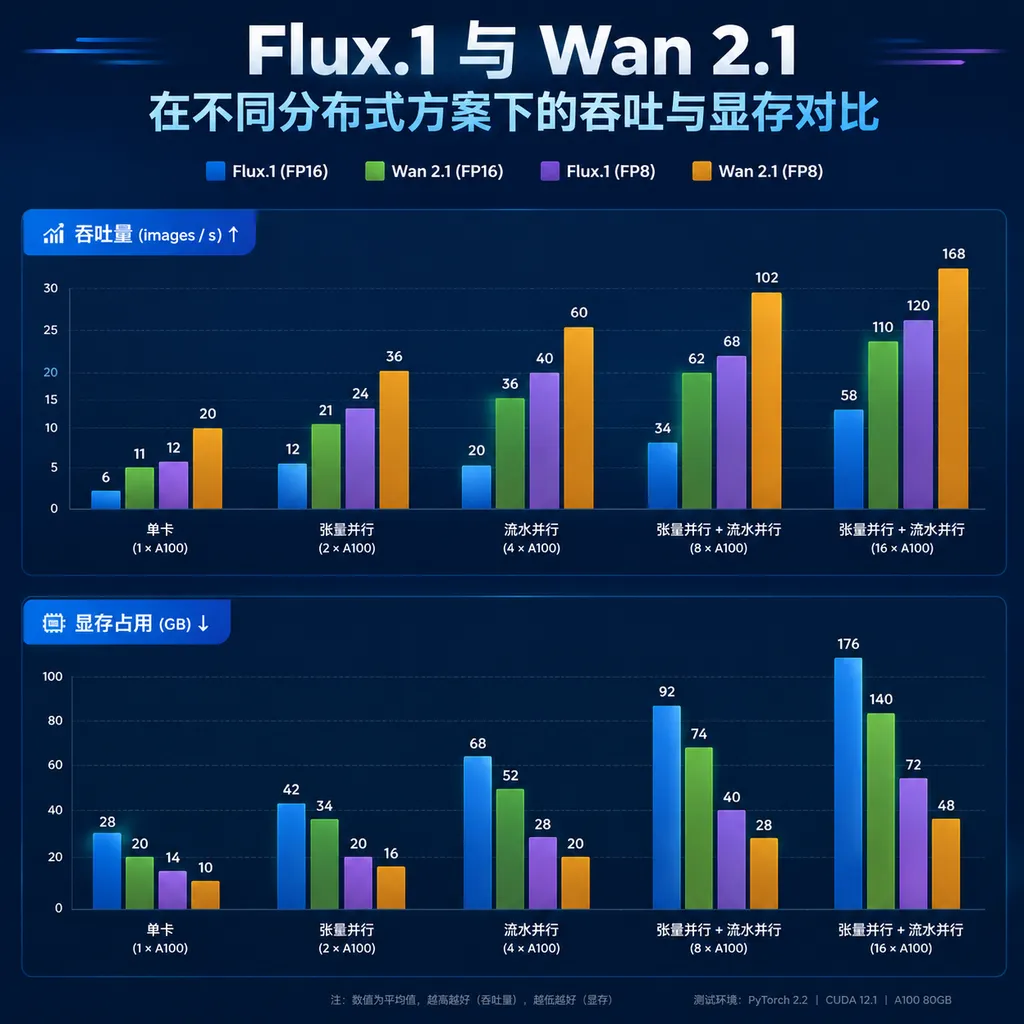
The numbers from the blog are clear: on Flux.1 dev full fine-tuning, 8×H100 delivers over 40% higher throughput than the original accelerate + FSDP1 setup. For the 14B Wan 2.1 video model—which used to rely on LoRA as a workaround—full fine-tuning is now possible on 16 GPUs.
Why Do This Now?
This year’s open‑source multimodal pace has been intense. Early 2024 saw Black‑Forest Flux Kontext elevate image editing to production quality, while Wan 2.1 and Tencent’s HunyuanVideo made open‑source video generation truly usable. Recently, Stability AI re‑entered the race with a new SD series. What do these models have in common? They’re all on Hugging Face, all integrated into Diffusers immediately, but all lacked a fine‑tuning route accessible to small and mid‑sized teams.
LoRA and DreamBooth suffice for small‑scale personalization. But when film, advertising, or gaming studios need to fine‑tune Wan 2.1 on tens of thousands of proprietary samples to “make it their own,” LoRA just doesn’t cut it—full fine‑tuning becomes essential.
Previously, the options were to pay NVIDIA for a Picasso‑tier commercial pipeline or hire distributed‑training engineers to build from scratch. What NeMo Automodel + Diffusers effectively does is democratize what used to be big‑tech‑internal multimodal training infrastructure.
A quick comparison makes it obvious:
| Solution | Full fine‑tuning large video models | Engineering barrier | Ecosystem coverage | |---|---|---|---| | Diffusers + accelerate | Feasible for small models, not for 14B scale | Low | Full | | DeepSpeed + custom mods | Possible but model code changes required | High | Needs adaptation | | NeMo (pure Megatron route) | Possible, highest performance | Very high, model conversion required | Limited | | NeMo Automodel + Diffusers | Possible | Low | Matches Diffusers |
Getting Started
The usage is simpler than you’d think. Install two packages, then write a training recipe:
model:
  _target_: nemo_automodel.diffusers.FluxTransformer2DModel
  pretrained_model_name_or_path: black-forest-labs/FLUX.1-dev
  subfolder: transformer

distributed:
  strategy: fsdp2
  sequence_parallel: true
  context_parallel_size: 2

trainer:
  precision: bf16
  gradient_checkpointing: true
  micro_batch_size: 1
  global_batch_size: 32
Then run nemo-run train recipe.yaml. DTensor partitioning, checkpoint sharded save/load, CP attention communication—all handled below the surface.
For developers already training with Diffusers scripts, the blog says migration cost is on the order of “dozens of lines”: mainly replacing accelerate’s prepare with NeMo Automodel’s Trainer, and attaching the optimizer and scheduler to it. Data pipeline unchanged, model definition unchanged.
A Few Details Worth Noting
First, checkpoint compatibility is preserved. Models fine‑tuned with NeMo Automodel can be directly save_pretrained into standard Diffusers format—same upload/download flow on the Hub. This matters: many frameworks chase performance at the cost of custom checkpoint formats, making inference reuse difficult.
Second, “Day‑0” support is in the collaboration agreement. NVIDIA’s blog last month clearly stated AutoModel’s goal: “New model architectures on Hugging Face should be trainable in NeMo on their release day.” This Diffusers partnership means that whenever a new open‑source diffusion model appears, both inference and fine‑tuning pipelines will be ready. A previous real‑world proof was Meta’s Llama 4—NeMo Automodel trained it on day one.
Third, hardware requirements aren’t harsh. The benchmark numbers use H100s, but A100 and L40S are also supported; only TransformerEngine’s FP8 kernel is unavailable, so speedups may be smaller. For teams without H100 access, this is friendlier.
An Honest Assessment
Who benefits most?
- Teams with proprietary data seeking vertical style transfer: ad, previs, or game concept‑art studios that used to buy API fine‑tuning services or settle for LoRA can now do full fine‑tuning themselves on 8–16 GPUs.
- Model researchers: doing ablations on Wan 2.1‑like models used to take a week just to set up training; now they can focus on experimental design.
- Inference service providers: a mature fine‑tuning toolchain yields more domain‑specific models, increasing the value of aggregating and distributing them.
Who might not need it? Pure application‑layer teams should still rely on APIs—training isn’t their core strength. And if LoRA suffices for your use case, don’t chase “full parameters” for its own sake; training cost is still training cost. NeMo Automodel improves efficiency, not order of magnitude.
Another Signal About Ecosystem Positioning
Zooming out, this partnership sends a deeper message.
Over the past two years, Hugging Face’s weakness has been training infrastructure. Transformers and Diffusers set the standard for inference and loading UX, but their self‑developed training tools—accelerate, TRL, alignment‑handbook—hit performance ceilings beyond 10B parameters or ultra‑long‑sequence video tasks. Meanwhile Meta and Google are pushing torchtitan and MaxText. If Hugging Face doesn’t address this, it risks shrinking from a “train+infer pipeline” to a “model Hub + inference portal.”
Partnering with NVIDIA is essentially acknowledging that “training stacks are for specialists.” Hugging Face handles model interfaces and ecosystem; NVIDIA handles performance and distributed training. The division already works for LLMs, and extending it to diffusion and video models is a natural next step.
For developers: one less decision to agonize over.
For open‑source multimodal development: a real drop in fine‑tuning barriers.
Next steps to watch: audio and 3D generation. NeMo Automodel’s roadmap lists “video generation coming soon” —which is now fulfilled; if audio‑diffusion and 3D generation (Trellis, Hunyuan3D, etc.) also join the same training stack, community productivity will level up again.
Finally, if you just want to quickly run fine‑tuned models to see results without setting up an inference environment, aggregators like OpenAI Hub already host mainstream open‑source multimodal models. With one key, you can call GPT, Claude, Gemini, DeepSeek, as well as Flux and Wan through the same OpenAI‑compatible interface—saving a lot of environment setup time for A/B tests and prototyping.
References
- Fine‑tune video and image models at scale with NVIDIA NeMo Automodel and 🤗 Diffusers — Hugging Face official blog; technical details and benchmarks of this collaboration
- NeMo Automodel Documentation — architecture overview and integration guide
- Accelerating Transformers Fine‑Tuning with NVIDIA NeMo Automodel — last month’s LLM acceleration post, technical basis for the multimodal solution
- Interpretation of NVIDIA NeMo AutoModel Accelerating Transformers Fine‑Tuning — Chinese community technical breakdown of NeMo Automodel