
Cursor blocks Hong Kong nodes from accessing Claude — where should developers go from here?

Cursor IDE recently blocked access to the Claude series models through its Hong Kong network node. When users select Claude, a message appears stating that the region is not supported; afterward, the model disappears completely from the list. This marks another step in Cursor’s continued tightening of access policies for China and neighboring regions.
Cursor has cut off Claude for Hong Kong nodes
The situation is simple: if you access Cursor IDE through a Hong Kong node, from now on, the Claude models—including Opus and Sonnet—no longer exist for you.
The first to report the issue were users from the Linux.do community. Some developers said they had been using a globally proxied, self-built Hong Kong node to run Cursor for over a month without problems. But just recently, when choosing a Claude model, they suddenly saw that blood-pressure-raising message pop up:
"This model provider is not supported in your region."
Even worse, the next day the Claude models disappeared completely from Cursor’s model selection list. Not grayed out, not erroring—just gone.
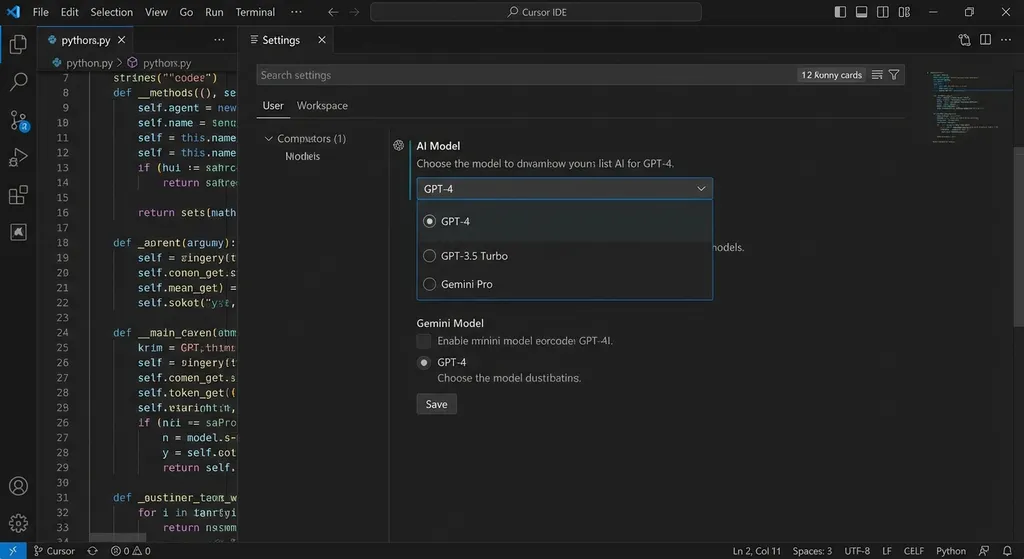
This isn’t an isolated case. On platforms like Zhihu and Juejin, many developers reported the same issue around the same time. Based on all feedback, the logic behind this block is clear—Anthropic has added Hong Kong nodes to the list of geographically restricted regions based on their outbound IP locations.
Not Cursor’s fault — it’s Anthropic’s compliance wall
Let’s get one key fact straight: the root cause lies with Anthropic, not Cursor.
Cursor doesn’t develop large models itself. It’s an AI coding IDE built from VS Code’s open-source base, calling APIs from third-party models like Claude, GPT, and Gemini through its own backend. In other words, Cursor is essentially just a middleman for model supply.
When Anthropic updated its Claude API service region policy to remove Hong Kong from the supported areas (or tightened its IP range detection), Cursor—being a downstream caller—had no way to bypass it. All it could do was either hide the unavailable models from the list or show an error when clicked. Cursor chose the former—first displaying a warning, then directly hiding the options.
From a product design perspective, that’s actually the more reasonable approach. Rather than letting users run into an error every time, it simply no longer displays those options. But from the user’s perspective, it feels like “my model was stolen.”
A notable trend here: Anthropic has steadily tightened its control over service regions. Early on, restrictions on the Asia-Pacific region were relatively loose—developers could access Claude through nodes in Hong Kong, Singapore, Japan, and other places. But starting in mid-2025, Anthropic began enforcing stricter regional compliance checks. Hong Kong had long been in a gray zone—usable but not officially listed as supported.
This change effectively closes that gray zone.
The impact is broader than you think
At first glance, it’s just “Hong Kong nodes can’t use Claude.” But in reality, the implications are far wider.
The most directly affected group are developers. Many developers from Mainland China have chosen Hong Kong nodes for one key reason: low latency. The network delay from Hong Kong to the Greater Bay Area is typically 10–30ms, and even to Shanghai or Beijing it stays under 50ms. In comparison, U.S. West Coast nodes often have 150–200ms latency, and Japan around 80–120ms. For interactive, AI-assisted coding, latency difference directly affects workflow smoothness.
Now that Hong Kong nodes are blocked, developers face a dilemma:
- Change node: switch to Japan, Singapore, or U.S. nodes—higher latency, worse experience.
- Change model: give up Claude, use GPT-4o or Gemini instead—even though Claude’s coding quality is well recognized.
- Change tool: leave Cursor entirely and find other AI coding platforms not restricted by region.
Each option comes with a cost.
Then there’s the chain reaction. According to recent Juejin posts, some users reported access issues even with GPT models. Although it’s not confirmed that GPT has officially been region-locked, this is still worrisome—if OpenAI follows suit, Cursor’s usability for Chinese developers will drop sharply.
On a larger scale, this marks a tightening trend across the entire overseas AI toolchain regarding access from China and nearby regions. Not only Cursor—GitHub Copilot, Replit, and others have similar regional restriction issues. Developers pay for subscriptions, yet can’t use core features simply because of their IP addresses. That’s a frustrating experience.
Are community workarounds reliable?
After the issue emerged, the community responded quickly. Zhihu and Juejin were soon flooded with detailed “tutorials.” Their core ideas are similar—let’s summarize:
Option 1: Enable TUN mode
This is the most frequently mentioned method. Normal system proxies (HTTP/SOCKS5) only route part of the application traffic, while some of Cursor’s network requests bypass system proxy settings. TUN mode creates a virtual network adapter, intercepting all traffic at the network layer to ensure every Cursor request goes through the proxy channel.
But this only addresses “whether traffic goes through the proxy,” not “whether the proxy node itself is blocked.” If your proxy’s outbound IP is still in Hong Kong, TUN mode won’t help.
Option 2: Use a proxy node from another region
This is the most straightforward fix—switch your proxy node from Hong Kong to Japan, Singapore, or the United States, regions explicitly supported by Anthropic.
Latency ranking:
- Japan (Tokyo): relatively friendly for East/North China, ~80–120ms.
- Singapore: acceptable for South China, ~60–100ms.
- U.S. West Coast: highest latency, ~150–250ms, but usually most stable.
The question is—who knows which region might be next? They’ve blocked Hong Kong today; will they block Singapore tomorrow? That uncertainty is what worries people most.
Option 3: Use an API relay service
This is a completely different approach—and in my view, the most sustainable one for developers.
Instead of fighting regional restrictions within Cursor’s built-in model pipeline, step out of that framework. Through API relay platforms, you can use a unified interface to call models like Claude, GPT, or Gemini without caring about each provider’s regional policies.
For example, through an API aggregation service like OpenAI Hub, you can directly call the Claude model with an OpenAI-compatible key, connecting from China without proxy hassle:
import openai

client = openai.OpenAI(
    api_key="your-openai-hub-key",
    base_url="https://api.openai-hub.net/v1"
)

response = client.chat.completions.create(
    model="claude-sonnet-4-20250514",
    messages=[
        {"role": "system", "content": "You are a seasoned code review assistant."},
        {"role": "user", "content": "Please review this Python code for potential performance issues and security risks."}
    ],
    max_tokens=4096
)

print(response.choices[0].message.content)
// Node.js example
import OpenAI from 'openai';

const client = new OpenAI({
  apiKey: 'your-openai-hub-key',
  baseURL: 'https://api.openai-hub.net/v1',
});

const response = await client.chat.completions.create({
  model: 'claude-sonnet-4-20250514',
  messages: [
    { role: 'system', content: 'You are a seasoned code review assistant.' },
    { role: 'user', content: 'Please review this code for potential issues.' },
  ],
});

console.log(response.choices[0].message.content);
The advantages are obvious: you no longer need to worry which region Anthropic or OpenAI restricts. The relay platform handles upstream regional policies within compliance, and since the interface format is unified, switching models only requires changing one parameter—no code rewriting needed.
Of course, this approach is best for integrating AI through APIs, not directly solving Cursor IDE’s internal model block. If you heavily rely on Cursor’s built-in AI, you still need to tackle it on the node level.
The deeper issue: fragmentation of AI tool availability by region
Beyond Cursor itself, we’re witnessing a troubling trend—AI development tools are fragmenting along geographic boundaries.
From 2024 to 2025, AI coding tools exploded—Cursor, Windsurf, GitHub Copilot, Cline, and countless AI code assistants emerged. Developers quickly adopted these tools as part of their workflows, and productivity genuinely increased.
But all these tools fundamentally depend on a few model providers—Anthropic, OpenAI, Google. When these providers adjust service regions based on compliance, business, or geopolitical concerns, every downstream tool and user is affected.
That leads to this absurd situation: as a developer, you pay $20/month for Cursor Pro. What features you get depend not on how much you paid, but on where your IP address is. Same subscription price—American users get full access, while you only get part of it.
This isn’t just about Cursor—it’s a microcosm of the entire industry, torn between globalization and localization.
Practical advice for developers
After all this analysis, let’s come back to the practical question—what should you do now?
Short-term workaround: If you must use Claude inside Cursor, switch to a Japan or Singapore proxy node. Latency will increase a bit, but it’ll still work. Make sure to enable TUN mode so all traffic goes through the proxy.
Mid-term adjustment: Don’t put all your eggs in one basket. Claude indeed excels at code generation, but GPT-4o and Gemini 2.5 Pro are catching up quickly. Learn their differences and switch flexibly depending on context—it’s wiser than clinging to one model.
Long-term strategy: If your workflow involves widespread AI API usage (not just for coding assistance), seriously consider using an API aggregation platform as a middle layer. This offers not only regional flexibility but also vendor-level flexibility—if one provider fails, you can switch to another seamlessly without touching your business code.
Mindset: These regional blocks are likely to become more common, not less. Instead of panicking each time, build a resilient toolchain in advance. Minimize dependency on any single tool, model, or network path.
Final thoughts
Technically, the Hong Kong node block isn’t complicated, and solutions aren’t hard to find. What truly matters is the underlying signal—it’s becoming increasingly difficult to ensure AI infrastructure accessibility.
For Chinese developers, we may have to get used to working in an “incomplete AI ecosystem,” learning to patch the gaps ourselves. It’s not fair, but it’s reality.
The good news: developers have always been resourceful and creative problem solvers. Every block sparks new tools, new solutions, new niches. This time won’t be any different.
References
- Cursor IDE disables Claude model access from Hong Kong nodes - Linux.do — earliest user report with full timeline
- Solutions for Cursor Claude model access issues - Juejin — includes various methods like switching network nodes
- Solving regional restrictions for Cursor’s Claude model - Zhihu — details TUN mode and technical approaches
- Cursor restricts Chinese users from using Claude? Full solution inside - Zhihu — analysis of Cursor’s architecture and model call mechanisms
- Recent Cursor regional lock issues and solutions for China - Juejin — covers reports that GPT models might also be affected


