Hugging Face Teams Up with NVIDIA: The Barrier to Fine-Tuning Video Diffusion Models Has Been Lowered
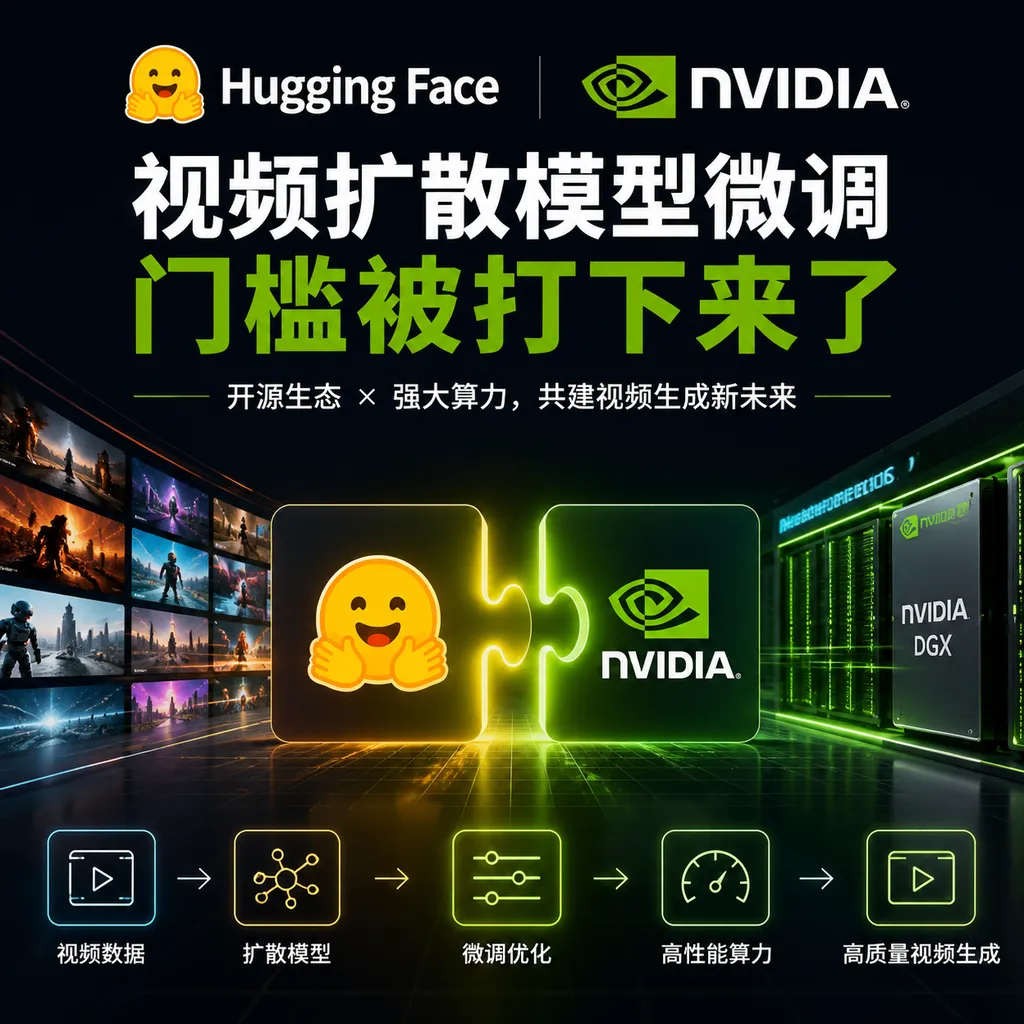
NeMo Automodel is now officially integrated into the Diffusers ecosystem. With the same YAML file, fine-tuning video/image models can run smoothly from a single A100 to hundreds of nodes—no checkpoint conversion required—and it’s open source under Apache 2.0.
In one sentence: The engineering barrier for fine-tuning video models has been lowered to nearly the same level as fine-tuning an LLM
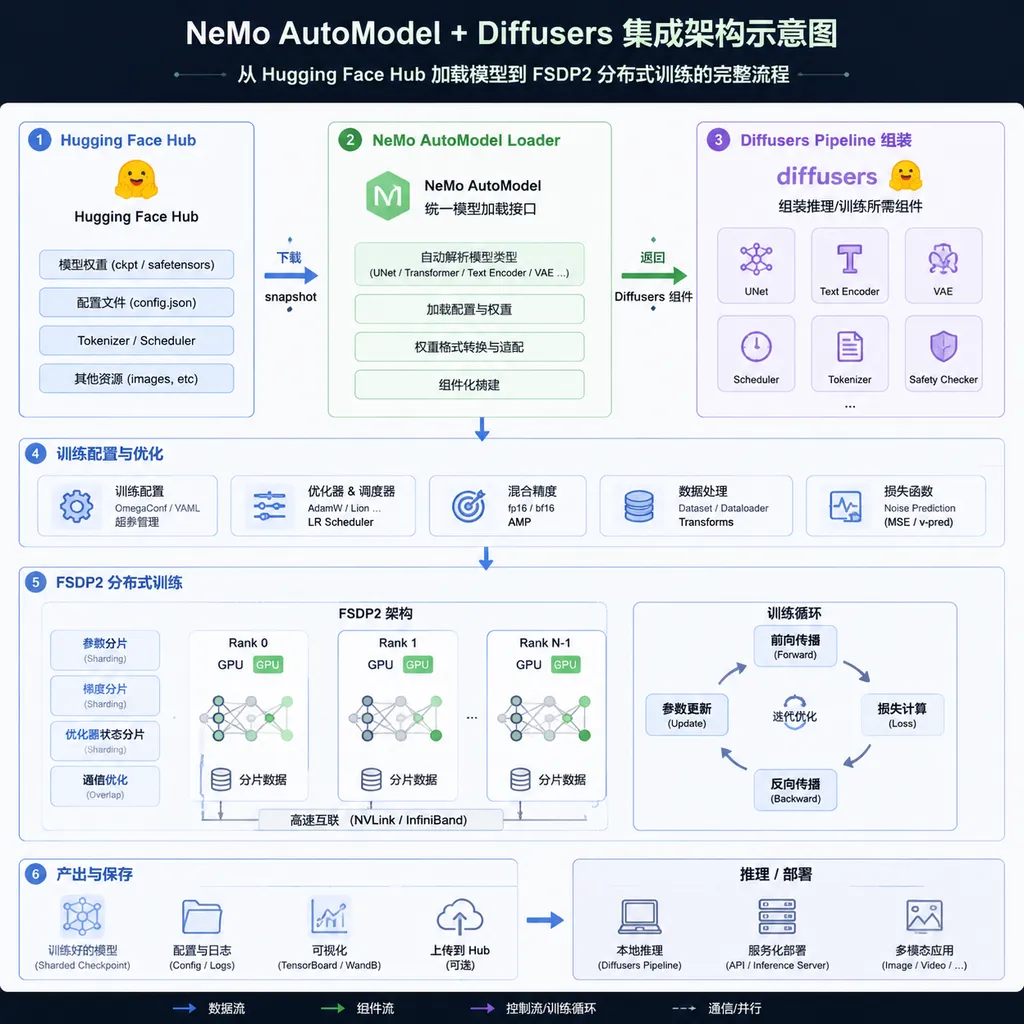
Hugging Face and NVIDIA officially announced yesterday that NeMo Automodel has completed native support for 🤗 Diffusers. This means that any diffusion model in Diffusers format on the Hub — including mainstream image/video generation models such as Wan 2.1, Flux, and SD3 — can now be pulled directly into NeMo Automodel for large-scale fine-tuning, with no need for checkpoint conversion or different training scripts for different scales.
Developers familiar with this line of work might remember that when NeMo Automodel was first released last November, it only covered Transformers' text generation and vision-language models. At the time, the official roadmap already promised to include video generation. After the June update that formally integrated Automodel into the Transformers library, this week they finally tackled the hardest part — Diffusers. With that, NeMo Automodel truly lives up to its name — whether you’re fine-tuning an LLM, a VLM, or a Diffusion Model, you now use the same interface and the same distributed training stack.
Why this deserves a separate newsflash
In short: fine-tuning video diffusion models has long been a field for “the big guys only, with individual developers watching in envy.”
For example, say you want to fine-tune a Wan 2.1 T2V 1.3B model to learn a particular cinematographic style. Theoretically, the model has only 1.3B parameters—sounds as straightforward as fine-tuning a small LLM. But in practice, it’s nothing alike:
- Complex data pipelines: Video is a spatiotemporal 4D tensor; resolution, frame rate, and duration all have to be bucketed. Otherwise, padding will waste more than half your GPU memory.
- Expensive VAE encoding: Each training step must run VAE encoding on raw videos, and this computation may even exceed that of the DiT backbone itself.
- Complicated distributed strategies: A single GPU not fitting even one batch is normal. The combination of FSDP, tensor parallelism, and sequence parallelism has never had a plug-and-play community solution.
- Fragmented engineering: To reproduce fine-tuning results from a paper, you often need to fork a heavily modified Diffusers version and wrap it in your own accelerate/deepspeed scripts.
NVIDIA had already encountered all these pitfalls in its internal model training and has full solutions within NeMo. But historically, NeMo’s problem was that it was too heavy: built around Megatron-Core, it required converting models into Megatron format before training—enough to deter ordinary developers.
The Automodel path is NVIDIA’s response to this tension: keep NeMo’s distributed training power, but narrow the entry point to the Hugging Face ecosystem. You no longer need to learn Megatron-Core or convert checkpoints; just pull models from the Hub and start training. Adding Diffusers support extends this philosophy into the visual generation domain.
Technical details: a few truly useful designs
Native PyTorch DTensor + FSDP2
NeMo Automodel is DTensor-native, using FSDP2 as its training backend. While this is no longer revolutionary in 2026, it’s a significant upgrade for the Diffusers ecosystem — historically Diffusers’ official training scripts relied mainly on accelerate, and scaling across nodes required users to integrate DeepSpeed or handcraft strategies. With FSDP2 native support, you can scale from one GPU to hundreds of nodes directly under torchrun, without editing your YAML recipe.
Multiresolution Bucketed Dataloading
This directly addresses the pain point of video training. Traditionally, all videos are resized/cropped to a uniform resolution and length, wasting both bandwidth and memory. Automodel introduces multiresolution bucketing — samples of different resolutions and durations are grouped into separate buckets, and batches are formed within each bucket. It sounds small, but for video training this optimization can save 30%–50% of compute costs.
Pre-encoded Latent Space Training
In diffusion training, VAE encoding is a major bottleneck — neither CPU nor GPU-friendly. Automodel supports pre-encoding the training data into latent space and storing it as .meta files, which are read directly during training. This eliminates the VAE overhead from GPU training loops. The benefit is especially large for video — a 5-second 480p clip’s VAE encoding latency can take up a third of each step’s time.
Flow Matching as the Default Training Objective
This is a noteworthy signal: NVIDIA considers flow matching the new default paradigm for modern diffusion/generative models, replacing the older DDPM/DDIM epsilon-prediction approach. Major recent models such as Wan, Flux, and SD3 were all trained using flow matching, and Automodel treats this as a first-class citizen.
Barrier to entry: Nearly “zero configuration”
A typical workflow looks like this:
# 1. Install Automodel
pip install nemo-automodel

# 2. Preprocess data (encode videos into latents)
nemo-automodel prepare-data \
  --model Wan-AI/Wan2.1-T2V-1.3B-Diffusers \
  --input ./raw_videos \
  --output ./latents

# 3. Edit a YAML recipe to specify model_id and data paths
# 4. Launch training
torchrun --nproc_per_node=8 train.py --config recipe.yaml

# 5. Inference directly with Diffusers
The inference side is fully compatible with DiffusionPipeline, meaning your fine-tuned checkpoint can be pushed straight back to the Hub, where others can load it with the standard three lines of Diffusers code. This “train with NeMo, infer with Diffusers” division of roles is actually the smartest part of the collaboration — each does what it does best, and users don’t need to switch ecosystems.
Realistically speaking: who will actually use this?
While the announcement sounds great, there are some boundaries.
The most direct beneficiaries are small-to-medium teams and research labs. Previously, reproducing or fine-tuning a Wan 2.1-level video model either meant paying for expensive A100 clusters and hand-writing training frameworks, or waiting for community scripts. Now, NeMo Automodel offers an official, open-source (Apache 2.0), NVIDIA-maintained solution. Wan 2.1 T2V 1.3B even fits in a single 40GB A100 — fine-tuning at this scale is now first-time accessible to individuals.
Enterprise product teams will also use it. Previously, teams chose NeMo to squeeze every drop of performance from H100 clusters, but that came at the cost of writing Megatron-Core-style code. Automodel makes the Megatron-Core “fast lane” optional — start with Hugging Face-native models to validate ideas, and switch seamlessly to the Megatron-optimized path when ready. This gradual path is highly friendly to engineering teams.
Less suitable scenarios: If you just want to tinker with a small LoRA or have only a single 3090, Diffusers’ built-in training scripts or the kohya-ss ecosystem remain lighter. NeMo Automodel’s sweet spot is between 8 GPUs and hundreds of GPUs.
Competitor comparison: How does it stack up against DeepSpeed and torchtitan?
A natural question. In short:
- vs DeepSpeed: DeepSpeed is more general-purpose and has a larger community, but lacks official first-class support for diffusion models — video training still needs manual assembly. Automodel is vertically optimized and plug-and-play.
- vs torchtitan: torchtitan, Meta’s official large-model training library, uses a similar approach (DTensor + FSDP2) but mainly targets LLM pretraining. Its diffusion ecosystem isn’t there yet.
- vs Diffusers’ official accelerate scripts: Diffusers’ official scripts are great for beginners and LoRA-level experiments; for large-scale training, much more engineering is needed.
From this perspective, the NeMo Automodel + Diffusers combo fills a genuine gap: for the first time within the Hugging Face ecosystem, there’s an officially endorsed, NVIDIA-backed fine-tuning solution for scaling image/video models from single GPU to cluster.
Points to watch next
- Model coverage pace: The first supported model is Wan 2.1 T2V 1.3B, with official docs mentioning more models coming soon. How fast Flux, SD3, and larger Wan 2.1 variants join will determine whether the ecosystem succeeds.
- Community recipe sharing: Whether the YAML recipe design succeeds depends on whether developers share their tuned configurations — similar to how Diffusers pipelines flourished.
- Relationship with Trainer/PEFT: Hugging Face’s Trainer + PEFT combo is mature; whether Automodel evolves into a parallel track or eventually converges remains to be seen.
For developers, this update serves more as an “infrastructure is ready” signal — expect an explosion of unofficial fine-tuned video-generation models in the coming months. And if you want to compare results against leading closed-source models, OpenAI Hub can connect to GPT, Claude, Gemini, DeepSeek, and others with one key, no proxy or multi-auth hassles required.
References
- NeMo Automodel × Diffusers official blog — Hugging Face’s official announcement and technical details
- NeMo Automodel documentation in the Diffusers repository — Official usage docs with supported model list and examples
- NVIDIA Technical Blog: NeMo AutoModel launch — Zhihu reprint of NVIDIA’s official blog introducing Automodel’s design philosophy