HF and Lao Huang joined forces to cut the threshold for multimodal fine-tuning down to ankle height.

Hugging Face and NVIDIA have teamed up to integrate NeMo Automodel with Diffusers, turning the large-scale fine-tuning of video and image diffusion models from an engineering nightmare into something achievable with just a few lines of configuration files, and with FSDP2 support, it can scale up to thousands of GPUs.
Make One Thing Clear
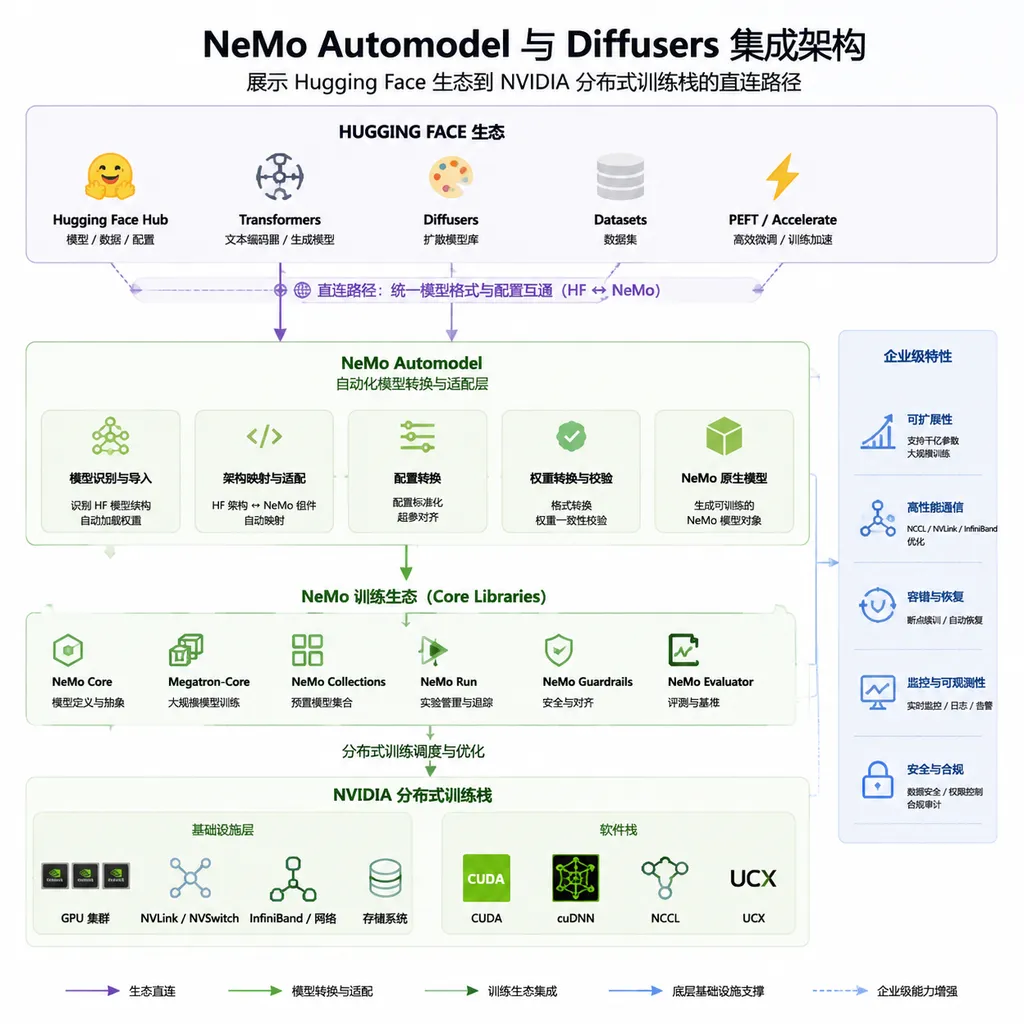
On July 17, Hugging Face published a co‑authored technical article with NVIDIA on its official blog, announcing that NeMo Automodel is now officially integrated with the 🤗 Diffusers library — meaning that from now on, large‑scale fine‑tuning of diffusion models like Flux, Wan2.1, and CogVideoX can directly use NVIDIA’s distributed training stack (FSDP2 + Sequence Parallel + Context Parallel) without needing to convert weights back and forth into Megatron format.
Anyone who has done multimodal fine‑tuning can see the significance immediately. In the past, if you wanted to fine‑tune a video generation model on tens or hundreds of H100s, you basically had only two options: either tolerate the Diffusers Accelerate scripts running barely at a medium scale (beyond 32 GPUs you’d face all kinds of memory overflows and communication issues), or spend a week converting Hugging Face checkpoints to Megatron‑Core’s sharding format, rewriting dataloaders, and tuning Transformer Engine fused ops before enjoying true industrial‑grade throughput. Now that gap has officially been closed.
Why This Isn’t Just Another “Integration” News
Every year there are plenty of “XX integrates with YY” press releases, most of which are meaningless. But NeMo Automodel × Diffusers is different because it addresses a real two‑year‑old pain point: there has never been a mature open‑source toolchain for large‑scale diffusion model training like there is for LLMs.
For LLMs you have Megatron‑LM, DeepSpeed, TorchTitan — pick any and you can train a 70B model across thousands of GPUs. For video diffusion? Look at the community: when people train models like Wan2.1 or HunyuanVideo with tens of billions of parameters and sequence contexts of tens of thousands of tokens (since videos are split into huge numbers of patches), they usually stitch together FSDP by hand, implement gradient checkpointing, and pray activations don’t explode. This wasn’t because the Diffusers team wasn’t trying — diffusion training’s communication and memory patterns differ greatly from LLMs, and one library alone simply couldn’t handle it.
NeMo Automodel takes a smart approach. Instead of modifying Diffusers’ model definitions, it positions itself as a native PyTorch distributed training runtime — your model is still the same nn.Module loaded from diffusers.pipelines, and the weights are the original safetensors from the Hugging Face Hub. Automodel handles slicing, orchestrating communication, applying FSDP2, and enabling Context Parallel. In other words, the community maintains the model code, NVIDIA maintains the training infrastructure, and you don’t need any heavyweight checkpoint conversions between them.
This design was already validated on the LLM side in February with NeMo 25.02 — at that time Automodel could directly load Hugging Face’s AutoModelForCausalLM, and DeepSeek V3 671B achieved 250 TFLOPS per H100 across 256 GPUs. Now the same idea is extended to Diffusers, replacing Transformer modules with DiT, UNet, and VAE support.
Technical Details: The Real Fixes
Why is large‑scale diffusion training hard? A few concrete pain points show how Automodel strikes the core issues.
First, exploding activations. Video diffusion deals with five‑dimensional tensors (batch, frames, channels, H, W) — increase the resolution a bit, and one forward pass can consume tens of GBs of memory. Automodel adds selective activation checkpointing for DiT architectures; coupled with FSDP2’s per‑parameter sharding, tests show it keeps memory use low enough to fit 720 p sequences of Wan2.1‑14B on 8 H100s.
Second, attention cost for long sequences. After patchifying a video, sequence length easily exceeds 100 k tokens, causing standard attention to OOM. Automodel integrates Context Parallelism — slicing the sequence dimension across multiple GPUs with overlapping communication via Ring Attention. Megatron had this long ago, but you previously had to port the whole model there; now it works directly on Diffusers’ FluxTransformer2DModel.
Third, FP8 training. NVIDIA Transformer Engine’s FP8 recipe can now transparently wrap Diffusers models, even leveraging MXFP8 on Blackwell GPUs. For teams training base models rather than only LoRA adapters, the throughput gain translates directly into cost savings.
Fourth, the data side. This used to be a total blank — Diffusers’ official dataloader assumed a single‑machine run, leaving multi‑node sharding, shuffling, and resuming to users. Automodel ports over the HFDatasetDataModule, directly consuming the streaming interface of HF Datasets so you can scale across nodes without changing code.
Getting Started Is Simple
According to the blog examples, setup cost is low. The core configuration is just a YAML specifying model ID, parallelism, and optimizer — like this:
model:
  _target_: nemo_automodel.diffusion.FluxAutoModel
  pretrained_model_name_or_path: black-forest-labs/FLUX.1-dev

parallelism:
  strategy: fsdp2
  context_parallel_size: 4
  dp_shard_size: 16

optim:
  lr: 1e-5
  precision: bf16-mixed
Then one torchrun command launches training. You never need to touch Megatron concepts or convert checkpoints; the saved model remains in standard Diffusers format, ready to push_to_hub for others to use.
Compare that to the old workflow — just converting Flux weights from Diffusers shards to Megatron TP shards took an experienced engineer half a day and often introduced bugs around the VAE and text‑encoder glue layers. Now the migration cost is virtually zero.
Who Will Actually Use It
This update will mainly benefit three groups:
- Large video‑generation teams: They already have compute but lack a toolchain that scales to 512 GPUs +. Before, they either wrote custom code or used closed‑source solutions; now there’s an open‑source baseline. Automodel has proven near‑linear scaling to thousands of GPUs for LLMs, and though diffusion’s communication differs, the underlying FSDP2 + Context Parallel design is similar — it should work.
- Mid‑size startups: The 8–64 GPU use case. These teams used Diffusers + Accelerate previously but faced strange issues past 16 GPUs. Now with an official recommended path, the engineering time saved outweighs the GPU hours saved.
- DGX Spark users: NVIDIA’s desktop‑class AI workstation natively supports Automodel 26.02, capable of fine‑tuning 70B‑scale LLMs and VLMs with PEFT locally. With this diffusion path enabled, in theory desktop users can fine‑tune Flux LoRA models with the same optimizations.
An interesting case is domain fine‑tuning. For example, an e‑commerce imagery team wants to keep training a full Flux base (not just LoRA). In open source this was nearly a forbidden zone — not impossible, but numerically unstable compared to LoRA due to distributed precision issues. Automodel’s new FP8 recipe and TE training stability make this path truly viable.
Comparison with Competitors
Two unavoidable benchmarks:
xDiT is currently the community’s most professional project for parallel inference/training of video diffusion, focusing on its unique USP (Unified Sequence Parallelism). Its strength is deep customization and up‑to‑date support for Wan‑series models; weakness — it diverges from Diffusers’ mainline, requiring per‑model adaptation. Automodel takes the opposite route: breadth first. Any Diffusers model can train out‑of‑the‑box, though it may be less refined for specialized cases.
Diffusers’ built‑in Accelerate integration is simply no longer in the same league. Accelerate fits single‑machine multi‑GPU to small multi‑node runs, but beyond that it struggles. After Automodel’s release, Diffusers’ positioning will likely shift — keeping Accelerate as entry‑level and recommending Automodel for scale‑out training.
Microsoft DeepSpeed also works for diffusion, but its configuration complexity is high, community activity has declined, and integration with Diffusers is not seamless.
Overall, Automodel’s role is clear: to be the default industrial‑grade solution for diffusion training. With Hugging Face’s official blog backing it, that “default” status is practically confirmed.
A Broader View
This collaboration signals something bigger — over the past two years NVIDIA has opened many parts of its stack (NeMo Automodel 25.02, NeMo‑RL, Transformer Engine), yet lacked a visible community touchpoint. LLM training is already crowded with Megatron‑LM and others; diffusion, an expanding market, becomes the perfect entry for NVIDIA to engage open source.
Hugging Face’s motive is straightforward: Diffusers usage is growing fast, but the training side remained weak, so partnering with NVIDIA is the easiest fix. It’s standard complementarity — HF provides ecosystem and model definitions; NVIDIA provides performance and hardware adaptation.
For developers this means that if you plan to work on video generation or large‑scale diffusion fine‑tuning later this year, you can skip evaluating self‑built setups and start directly with NeMo Automodel. For inference, the fine‑tuned model outputs remain in standard Hugging Face format, compatible with any inference service (including aggregate platforms like OpenAI Hub’s image/video generation APIs) — training pipelines belong to NVIDIA, inference remains your own.
One timeline note: the blog states these features are already available in the NeMo Automodel main branch, with tutorial notebooks covering Flux and Wan2.1 typical cases. You can clone and run them now — no need to wait for the next major release.
References
- Fine‑tune video and image models at scale with NVIDIA NeMo Automodel and Diffusers — the official technical blog by HF and NVIDIA, the primary source for this update