PPIO Bets on the Agent Era: The Intelligent Gateway Behind Trillions of Tokens
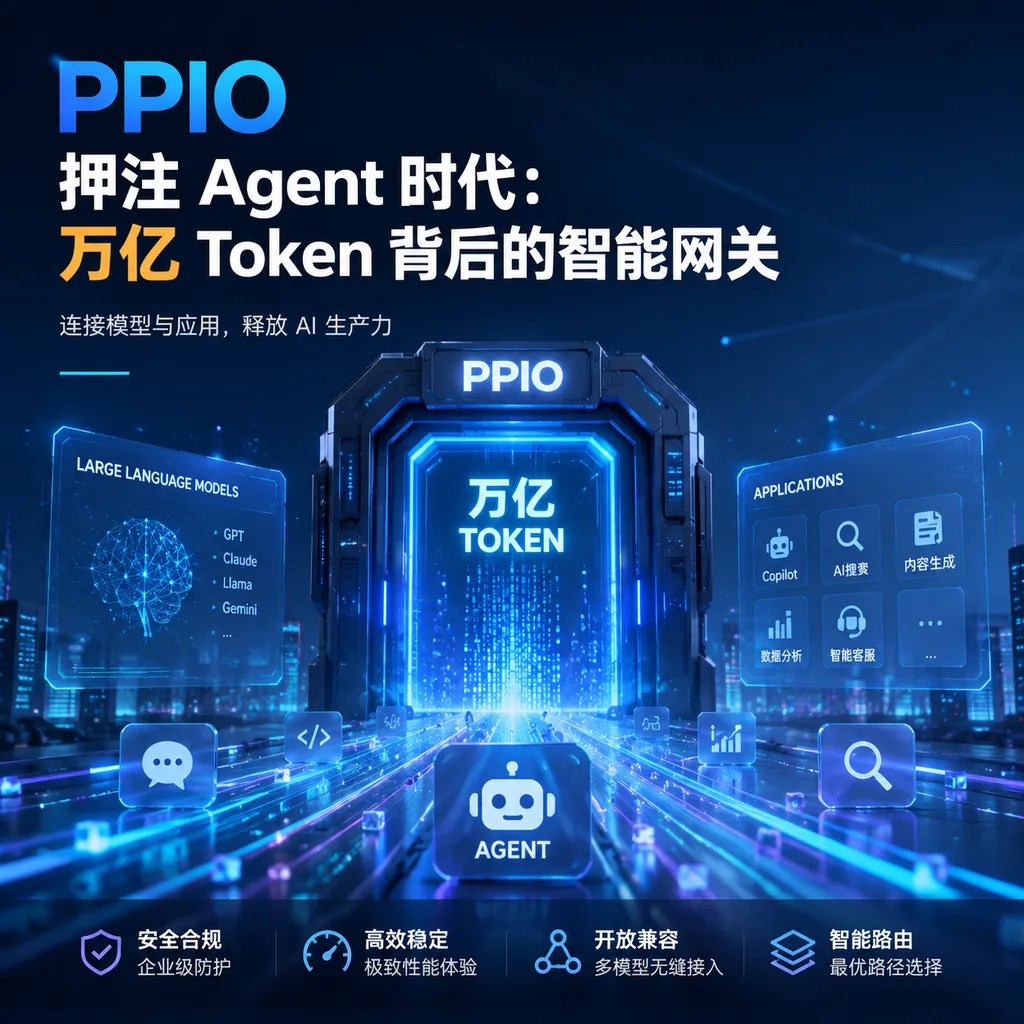
At WAIC on July 17, PPIO shifted its positioning from a distributed AI cloud to an Agentic Cloud, while also launching a new intelligent model gateway product. Their confidence to make this change comes from a daily call volume of 1.2 trillion tokens.
At the site of the World Artificial Intelligence Conference on July 17, PPIO quietly changed its positioning. The original tagline “Distributed AI Cloud” was replaced with “Agentic Cloud,” along with the launch of a new product called the Intelligent Model Gateway. CEO Yao Xin gave a formula at the media briefing:
Agent Productivity = Token Intelligence Density × Agent Loop Duration
It sounds like a slogan crafted by the marketing team, but this time it’s backed by hard data—by June 2026, PPIO’s daily average token call volume exceeded 1.2 trillion, up more than eightfold year over year. According to CMM Intelligence, PPIO now ranks first among independent AI cloud service providers in China.
In other words, this isn’t a company telling stories because it wants to—it's a company that has already scaled, redefining its battlefield.
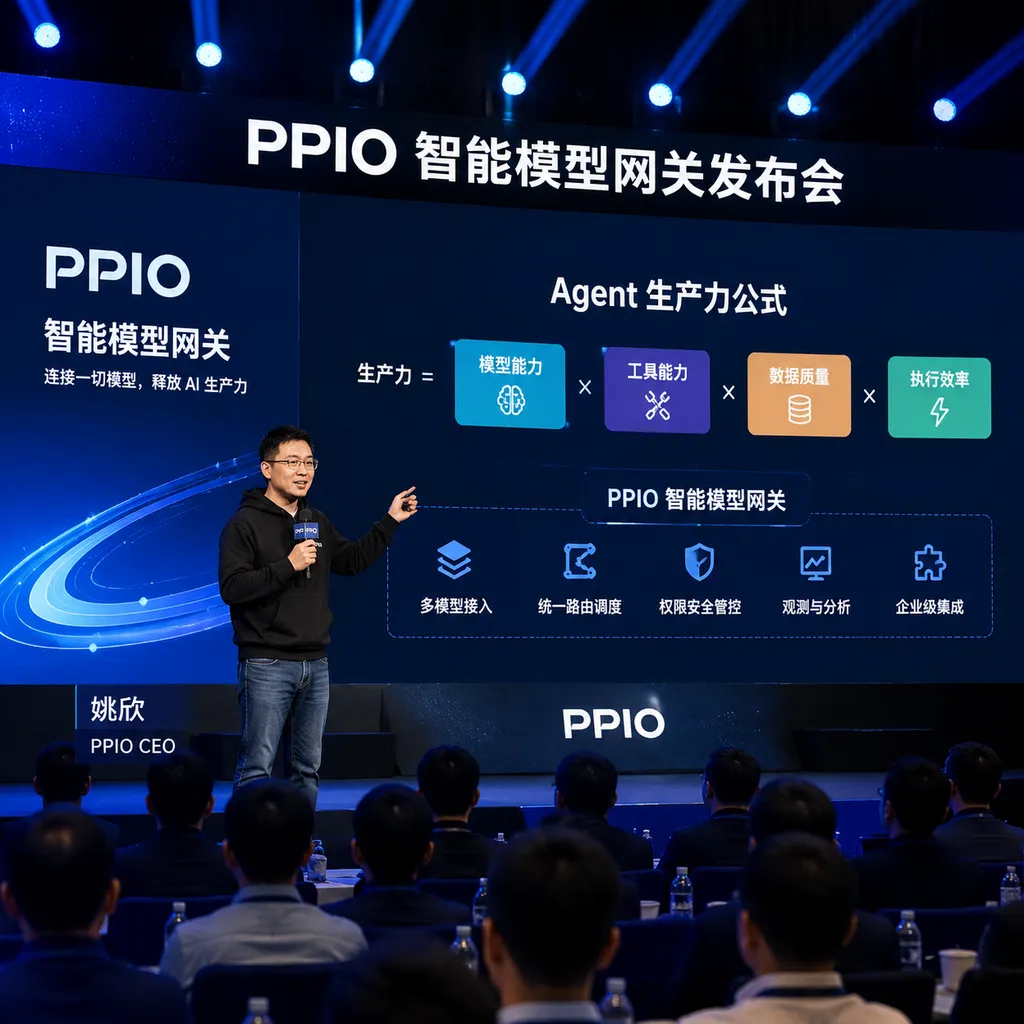
What Exactly Is the Intelligent Model Gateway?
A year ago, “model gateways” were an edge-case concept. Now, almost every company doing AI infrastructure has one. The logic is simple: a developer uses a Key, and the gateway routes requests to the backend model pool. OpenRouter was the first to make this work; domestic platforms like OpenAI Hub follow a similar approach—one Key giving access to GPT, Claude, Gemini, and DeepSeek, OpenAI-format compatible, with domestic connectivity, and very developer-friendly.
PPIO’s difference lies in the word “Intelligent.” Traditional gateways perform protocol aggregation, while PPIO aims for decision-based routing:
- Critical tasks are handled by hybrid models, ensuring result quality with models of high intelligence density
- Simple tasks automatically route to lightweight models, lowering the Token unit cost
- Dynamically balance task difficulty, cost, and latency
In terms that Agent developers can understand: suppose you’re building a multi-step Agent—some subtasks are as simple as “rename a variable,” while others require heavy reasoning like “analyze potential concurrency bugs in the code.” Previously, you either used a GPT-4 level model for everything—painfully expensive—or wrote manual if-else routing logic and kept tuning thresholds. The Intelligent Model Gateway wants to handle that for you.
The prerequisite for making this work is that the gateway must sit atop a model pool that’s comprehensive, affordable, and stable enough. That’s the value of PPIO’s trillion-scale Token traffic—dynamic routing only makes sense once your call volume is enough to flatten the fixed cost of model serving. At small scales, the savings from routing don’t even cover the cost of maintaining a routing algorithm team.
Agent Harness: The Real Ambition Lies Here
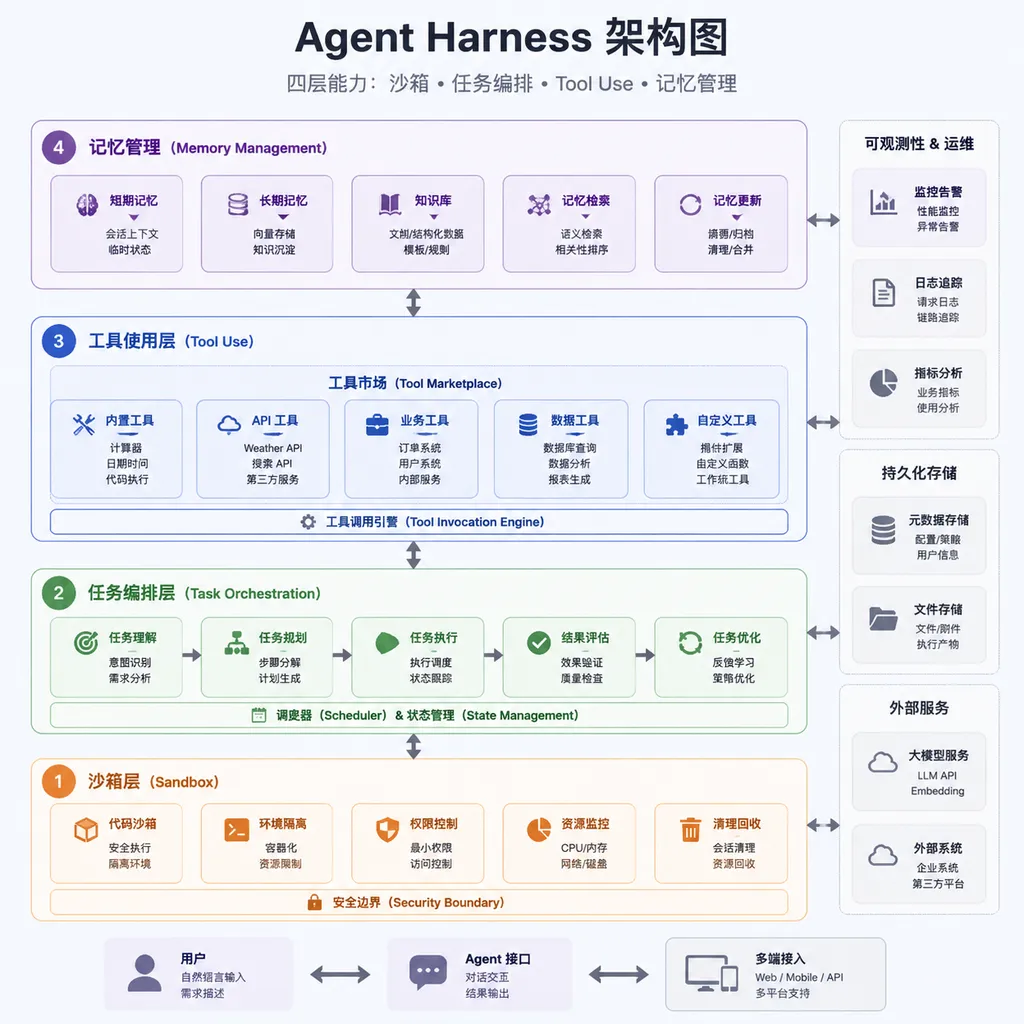
If PPIO only had a model gateway, it would at most be a “Chinese OpenRouter.” What truly embodies the Agentic Cloud positioning is their new Agent Harness layer—a complete suite combining sandboxing, task orchestration, Tool Use, and memory management.
One term in Yao Xin’s formula is Agent Loop Duration, which basically measures how long an Agent can run without crashing, forgetting, or getting lost. The Harness layer addresses exactly that.
The Sandbox Is the Core
In 2025, PPIO launched China’s first Agent sandbox compatible with the E2B interface. Why is sandboxing important? Think of Anthropic’s Computer Use, OpenAI’s Operator, or all the Agents for Vibe Coding—they all need an isolated environment that can actually execute code, click in a browser, install dependencies, and read/write files. You can’t let Agents run directly on your production server, nor risk a rogue Agent kernel deleting everything with one rm -rf.
PPIO’s sandbox metrics tell the story:
- Business scale grew 50× within one year
- Covers scenarios such as Browser Use, Computer Use, Vibe Coding, reinforcement learning training, and long-running assistants
- Supports one-click cloud hosting—no need to buy your own servers
Hosted Agents: PPClaw and PPHermes
This year, PPIO launched two hosted Agents through the Harness layer—PPClaw and PPHermes—claiming 7×24 hours of continuous operation with self-healing capability. “Self-healing” matters because long-running Agents often suffer from drift and state contamination, leading to gibberish after dozens of steps. The ability to self-heal implies serious work in memory compression, state checkpointing, and error recovery.
“The Cloud’s First Customer Has Changed from Humans to Agents”
Yao Xin said something interesting at the briefing:
“Traditional cloud computing was designed for humans using software; the Agentic Cloud is built for Agents running autonomously.”
This isn’t just marketing copy. Traditional cloud APIs assume human engineers are the callers, so documentation must be readable, errors human-understandable, and SDKs elegant. But Agents don’t read docs—they work via Function Calling and structured outputs. This implies:
- API semantics must be LLM-friendly — parameter names, error formats, and return structures must be designed so that LLMs can call them correctly the first time.
- Billing granularity must match Agent behavior — a single Agent might call APIs tens of thousands of times a day; session-based billing models won’t suffice.
- Observability must track Agent behavior — metrics should focus not just on QPS and P99 latency, but on loop completion rates, average steps, and repair counts.
PPIO’s repositioning acknowledges a larger truth: Agents are not just another workload on existing clouds—they’re the reason the cloud itself needs redesigning. This view diverges from AWS’s and GCP’s current stance; big providers still treat Agent scenarios as extensions of existing services.
A Few Cautious Observations
After the optimism, here’s what’s worth watching.
How strong is the “intelligence” part of the Intelligent Model Gateway? PPIO hasn’t disclosed the specifics of its routing algorithm or comparative benchmarks (e.g., cost/quality tradeoffs between intelligent routing vs all-large-model vs all-small-model setups). Others like Martian, RouteLLM, and even OpenRouter’s own routing experiments are working on similar ideas. From the launch alone, PPIO’s moat isn’t yet evident.
The trillion-Token metric deserves a closer look. The 1.2 trillion daily calls include low-intelligence-density small-model traffic. With high-value models like DeepSeek-V3 driving prices down market-wide, token-scale numbers can be inflated by cheap volume rather than meaningful intelligent productivity.
Ecosystem challenges for Agent Harness. E2B compatibility is great, but Agent frameworks haven’t converged—LangGraph, CrewAI, AutoGen, Anthropic’s Claude Agent SDK all differ. PPIO’s full-stack hosting vision means integrating with all these, a nontrivial effort.
What It Means for Developers
If you’re building Agent applications—especially those needing long runtimes, multi-model collaboration, or real execution environments—PPIO’s offering is worth a try, particularly for its sandbox and hosted Agents. Pricing is also attractive: GPU Spot billing currently puts RTX 4090 at 0.99 RMB/hour, with preemptible instances at half price—friendly for both training and inference.
If you just want to link your app to various large models or flexibly switch between providers to compare outputs, OpenAI Hub–style aggregation gateways may be lighter—a single Key connects GPT, Claude, Gemini, DeepSeek, etc., OpenAI-format compatible with domestic access, usable by changing just one base_url. These two approaches solve different problems: one aggregates model access, the other manages the entire Agent lifecycle.
In Closing
PPIO’s move is essentially a bet that Agents will become the primary workload of the cloud. Yao Xin’s formula sounds like a slogan, but broken down—Token intelligence density corresponds to model capability and routing efficiency, while Loop duration relates to runtime infrastructure—these are precisely the two biggest bottlenecks in real-world Agent deployments today.
The direction of the bet makes sense. The execution challenges lie ahead: can the Intelligent Gateway truly cut costs without degrading intelligence? Can the Harness layer support complex long-range Agent operations? And most crucially—when giants like AWS and Alibaba Cloud eventually realize Agents are the next-generation cloud’s core load—will PPIO’s two- to three-year head start be enough?
We should see part of the answer in the second half of 2026.
References
- PPIO Official Site – Company Overview and Business Panorama — official description of PPIO’s Agentic Cloud positioning, including distributed nodes, developer counts, and basic stats