
MiniMax M2.7 Day-0 runs successfully on domestic GPUs—what does that mean?
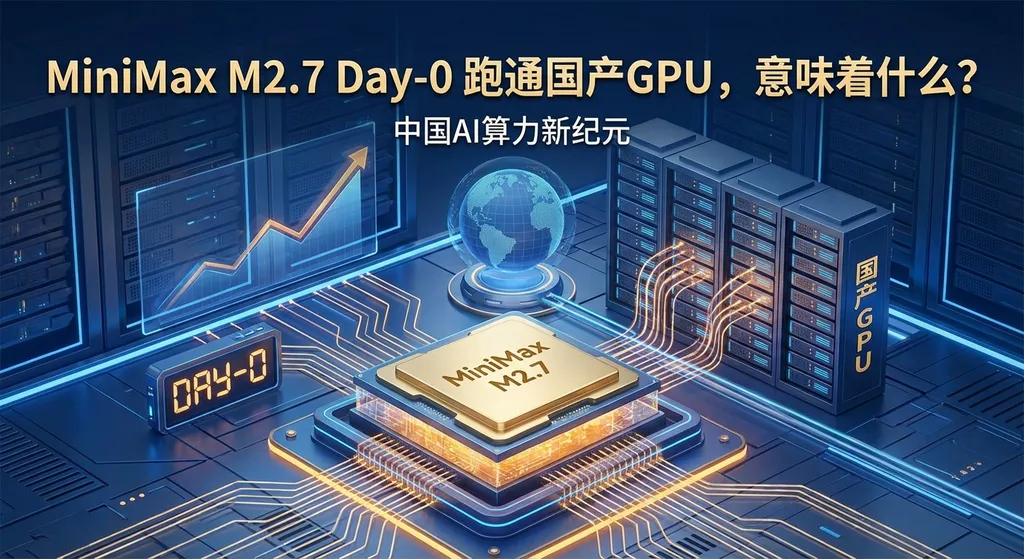
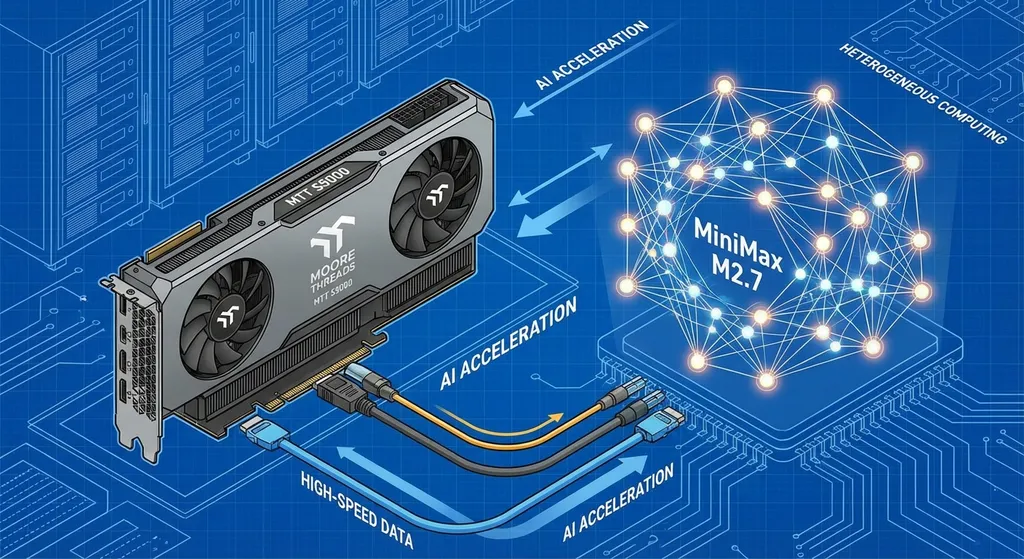
Moore Threads MTT S5000 has completed Day-0 adaptation for the MiniMax M2.7 large model. For the first time, a domestic GPU achieved full training and inference integration on the same day as the release of a flagship model, marking the transition of China’s computing ecosystem from "able to run" to "running in sync."
What Happened
On April 12, Moore Threads announced it had completed Day-0 adaptation for the MiniMax M2.7 large model, running on its flagship AI training–inference GPU—the MTT S5000.
“Day-0 adaptation” means that on the day the model is released, it can already be fully trained and deployed on that hardware. It’s not “compatible” or “planned support”—it’s genuinely available in sync with release.
This isn’t Moore Threads’ first time doing this. For previous releases of leading domestic models such as Zhipu GLM‑5 and Qwen QwQ‑32B, Moore Threads also achieved Day‑0‑level instant adaptation. But the M2.7 case is different in significance—it’s MiniMax’s most powerful programming and Agent model, with greater complexity and higher computing‑power demands.
What Makes M2.7 So Strong
Let’s start with the model itself. MiniMax M2.7 is officially described as “the industry’s first large model with deep self‑evolution capability.” While that may sound abstract, it actually refers to a combination of specific features:
- Self‑built Agent Harness: The model can construct its own Agent execution framework rather than rely on externally predefined workflows.
- Agent Teams Collaboration: Multiple Agents can cooperate and divide tasks to handle complex, multi‑step jobs.
- Tool Search Tool: The model can not only call tools but also “search” for what tools it needs—an emergent meta‑capability.
- Deep participation in its own iteration: The model can take part in the filtering, evaluation, and optimization of its own training data.
A simple analogy: previous large models were like interns who needed you to assign tasks step by step; M2.7 is more like a project manager who can break down a project, find resources, recruit a team, and get the job done.
From public benchmarks, M2.7 performs impressively in programming and Agent tasks. MiniMax’s previous M2.5 model had already ranked first in global model‑call volume for five consecutive weeks. M2.7 builds on M2.5 by further strengthening code generation and complex reasoning. Based on community feedback and third‑party evaluations, M2.7’s performance on real programming benchmarks such as SWE‑bench is close to—and in some areas surpasses—peer models like Claude Opus 4.
Even more noteworthy is MiniMax’s simultaneous launch of its all‑modal Token Plan subscription—one API key gives access to programming, video (Conch Video), speech, music, image, and other multimodal models. This “one entry, all capabilities” product philosophy saves developers the cost and hassle of integrating multiple platforms.
MTT S5000: Are Theoretical Specs Enough?
Back to the hardware. The MTT S5000 is built on Moore Threads’ fourth‑generation MUSA architecture, “Pinghu.” Key specs:
| Metric | MTT S5000 | Reference (NVIDIA A100) | |--------|------------|--------------------------| | Peak AI Compute | 1000 TFLOPS | 624 TFLOPS (BF16) | | Memory Capacity | 80 GB | 80 GB | | Memory Bandwidth | 1.6 TB/s | 2.0 TB/s | | Inter‑GPU Bandwidth | 784 GB/s | 600 GB/s (NVLink) | | Precision Support | FP8 – FP64 full precision | FP16 – FP64 |
On paper, the S5000’s peak TOPS exceeds the A100, memory capacity matches, and inter‑GPU bandwidth is even higher. Memory bandwidth is slightly lower but not by much. Full‑precision support from FP8 to FP64 means it covers everything from low‑precision inference to high‑precision scientific computing—a relatively complete range for a domestic GPU.
But there’s always a gap between specs and real‑world performance. A research note by Guojin Securities’ computing team points this out: domestic GPUs have basically caught up with NVIDIA’s H20 and A100 models in performance metrics, but still lag behind the most advanced NVIDIA generation in software ecosystem, compiler optimization, and operator‑library completeness.
That’s precisely why Day‑0 adaptation is more convincing than any spec comparison—it proves not only “it can theoretically run” but “it runs in practice.” If a model can be fully trained and deployed on a domestic GPU the very day it’s released, it shows that the underlying drivers, compilers, operator libraries, and communication protocols—those invisible layers—have reached a certain level of maturity.
Why Day‑0 Adaptation Matters
For most developers, “domestic GPU adaptation” might sound remote. But if you’re doing ToG (government) or ToB (enterprise) projects—or if your business involves data compliance and Xinnchuang (domestic‑IT‑innovation) requirements—then this matters directly.
Previously, the typical process for adapting a large model to domestic GPUs looked like this:
- Model release
- GPU vendor obtains model weights and code
- Spend weeks or months on operator adaptation and performance tuning
- Release an adapted version
- Developers encounter issues, give feedback, iterate
This cycle could take one to two months, or up to half a year. With large‑model development speeding up, such delays mean domestic GPUs are always playing catch‑up.
Day‑0 adaptation reduces that cycle to zero. The logic is that GPU vendors and model developers have already collaborated deeply before release to finish adaptation in advance. It’s not purely a technical achievement—it’s an ecosystem cooperation milestone.
Moore Threads being able to repeatedly deliver Day‑0 readiness shows it has established a stable pre‑adaptation mechanism with domestic top model providers. Once this mechanism is in place, the adaptation cost for each new model decreases, since the underlying software stack keeps improving and reusing components.
Bigger Picture: Domestic Compute Ecosystem Closing the Loop
Looking more broadly, MiniMax M2.7 + MTT S5000 Day‑0 adaptation is just one snapshot of the accelerating closure of China’s computing‑power ecosystem.
Since 2026, collaboration along the “chip–model–application” chain has visibly sped up:
- Tencent Cloud announced full adaptation for mainstream domestic chips
- Baidu, Alibaba, and other CSPs accelerated their domestic‑chip work
- Huawei opened its full‑scale Pangu large‑model series (1B–718B parameters), launching a Model Plaza with 160+ advanced models
- MiniMax, Zhipu, DeepSeek, and other model companies are proactively establishing pre‑adaptation partnerships with domestic GPU vendors
Policy incentives play a role—data‑security and Xinnchuang compliance requirements are increasingly clear. But more importantly, domestic GPUs’ capabilities have reached a critical point: no longer “barely usable,” but “ready for production environments.”
For developers, this adds another dimension to tech‑stack choices. If your scenario demands data sovereignty or less dependence on a single supplier, the domestic GPU + domestic model combo is now worth serious evaluation.
How Developers Can Use M2.7
MiniMax M2.7 is already accessible via API; its model weights will be released in two weeks. If you just want to try it quickly, there’s no need to wait—use the API directly.
M2.7 is compatible with the OpenAI API format. If you’re using an aggregation platform like OpenAI Hub, a single key can invoke it—no need for separate MiniMax account registration:
from openai import OpenAI

client = OpenAI(
    api_key="your-openai-hub-key",
    base_url="https://api.openai-hub.net/v1"
)

# Call MiniMax M2.7 for code generation
response = client.chat.completions.create(
    model="minimax-m2.7",
    messages=[
        {
            "role": "system",
            "content": "You are a senior programming assistant specializing in complex system design and code implementation."
        },
        {
            "role": "user",
            "content": "Design a Redis-based distributed rate limiter using a sliding-window algorithm and provide a Python implementation."
        }
    ],
    temperature=0.7,
    max_tokens=4096
)

print(response.choices[0].message.content)
# Use M2.7’s Agent capability for multi-step tool invocation
response = client.chat.completions.create(
    model="minimax-m2.7",
    messages=[
        {
            "role": "user",
            "content": "Analyze this GitHub repository’s code quality, identify potential performance bottlenecks, and suggest optimizations."
        }
    ],
    tools=[
        {
            "type": "function",
            "function": {
                "name": "search_code",
                "description": "Search files and functions in a code repository",
                "parameters": {
                    "type": "object",
                    "properties": {
                        "query": {"type": "string", "description": "Search keywords"},
                        "file_type": {"type": "string", "description": "File type filter"}
                    },
                    "required": ["query"]
                }
            }
        }
    ],
    tool_choice="auto"
)

print(response.choices[0].message)
Usage tips:
- M2.7 performs best in programming and Agent scenarios; for pure text generation, M2.5 may offer better cost‑effectiveness.
- Tool Search Tool is M2.7’s differentiating feature—use it fully in Agent workflows.
- At peak times MiniMax enforces dynamic rate‑limits; if latency matters, call off‑peak or use aggregation platforms with load balancing.
Keep a Cool Head About a Few Issues
Despite all the positives, several caveats remain.
First, the depth of Day‑0 adaptation deserves scrutiny. “Running” and “running well” are different things. The fact that the model can complete training and inference on the S5000 doesn’t mean its performance is fully optimized. Detailed metrics such as tokens‑per‑second throughput, training‑convergence speed, and multi‑GPU scaling efficiency haven’t been disclosed. Until independent third‑party tests are available, a cautious view of performance is reasonable.
Second, M2.7’s “self‑evolution” capability is still mostly conceptual. A model participating in its own iteration sounds exciting, but details such as the exact mechanism, safety boundaries, and controllability need further disclosure. Developers have already raised the question—if the model can influence its own training data, how do we ensure alignment doesn’t drift?
Third, while the domestic GPU ecosystem is accelerating, the developer toolchain’s maturity remains a weakness. CUDA’s ecosystem has had more than a decade to accumulate libraries, tools, tutorials, and community support. MUSA architecture is catching up fast, but learning and troubleshooting costs for migration shouldn’t be underestimated. For most small‑to‑medium teams, the difference between “usable” and “easy to use” may be larger than expected.
My Take
The Day‑0 adaptation of a flagship model on domestic GPUs carries more signaling value than immediate practical value.
It proves China’s compute‑power ecosystem has reached a new level of collaboration efficiency—the “chip–model–application” loop is becoming reality. From a developer’s perspective, though, domestic GPUs still need continued investment in usability, performance‑tuning tools, and community ecosystem—the “last mile.”
MiniMax M2.7 itself is a model worth attention. Its deeper Agent abilities and all‑modal Token Plan design show clear thinking on commercialization. Once its weights are released in two weeks, community evaluations will offer more objective answers.
For teams needing to deploy large models on domestic compute, now is a suitable time for assessment—not because everything is perfect, but because the ecosystem has matured enough to make it worth a serious try.
References:
- ITHome: Moore Threads completes Day‑0 adaptation for MiniMax M2.7 large model — Primary information source, including MTT S5000 hardware specs and adaptation details
- Zhihu: Liu Gaochang, Guojin Computing Team | China’s computing power further accelerates — Analysis comparing domestic GPU and NVIDIA products plus industry‑trend assessment


