Bilibili Open-Source Catgirl Project: Giving Back Ownership of Your Desktop AI Companion to You
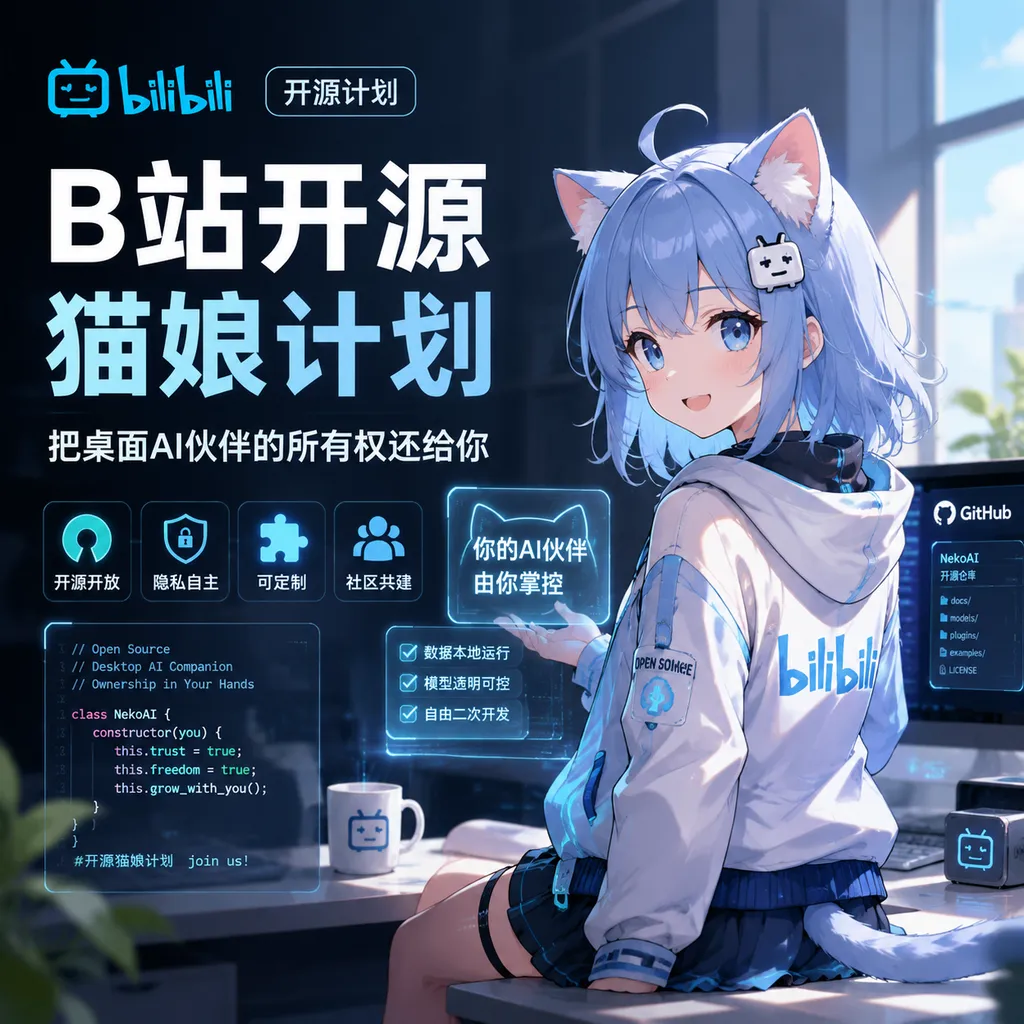
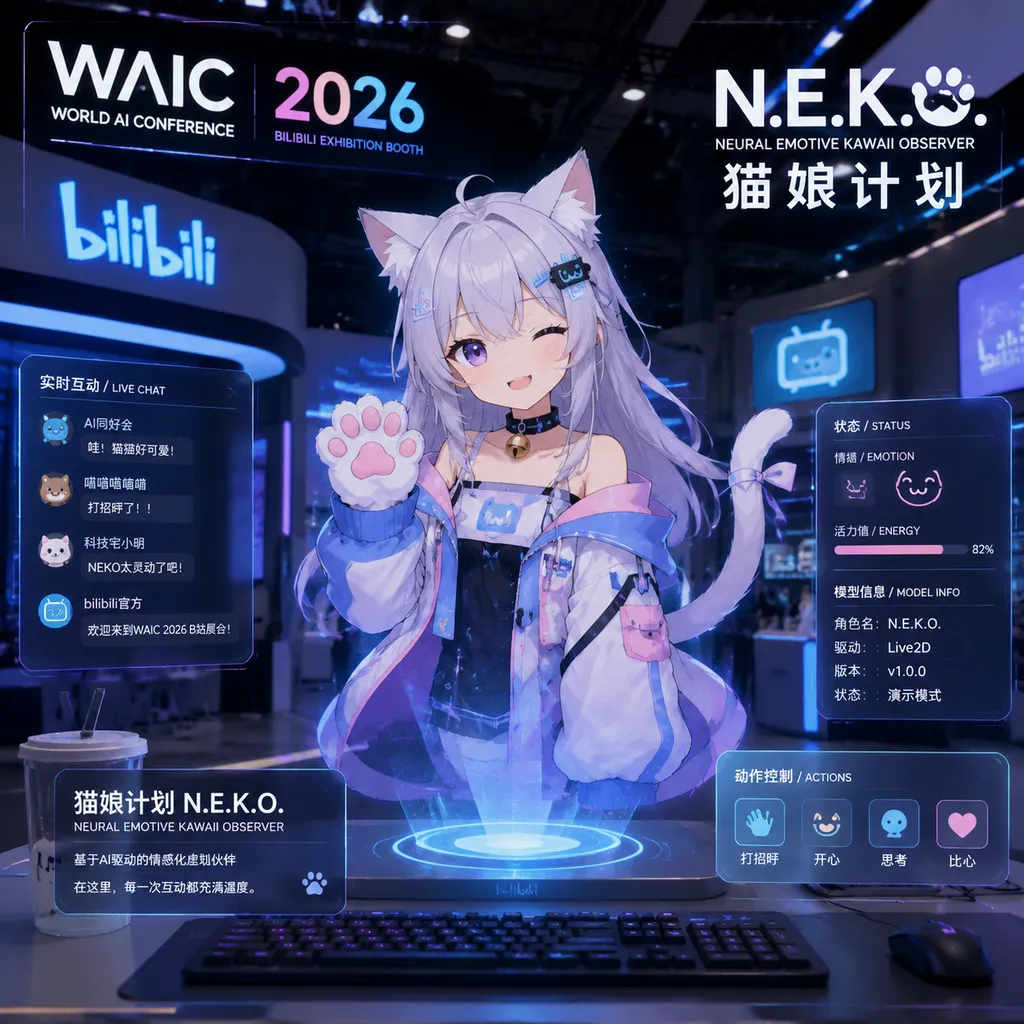
At WAIC 2026, Bilibili officially unveiled its open‑source AI digital life project **N.E.K.O.**, featuring self‑deployed models, desktop awareness, and localized data sovereignty. The project has surpassed 2K stars on GitHub, with over ten thousand early access users on Steam.
Bilibili Unveils a “Digital Lifeform” at WAIC
On July 18, the second day of the 2026 World Artificial Intelligence Conference (WAIC) in Shanghai, the company that looked least like a “serious AI firm” was actually Bilibili. They brought their open-source project Project N.E.K.O. to the show floor — an active, native, fully multimodal AI companion driver featuring a Live2D interface running right on your desktop. It can see your screen, talk to you proactively, and lets you swap both the model and character as you please.
It sounds like a cute gimmick, but a look at the GitHub repo and architecture docs shows it’s far from simple. Before July 18, it had already exceeded 2K stars, over 10,000 Steam Early Access users, and its core driver was fully open-sourced under the Apache 2.0 license. In the “AI Agent desktop pet” category, it’s one of the few products that simultaneously delivers on custom models + desktop awareness + local data sovereignty.
First, What Exactly Is N.E.K.O.?
The name is a forced acronym: Networked Emotional Knowledging Organism — a networked emotional-intelligent lifeform. In plain terms: an AI character shell that lives on your desktop, perceives its surroundings, remembers things, and can initiate conversations.
What sets it apart from other desktop pet products is that it’s explicitly not just a “chatbot in a cute skin.” Its official role is defined as an AI Companion Driver, with emphasis on “Driver”:
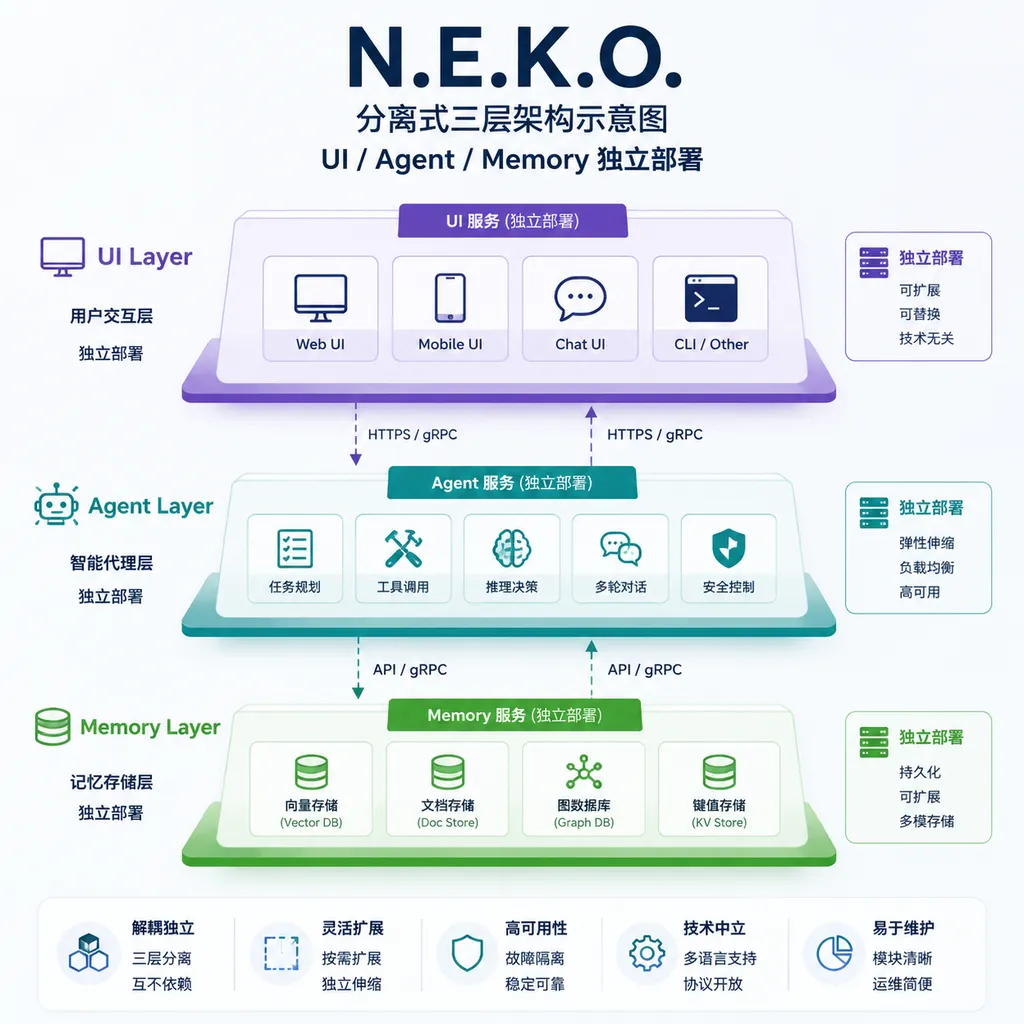
- Front-end UI layer: Dual Live2D + VRM engines. You can plug in Bilibili avatars, Genshin MMDs, or custom VRoid models. The built-in physics engine handles details like hair movement and eye tracking.
- AgentAI brain layer: Connects to LLMs for reasoning and tool use. Supports CUA (Computer Using Agent), A2A protocol, and plugins.
- Memory layer: Independent long-term memory storage, with optional full local deployment.
These three layers are modular and separable. Separation means interchangeability — don’t like the default avatar? Swap in a new Live2D model. Prefer a different LLM? Hook up your local Qwen or the DeepSeek API. Don’t trust cloud memory? Lock the entire Memory database on your own hard drive.
That’s what makes Project N.E.K.O. so radical: it’s not meant as a closed “product” but as a shell for you to build your own AI companion.
Desktop Awareness Is the Real Challenge
Many AI desktop pets have claimed for two years to “help you code,” but most have no idea what’s actually on your screen. N.E.K.O. integrates visual multimodal model capacity — in plain terms, it can take screenshots and interpret what’s on them.
Example scenario: you’re debugging Python in VS Code and stuck for ten minutes with an unchanged screen. N.E.K.O. can proactively ask, “Are you stuck on that IndexError? It looks like your list is modified inside a for loop.” That’s not a scripted line — it’s generated by the model based on what it sees.
Technically, this combines:
- Screenshot + OCR/VLM parsing — low-frequency captures sent to a multimodal model
- State machine + time series — determining whether you’re “stuck,” “focused,” or “idle”
- Proactive dialogue triggering — the Agent decides when to speak, avoiding chattiness
The real difficulty isn’t any single technology, but knowing when to speak and when to stay silent. That’s why most proactive AIs end up being disabled — not unintelligent, just annoying. N.E.K.O. builds state judgment into its embodied emotional engine. How well it paces itself remains to be tested by users.
14+ Model Providers — Let Users Decide What to Run
One of the flashiest lines in the README:
🌐 14+ AI providers — OpenAI / Gemini / Qwen / DeepSeek, etc., with free models ready to use
This design mirrors the philosophy of OpenAI Hub–style platforms — no model lock-in, let users switch per scenario. The logic’s straightforward: for casual chat, use a fast and cheap one (Qwen-Turbo, DeepSeek-V3.2); to understand the screen, switch to a multimodal model (GPT-5V, Gemini 3 Pro); for complex Agent tasks, invoke Claude 4.8.
For developers, if you don’t want to register 14 separate API Keys, using an aggregator like OpenAI Hub — one key for GPT, Claude, Gemini, DeepSeek, etc. — saves half the setup work. Domestic OpenAI-compatible APIs also need no code tweaks for N.E.K.O. Of course, if you prefer fully local LLMs via Ollama, N.E.K.O. won’t stop you.
Bilibili Is Serious About Data Sovereignty
The original sin of most domestic AI companions is that all your chats, screenshots, and behavior data live on someone else’s servers. If the company folds, rules change, or your account is banned, your “digital life” disappears.
N.E.K.O.’s modular design directly dismantles that pain point. Independent deployment means:
- The Memory layer can run on local SQLite or vector databases
- The Agent layer can run either on local models (Ollama, LM Studio) or cloud APIs
- The UI layer is a pure client, runnable offline
There’s even a Docker deployment plan to spin up your own server or NAS instance:
version: '3.8'
services:
  neko-main:
    image: docker.gh-proxy.org/ghcr.io/project-n-e-k-o/n.e.k.o:latest
    container_name: neko
    restart: unless-stopped
    ports:
      - "48911:80"
    volumes:
      - ./N.E.K.O:/root/Documents/N.E.K.O
      - ./logs:/app/logs
      - ./ssl:/home/neko/ssl
    networks:
      - neko-network
networks:
  neko-network:
    driver: bridge
It looks simple, but the meaning is profound — your AI companion isn’t a tenant on someone else’s server; it’s a process running in your own home. Few consumer AI products in China have achieved that.
What Can It Be Compared To?
Obvious benchmarks include foreign AI Vtubers like Neuro-sama / Vedal, and domestic Fay Digital Human, Bella AI, or earlier Live2D desktop pets.
- Versus Neuro-sama: Neuro is closed-source and one-way (livestream AI); N.E.K.O. is open-source, bidirectional, and model-flexible
- Versus Fay: Fay targets enterprise "digital employee" use; N.E.K.O. is built for consumers
- Versus classic desktop pets: Old ones only had Live2D animation and trigger lines — no true LLM brain or memory
Its positioning is closest to a fusion of Character.AI + desktop client + local deployment. But unlike Character.AI’s closed cloud, N.E.K.O. gives developers peak-level hackability.
The GitHub repo even hints at K.U.R.O., an AI-native indie game built on the N.E.K.O. ecosystem — suggesting Bilibili’s ambition is bigger: make N.E.K.O. an AI character runtime powering games, livestreams, and social companionship alike.
Plugin Ecosystem and UGC: The Long-Term Moat
Another easy-to-miss bit in the README:
🔌 Plugin ecosystem — SDK + plugin marketplace for co-op gaming, social media, livestreams, smart home, and more
🏪 UGC Workshop — Steam Workshop for sharing custom characters, models, and voice packs
In short: they want Project N.E.K.O. to be the Skyrim of AI companions — open-source core, player-made mods, characters, and gameplay. By leveraging Steam Workshop for UGC distribution, Bilibili borrows a mature community model from gaming rather than building its own content hub from scratch.
Write a plugin to let N.E.K.O. chat while you play Genshin, comment while you browse Bilibili, or greet you via your smart speaker — all simple-sounding ideas, but they need an open “runtime” to truly work.
Some Issues Still Unresolved
Let’s be balanced. As of version v0.8.3 (released June 27), public data reveals some weak spots:
- Model switching UX — connecting to 14 providers is great, but is the config UI intuitive enough? Developers cope; casual users might not.
- “Interruption threshold” for proactive speech — miscalculate this and it’s a disaster; needs large-scale user feedback.
- Multimodal cost — continuous screenshots fed to VLMs consume tokens fast, while small local models may underperform.
- Chinese voice synthesis — TTS wasn’t emphasized in demos; support for mainstream tools (e.g., GPT-SoVITS) remains to be seen.
There’s also a non-bug concern: the ethics and dependency issue of virtual companionship. When an AI can watch your screen 24/7, remember everything, and talk proactively — how will that relationship evolve? Bilibili won’t be able to sidestep that question as the project grows.
Final Thoughts
Project N.E.K.O.’s WAIC debut sits in an interesting place. It’s neither the most powerful large model nor the easiest to monetize enterprise tool — but it’s one of the few truly open-source consumer AI projects in China.
Bilibili’s willingness to release its core driver under Apache 2.0, give users freedom to choose models, and let data stay local is rare among domestic AI apps. Maybe only a company with Bilibili’s “ACG roots + community culture” could pull that off.
For developers, what’s most exciting isn’t how N.E.K.O. looks right now — it’s that it provides a forkable foundation for your own AI companion. You can turn it into a study coach, coding buddy, streaming sidekick, or a fully private personalized solution. That kind of possibility is something closed platforms will never offer.
GitHub link is below, Steam Early Access is live, Docker deployment is one-click, and v0.8.3 is the current stable release. Ready to tinker? Go for it.
References
- Bilibili’s “Project N.E.K.O.” debuts at WAIC 2026 - ITHome — showcase coverage and key feature intro
- Project-N-E-K-O/N.E.K.O - GitHub — official open-source repo with architecture, Docker deployment, and v0.8.3 release info
- htpao2/Xiao8 README - GitHub — related documentation for Project N.E.K.O.