Huawei MateBook Pro Obtains the First National Standard AI L3 Certification, HarmonyOS PC Takes the Lead in Intelligence Accreditation
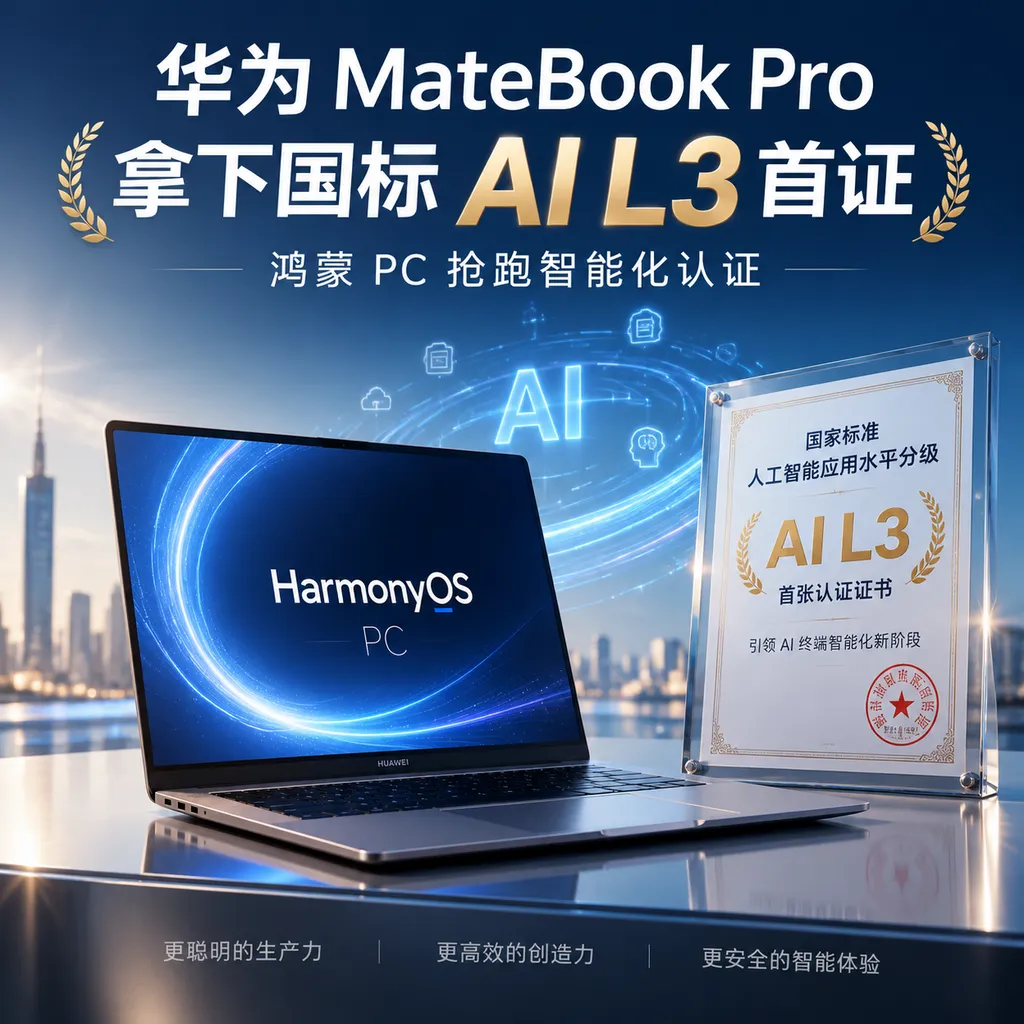
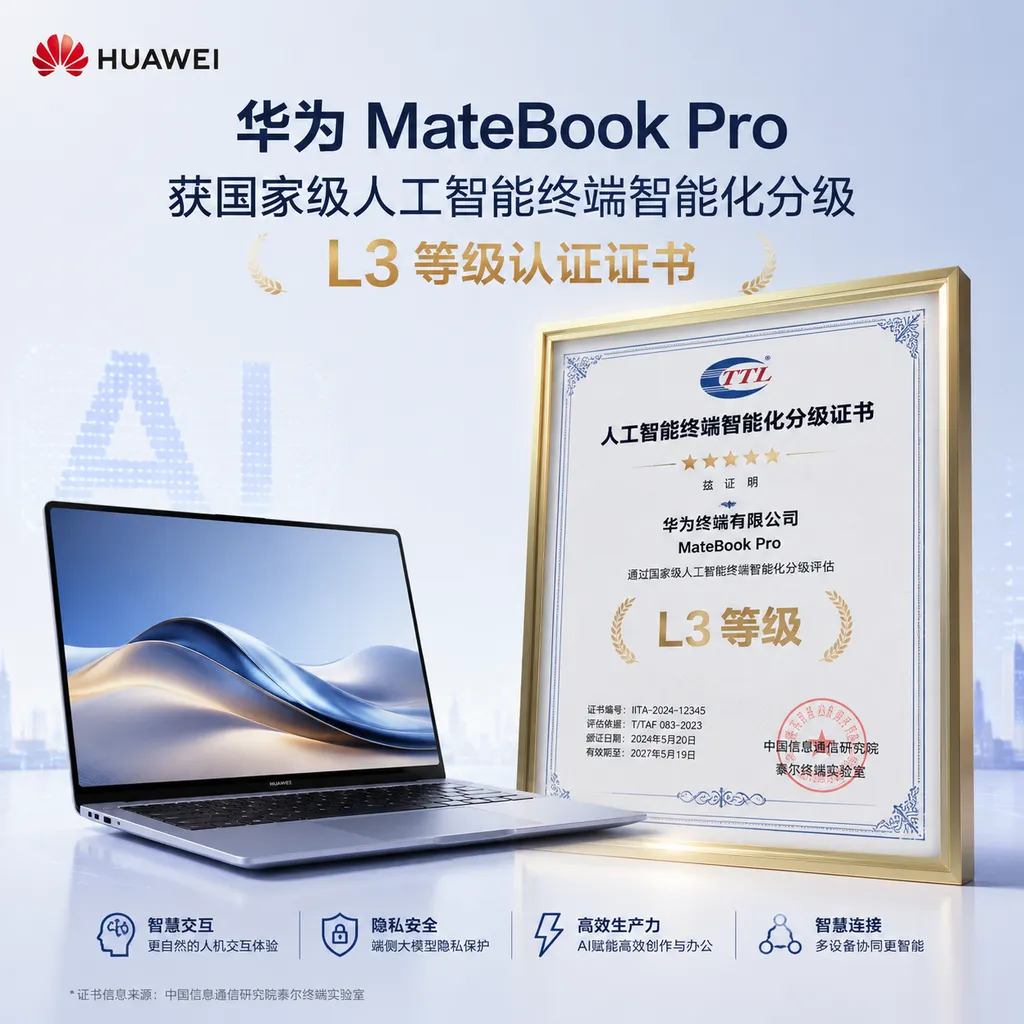
Huawei MateBook Pro has become one of the first terminal products to obtain Level 3 (Assisted) certification under the national standard *“Artificial Intelligence Terminal Intelligence Classification.”* The HarmonyOS PC has taken the lead in positioning itself in the AI capability evaluation track.
Huawei MateBook Pro Obtains the First National AI L3 Certificate — HarmonyOS PC Takes the Lead in Intelligent Certification
On July 18, the Huawei MateBook Pro obtained the first national-level Artificial Intelligence Terminal Intelligence Classification L3 certificate — importantly, the first in the PC category. This marks the release of the first batch of evaluation results following the joint publication of Artificial Intelligence Terminal Intelligence Classification (GB/Z 177—2026) in May by the Ministry of Industry and Information Technology, the State Administration for Market Regulation, and the Ministry of Commerce. HarmonyOS’s 970 g ultralight notebook became the most eye-catching name on that list.
It may seem like just another certification, but at this moment, its significance runs deeper: for the first time, the national standard has defined a clear measuring scale for “AI terminals.” From now on, OEMs will have a public and comparable benchmark for intelligence levels. Those fancy terms like “AI PC” or “smart terminal,” often boasted about at product launches, finally have to face a unified ruler.
What Is L3, and Don’t Be Misled by the Word “Assisted”
Let’s start with the standard itself. GB/Z 177—2026 divides terminal intelligence into four levels:
- L1 Responsive Level: Can understand instructions and give feedback — essentially still the traditional “you say it, it does it” interaction.
- L2 Tool Level: Can invoke internal system tools to complete single-point tasks, such as taking screenshots or summarizing text.
- L3 Assisted Level: Can understand complex contexts and coordinate across apps and scenarios to complete tasks with a degree of proactivity.
- L4 Collaborative Level: True intelligent collaboration between agents; the standard states, “to be further defined in future revisions according to industrial development” — in plain language: nobody can achieve it yet, it’s a placeholder.
So don’t be fooled by the word “assisted” — L3 is already the highest achievable level under the current national standard. L4 is the theoretical ceiling, unattainable for now. This means that, for at least the next year or two, L3 will be the practical upper limit for competition among AI terminal manufacturers.
Comparing the previously released first batch of evaluated devices, the L3-level PCs were almost entirely Lenovo machines — ThinkPad X1 Carbon Gen 14, ThinkBook 14 G8+, YOGA Air 14 Ultra, Xiaoxin Pro 14 IPH11, etc., all x86 devices on Intel/AMD platforms. Huawei, however, is the only brand entering the L3 list with a native HarmonyOS PC, and since the evaluation criteria were identical but the underlying OS was completely different, that distinction alone deserves mention.
Why the MateBook Pro and Not Another HarmonyOS Device
The MateBook Pro, launched in June last year, was Huawei’s first PC to feature native HarmonyOS 5. Its product positioning has been clear from the start: not chasing benchmark performance, but serving as “the flagship laptop for the HarmonyOS ecosystem.”
Its hardware is fairly restrained:
- 14.2-inch 3.1K flexible OLED (Cloud Clear Anti-glare)
- 970 g weight — lighter than many 13-inch models
- Yun Falcon architecture + foam copper VC cooling, 40W performance release
A 40W TDP is average in the x86 world, but paired with HarmonyOS’s self-developed kernel, it achieves extremely low power consumption and seamless multi-device collaboration. While such trade-offs may not shine in traditional PC benchmarks, they score points in AI terminal evaluations — the national standard measures “intelligence level,” not benchmark scores.
What truly earned it L3 status lies in three software features:
- Xiaoyi Smart Key — A physical keyboard key that directly launches an AI session, halving the interaction path compared with invoking Copilot.
- Pangu + DeepSeek Dual-model Fusion — Local small models handle privacy-sensitive tasks, while cloud large models tackle complex reasoning.
- HarmonyOS Intelligent Agent Framework — Introduced with HarmonyOS 6 in October last year; this was the key to achieving L3 certification.
The third point is crucial. The HarmonyOS 6.1 update in May this year also brought “Xiaoyi Deep Research,” “Smart File Management,” and “Phone-to-PC Tap Link” — all powered by this intelligence framework. The L3 criteria of “cross-app collaboration” and “multi-step task planning” rely precisely on this foundation.
What HarmonyOS PC Gains by Getting This Certificate
From an industry perspective, this goes far beyond “one Huawei laptop passing a test.”
First, HarmonyOS PC needed credible endorsement outside performance metrics. Native HarmonyOS has only been on PCs for a little over a year, and both users and developers are watching to see whether it can truly replace the Windows ecosystem. It can’t outperform top x86 flagships in benchmarks nor match Wintel’s compatibility. But the national L3 certificate gives it a different kind of proof — measured against the state-defined AI capability scale, it stands on par with Lenovo’s devices. That adds more weight to the ecosystem than any product launch event could.
Second, the evaluation metrics have quietly shifted. Previously, a PC evaluation focused on CPU models, memory speed, and display specs. Now, the national standard introduces “AI capability” as a quantifiable metric. Future OEM iterations will inevitably optimize around this benchmark. It’s a shift of evaluation authority — from benchmark software to the national standard itself.
Third, this standard will spill over into other categories. Smartphones, tablets, AR glasses, TVs, in-car systems — all appeared in the first batch of evaluations. Once all device types adopt the same AI classification, both OEM comparisons and consumer purchase decisions will begin to align to this new coordinate system. This is a much larger shift than a single certification.
An Important Question: How High Is the L3 Threshold?
To be honest, based on the publicly available first batch of results, the L3 pass rate isn’t low. Lenovo alone obtained L3 certifications for seven or eight PC models across ThinkPad, ThinkBook, ThinkCentre, YOGA, and Xiaoxin lines. In smartphones, Huawei HOP-AL00 and Motorola XT2651-4 also passed L3.
This indicates two things:
- On the positive side: It shows that major flagship devices have indeed reached the “assisted-level” capability defined by the standard — the criteria match the industry’s current maturity.
- On the cautionary side: If L3 becomes too easy to obtain, its differentiation value diminishes. With no clear L4 guidelines yet, the market might soon see an “everyone is L3” landscape, making it harder for consumers to distinguish products.
In the short term, therefore, the “first certificate” label carries more weight than “L3” itself — Huawei obtained the first in the PC category, perfectly timed. By next year, L3 will likely be standard among both HarmonyOS PCs and Windows AI PCs; the next competition will be who reaches L4 first.
Final Thoughts
For developers, the message from this certification is clear: AI terminal evaluation has entered the “national standard” stage, moving beyond self-defined metrics by manufacturers. In the coming period, the HarmonyOS Intelligent Agent Framework, hybrid scheduling between Pangu and DeepSeek, and multi-task planning on the device side will all see expanded productization opportunities. For developers targeting the HarmonyOS PC ecosystem, this L3 certification means the underlying AI capabilities are now officially validated — integrating with the intelligent agent framework now delivers tangible benefits.
Additionally, HarmonyOS’s dual-model strategy with Pangu and DeepSeek — local + cloud hybrid scheduling — reflects the mainstream approach for AI terminals today. If your development work requires invoking multiple vendors’ models under a unified API for comparison or routing, platforms like OpenAI Hub can connect to GPT, Claude, Gemini, DeepSeek, and other major models with a single key, fully OpenAI-compatible and directly accessible within China — saving a great deal of SDK integration effort.
References
- Huawei MateBook Pro obtains first national AI certification L3 — IT Home — The original report of Huawei MateBook Pro’s L3 certification, including hardware specifications and HarmonyOS development timeline.
- First batch of AI Terminal Intelligence Classification test results released — IT Home — The full list of L3-certified devices across categories including smartphones, PCs, tablets, glasses, and in-car systems.