SenseTime U1 Pro delivers native 8K resolution, directly competing with GPT-Image-2.
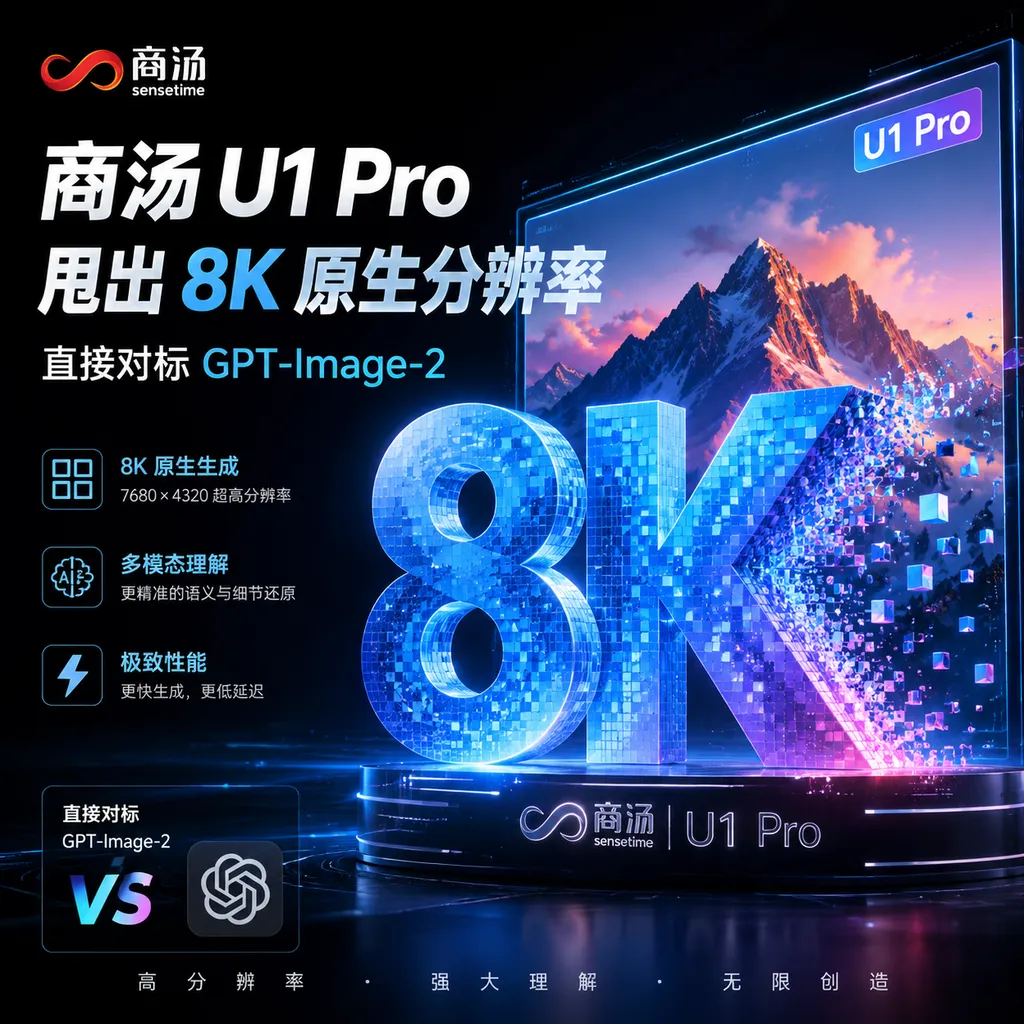
On July 18, SenseTime released the SenseNova U1 Pro image generation model, featuring native 8K output and an image-text interleaved chain of thought, targeting professional design scenarios and directly challenging GPT-Image-2’s 4K limit.
On July 18, SenseTime put the SenseNova U1 Pro image creation model on the table. This is not just another general-purpose text-to-image score-chasing model—SenseTime’s target this time is clear: professional design delivery and a parameter that almost no one has touched before: native 8K resolution.
A quick comparison shows what that number means. The leading overseas GPT‑Image‑2 tops out at native 4 K; most mainstream domestic models hover around 2 K–4 K. U1 Pro doubles that and explicitly stresses “native”—not upsampled 8 K by interpolation, but pixels directly produced by the model. When enlarged to print or exhibition grade, the text, lines, and icons withstand close inspection. This draws a line between images “for social posts” and deliverables “for demanding clients.”
1. From “looks real” to “ready for use”: an upgrade in dimension
Over the past two years, the text‑to‑image arms race has centered on fine‑grained realism—hair, skin texture, lighting, fingers—and further gains bring minimal return. The difference among Midjourney v7, Flux.1, and Seedream 4.x is so small that you must zoom 200 % to find flaws.
SenseTime set U1 Pro’s coordinates elsewhere. The official claim: “from detailed realism to professional design aesthetics”—in plain terms, it’s no longer “this picture looks real,” but “this picture can go straight to the design director for approval.”
That distinction matters for developers. Anyone who has worked with AIGC knows there’s a large gap between what a model outputs and what’s actually usable:
- crooked layouts
- garbled or misplaced fonts
- oversaturated colors that look cheap
- cluttered elements without visual hierarchy
These aren’t issues of “insufficient realism,” but of missing aesthetic and layout training. U1 Pro aims to fix this. Whether it succeeds will depend on practice, but the direction is right—purely chasing pixel accuracy no longer sells.
2. Why native 8 K output is hard
You might ask: it’s just resolution—why make a fuss?
Because of those two words: native output.
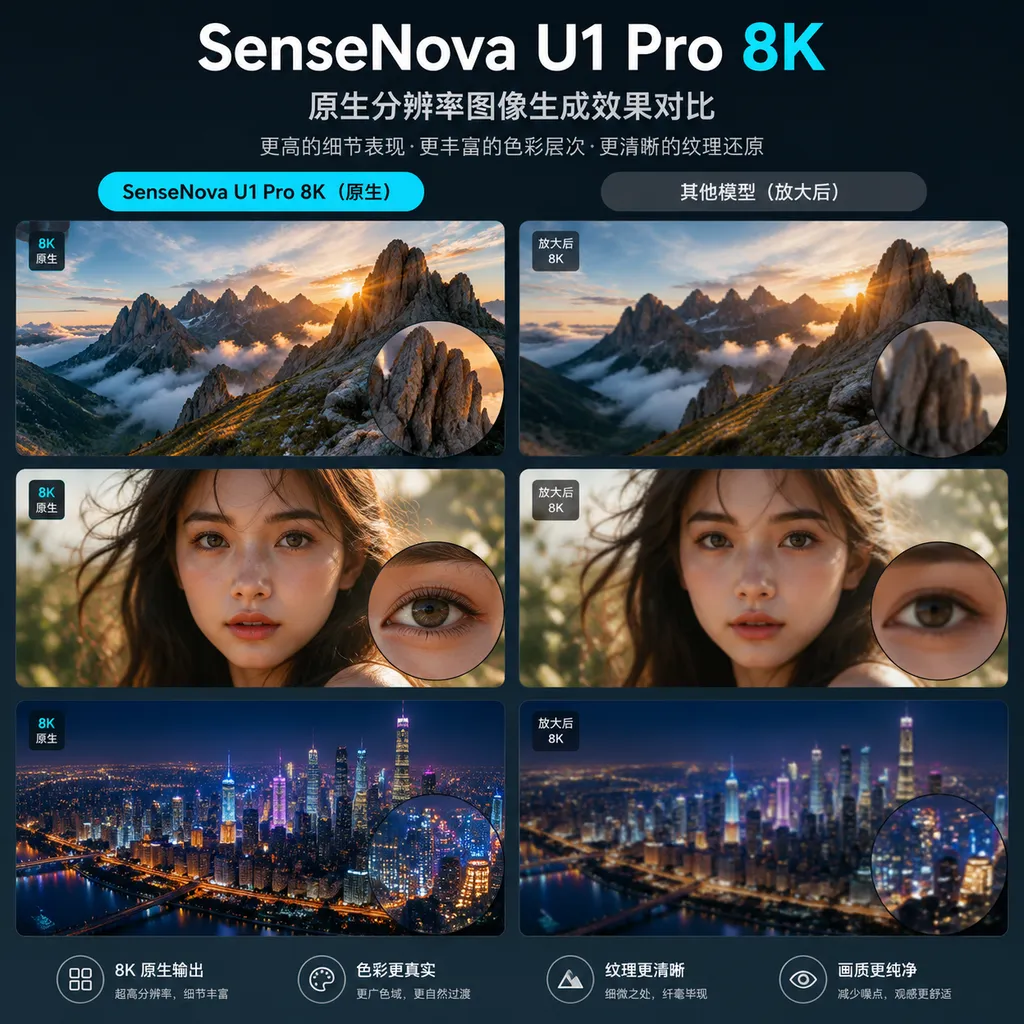
Most current models above 4 K first generate a 1 024 or 2 048 base image, then upscale with a super‑resolution model. That has clear drawbacks:
- Loss of consistency – the upscaler is separate and doesn’t understand semantics; it “hallucinates” details, causing weird textures, broken text, distorted icons.
- Text corruption – super‑resolution destroys text; characters readable at 4 K often turn into gibberish at 8 K.
- No further editing – once upscaled, the image is a final render; you can’t modify modules individually.
Native 8 K means the model decides every pixel directly at 8 K during generation. The benefits: crisp text, intact lines, precise alignment among elements—critical for printed materials, key visuals, and exhibition‑grade posters.
In the official infographic examples, U1 Pro shows extremely dense layouts that remain intact, with “very low” text‑rendering error rates. The infographic segment has long been a weak spot for open‑source models; those able to produce a structurally sound infographic can be counted on one hand.
3. NEO‑Unify architecture: ending the relay race between image and text
Underneath U1 Pro lies SenseTime’s NEO‑Unify architecture (released in March). This foundation deserves more attention than the model itself.
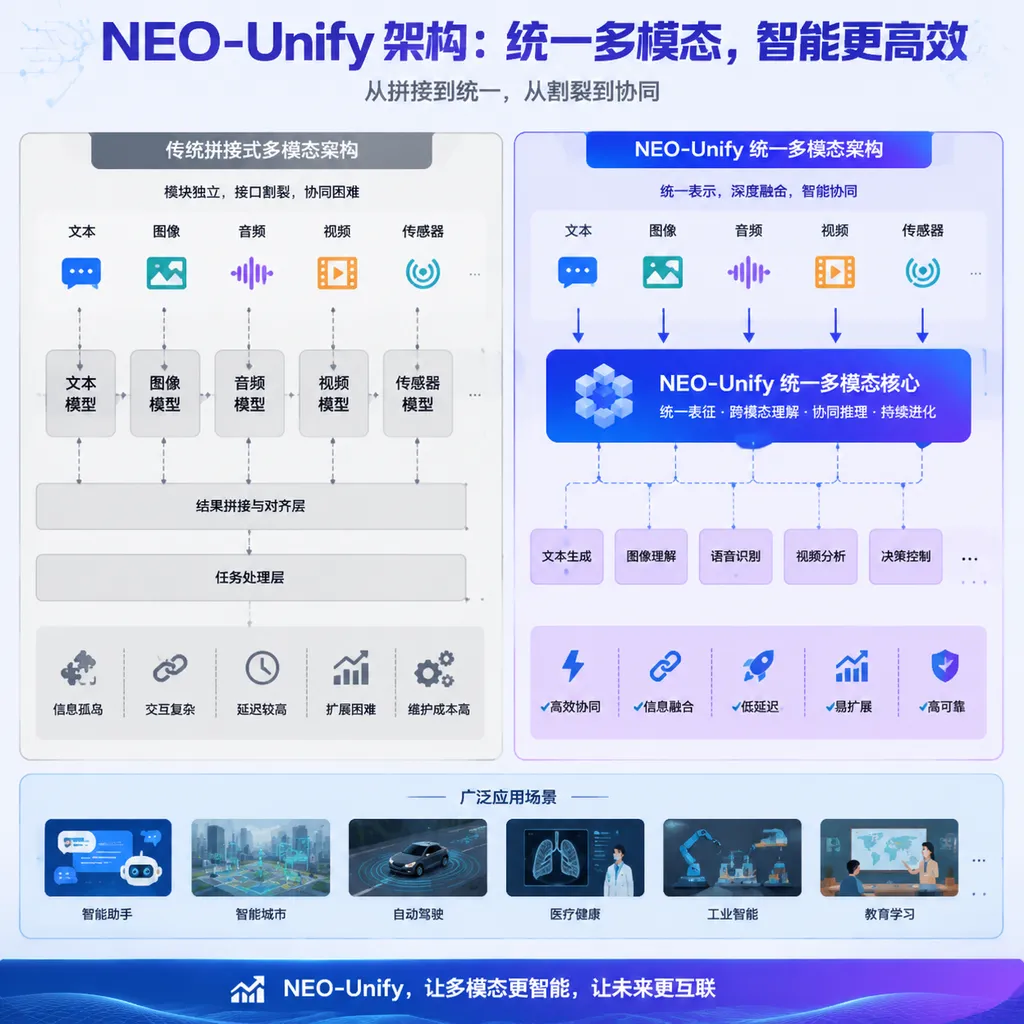
Traditional multimodal systems are essentially “assembled”:
[Visual Encoder VE] → [Adapter] → [Language Backbone LLM] → [Adapter] → [VAE Decoder]
Each module works separately, passing messages through adapters. As SenseTime puts it, it’s like a team where members speak different languages—one translates an image into text, another interprets it, and a third re‑renders it, with loss and delay at every handoff.
NEO‑Unify discards that pipeline entirely. It removes VE and VAE, building a unified representation space within a single architecture. Images and text are no longer two languages but two modalities within the same vector representation.
This shift has decisive downstream effects:
- Interleaved visual‑text reasoning – the model can “think while drawing,” mixing text and image as intermediate reasoning steps.
- Intrinsic style consistency – shared context keeps multi‑round generations from drifting in style.
- Parameter efficiency – no need to inflate parameter count to offset conversion loss.
The previously open‑sourced U1 Lite (8 B dense and A3B‑MoE versions) already outperformed some tens‑of‑billions‑parameter closed models. U1 Pro is the scaled‑up full version on the same architecture.
4. Agentic Generation Loop: where U1 Pro truly pulls ahead
If it only offered higher resolution and better aesthetics, U1 Pro would just be a stronger text‑to‑image model. Its real significance for developers lies in its long‑range Agentic generation loop.
Translated from the official description: the model can carry out dozens of image‑generation rounds around a complex goal, maintaining overall style consistency while enabling precise local text edits throughout the loop.
Two official examples:
Task 1: How to cook a medium‑rare steak. U1 Pro breaks the process into steps and creates an image for each. Crucially, the visual style, lighting, and composition remain consistent across all images—no jump from watercolor to photo to doodle.
Task 2: From sketch to Iron Man. Given a scanned sketch, the model refines it iteratively, inheriting structure and detail precisely at each step, producing a highly finished result.
For Agent‑application developers, that’s huge. Previously, multi‑round edits nearly always caused style drift—ask to change a blue logo, and it would also alter fonts or colors elsewhere. The root cause: each generation round was stateless; the model couldn’t remember full semantics of the previous image.
With native unified representation, U1 Pro can retain image signals entirely within context. That’s what enables synchronized and precisely controllable global‑style plus local‑text editing—finally a truly usable image generator for the Agent era.
5. Who are its rivals, and where does it compete?
Viewed globally, U1 Pro’s positioning is clear:
| Dimension | SenseNova U1 Pro | GPT‑Image‑2 | Seedream 4.5 | Qwen‑Image 2.0 Pro | |------------|-----------------|-------------|---------------|--------------------| | Native resolution limit | 8 K | 4 K | 4 K | 4 K | | Interleaved text‑image reasoning | ✅ Native | Partial | ❌ | ❌ | | Infographic capability | Commercial‑grade | Commercial‑grade | Medium | Medium | | Multi‑round edit consistency | High (Unified repr.) | Medium | Medium | Medium | | Architecture | NEO‑Unify Unified | Undisclosed | Stitched | Stitched |
On paper, U1 Pro’s differentiation strategy is explicit—not chasing benchmark scores for general text‑to‑image, but achieving vertical breakthroughs in “professional delivery.” The trio of native 8 K + infographics + Agentic editing defines a clear user group: designers, marketing agencies, print‑production houses, and enterprise content teams.
That’s a steady path. The general text‑to‑image race is a red ocean—Midjourney, Flux, GPT‑Image, Seedream are locked in costly battles. Users switch cheaply and rarely stick. In contrast, the “design delivery” market has strong willingness to pay, high switching cost, and measurable ROI (e.g., “will the client approve it”)—a clearer business case.
6. From a developer’s perspective: key points to watch
Several signals warrant attention:
1. Open‑source cadence
SenseTime open‑sourced U1 Lite (8 B and A3B‑MoE). U1 Pro is commercial for now, but given prior patterns, larger open‑source versions are likely. Teams needing on‑premise deployment can experiment with Lite to learn NEO‑Unify’s traits.
2. Infographics as an overlooked high‑value scenario
Most text‑to‑image apps focus on “picture generation,” rarely on “infographic generation.” Yet enterprise clients need infographics—PPT illustrations, annual‑report covers, product explainers, event posters—all involving text‑heavy layout. If U1 Pro’s performance here matches publicity, vertical Agents built on it could be promising.
3. Cost of native 8 K
An 8192 × 8192 image has 4 × the pixels of 4096 × 4096. Even with optimizations, inference cost and latency rise markedly. Pricing isn’t public yet; ideally, there’ll be APIs to select resolution on demand—since 8 K isn’t always necessary, a 2 K base + 8 K polish mix may be optimal.
4. Token cost in Agent loops
Dozens of Agentic loop rounds sound appealing, but each must preserve full image context, inflating token usage. Products should design save‑point mechanisms instead of handing the entire loop to the model unchecked.
7. Final thoughts
My verdict on U1 Pro’s launch: strong strategy, solid product.
“Strong strategy” means SenseTime chose the differentiated “professional design” track, avoiding the brutal generic market. “Solid product” means native 8 K, NEO‑Unify architecture, and Agentic editing are real, tech‑backed advantages, not marketing buzzwords.
China’s text‑to‑image scene has been livelier than many realize—Seedream (by Doubao), Qwen‑Image (by Tongyi), Tencent Hunyuan, Kuaishou Keling, and now SenseTime U1 Pro—each exploring different directions. The overseas pattern of “one superpower (GPT‑Image + Nano Banana) plus many strong players (Flux, Ideogram, Midjourney)” hasn’t simply replicated domestically; instead, each company has carved unique niches.
For developers, that’s good news—if all adopt OpenAI‑compatible interfaces (for instance, via an OpenAI Hub‑style aggregator letting one key access GPT, Claude, Gemini, DeepSeek, and major Chinese models), then A/B testing across models costs almost nothing. One run reveals which excels in which scenario.
The next two things to watch: (1) U1 Pro’s API pricing and inference speed, (2) whether SenseTime open‑sources the full version. If both turn out positive, SenseTime will have made a brilliant move on the home‑grown text‑to‑image chessboard.
References
- SenseTime releases SenseNova U1 Pro image creation model: up to native 8 K output, said to eliminate “AI flavor” — ITHome — On‑site launch report with core feature summary
- SenseTime’s new SenseNova‑U1 Pro model revealed, targeting GPT‑Image‑2 and the “design” sector — Zhihu — Industry analysis comparing native 8 K vs 4 K background