Alibaba Cloud Zhenwu M890 Supernode Public Beta: Trillions of Parameters in a Single MoE Machine
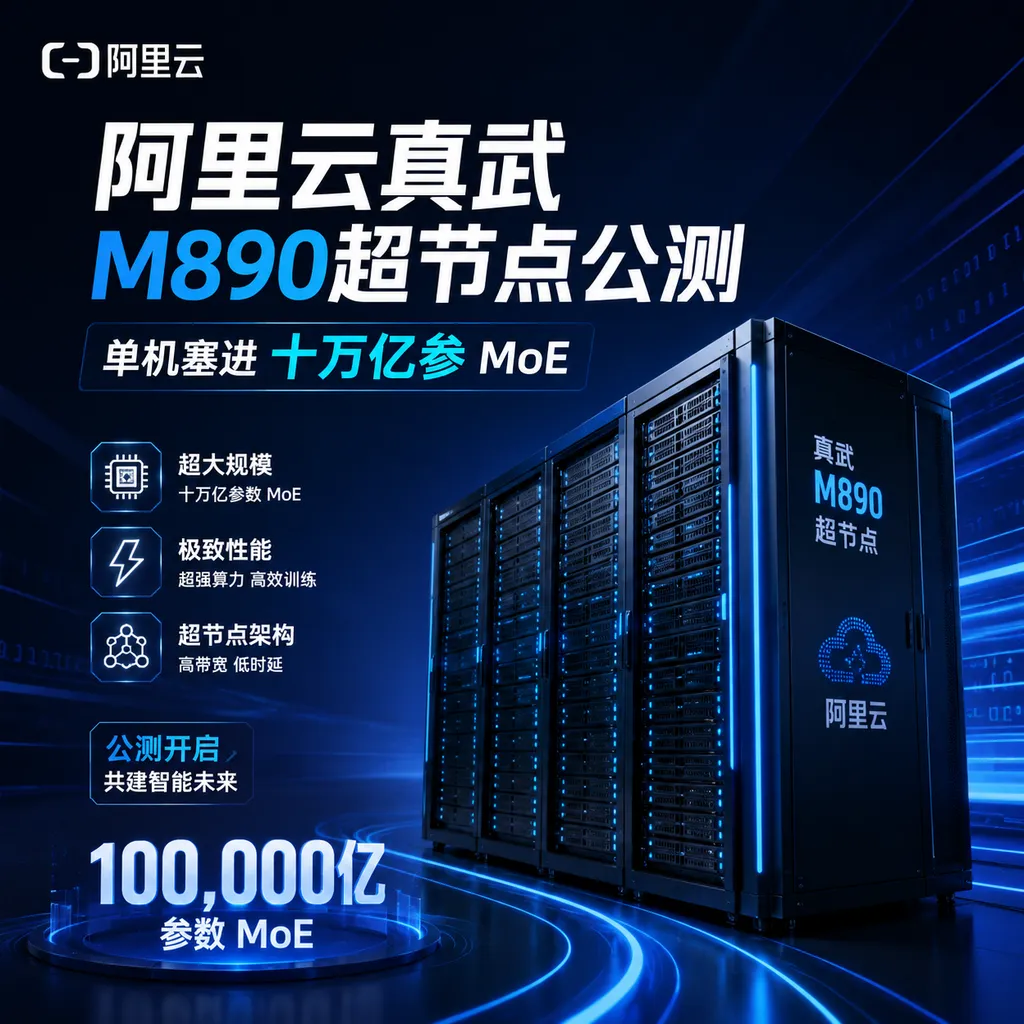
At WAIC 2026, Alibaba Cloud brought the Zhenwu M890 super node to its public cloud. With 64-card scale-up interconnect and 800 GB/s inter-card bandwidth, a single instance can perform inference on trillion-parameter-scale MoE models. The Ulanqab node in Inner Mongolia is now open for invitation-based testing.
At the WAIC venue on July 18, Alibaba Cloud officially brought the Zhenwu M890 chip—first unveiled at the Cloud Summit two months earlier—into the public cloud. The Lingjun Zhenwu M890 super‑node instance was opened for invitation‑only testing, with the first site located in Ulanqab, Inner Mongolia—marking Alibaba Cloud’s first time offering “super‑node” compute power to external users through its public cloud.
For developers, the real gold in this announcement isn’t just another AI chip going on sale, but that a single machine can now handle inference for a MoE model with tens of trillions of parameters. Just a few months ago, that would have required coordination across cabinets and nodes.
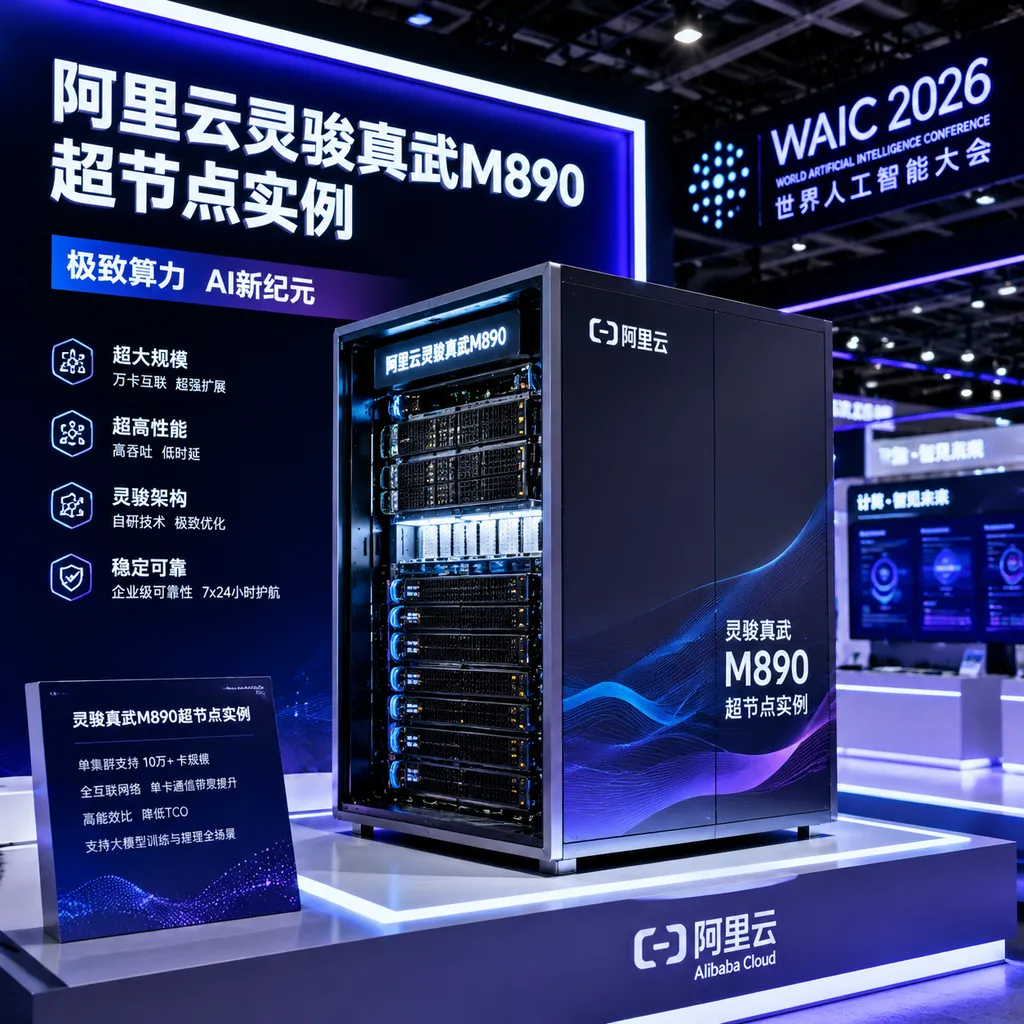
From 16 to 64 GPUs: The physical boundary of scale‑up pushed further
Let’s first unpack the specs. The Zhenwu M890 is the new generation all‑in‑one training‑and‑inference chip launched by PingTouGe in May of this year, featuring 144 GB memory, 800 GB/s chip‑to‑chip interconnect, and native precision support from FP32 down to FP4. At the Cloud Summit three months ago, Alibaba paired it with the Panjiu AL128—a 128‑GPU machine interconnected via its self‑developed ICN Switch 1.0, delivering P2P latency under 150 ns.
The newly released “Zhenwu M890 super‑node instance” for the public cloud is officially described as having scale‑up interconnect expansion from 16 GPUs (Zhenwu 810E generation) to 64 GPUs, and card‑to‑card bandwidth raised to 800 GB/s. Note this detail: the 128‑GPU Panjiu AL is a full‑machine architecture, while the 64‑GPU configuration defines the scale‑up domain—the maximum symmetric full‑bandwidth scope. For inference workloads, the size of the scale‑up domain almost directly dictates the maximum model size and concurrency you can support.
64 cards × 144 GB each gives a theoretical 9.2 TB of HBM accessible within one high‑speed domain—a physical foundation for “single‑machine inference of a ten‑trillion‑parameter MoE.” In mainstream MoE routing (e.g., 16‑to‑2 sparsity), an active parameter set around one trillion with FP8 weights occupies just over 1 TB; together with KV Cache, expert routing buffers, and intermediate data, about 9 TB memory is a perfect‑fit waterline for batch inference.
In other words, Alibaba has compressed “rack‑scale” capability into the saleable unit of a single instance. When you click on the console, what you get is a fully symmetric, nanosecond‑latency compute body—not a distributed tensor‑parallel or expert‑parallel setup you must orchestrate yourself. That’s a real workload relief for inference‑engine developers.
Triple training performance over Zhenwu 810E
Alibaba’s comparative figure: in training scenarios such as autonomous driving and embodied AI, the Zhenwu M890 delivers three times the training performance of its predecessor 810E. The 810E was launched in Q2 2024; with a two‑year iteration cadence, a 3× improvement is substantial but paced.
One more interesting aspect is the precision stack. Native FP4 support—the feature that gave NVIDIA Blackwell a lead in inference throughput last year—has now been matched by most domestic chips of this generation. FP4 inference means twice the model parameters in the same memory, or double the batch size for the same model scale—an exponential gain for memory‑ and bandwidth‑bound MoE models.
Alibaba has also revealed its public roadmap: Zhenwu V900 in Q3 2027 with 216 GB memory and 1200 GB/s interconnect; Zhenwu J900 in Q3 2028. Three generations in three years—a steady rhythm that’s impressively fast among domestic chip vendors.
130 k GPUs per cluster, extending toward the million‑GPU scale
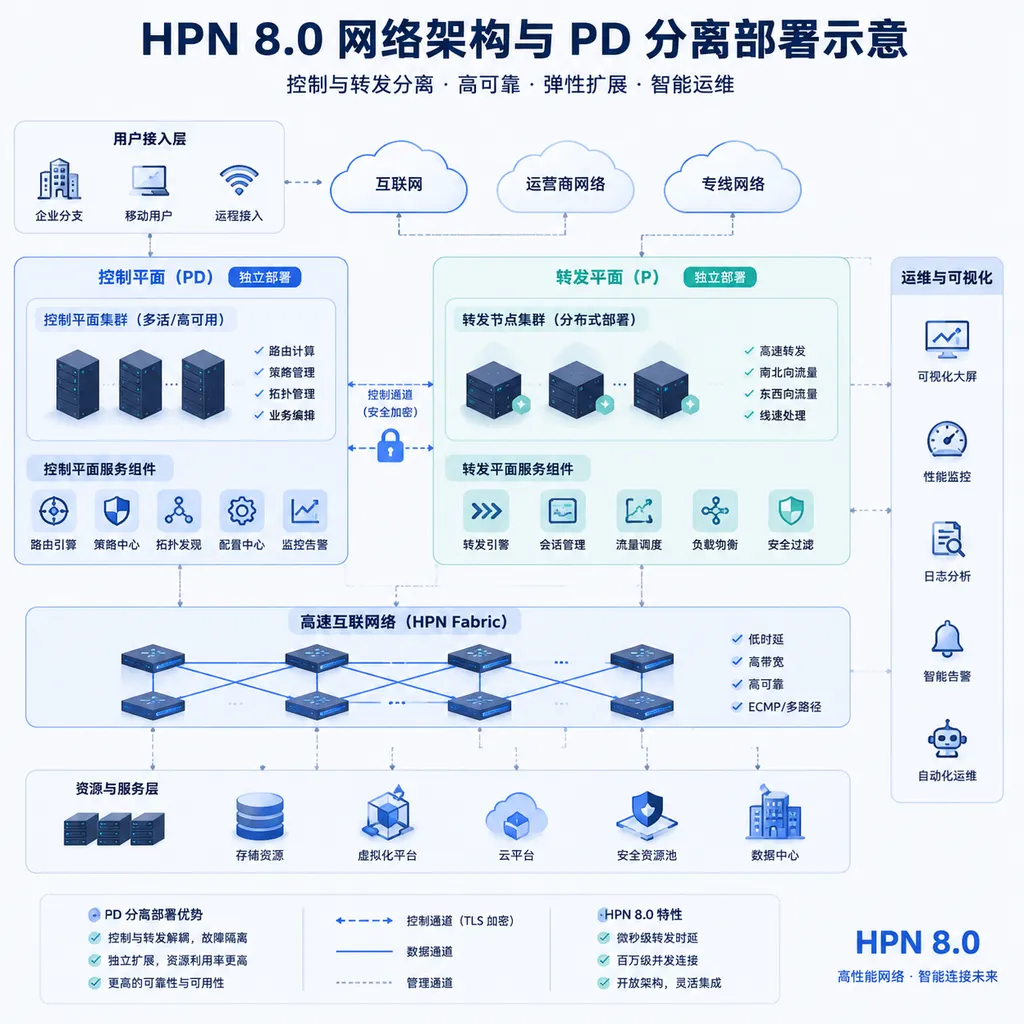
Having covered single‑machine numbers, let’s look up at clusters. Alibaba has simultaneously updated its all‑in‑one HPN 8.0 training‑and‑inference network. Official data show that the Lingjun intelligent‑computing cluster now supports up to 130 k heterogeneous GPUs in a single cluster, with PD‑separated deployment and scalability to the million‑GPU level.
The two terms heterogeneous mixing and PD separation are major pain points in current large‑model inference clusters:
- Heterogeneous mixing: the Prefill stage is compute‑intensive while Decode is memory/bandwidth‑bound; running both on the same GPU type is inefficient. Letting different generations and specs of chips play to their strengths within one cluster maximizes utilization.
- PD separation: Prefill/Decode separated deployment means Prefill nodes run once and exit; Decode nodes persist for streaming output. Separation allows different parallel strategies, GPU types, and batch policies on each side.
With large scale‑up domains like the Zhenwu M890 node, PD separation can be exploited even more: the Decode side uses super‑nodes to handle explosive concurrency, and Prefill uses cheaper legacy GPUs upfront. This orchestration approach—validated over the past year by Character.AI, DeepSeek, and Kimi—is now a default capability purchasable on Alibaba’s public cloud.
As for reliability, the official figures claim 99.7% average availability and self‑recovery within minutes. That’s especially critical for training—restarting a checkpoint at ten‑thousand‑GPU scale costs a fortune; proactive monitoring and second‑level failover are necessities.
Storage and front‑end network: not supporting actors
Many focus solely on peak compute, ignoring data supply. Alibaba simultaneously announced upgrades to CIPU 2.0 and CPFS:
- Front‑end network: CIPU 2.0, responsible for stability, security, and storage‑access acceleration—essentially offloading the data plane from the CPU.
- Storage: CPFS rebuilt on the Feitian Pangu stack, separating data/control planes with native horizontal scalability, scaling a single file system to hundreds of PiB capacity, hundreds of TB/s throughput, and hundreds of millions IOPS.
This pairing ensures “no starvation during training and no lag on first‑token inference.” Loading weights for a 10 trillion‑parameter model on cold start can take tens of minutes if storage lags—a money‑burning bottleneck invisible in demo videos but critical in production.
A few open questions
After reading the entire press release, several developer‑relevant points remain unanswered:
- Pricing model during the invitation phase. Is the super‑node instance sold by the full unit or partitionable? Can the 64‑GPU scale‑up domain be subdivided MIG‑style into smaller instances? These determine accessibility for small teams.
- Which specific MoE model corresponds to “ten‑trillion‑parameter”? Official wording is “supports.” Qwen’s largest public MoE now is Qwen 3.7‑Max, well below 10 T parameters. The phrase likely indicates hardware upper limit, not a running model.
- Compatibility layer. The Zhenwu M890 uses a proprietary PCCL communication library and ICN interconnect bus. Alibaba Cloud’s Bailian platform likely abstracts mainstream training frameworks (vLLM, SGLang, Megatron) to PingTouGe’s stack—but migration curve for self‑built clusters on raw hardware awaits documentation.
Position in China’s computing‑power race
Comparable moves: Baidu Kunlun’s Tianchi 256‑GPU super‑node lit up last month, focusing on HPN 5.0 and multi‑model adaptation; Huawei Ascend’s CloudMatrix series already maps toward million‑GPU clusters. Alibaba Cloud’s differentiation is clear:
- Not chasing single‑chip peak, but the size of the scale‑up domain;
- Not pure machine stacking, but hierarchical orchestration machine → cluster → million‑GPU;
- Full‑stack control of chip, network, storage, and model, betting on efficiency from vertical integration.
Behind this is the ¥380 billion three‑year AI‑infrastructure pledge and Wu Yongming’s goal of “US $100 billion annual revenue from Alibaba Cloud + AI within five years.” Putting the Zhenwu M890 super‑node onto the public cloud is the most tangible execution of that strategy—because success depends not on summit PPTs but on actual cloud billing volume.
Practical advice for developers: if you’re building long‑context agents, large‑scale MoE inference, or multimodal embodied‑AI training, the Ulanqab invitation program is worth applying for. Not everyone needs a ten‑trillion‑parameter machine, but “single‑machine suffices” will redefine many inference‑system architecture choices.
By the way, recently released major models—Qwen 3.7‑Max, DeepSeek V4 Pro, Kimi K2.6, GLM‑5.1—are all onboarded to OpenAI Hub with OpenAI‑format compatibility, switchable via a single key for model comparison tests. Once the Zhenwu M890 super‑node’s public trial stabilizes, if Alibaba exposes exclusive model capabilities on this machine via API, such aggregation platforms will likely integrate immediately.
References
- Alibaba Cloud launches Lingjun Zhenwu M890 super‑node instance enabling single‑machine 10‑trillion‑parameter MoE inference – ITHome: WAIC 2026 launch report with key indicators such as scale‑up domain and availability.
- Alibaba Cloud unveils “Zhenwu M890” AI chip and 128‑GPU super‑node server supporting massive Agent concurrent inference – ITHome: May Cloud Summit chip debut details covering Zhenwu M890 and ICN Switch 1.0 technology.