Youdao OpenPods take the lead: The first open-style AI earbuds to obtain MFi certification
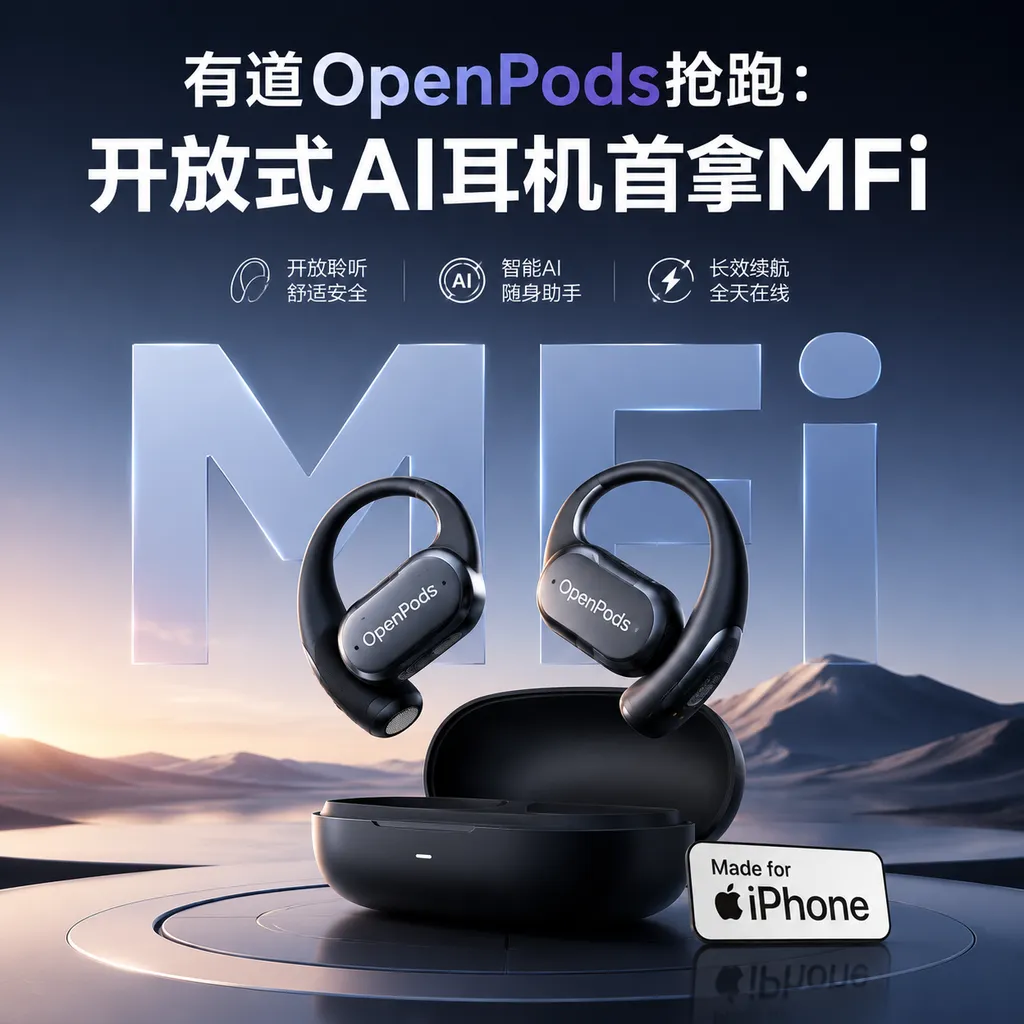
At WAIC, NetEase Youdao unveiled its AI conference earphones, OpenPods, for the first time. These are the first open-style AI earphones in China to receive Apple’s MFi certification. Powered by the Ziyue 4.0 large model, they integrate recording, transcription, translation, and simultaneous interpretation into a single workflow. The charging case can also function independently as a recording and translation terminal. Mass production and market launch are scheduled for August, with an eye on international expansion.
Youdao Turns the Earbud Case into a Standalone Translator
At the 2026 WAIC, which opened in Shanghai on July 17, NetEase Youdao showcased a pair of earbuds called Youdao OpenPods. This isn’t just another TWS product trying to squeeze into a saturated market; it’s the first open‑style AI earbuds in China to receive Apple’s MFi certification—a “first” with significant weight. MFi certification has always been strict about open‑style (semi‑in‑ear/ear‑clip) designs—Apple’s own AirPods Pro are in‑ear—so earning this approval means the device had to get power consumption, antenna, and Bluetooth stack compatibility all finely tuned.
Even more interesting is the product positioning. OpenPods skip the “listen to music on the go” narrative and directly target business and cross‑language communication—recording, transcription, summarization, and translation—all integrated into one chain. Powering it is Youdao’s newly upgraded “Ziyue” large model 4.0. At the same WAIC, Youdao also demonstrated a full‑stack AI Agent application matrix based on Ziyue 4.0. Since the same team developed both the hardware and the model, the end‑user experience often benefits more than from simply piling up specs.
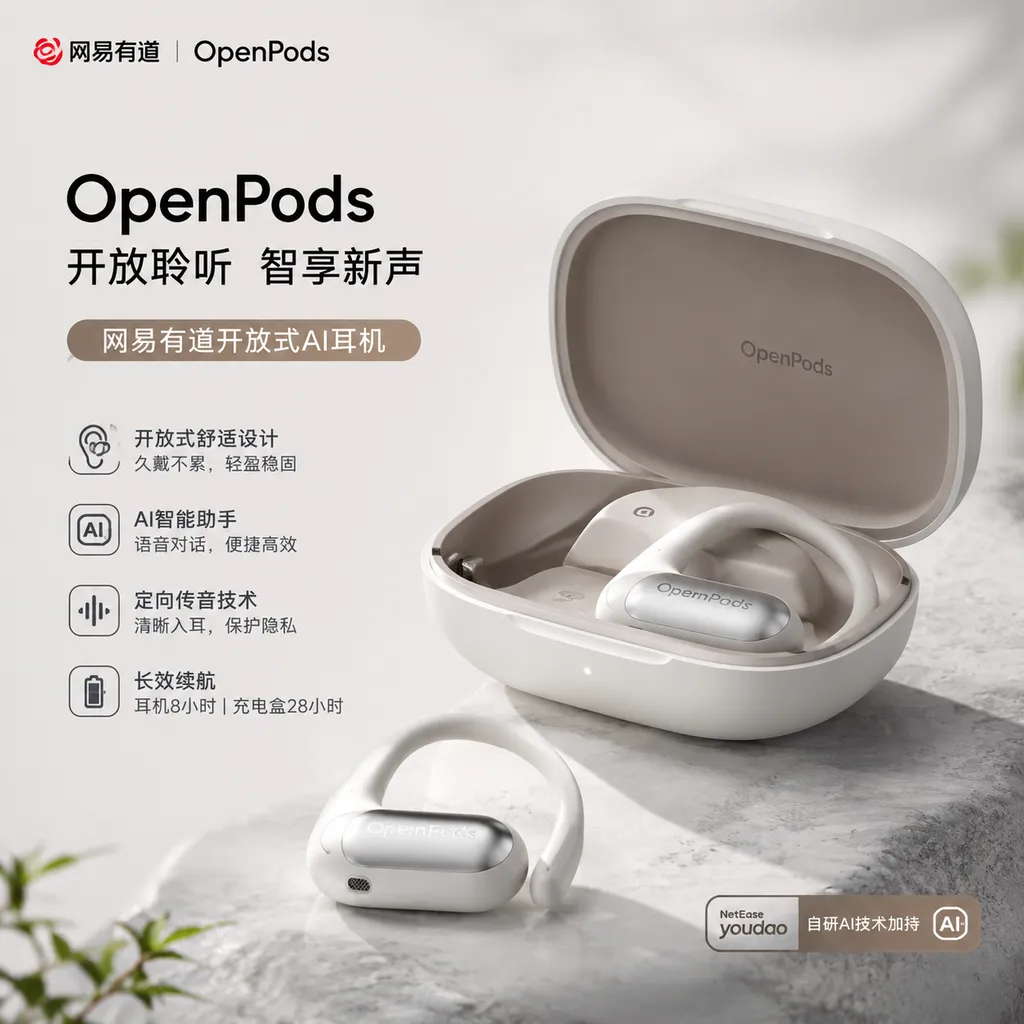
The Case Can Record and Translate on Its Own — an Atypical Design
Let’s start with the most counter‑intuitive aspect: the OpenPods charging case isn’t just a charging case.
It has built‑in microphones and a speaker, enabling face‑to‑face bilingual conversations without a phone. Literally—place the case on a table between two people: one speaks Chinese, the case plays English; the other speaks English, the case plays Chinese. No need for earbuds, phones, or apps.
At first glance, this design looks odd, but essentially it absorbs the translator‑device category. Business travelers once carried AirPods + a translation device + a phone; OpenPods aim to replace all three. Traditionally, a TWS case served only as a “battery compartment + storage,” but OpenPods turn it into an independent edge terminal—meaning it houses a standalone SoC, microphone array, speaker, and larger battery. Costs rise, but the form factor’s potential expands.
It’s reminiscent of when Insta360 embedded gimbals inside cameras or DJI integrated video transmission into controller screens—when a familiar component gains a new role, product definitions are rewritten.
Translation Capability: Over Ten Languages, in Your Own Voice
Translation is the earbuds’ main battlefield. Official specs:
- Supports real‑time mutual translation among more than ten languages, including English, Japanese, and Spanish
- Simultaneous‑interpretation functionality for both calls and online meetings
- Claimed professional level‑8 translation quality (take that with a grain of salt, but humans are still the benchmark)
- Built‑in voice‑cloning, so translations are spoken in your own voice
A few more words on voice cloning. Youdao didn’t improvise here—it recently open‑sourced Confucius4‑TTS, the industry’s first model supporting 14 languages with cross‑lingual, accent‑free cloning without reference text—able to clone a voice from just 3 seconds of audio, according to the company. The OpenPods likely use a productized form of this technology.
Why does that matter? Anyone who’s done cross‑language communication knows: hearing a neutral synthetic voice is quite different from hearing “yourself” speaking another language. The former feels tool‑mediated; the latter creates the illusion that you truly speak it. In business contexts, that emotional nuance directly affects trust building.
One‑touch activation of recording and translation from the lock screen is another practical win of MFi certification—non‑MFi devices can hardly achieve such deep iOS integration.
98% Transcription Accuracy, Focused on Structure
For recording, OpenPods support real‑time capture in interviews, calls, and meetings, with a claimed 98% accuracy. While that alone isn’t unique now, the value lies in what follows:
- Automatically generates structured minutes with speaker distinction
- Extracts to‑do items
- Simultaneously outputs a mind map
This extends far beyond transcription—it’s a full meeting agent. Speaker diarization is critical in multi‑person meetings but places high demands on open‑style earbuds’ mic arrays and noise reduction. OpenPods use two high‑precision mics plus bone‑conduction pickup—with the bone mic dedicated to distinguishing the wearer’s voice from ambient noise, forming the basis for accurate speaker separation.
Paired with the agent’s intent understanding, the pipeline—from raw audio to a share‑ready meeting summary and schedule‑ready to‑do list—could, if as smooth as claimed, replace combinations like Otter.ai + Notion AI + a mind‑mapping tool.
Hardware Specs: 7 g Per Ear, 24‑Hour Total Battery Life
Quick glance at the specs:
| Item | Specification | |---|---| | Wearing style | Open‑style | | Weight per ear | 7.0 g | | Microphones | Dual high‑precision + bone‑conduction pickup | | Noise reduction | Smart noise cancellation | | Combined battery life | 24 hours (with charging case) | | Certification | Apple MFi (first open‑style AI earbuds in China to obtain it) |
At 7 g, the weight is moderate‑light among open‑style models; and since it doesn’t enter the ear canal, long‑meeting comfort should be better than in‑ear types. A 24‑hour total battery life is reasonable for a device that also runs local voice tasks and drives an independent interactive case.
Ziyue 4.0 Is the Hidden Protagonist
Discussing OpenPods inevitably leads to Ziyue 4.0 behind it.
Over the past year, Youdao has been very active in open‑sourcing:
- Released the open‑source Ziyue 3 math model, runnable on a single consumer GPU
- Fully open‑sourced Lobster (AI), a personal assistant agent
- Open‑sourced the Ziyue 4 multimodal and speech‑synthesis models
- Open‑sourced Confucius4‑TTS
Combined with the Agent capabilities shown with OpenPods, Youdao’s overall approach is clear: open‑source models for technical influence and developer ecosystems; hardware integration for commercialization. Unlike teams that only build models or those that white‑label hardware with third‑party models, Youdao is pursuing a software‑hardware integrated path.
For earbuds—where latency, privacy, and offline usability are critical—such integration is almost the only viable approach. You can’t send every translation request to the cloud; task distribution between local and cloud, on‑device model distillation, and how mic signals feed the model all demand tight coupling, not just a generic API.
Assessment: Who Will Buy It
With its debut on July 17 and full launch in August, the pace is brisk. Youdao explicitly plans global expansion.
Likely target users:
- Business travelers needing cross‑language communication — today they carry earbuds + translator + phone; OpenPods unify that.
- Journalists and interviewers — recording with structured notes is essential; this encroaches on the professional recorder market.
- Participants in multilingual online meetings — simultaneous interpretation is increasingly common in remote‑work scenarios.
Pricing is undisclosed, but judging from form, certification, and capability, it won’t be cheap—probably 2,000–3,000 RMB, aligning more with the combined cost of professional recorders and translators than regular TWS earbuds.
One risk to watch: open‑style pickup in noisy environments. Even with bone conduction, physics imposes limits. Whether the claimed 98% recognition holds up in airports, restaurants, or subways will determine its reputation.
A Side Note
For developer readers, you might not directly use OpenPods, but Youdao’s open‑sourced models—Ziyue 4.0, Confucius4‑TTS, etc.—are available. If you want to integrate or benchmark multiple models in your app, OpenAI Hub offers unified access keys for GPT, Claude, Gemini, DeepSeek, and others—domestic connectivity, OpenAI‑compatible, minimizing integration work for multi‑model evaluation or routing.
See you in August with OpenPods. This marks the first time a Chinese open‑style AI earbuds product combines MFi certification, open design, large model, and standalone case terminal. If the real‑world experience in August matches the WAIC demo, it could redefine the still‑nascent “AI earbuds” category.
References
- China’s First Open‑Style AI Earbuds Certified by Apple MFi: NetEase Youdao OpenPods Debut at WAIC, with Case Supporting Standalone Recording and Translation – ITHome — first‑hand report on OpenPods covering specs, translation capability, and release timeline
- NetEase Youdao Latest Updates – ITHome — overview of Youdao’s recent model and product lineup, including Ziyue 4, Confucius4‑TTS, and LobsterAI