JD JoyAI Matrix Expands Again: Two Models Released—Speech Tocker and Video Edit
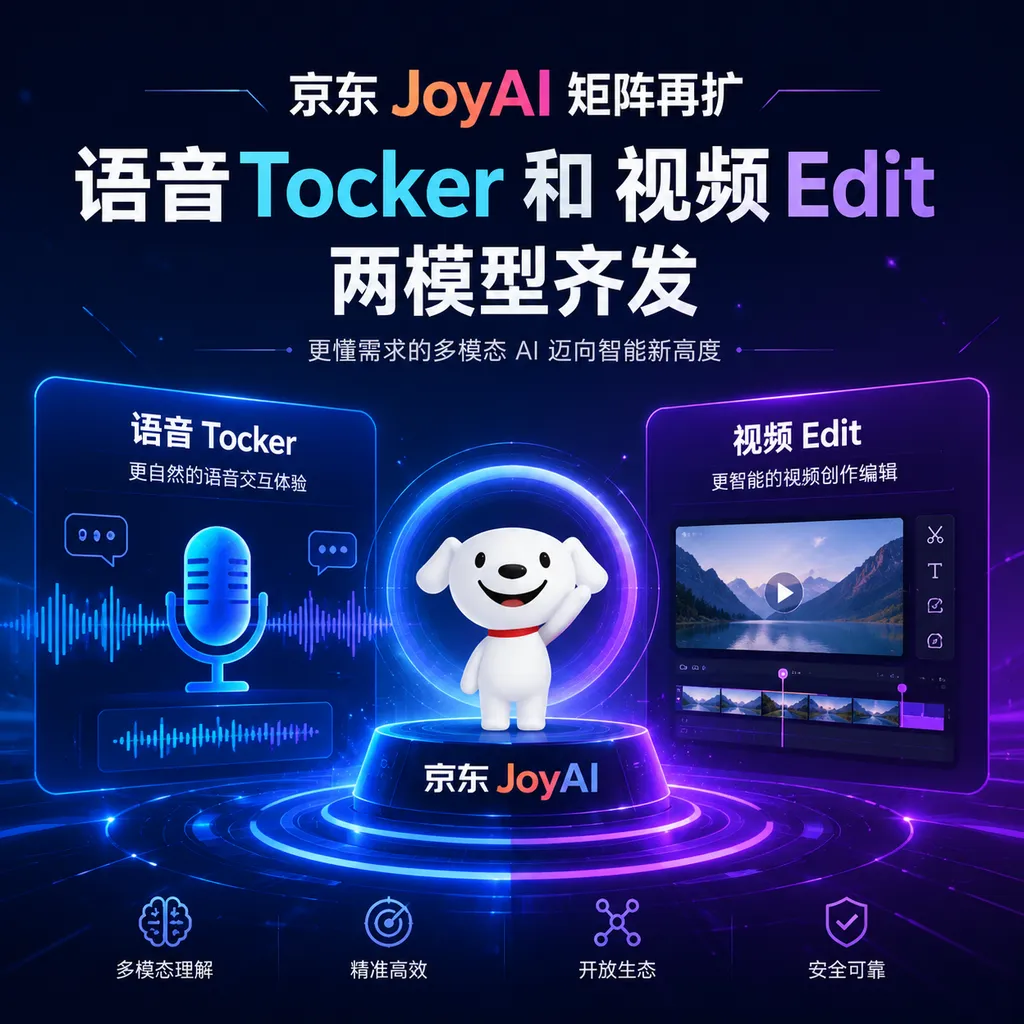
On the first day of WAIC 2026, JD.com unveiled two new models at the Expo Exhibition Hall — JoyAI-Talker and JoyAI-Video-Edit — positioning its main focus on real-time interaction: on the voice side, understanding emotions and recognizing voiceprints; on the video side, supporting natural-language-based live editing while viewing.
JD JoyAI Matrix Expands Again: Talker and Video-Edit Push the Battlefield to “Real-Time”
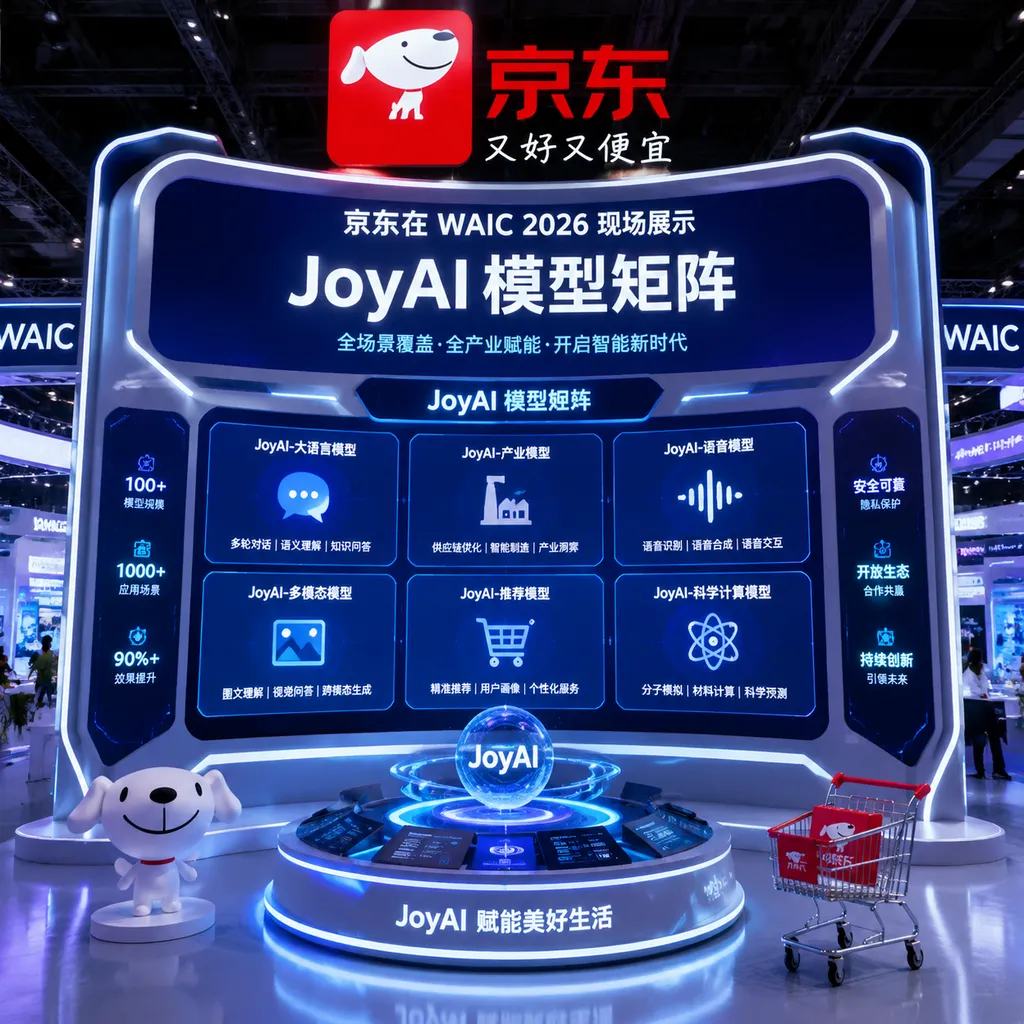
On July 18, WAIC 2026 kicked off simultaneously at three venues and four halls across the Shanghai Expo, Zhangjiang, and West Bund. JD chose the Expo Exhibition Hall as its main site, launching the slogan “AI Enters the Physical World.” It might sound lofty, but the corresponding moves are substantial: two new models were unveiled, JoyAI-Talker (real-time voice interaction) and JoyAI-Video-Edit (real-time video editing).
Together with previous releases such as Joy-Image-Edit, JoyAI-Echo, and JoyAI-VL-Interaction, JD has launched seven foundational models this year. Under the JoyAI platform, there are now six main lines: voice, image, video, real-time interaction, world models, and embodied intelligence. Among e-commerce giants taking a cautious approach this year, this pace is relatively aggressive.
JoyAI-Talker: Pushing Voice Assistants from “Understanding Commands” to “Understanding People”
Let’s start with Talker. The official keywords are fourfold: low-latency dialogue, emotion understanding, tool invocation, and memory. None are new individually, but when combined, the roadmap becomes clear—JD is aligning itself with the same real-time voice track as GPT-4o Realtime and Gemini Live.
One notable capability is voiceprint-based user identification. Traditional assistants treat every interaction as a new session: once you say, “Book a flight to Beijing for tomorrow,” the task ends. Talker’s approach is different—it first identifies the speaker through their voiceprint, then attaches the session to your memory chain: “Last time you said you’d travel without your laptop—should I remind you to bring a power bank this time?” That moves from “one question, one answer” to “always by your side.”
This isn’t unique to JD. OpenAI’s Advanced Voice, ByteDance’s Coze Voice, and Doubao’s real-time voice share similar ideas. What gives JD an edge is its closed-loop ecosystem:
- Shopping scenarios: Chat with the AI in your living room about buying a down jacket, and it can directly access JD’s product database and your past orders to generate recommendations.
- Home appliance scenarios: With IoT data, the AI knows your refrigerator’s temperature and can infer whether “a bit cold” means adjusting the air conditioner or suggesting a blanket.
- Logistics scenarios: Integrates environmental data to interpret user intent—likely referring to IoT sensor data.
In short, Talker’s ceiling isn’t defined only by model strength but by how many real-world data pipelines JD can connect. That’s why JD’s theme is “the physical world”—its moat lies not in models, but in data entry points grounded in the real world.
Evaluation: In low-latency dialogue, JD might struggle to outperform top players purely by modeling, but in integrating scenes and data pipelines, its hand isn’t weak.
JoyAI-Video-Edit: Turning “Editing Video” into “Talking Video”
If Talker fills a gap, Video-Edit is arguably the more intriguing debut.
Over the past year, video generation has been dominated by players like Sora, Veo, Keling, and Vidu—but video editing, especially “streaming editing” (modifying as it generates), remains largely unexplored. The reason is simple: video generation is like drawing cards—prompt a model and it outputs a fixed 90‑second clip; if unsatisfied, you rerun it. There’s no real “editing,” since every regeneration resamples everything—frames, characters, scenes.
Video-Edit’s core selling points are:
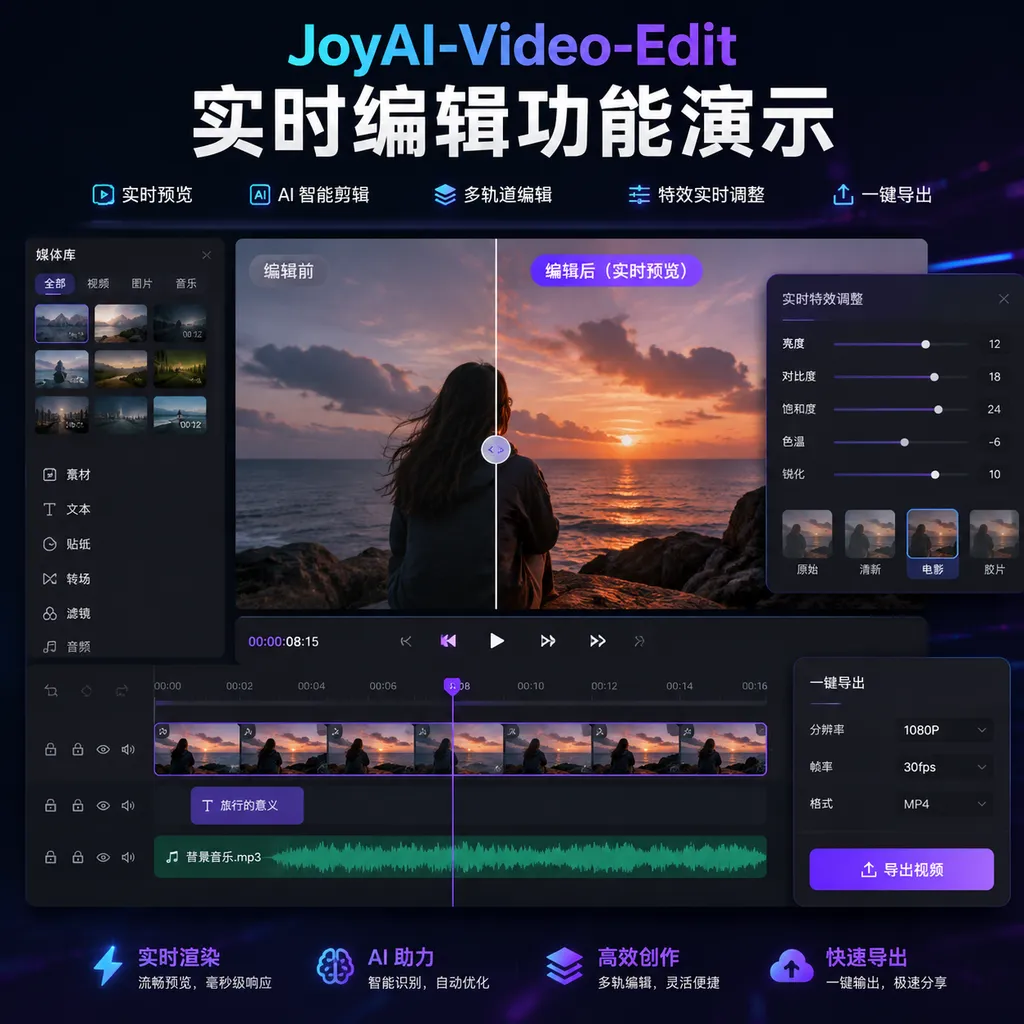
- Custom visuals + live preview and modification: No longer one-shot generation, but streaming.
- Natural language control: Simply say, “Change this person’s T-shirt to a suit.”
- Object-level fine control: Add/remove objects, replace people, swap clothing, rebuild scenes.
This is technically hard. Maintaining temporal consistency while accepting real-time user commands with controllable changes isn’t simple prompt-to-video—it treats video as an interactive live state.
Analogy:
- Traditional video generation ≈ instant photo—if it’s bad, you retake.
- Video-Edit ≈ Photoshop with real-time layers, except each layer is a 90‑second dynamic asset you can edit anytime.
If this performs well, JD’s merchant ecosystem will be the immediate beneficiary—live broadcast promos, product showcase videos, and outfit changes are all strong use cases. For consumers, adoption may hinge on stabilization and cost reduction.
Evaluation: Based on the demo, Video-Edit clearly targets commercial video production. That’s a pragmatic approach—pursuing immediate monetization rather than chasing Sora’s cinematic fidelity.
Overall View: JoyAI Matrix Organized by the Logic of the “Physical World”
Looking at JD’s lineup this year, the roadmap is clear:
| Model | Positioning | Time | |--------|--------------|------| | Joy-Image-Edit | Image editing | Early 2026 | | JoyAI-Echo | Long-form audio/video generation (open source) | H1 2026 | | JoyAI-VL-Interaction | Real-time video-vision-language interaction (open source) | H1 2026 | | JoyAI-Talker | Real-time voice interaction | 2026-07-18 | | JoyAI-Video-Edit | Real-time video editing | 2026-07-18 |
The common keyword: real-time. JD is pushing its entire base model suite toward “real-time interaction.” Echo addresses long-form video consistency, VL-Interaction enables “watch and talk,” Talker enables live dialogue, and Video-Edit enables live editing. This isn’t about sporadic models—it’s assembling a full real-time multimodal interaction stack.
Together with EgoLive, an open-sourced human-perspective dataset (claimed to be the largest of its kind), and the JoyEgoCam headsets for first-person data capture showcased at the event, JD’s goal is apparent: to build full-stack multimodal perception and interaction infrastructure for embodied intelligence, AR glasses, and robotics—the interfaces of the physical world.
A Not-So-Small Signal
On open-source strategy: JoyAI-Echo and VL-Interaction are open sourced, EgoLive is too, but Talker and Video-Edit currently have no open-source plans.
This logic makes sense:
- Open source for foundational capabilities and datasets—to build ecosystem and influence.
- Keep closed the directly monetizable, business-facing ones (video editing, voice assistant)—to capture commercial value.
This strategy mirrors Alibaba’s Tongyi and ByteDance’s approach: open-source the foundation, close-source the application layer. Meta’s early Llama roadmap was similar. In China’s current wave of AI open-source activity, JD is walking a pragmatic middle path.
Some Open Questions
After this release, several questions remain unanswered but noteworthy:
- How low is Talker’s latency, exactly? JD calls it “low latency” but provides no number. GPT‑4o Realtime responds within <300 ms; Doubao claims 200 ms. JD’s silence is mildly suspicious.
- Video-Edit’s consistency and stability: The promo shows outfit swaps and scene reconstructions—but how long can consistency hold in real use? 90 seconds? 5 minutes?
- When will the API open? JoyAI currently runs mainly inside JD and B2B partnerships; access and pricing for smaller developers are still unclear.
The JoyAI website (jdai.jd.com) currently displays “AI Video Generation – Coming Soon.” Given the WAIC announcements, official APIs or applications will likely appear soon.
Epilogue
Among Chinese tech giants, Alibaba is building the Qwen ecosystem, ByteDance is developing Doubao + Coze, Tencent blends Hunyuan with WeChat, and Baidu focuses on Ernie Bot. JD’s showcase signals a move into the relatively untapped field of multimodal real-time interaction—not competing with GPT‑5 or Claude 5 on general capability, but building a full-stack around the “physical world” narrative that connects voice, video, vision-language, and embodied intelligence.
For developers: If you work in retail, livestreaming, customer service, or smart home IoT—domains tightly coupled with the physical world—the JoyAI matrix deserves attention, especially once Talker and Video-Edit open their APIs.
For developers seeking plug‑and‑play access to major models, aggregator platforms like OpenAI Hub remain the easiest gateways—one API key connecting GPT, Claude, Gemini, DeepSeek, and others.
JD’s opening move is strong. The real test is whether it can push these models beyond the “WAIC stage demo” and into live business use—the decisive second half.
References
- JD Releases JoyAI‑Talker Real-Time Voice Interaction Model and JoyAI‑Video‑Edit Video Editing Model – ITHome — First-hand report on JD’s JoyAI matrix release at WAIC.
- Another Tech Giant Enters AI Video Generation: Stable Five‑Minute Narrative with Consistent Voices – Zhihu — Technical breakdown of JD’s open-sourced JoyAI‑Echo long audio-video generation framework.