Musk Officially Announces Grok 4.6: Initial Training with 2 Trillion Parameters to Be Completed Next Week
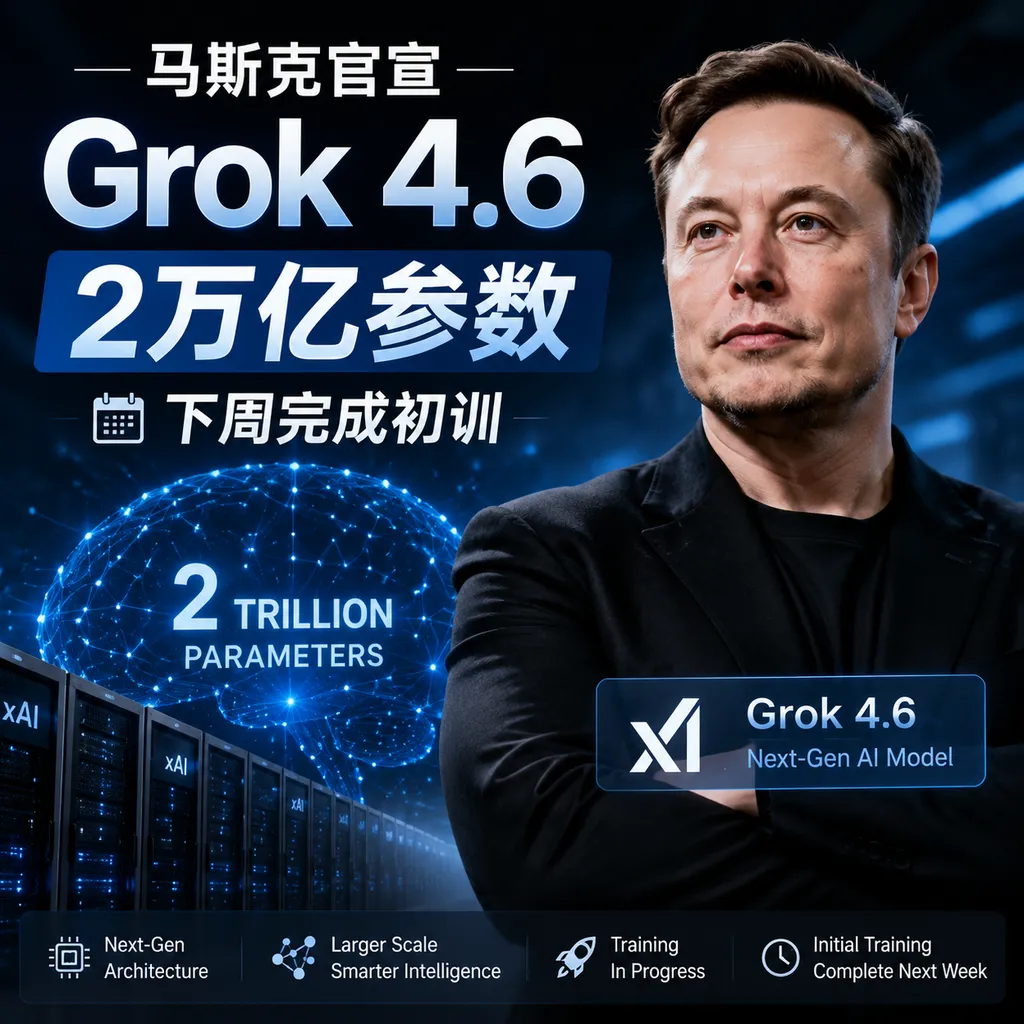
xAI’s next-generation model Grok 4.6 has reached 2T parameters. According to Musk, initial training will be completed next week. Its efficiency is on par with the 1.5T Grok 4.5, and its target is clearly Kimi 3.
Musk Tweets Again: Grok 4.6, 2 Trillion Parameters, Initial Training Wraps Up Next Week
On July 18, while replying to a netizen on X, Musk casually unveiled xAI’s next-generation model — Grok 4.6, with 2 trillion parameters, finishing initial training next week. This wasn’t a formal announcement or an official tech blog teaser, just a spontaneous comment from the boss himself on the timeline — but enough to keep the entire model community up tonight.
According to Musk, the 2T version outperforms the current 1.5T Grok 4.5 in all aspects, while reasoning speed and token efficiency are “close” to the previous generation. He added: this new model might surpass Moonshot’s recently launched Kimi 3.
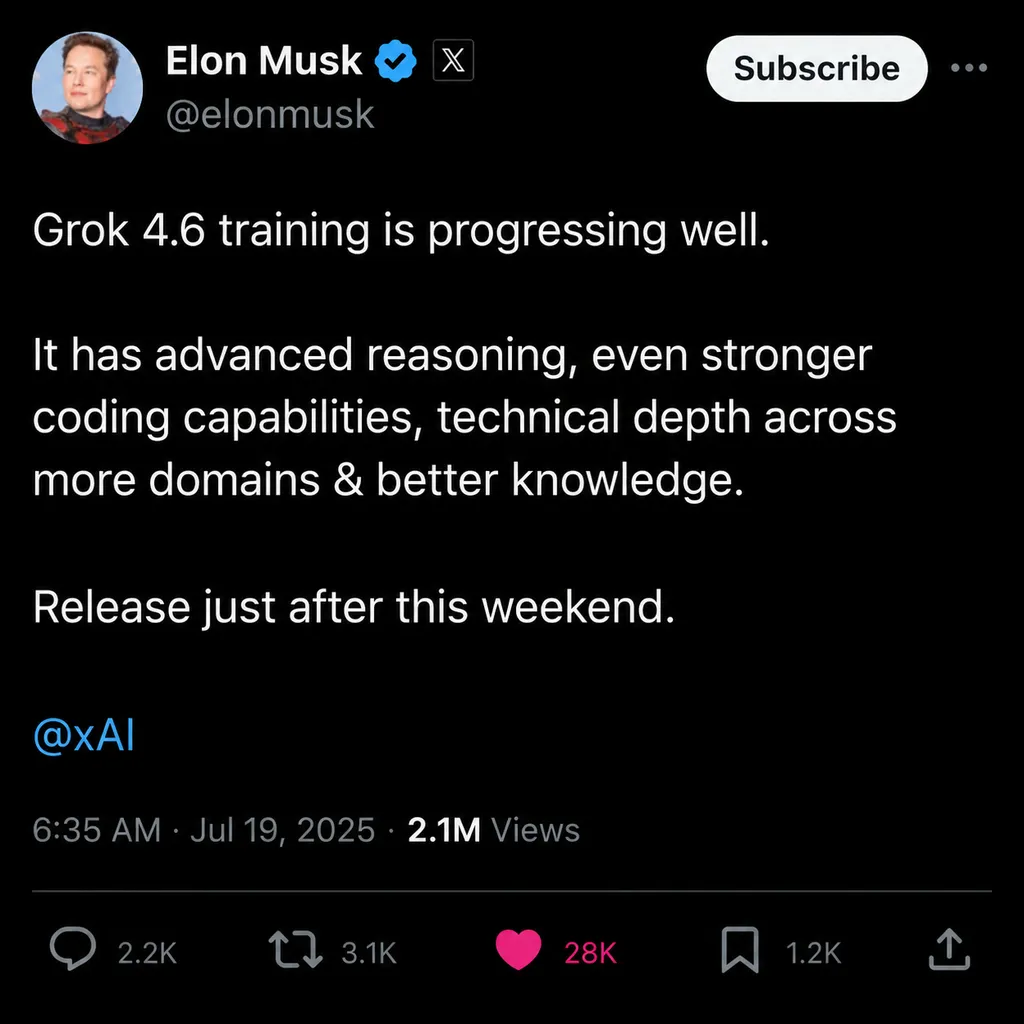
Don’t take “might surpass Kimi 3” too seriously yet. Musk’s tweets are always a mix of “teaser + emotion + a bit of fact.” The training isn’t finished, no benchmark results have been released, and the so-called “surpass” is just his intuition based on internal metrics. But the fact that initial training finishes next week is significant — from that point, it usually takes just a few weeks to a month or two before a public, usable version appears.
From 1.5T to 2T — What This Leap Means
Let’s sort out the timeline. In May this year, Musk revealed that Grok’s base model V9-Medium had finished training with 1.5T parameters and entered fine-tuning and RLHF — that’s the foundation of Grok 4.5. By late June, Grok 4.5 was already in internal testing at SpaceX and Tesla, and Musk claimed its “performance [is] close to Opus.” Now, by mid-July, the 2T 4.6 is on deck.
From 1.5T to 2T looks like a 33% increase in parameters, but on the training side, that’s far from “just adding a bit more”:
- Active vs. total parameters: xAI has not disclosed whether Grok 4.5/4.6 uses an MoE architecture, but given its “inference speed close to 1.5T,” it’s likely a sparse model, keeping active parameters within an acceptable range. If it were fully dense, inference costs would jump over 30%, which wouldn’t be “close.”
- Data pressure: According to the Chinchilla scaling law, a 2T-parameter model needs at least 40T high-quality tokens to reach optimal training. At that scale, open internet data is exhausted; the proportions of synthetic data, code, multimodal materials, and tool-use logs will decide the model’s ultimate ceiling.
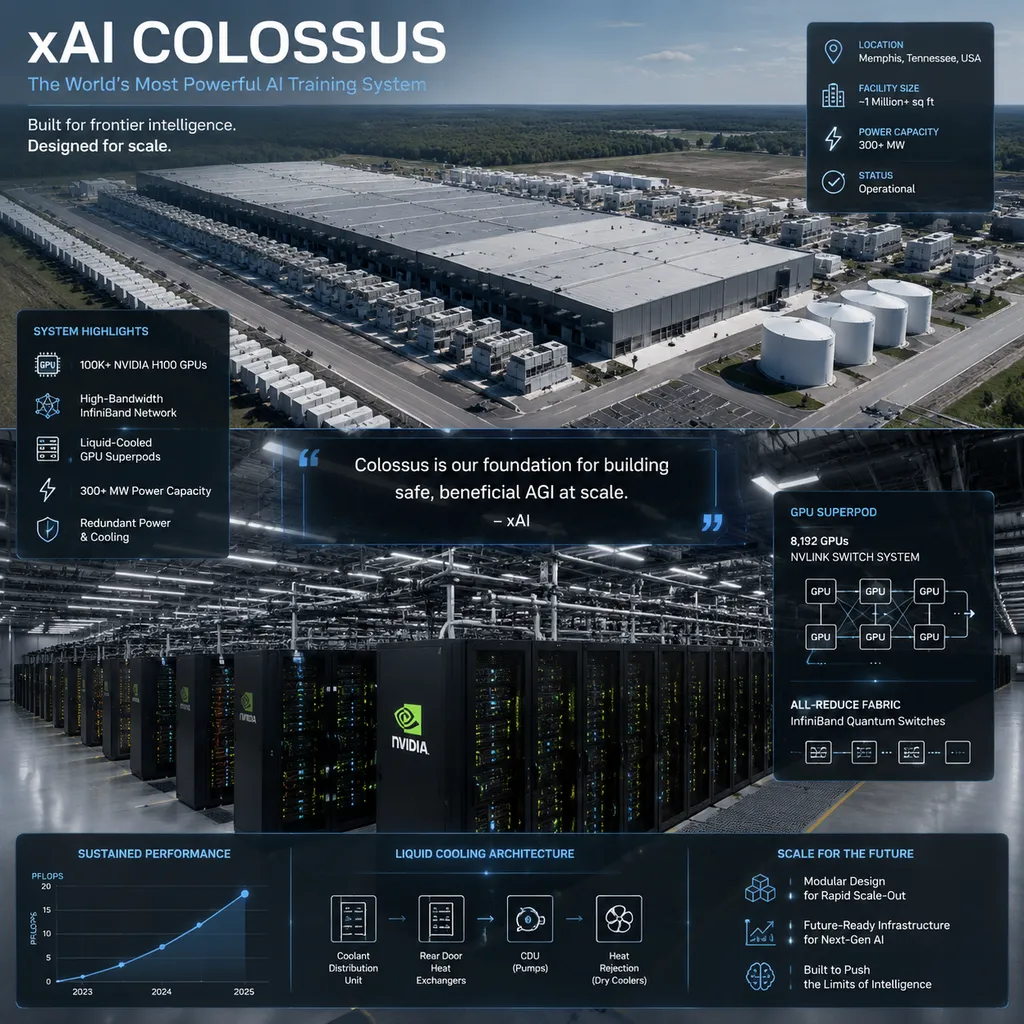
- Compute resources: xAI’s Colossus cluster is reported to have around 200,000 GPUs mainly optimized for RL training. Rumor has it xAI is scaling up to around a million GPUs, and Grok 4.6’s training likely benefited from this new capacity.
So when Musk says “efficiency close to 1.5T,” in plain language that means: we made it bigger, but inference won’t be more expensive. That’s the real headline — far more important than just the “2 trillion” number.
Is the Parameter Arms Race Still Worth It?
Between 2024 and 2025, the consensus seemed to be: parameters don’t matter, data quality and post-training do. Open models like DeepSeek V3, Qwen 3, and GLM 5—each just a few hundred billion parameters—beat many trillion-parameter closed models in benchmarks. Academics also spoke of “diminishing returns from scaling parameters.”
But in early 2026, things took an interesting turn — top closed-source players are scaling up again:
| Model | Parameter Scale (Public or Estimated) | Date | |--------|---------------------------------------|------| | Grok 4.5 | 1.5T | 2026 Q2 | | Kimi 3 | ≈1T MoE | 2026 Q2 | | GPT-5.5 (estimated) | Unreleased, rumored 2T+ | 2026 Q2 | | Gemini 3 Ultra | Unreleased | 2026 Q1 | | Grok 4.6 | 2T | Q3 2026 (training) |
So why ramp up again? Two main reasons.
First, RL training needs a larger base — reasoning models require deeper internal world models to support long reasoning chains; smaller models can’t sustain o-series or r-series deep-reasoning tasks.
Second, multimodal and agent scenarios are parameter-hungry — long-context understanding, tool use, code execution, and visual comprehension all add up, requiring far more “knowledge” and “experience” than text-only eras.
In short, this wave of scaling isn’t nostalgia — it’s demand-driven.
Grok’s Roadmap: From Chatbot to “Universal App”
At xAI’s all-hands this year, Musk stated clearly: Grok isn’t meant to be a ChatGPT replacement, but the “universal app” within the X ecosystem — integrating voice, video generation, agent functions, payments, and social features.
So, in this context, the 2T Grok 4.6 isn’t just about leaderboard bragging. It’s more like a foundation for the X super app:
- Video generation: xAI is rolling out a video version of Grok Imagine; the 2T base should greatly improve long video temporal-spatial coherence.
- Voice interaction: Grok Voice aims to rival GPT-4o’s real-time conversational experience; model size directly affects latency and naturalness.
- Agent scenarios: Tasks like placing orders, booking tickets, posting, and multi-account operations on X require strong, long-horizon reasoning.
- Code generation: Musk places special emphasis here — Grok 4.5 already serves as a coding assistant in Tesla and SpaceX.
Rivals with Kimi 3 — What Are the Odds?
Musk specifically called out Kimi 3, so let’s go into that. Moonshot’s Kimi 3 launched last month, following a large-sparse MoE design. It shines in Chinese and long-context tasks and currently tops the LMSYS Chinese leaderboard, C-Eval, and major domestic agent benchmarks.
For Grok 4.6 to surpass Kimi 3, the pressure is mainly in two areas:
- Depth of Chinese data: Most of xAI’s training data is in English and code — Chinese remains a weak spot. Grok 4.5 fares worse than top domestic models in Chinese reasoning and classical text. Without sufficient Chinese data, the advantage from scaling will dilute.
- RL alignment quality: Kimi 3 invested heavily in post-training, especially for long-horizon planning and tool use. The Grok series iterates RLHF faster but with less fine-grained tuning than domestic peers.
Musk’s intuition might not be wrong, but benchmarks will tell the truth. Once initial training wraps next week, we’ll likely see the first public scores in two to three weeks.
Developer View: When Will Grok 4.6 Be Available?
Judging by Grok 4.5’s timeline (trained in May, internal rollout in late June, public API by July), Grok 4.6 will likely open its API in mid-to-late August or early September. It will instantly appear on OpenAI Hub, allowing unified access to Grok 4.6, Claude, GPT, Gemini, and DeepSeek with one key — no need for separate accounts or credit cards.
Here’s a current example for the Grok series; just replace the model name when 4.6 launches:
from openai import OpenAI

client = OpenAI(
    api_key="your-openai-hub-key",
    base_url="https://api.openai-hub.com/v1"
)

response = client.chat.completions.create(
    model="grok-4.5",  # replace with "grok-4.6" after release
    messages=[
        {"role": "system", "content": "You are an experienced backend engineer."},
        {"role": "user", "content": "Explain how MoE inference is optimized at a 2T parameter scale."}
    ],
    temperature=0.7,
    stream=True
)

for chunk in response:
    if chunk.choices[0].delta.content:
        print(chunk.choices[0].delta.content, end="")
For agent scenarios, Grok’s function calling follows the OpenAI format, so migration is seamless:
tools = [{
    "type": "function",
    "function": {
        "name": "query_gpu_price",
        "description": "Query the current market price of a specific GPU model",
        "parameters": {
            "type": "object",
            "properties": {
                "model": {"type": "string", "description": "GPU model, e.g. H100, B200"}
            },
            "required": ["model"]
        }
    }
}]

response = client.chat.completions.create(
    model="grok-4.5",
    messages=[{"role": "user", "content": "How much does an H100 cost now?"}],
    tools=tools,
    tool_choice="auto"
)
Things Yet Unsaid
A few points to watch for once real tests arrive next week:
- Context length: Grok 4.5 supports up to 256K. 4.6 probably won’t be below that, but will it reach Gemini’s 2M–10M level? We’ll see.
- Inference cost: “Close to 1.5T” isn’t the same as “equal.” Wait for pricing before judging.
- Multimodal coverage: Grok 4.5 already supports visual inputs; whether 4.6 adds native audio and video inputs will be key.
- Release rhythm: xAI traditionally leaves a short “internal gray stage” after initial training — during that time, SpaceX and Tesla employees basically serve as free beta testers.
Two trillion parameters sound impressive, but what really matters is whether developers can make it power real applications. Finishing initial training next week is just the beginning — benchmarks, API pricing, context performance, tool-call stability — every part will be a hard test.
Stay tuned — we’ll update as soon as new info drops.
References
- Musk: Grok 4.6 Training Enters Final Stage, 2T Parameter Model Finishing Initial Training Next Week - IT Home: Original news source with Musk’s X post and Grok model background.
- Musk Spends $2B to Send Grok 4 to Mars! 200,000 GPUs Building a Cosmic Brain - Zhihu: Detailed background on xAI’s Colossus cluster and training compute investment.