Honor launches AgenticOS, turning smartphones from tools into stages for agents
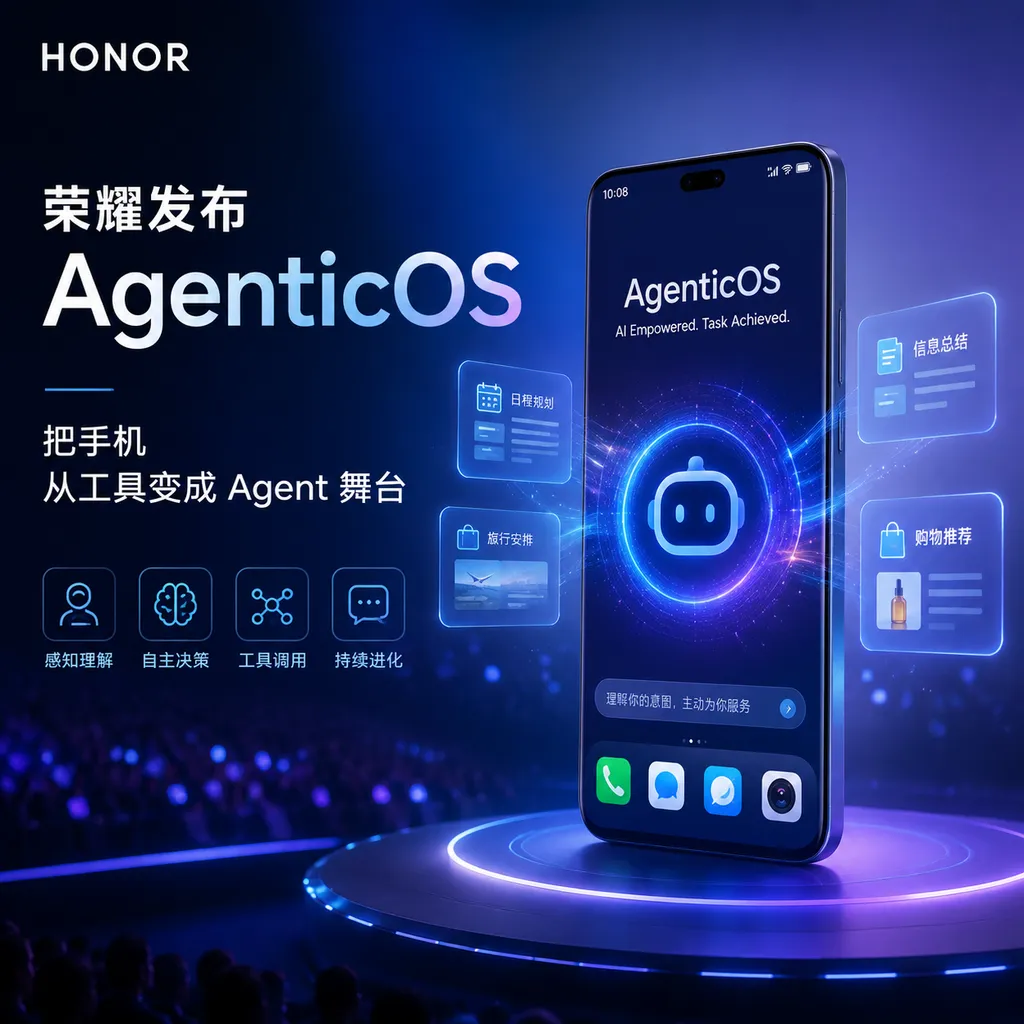
At WAIC 2026, HONOR officially unveiled its system-level multi-agent operating system, AgenticOS, featuring four major highlights: intent-driven design, innate cross-device capability, and more. The Robot Phone will debut the kernel in August, followed by a preview version on the Magic9 series in Q4.
Honor Launches AgenticOS: Turning Smartphones from Tools into an Agent Stage
On July 19, at the 2026 World Artificial Intelligence Conference (WAIC), Honor finally played the card it had been holding for over half a year—the official release of the next-generation companion-type multimodal intelligent agent operating system AgenticOS. The Robot Phone, which will go on sale in August, will be the first device powered by this new kernel, followed by the Magic9 series in Q4 with an “early access” version.
This is not an ordinary system iteration. Over the past five years in the smartphone industry—MIUI becoming Surge, EMUI transitioning into HarmonyOS, ColorOS evolving to 15—these were essentially incremental optimizations within Android’s “application container” framework. But this time, Honor directly redefined the OS: It’s not a container for apps; it’s a stage for agents.
This line was first said verbatim by Honor’s Product Line President Fang Fei on June 24 at MWC Shanghai. At that time, it sounded like a slogan; now it looks more like a script—one month later, the OS is real, the product schedule is set, and the debut device is confirmed.
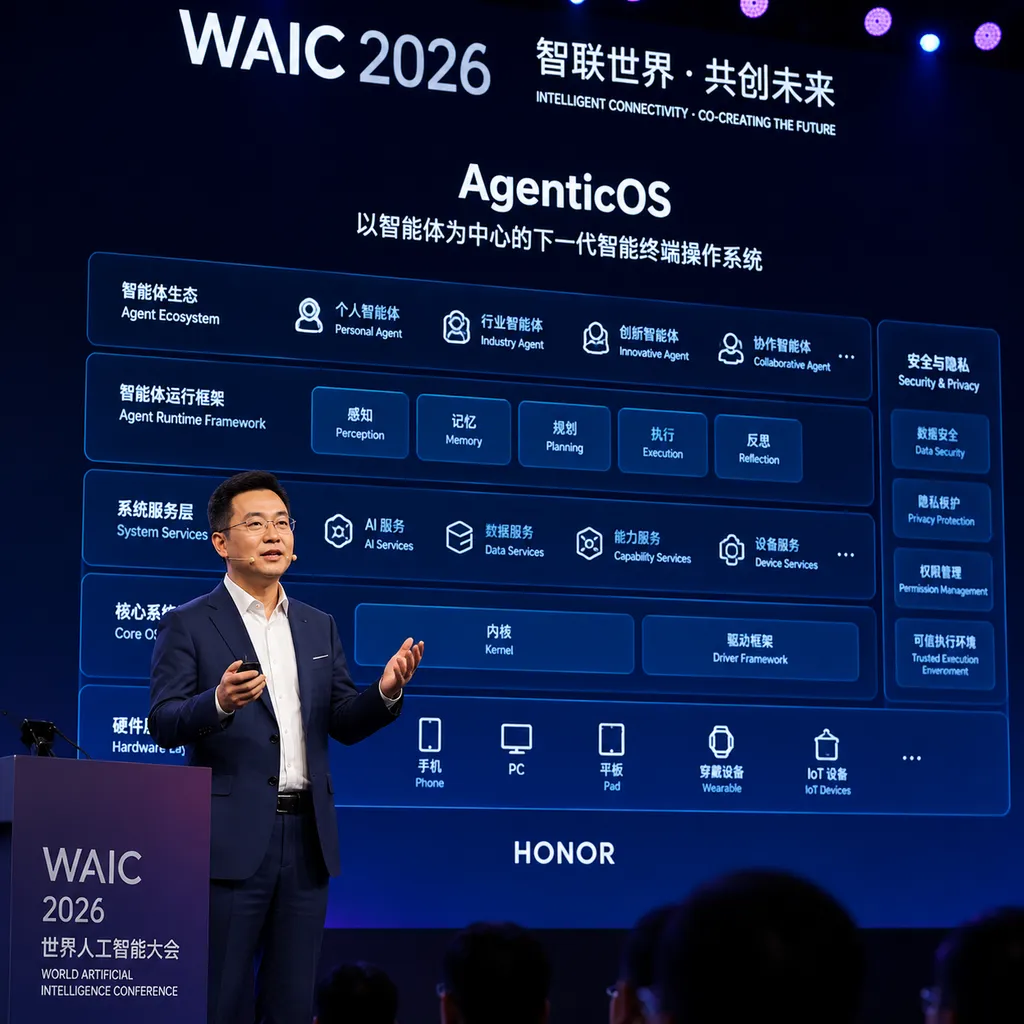
I. What AgenticOS Actually Redefines
Let’s start with the four official features: Intent-driven, Natural Interaction, Proactive Intelligence, and Born Cross-device. None of these words are new; almost every manufacturer has used them recently. What truly stands out, however, is the claim that it’s the “industry’s first system-level agent architecture.”
“System-level” contrasts with the mainstream AI smartphone approach today—Apple Intelligence, Samsung Galaxy AI, and domestic equivalents—all basically embedding a large model interface within the system. You open an app, summon an AI assistant when needed; the assistant calls a cloud or local model and returns results. The system is the host, AI is a plugin.
AgenticOS flips this model. It reconstructs the OS kernel into a runtime environment for multi-agent collaboration. Agents are no longer functions hidden inside apps but first-class citizens of the operating system. Honor emphasized three key capabilities at the launch:
- Global multi-agent collaboration: Different agents can call each other and orchestrate tasks, rather than working in isolation.
- Scenario-adaptive learning: Agents continuously learn from users and embed their capabilities into the system.
- Self-cycling agent execution: Agents can trigger other agents, forming closed-loop task chains.
To use an analogy: Traditional AI smartphones give you a secretary who understands what you say; AgenticOS aims to give you a project manager who can assemble a team, assign work, and track progress. The former is a chat model, the latter a workflow model.
For developers, this could change the way they think about apps entirely. Instead of building a closed-loop application, you’re providing an agent capability module—which may be invoked by other agents, routed by the OS’s intent mechanism, or serve as a node in a longer task chain. This is a completely new mental model compared to building iOS or HarmonyOS apps.
II. Why the Robot Phone Comes First
The choice of debut device is interesting. Instead of the mass-market Magic9 or the standard digital series, Honor chose the Robot Phone—the one with a “gimbal head” on top.
Pre-orders for this device opened on July 18, personally announced by CEO Li Jian at WAIC. Its core hardware feature is an industry-first four-degrees-of-freedom (4DoF) titanium-alloy mechanical gimbal system—the top camera module can tilt and pan like a mini stabilizer. Its micromotors are 70% smaller than mainstream solutions. It runs on the Snapdragon 8 Gen 5 Ultimate Edition, has a 1.5K flat display, and supports 120W wired charging.
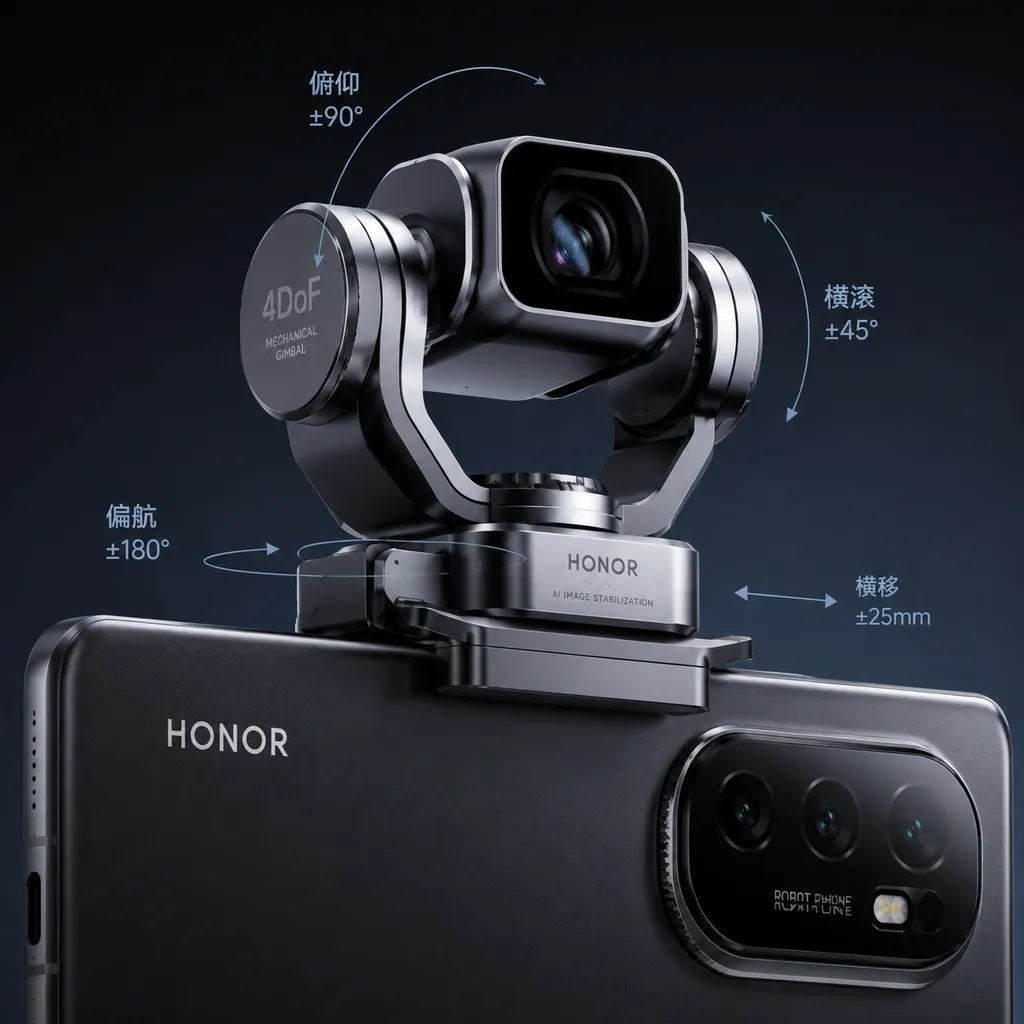
Judging by hardware alone, it’s a bold but unconventional phone. But with AgenticOS installed, everything changes:
A phone that can rotate its camera, sense the environment, and perceive actively, paired with an OS that enables autonomous task planning and multi-agent collaboration—it’s no longer just a responsive tool, but a small embodied intelligent agent.
Honor describes it as a “new species” in the era of embodied intelligence. That might sound grand, but it fits logically—multi-agent OS needs a device that can physically interact with the world to showcase its value, and a phone that can turn its head better conveys “proactive intelligence” than a flat slab.
Pre-order users will get benefits like a one-year gimbal protection plan and lifetime YOYO SVIP membership. Pricing isn’t yet announced, but given the hardware, it won’t be cheap.
III. The Magic9 Series Gets the “Early Access” Version
The real volume will come from the Q4 Magic9. Honor’s strategy is smart: launch the full kernel on the Robot Phone to grab attention and shape perception of a “new AI smartphone paradigm,” then roll out the “early access” version on the mainstream Magic9 series. This lets it reach mass users without taking all the technical risks.
This rhythm mirrors Apple’s approach—use Vision Pro to build the concept, then bring its tech down to the iPhone—or Xiaomi’s strategy with the SU7 to strengthen brand identity and drive phone sales. Use a high-buzz product to shape perception, then rely on mainstream models for volume.
With a Q4 release, Honor will ship right after the iPhone 18 series and before the next wave of Android flagships. Whether AgenticOS proves useful and whether multi-agent collaboration holds up in daily use will be critical to Magic9’s performance.
IV. Key Areas for Developers to Watch
As a tech editor, here’s a more candid take: AgenticOS today is a vision. Whether the implementation can sustain the narrative depends on several technical factors.
1. Multi-agent orchestration and scheduling
Multi-agent collaboration frameworks like LangGraph, AutoGen, and CrewAI have existed on the server side since 2024. But integrating this into a mobile OS kernel is a very different challenge. The smartphone context introduces questions like:
- Compute allocation: How to balance which agents run locally and which in the cloud?
- State consistency: How to ensure shared contexts between agents don’t conflict or duplicate work?
- Failure recovery: If one agent crashes, how does the system roll back or resume the task chain?
- Permission model: If an agent invokes another, how is privilege propagation handled?
Honor hasn’t released a whitepaper yet, so we’ll have to wait until the Robot Phone ships in August to find out.
2. Is “Born Cross-device” truly cross-device?
Honor has products across PCs, tablets, watches, and earbuds. The key question: how does AgenticOS’s “Born Cross-device” differ from Huawei’s distributed HarmonyOS? If it’s merely syncing data and continuing tasks under one account, that’s not truly cross-device agents. If agents can migrate execution contexts across devices and select where to run dynamically based on compute and scenario, that’s new.
3. Building a developer ecosystem
Even the best OS is hollow without an ecosystem. AgenticOS represents a new paradigm—requiring developers to learn new APIs and a new mindset. Whether Honor provides a solid Agent SDK, Agent Store, and Agent monetization model will determine if third parties engage.
V. Context within the AI Smartphone Race
By 2026, the AI smartphone race has diverged into different paths:
- Apple: Apple Intelligence focuses on restraint—on-device + cloud coordination, privacy first, AI as enhancement not overhaul
- Samsung: Galaxy AI is a toolkit of independent features like translation, summarization, and editing
- Google Pixel: Deep Gemini integration, leveraging Google’s model capabilities
- Xiaomi/OPPO/vivo: Proprietary models plus system assistants, still within the chat paradigm
- Huawei: With Pangu models and HarmonyOS NEXT, closest in concept to AgenticOS
- Honor: Flips the table—reconstructing the OS itself as an agent runtime
Honor’s approach is bold—a wager that the next interaction paradigm will be agentic, and that being early earns a lead. If it’s right, the Android ecosystem could follow within a few years; if wrong, it becomes an expensive tech demo.
Notably, AgenticOS still runs atop Android (no indication of a self-developed kernel yet), meaning most of the innovation is in the application and AI middleware layers. The upside: better ecosystem compatibility and faster rollout; the downside: the ceiling remains limited by Android itself.
VI. What It Means for Developers and Practitioners
If you’re a mobile developer, this isn’t something you can just observe. Once multi-agent OS architecture takes off, the notion of “apps” will be diluted. Users won’t think “open an app to do something,” but rather “say what I want, and let the system’s agents handle it.” The value shifts from app entry points to capability units.
If you build AI apps—especially agent frameworks, orchestration, or tool integration—the device side is becoming a critical market. Much of the multi-agent orchestration logic that once ran on servers will migrate to devices. This opens opportunities for inference frameworks and agent middleware.
For developers integrating multiple large models, API aggregation remains the fastest way to deploy before AgenticOS matures. OpenAI Hub currently supports GPT, Claude, Gemini, DeepSeek, and other mainstream models under one key, OpenAI-compatible and directly accessible in China—ideal for quickly testing and comparing model performance before porting orchestration to devices.
In short: Honor didn’t just launch a new system—it offered a new answer to “what is a phone.” Whether the answer holds up, we’ll know when the Robot Phone hits the market in August.
References
- Honor launches next-generation companion-type multimodal intelligent agent OS AgenticOS; Robot Phone debuts the kernel in August – IT Home: Original report on AgenticOS launch and Robot Phone debut by IT Home