StepStar Teams Up with Andrew Chi-Chih Yao: Filling in the "Fundamental Theory" Piece for the Agent Era

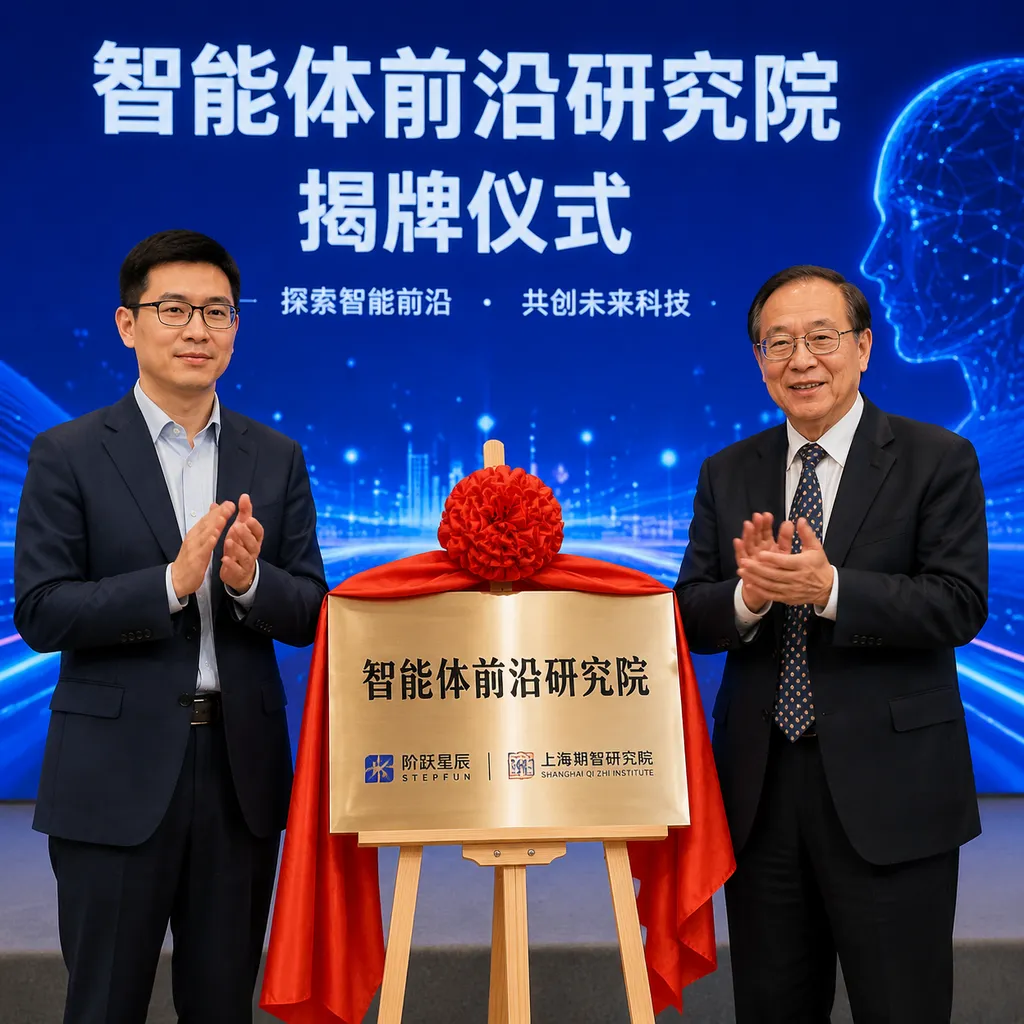
On July 18, StepStar and the Shanghai Qi Zhi Institute officially announced the joint establishment of the "Frontier Institute for Intelligent Agents," focusing on agent networks, economic principles, and AI Safety. At a time when end-user applications are not yet mature, this model company has chosen to tackle the fundamental theories first — a move that’s worth pondering.
Step Zen and Andrew Yao Join Forces: Completing the “Fundamental Theory” Puzzle for the Agent Era
On July 18, Step Zen and the Shanghai Qi Zhi Institute officially announced a joint initiative—the establishment of the “Frontier Institute for Intelligent Agents”, focusing on foundational topics such as Agent networks, economic principles, and AI Safety.
The announcement itself is brief, but its implications at this point in time are significant. Why would a model company, still busy embedding its model into cars and smartphones, suddenly pivot toward theoretical research?
An “Early” Move
Let’s start with the timing. Typically, the “superstructure” of a technological direction—order building, ethical frameworks, economic principles—emerges only when the field matures, scales for commercialization, and begins to hit friction.
The internet serves as a precedent. In the late 1990s, everyone was racing to stake their claims; topics like platform governance, algorithmic ethics, and data ownership became mainstream only in the mobile internet’s mid-to-late phase.
But this Agent wave is different. Even before Step has fully rolled out its own devices, it has already founded a research institute. You can call this strategic foresight—or put it more bluntly: the entire industry is collectively anxious.
Anxious about what? About the problems that will flood in once Agents truly begin operating—problems that never surfaced in the “cloud chatbot era”:
- If two Agents transact and something goes wrong, who’s liable?
- When an Agent signs a contract or places an order for you, who’s the legal principal?
- If hundreds of Agents run within a single enterprise, invoking and delegating tasks to one another, how do we trace accountability?
- When the scale of the Agent network nears or surpasses today’s internet, how do we define safety boundaries?
These aren’t ivory tower musings—they’re real walls every Agent system will hit in the physical world. If no one answers them, the collision will happen.
Why Step Zen × Shanghai Qi Zhi
Readers outside the academic circle may be unfamiliar with the Shanghai Qi Zhi Institute, but everyone knows Andrew Yao—the Turing Award laureate and founder of Tsinghua’s “Yao Class.” The institute focuses strictly on fundamental research, with solid theory and a global academic vision.
On Step Zen’s side, its chairman, Yinqi, is himself a Yao Class alumnus. Teacher and student from twenty years ago, standing shoulder to shoulder two decades later—this has built-in narrative appeal. But beyond the story, the partnership makes sense strategically:
| Dimension | Shanghai Qi Zhi Institute | Step Zen | |---|---|---| | Strengths | Fundamental theory, academic depth, interdisciplinary resources | Full-stack model capabilities, deployment experience, real-world data | | Weaknesses | Lacks industrial feedback loop | Lacks theoretical depth and long-horizon research capability | | Role | Formulates problems, builds frameworks | Validates solutions, feeds back into theory |
Their collaboration addresses five global “new propositions,” spanning individual rights, accountability, safety frameworks, economic infrastructure, and social ethics. Each is ambitious—and technically demanding.
Take one concrete example: how to confirm and authenticate microtransactions between Agents? This is not a purely technical issue—it cuts across cryptography, economics, law, and game theory. No single discipline, and no single company, can cover it; only a coordinated institute can set the stage.
Within Step’s Strategic Chessboard
This institute move makes the most sense when seen against Step’s recent flurry of actions.
On July 13, Step released major updates:
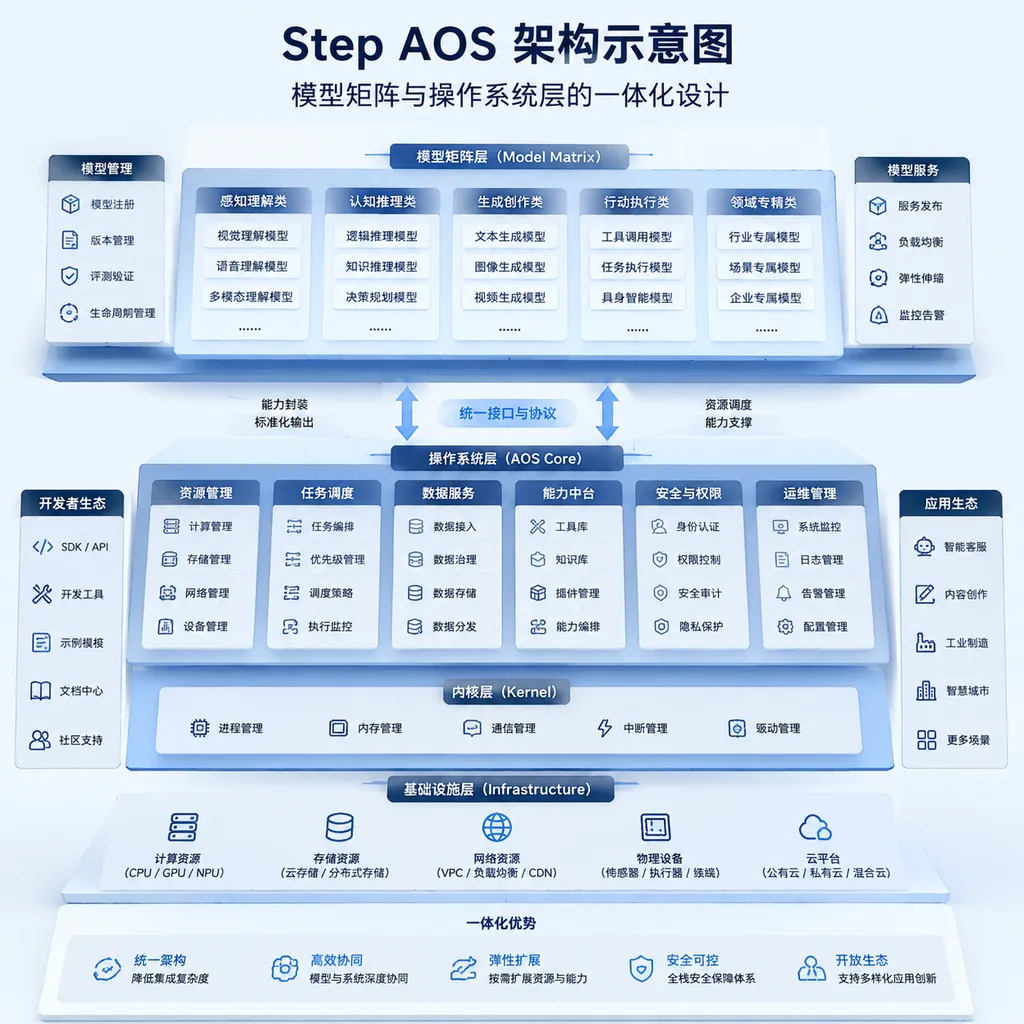
- Step AOS – an Agent-native operating system
- Step Amoo – Agent built on the Step model suite and Step AOS
- STEPX Neo – an Agent-native smartphone
Earlier, Step’s “native intelligent driving base model” debuted in the Zeekr 8X, and its end-to-end voice model shipped with the Geely Galaxy M9.
Viewed as a sequence, Step’s roadmap is clear—foundation models → Agent operating system → terminals → governance research—four interconnected pieces. The research institute is the most upstream of these, also the one least likely to yield near-term returns.
A side note: when a model company builds an operating system, it’s quite different from how an OEM or internet firm builds “OS + AI.” The latter invokes models as add-ons, with an inevitable coupling loss between model and system layers; Step AOS, instead, aims to have model capabilities evolve directly into system primitives—perception, memory, planning, execution, and safety co-designed within the model architecture.
Whether this approach will succeed is too early to judge, but it explains both why Step insists on building its own OS and why it must also develop theoretical frameworks in parallel. If the model itself functions as the system’s neural core, then issues of scheduling, safety, isolation, and auditing—all classic OS challenges—must now be readdressed in the Agent context.
Pro / Flash / Edge Architecture — Who It’s For
Step’s model suite comprises three tiers: Pro, Flash, and Edge.
- Pro: deep reasoning, cloud-heavy model
- Flash: high-frequency production usage, optimized for performance and cost (Step 3.7 Flash is now the mainstay)
- Edge: low-latency on-device deployment
This stratification isn’t new; OpenAI, Anthropic, and Google all do something similar. What’s unique is Step’s explicit positioning to serve Agent collaboration networks.
In any real-world Agent scenario, multiple models collaborate: a user request triggers Edge for intent parsing and context compression, Flash executes most operations in the cloud, and Pro joins only for complex reasoning or multi-Agent coordination. All three share a unified capability layer to ensure seamless context and intent transfer.
This is why Step keeps emphasizing cost control for high-frequency Agent scenarios. If every action invoked the most expensive model, the business model wouldn’t hold. Flash is the main battleground of the Agent era.
The AI Safety Thread Deserves Special Attention
Among the institute’s focuses, “AI Safety” may look like just four words—but it’s actually one of the most critical bottlenecks for industrial Agents.
Unlike traditional model safety (jailbreaking, prompt injection, harmful content), Agent safety revolves around controllability of actions:
- How to ensure minimal permissions when an Agent uses a tool?
- How to prevent a compromised Agent node from infecting an entire network?
- How to detect and roll back when an Agent’s “memory” is poisoned?
- How to monitor goal drift in long-running tasks?
Academic debate on these issues is intensifying, but industrial solutions remain distant. Whether the institute can create usable frameworks is the most watchworthy aspect of this collaboration. Compared with “Agent economics,” a more mid- to long-term theme, Safety is a problem for next year, not the next decade.
Incidentally, Step’s model suite is already connected to the OpenAI Hub. Developers can invoke it using the OpenAI-compatible API, meaning domestic users can make direct benchmark comparisons among Step, Claude, and GPT Agents without network complications.
Some Reservations
Let’s be candid: the translation between fundamental research and industrial deployment has never been linear.
Whether this new institute can yield influential results depends on several factors: recruiting enough top researchers, maintaining commitment beyond media hype cycles, and producing insights that feed back into Step’s products.
China’s industry–academia collaborations have produced successes, but many became mere “signboard institutions” for PR. Whether Step can break that pattern will take at least one or two years to observe.
There’s also a deeper question—is “Agent economics” even a real problem?
The optimistic view: as billions of intelligent Agents collaborate, trade, and strategize online, we’ll need economics-like theories and mechanism design principles to describe and regulate them.
The skeptical view: until concrete commercial Agent ecosystems truly emerge, “economic principles” may be speculative.
Both have merit. Our lean is toward optimism—but the risk of detachment is real.
In Closing
At an industry scale, this announcement signals a new divergence among China’s large-model players.
In the first half, everyone competed on parameter counts and benchmark scores. By mid-2026, model developers are seeking differentiation: some build enterprise Agent platforms, some bet on lightweight edge models, others on native multimodality. Step’s chosen path is a “full-stack + fundamental research” heavy-investment model—model, system, terminal, and governance all self-developed.
Is that path easy? No—it’s costly, time-consuming, with delayed returns. But if the Agent era truly is the next great frontier of AI, those who lay deep foundations may ultimately stand the steadiest.
Multiple research reports project 2026 as the breakout year for AI-powered devices. If that’s right, then from late this year into next, we’ll see more “infrastructure + governance” co-developments like this. Step fired the first shot; whether others follow will be well worth watching.
References
- Agent Safety and Alignment Paper Collection (GitHub) — A community-maintained list of Agent Safety papers and open-source tools, a good entry point for AI Safety research.
- Zhihu – Intelligent Agent (Agent) Technology Topic — Discussions among Chinese developers on Agent architecture, multi-Agent collaboration, and Agent OS design.
- ITHome – AI Large Model Channel — A daily news source for China’s AI industry developments.