Alibaba’s “Happy Oyster” enters Bailian: The world model is getting serious

Alibaba HappyOyster 1.0 lands on the Bailian platform today and begins its gray-box testing. It features two main modes: World Exploration and Real-Time Directing. With just one sentence or one image, it can generate an interactive open world with synchronized audio and visuals, and it also supports story rewind and branching narratives.
On July 19, Alibaba moved HappyOyster 1.0 (Chinese name: "Happy Oyster")—which it had released a month earlier as a demo on its official site—onto the Alibaba Cloud Bailian platform, launching a limited beta for enterprises and developers. The name sounds like something from a trendy snack brand, but it is in fact Alibaba’s strongest bet yet in the “world model” race—a real-time generative, interactive open-world model that lets you act as the “director,” modifying the script on the fly.
From its first public demo on the official site (June 17) to the opening of the API access channel on Bailian today, only one month has passed. That pace shows a fair degree of confidence in productization.
What kind of model is it, exactly?
Let’s get the positioning straight: HappyOyster is not text-to-video, and not text-to-3D. It’s a World Model. The term has been hyped repeatedly over the past two years by Yann LeCun, Genie, Runway, and World Labs, but few have released a truly playable product.
Where’s the difference?
Text-to-video models aim to learn a one-way mapping—“text → video.” You type a prompt, wait over a minute, and get a generated clip; if you’re unhappy with the edit, you must regenerate the whole thing.
A world model, on the other hand, learns the transition rule “current state/action → next state/action”—basically learning the causal chain. So instead of outputting a closed-ended video, it produces a continuous real-time state stream that can be interrupted, rewritten, or extended at any moment.
Think of it like this: text-to-video is a film reel you watch once; a world model is more like a game engine running on your machine—but instead of hard-coded content, it’s inferred by the model in real time.
HappyOyster 1.0 emphasizes three points:
- Long-range physical consistency. Walk past a vase and come back later—it’s still there. Drive into an object—it flies off in a physically plausible direction. This is notoriously hard for text-to-video since they lack a concept of “state.”
- Synchronized audio-visual output. Characters’ lip movements match their speech, environmental sounds shift with the camera—not visuals first and audio dubbed later.
- Multi-modal input. A sentence, a picture, or even an audio clip can be used as a “start setting.”
Two Core Modes: One as Player, One as Director
Version 1.0 on Bailian is cleverly split around “the user–world relationship” into two product lines.
World Exploration Mode (Adventure)
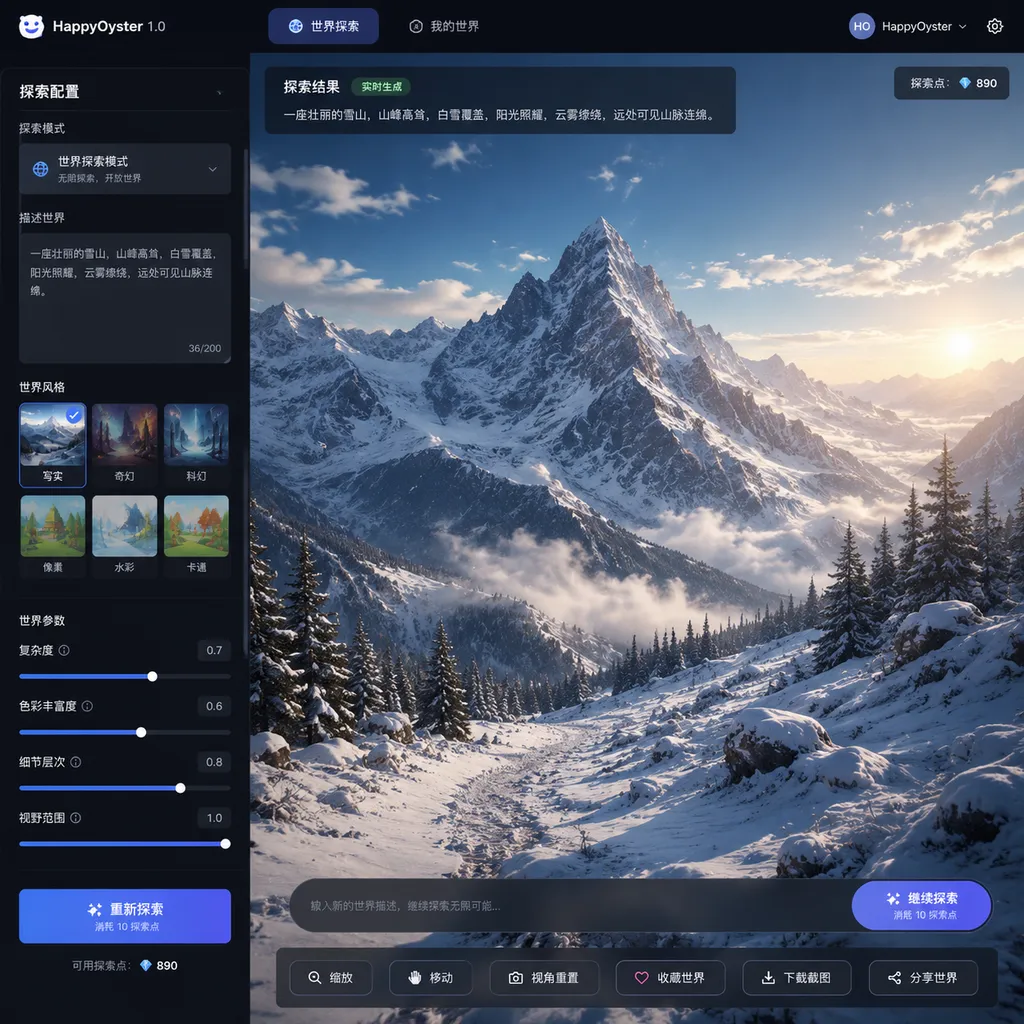
You are the player. Enter a sentence or image, the model generates an open world, and you control your character in first-person view—running, jumping, crouching, sprinting, attacking, even driving or using weapons.
The current version supports over one minute of continuous character actions and environmental interactions.
The most compelling feature: “any character in any world.”
You can drop a cyberpunk avatar into Journey to the West’s Flower-Fruit Mountain—or upload a photo of your cat and turn it into a controllable character.
In a normal game engine this would require modeling, rigging, and state machines. HappyOyster skips that entire workflow.
For indie developers, this doesn’t replace Unity or Unreal—it compresses prototyping time. A gameplay idea that used to take weeks to make playable can now be tested in minutes. That value shouldn’t be underestimated.
Real-Time Directing Mode (Directing)
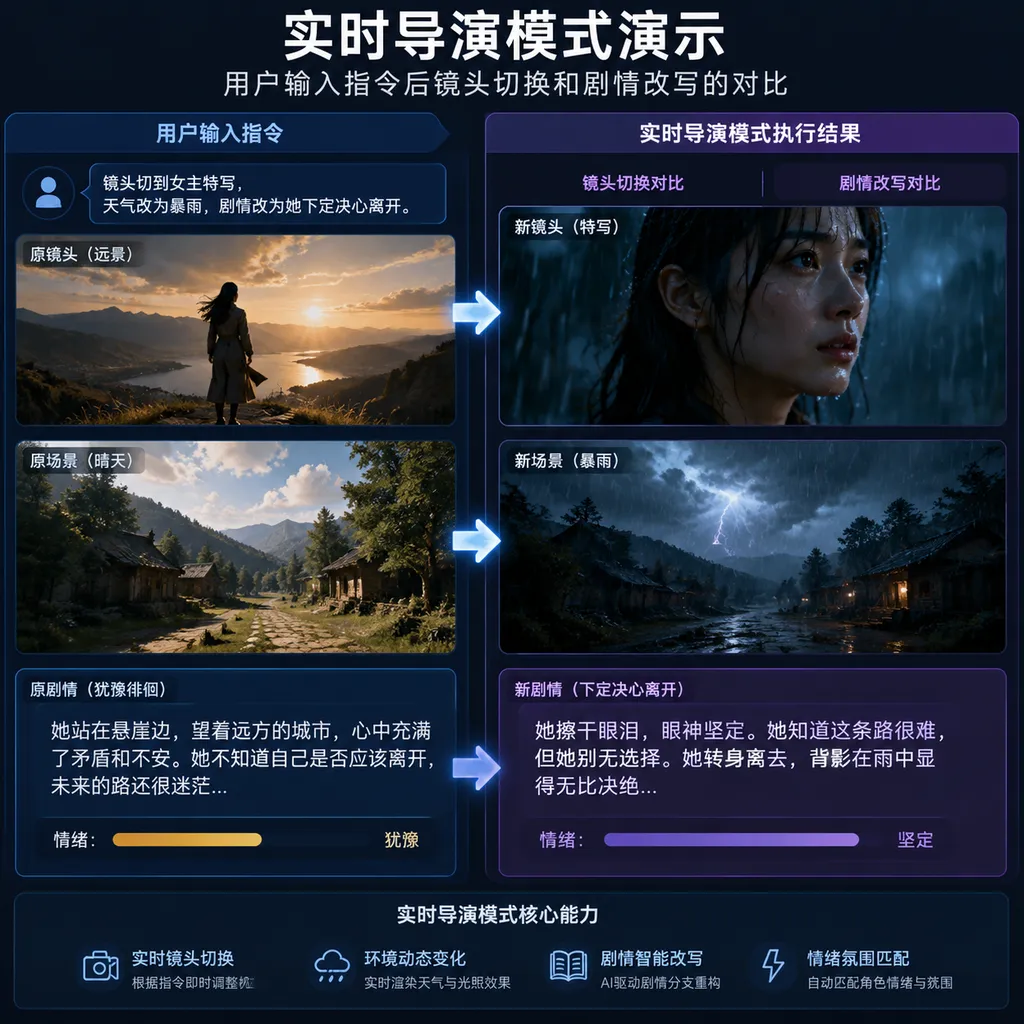
Here you are the director. With natural-language instructions, you can control the camera, cue characters, and alter the plot in real time, with immediate visual feedback. Crucially, it supports pause, rewrite, rewind, and branching—if you don’t like the short drama’s ending, rewind three minutes, type “She should reject him here,” and the AI replays accordingly.
Alibaba positions this mode for digital-human interaction, story performance, and POV immersive experiences. It currently supports real-time scenes over 3 minutes long at 480p or 720p.
To be frank, the Directing mode’s potential is even greater. Interactive short dramas have already gone commercial in China, but production costs remain high because every branch requires live filming.
If HappyOyster can spawn theoretically unlimited plot branches from one starting point, it may rewrite the cost structure of the short-drama industry.
Three SDKs Ready: Gunning for an Ecosystem
What makes this update weightier is the developer ecosystem accompanying it.
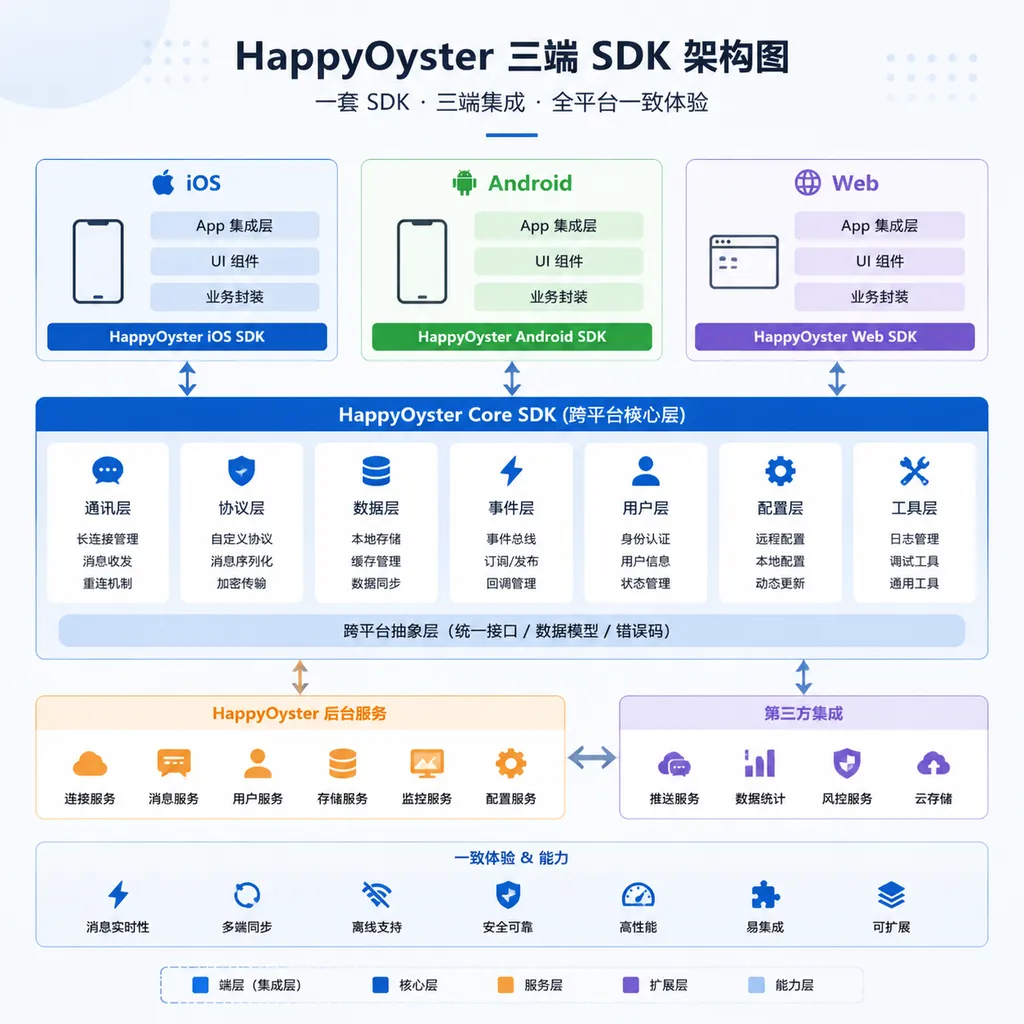
HappyOyster 1.0 provides SDKs for Android, iOS, and Web, with the server managing world states through Open API. The client SDK packages three components:
- RTC real-time audio/video connection
- Video rendering
- Real-time interaction protocol
This technical arrangement may look simple, but it tackles one of the toughest parts of commercializing world models. Every second, the model must push new frames to the client, receive the next user action, and respond instantly. Controlling latency and jitter along this chain is more engineering-challenging than the model itself.
Alibaba has clearly leveraged its strengths from DingTalk, Tongyi Qianwen, and its RTC cloud services here.
For developers, that means: no need to set up WebRTC yourself or figure out how to feed model output streams to a phone renderer. Upload parameters, call APIs, integrate the SDK—and you’ve got a “playable world.”
During beta, access will likely be limited to interactive entertainment, AI companionship, short video, and cultural tourism use cases.
You can even export a video of your session with one click—a small but telling UGC-friendly touch.
How It Stacks Up Against Competitors
Current leading players in world models include:
- DeepMind Genie 3 — academic benchmark, but not publicly available.
- Fei-Fei Li’s World Labs — well-funded, strong backing, but no formal product release yet.
- Runway, Luma, and others — mainly focus on video generation; world models are extensions.
- Chinese players like Kunlun Wanwei and Tencent — some public technical announcements, but no large-scale accessibility.
HappyOyster 1.0 occupies an interesting position—it may not be the most cutting-edge technically, but it’s likely the first in the world to package a world model as a full SaaS + SDK solution that enterprises can actually integrate into products.
That’s Alibaba’s classic play: not about publishing the first paper, but being the first to close the commercial loop.
There’s a lingering concern: there are currently no quantitative industry benchmarks for world models. Long-term consistency, physical accuracy, and cross-modal alignment lack any authoritative yardstick.
The HappyOyster team and Nanjing University are working on the industry’s first benchmark covering process interaction, cross-modal alignment, long-term consistency, and physical simulation validation.
If widely adopted, this would strengthen Alibaba’s voice in this domain.
Practical Issues During Beta
For developers planning to integrate, a few points to assess:
- Inference cost. Real-time state transition consumes far more computing power than text-to-video—by at least an order of magnitude. Bailian’s pricing isn’t public yet, but expect per-minute billing rather than per-token.
- Latency performance. The end-to-end delay from RTC + model inference determines responsiveness. Under 500 ms is acceptable for short-drama use; games will demand tighter control.
- Visual stability. Official claims: 1 minute of continuous movement, 3 minutes of continuous video. You’ll need to test in your own business for sustained character consistency.
- Content safety. Open world generation naturally raises moderation challenges; Bailian’s version will almost certainly include compliance mechanisms—check the details before integration.
A Bit of Industry Perspective
If world models really take off, the biggest disruption might not hit game engines—but the entire interactive content category. Short dramas, livestreaming, virtual companionship, cloud gaming, tourism—every scenario where users “want to influence the story or outcome” could get reshuffled.
Alibaba’s choice of the name “Happy Oyster” is interesting—it implies “the world is like an oyster that can be opened anytime, containing endless possibilities.” Poetic as that is, how the product really performs will depend on developer retention over the next few months.
Worth noting: OpenAI Hub already lets users call mainstream models (GPT, Claude, Gemini, DeepSeek, etc.) through a unified API, directly accessible domestically and compatible with the OpenAI format.
If HappyOyster’s Open API goes fully public later, integration barriers will drop further—one key to invoke all models, saving developers a lot of pain when comparing and selecting.
The world-model track is only just starting. Version 1.0 is just the appetizer.
Whether this tech breaks out of the demo stage will depend on the next six months—on whether the first wave of products are just more demo videos, or a truly “can’t-put-it-down” interactive application.
References
- Alibaba’s open-world model HappyOyster 1.0 launches on Bailian platform, supporting two core modes – IT Home — IT Home’s initial report on HappyOyster 1.0’s Bailian launch, detailing its two modes and SDK features.